A trading competition with one leaderboard rewards whoever trades the most. Bitbase is running two at once, from 3 to 18 September 2026, because size and skill are different questions and a single ranking cannot answer both. The prize pool has a ceiling of 300,000 USDT, it is paid in futures trial funds rather than cash, and how much of it exists at all depends on what every participant does together.
What the competition is
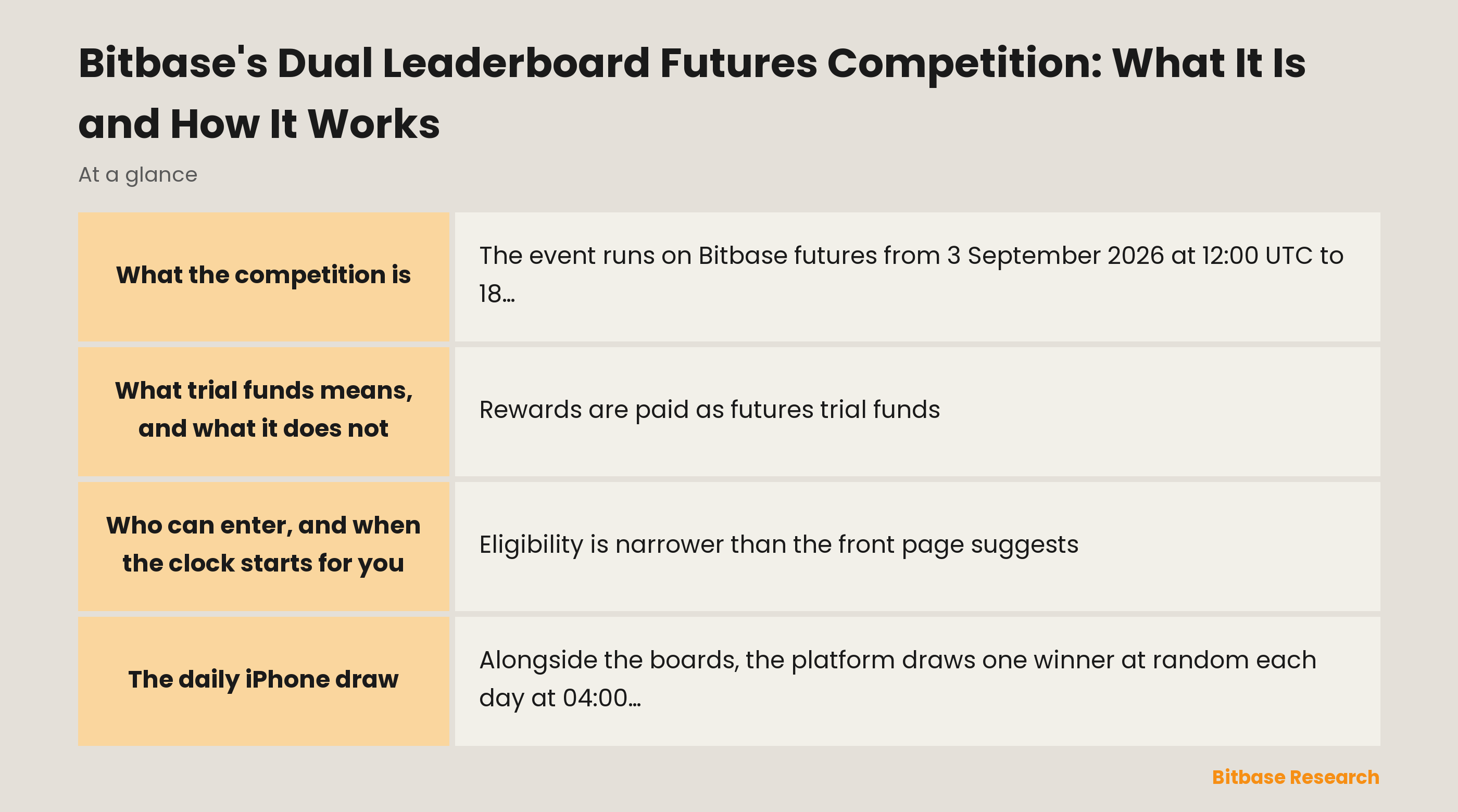
The event runs on Bitbase futures from 3 September 2026 at 12:00 UTC to 18 September at 11:59 UTC, which is 20:00 on 3 September to 19:59 on 18 September in UTC+8. Registration stays open for the whole period rather than closing at the start, and entry is an explicit act: you have to click the registration button on the event page before anything you do counts.
That last point is worth pausing on, because it has a consequence people miss. Your personal volume is measured from the moment your registration succeeds through to the end of the event, not from the day the event opened. Register on the tenth day and the nine days before it are simply not part of your total. Both TradFi futures and non-TradFi futures count toward it.
Rankings refresh every ten minutes, and the platform states plainly that a refresh can lag behind the data. Final standings, the list of qualifying users, reward eligibility and the settlement arithmetic are all subject to Bitbase's own final review, so a number you see mid-event is an indication rather than a settled result.
Two boards, because volume and skill are different questions
The competition ranks the same participants twice, on two measures that do not move together.
The trading volume board ranks by valid futures volume. It answers how much someone traded. The PnL percentage board ranks by return on the futures account. It answers how well the account performed relative to what was put into it.
| Trading volume board | PnL percentage board | |
|---|---|---|
| Ranks by | Valid futures volume | Return on futures equity |
| Entry threshold | 50,000 USDT valid volume | 50,000 USDT valid volume, plus at least five valid position openings |
| Share of each unlocked tier | 80% | 20% |
| Ranks that receive rewards | 1st to 500th | 1st to 200th |
The five-opening requirement on the PnL board exists because a percentage return computed from one or two trades is mostly noise. Requiring five openings does not make the figure a skill measurement, but it does stop a single lucky fill from topping a leaderboard.
If you qualify for both boards, only the higher of the two rewards is paid. That is worth knowing before you plan around it: the boards are two ways to be counted, not two ways to be paid.
The prize pool is a ceiling, not a cheque
The figure attached to this event is 300,000 USDT, and it is the maximum rather than the amount currently sitting there. The pool unlocks in tiers, and the trigger is the aggregate futures volume of everyone in the competition, not anything you do individually.
| Combined competition volume | Pool unlocked |
|---|---|
| 500 million USDT | 15,000 USDT |
| 1 billion USDT | 30,000 USDT |
| 2 billion USDT | 60,000 USDT |
| 5 billion USDT | 150,000 USDT |
| 10 billion USDT | 300,000 USDT |
Each tier splits the same way the boards do: 80% to the volume board, 20% to the PnL board. Below the first tier, nothing is unlocked at all.
This design makes the headline number conditional in a way a flat prize pool is not. It also means that reading "300,000 USDT" as the amount being distributed is a misreading of the mechanic, not a small rounding difference. The event page shows the running total and the unlocked amount side by side, and checking both is the only way to know which tier is actually in play.
What trial funds means, and what it does not
Rewards are paid as futures trial funds. This is the single most important thing to understand before deciding whether the event is worth your attention, because trial funds and USDT in your balance behave differently.
Trial funds carry a 50% deduction ratio and require matching assets in your futures account at a one-to-one ratio to be used. They arrive after settlement and appear in the coupon centre. They are a trading credit with conditions attached, not a withdrawable balance, and any calculation that treats a reward figure as cash will overstate what it is worth to you.
There is a second consequence inside the rules themselves. Volume generated using futures bonuses or futures trial funds does not count as valid volume, so a reward from one event cannot be recycled into ranking in another.
Who can enter, and when the clock starts for you
Eligibility is narrower than the front page suggests. The event is open only to invited users in designated regions; users who have not been invited, or who are in restricted regions, cannot participate. Sub-accounts, institutional users, market makers and other ineligible account types are excluded, and so is anyone already taking part in an existing community trading competition.
For everyone who does qualify, the clock is personal. It starts when your registration succeeds, which makes registering early the one piece of timing that is entirely within your control, and the only one this article will comment on. What you do with position sizing, stops or a written plan is the same set of decisions it was before the event existed, and a leaderboard does not change what good risk practice looks like.
The daily iPhone draw
Alongside the boards, the platform draws one winner at random each day at 04:00 UTC, which is 12:00 in UTC+8, from the users ranked on the leaderboard that day. The prize is an iPhone 18 Pro Max, and a winner may instead take tokens to a fixed value of 1,999 USDT. Each user can win it only once. Winners are announced on the event page and contacted by the platform.
Draw rewards stack with board rewards. That makes the draw the one part of the event where being ranked at all matters more than being ranked highly, since every user on a board that day is in the same hat.
The bottom line
The competition runs from 3 to 18 September 2026 on Bitbase futures, ranks participants on volume and on percentage return, and pays from a pool whose size the field decides collectively. Reaching 50,000 USDT of valid volume puts you on a board; five valid openings on top of that puts you on the second one.
Three details do most of the work in deciding whether it is worth entering. The pool is a ceiling that unlocks in tiers rather than a pot already filled. Rewards are futures trial funds with a 50% deduction ratio and a one-to-one asset requirement, not cash. And your volume counts from the moment you register, not from the day the event opened. The rules on the event page are the authoritative version of all three. To keep learning the fundamentals, follow more from Bitbase Academy.
Related reading
Other Bitbase articles on this topic:
- Dual Leaderboard Competition: What the Standings Say Four Days In
- Normal Versus Abusive Trading in a Contest: Two Lists That Are Not the Same
- Inside Futures Team Pro: BWTC's Main Stage, and How a Team Competes
- Auto Compounding vs Manual Staking: What the Difference Is Worth
- Is Crypto on the Stock Market? Three Places the Two Connect
Disclaimer: This article is educational content from Bitbase Academy, provided for information only. It does not constitute investment, trading, tax, or financial advice. Crypto assets are volatile; assess your own risk. Written as of September 2026; refer to the latest official information.
References
[1] Bitbase, dual leaderboard futures trading competition, official rules and event page www.bitbase.com