In the past half month, I have been in Qingdao busy with my child's school enrollment. I thought I could take the opportunity to slack off and enjoy some leisure, but in the end, I didn't miss a single conference call. Today is even more absurd - several partners flew directly to Qingdao for on-site work. What is meant to come cannot be avoided.
At the Olympic Sailing Base, we found a coffee shop near the yacht marina and sat there for the whole afternoon. The main topic was a project we had been following for a long time - one that builds world models.
To be honest, this thing was a tough job last year. It belongs to the most fundamental hard bone in AI, with extremely high technical thresholds and no way to monetize in the short term. Last year, these young guys were struggling on the brink of life and death, unable even to fabricate a clear business story.
But guess what? By this year, it has transformed into the sexiest track in the eyes of capital. You don't even need to explain how to make money; as long as your BP says 'simulating the real physical world,' funds line up to pour in. In half a year, they raised over a billion, and the next round is even crazier, with valuations approaching several hundred million, and even if you want to invest, you might not get a share. This project has shown us clearly the current FOMO (fear of missing out) sentiment in the primary market.
The topic expanded from this project to a series of phenomena in the current capital market: Unitree Robotics listed on the STAR Market, initially surging at the open but quickly pulling back, with market enthusiasm far less than that of ChangXin Memory's IPO earlier; Yangtze Memory's listing materials have been accepted. In addition, a batch of computing power, AI, and chip companies are queuing to list on the A-share market in the second half of the year, along with the numerous hard tech targets already listed in the first half. The disconnect between the primary and secondary markets has been laid on the table.
Several of us all feel that the structural frenzy in the primary market has reached a surreal level. According to Zero2IPO research data, in the first half of 2026, the domestic equity investment market completed 5,944 investment cases, a year-on-year increase of 14.7%; the investment amount was approximately 565.4 billion yuan, a year-on-year increase of 31.9%. Venture capital institutions have significantly accelerated their investment pace, and frontier hard technology has entered the cycle of technology implementation.
But where did the money go? According to industry insiders' statistics, 'this year, 90% of funds in the primary market are concentrated in tracks such as AI, robotics, world models, quantum technology, controlled nuclear fusion, integrated circuits, and commercial aerospace.'
90%. That is an extremely exaggerated number. It means that out of every ten yuan, nine are chasing the same few labels.
What is the result? One of my partners told me that he saw a brain-computer interface project whose valuation tripled in two months; there are also projects where 'the valuation changes after a week, and it may even conduct three rounds of financing simultaneously'; entrepreneurs have also become assertive, saying 'no betting, no buyback, invest if you want' - some projects even refuse to cooperate with due diligence.
Do you invest or not? If you don't, others will. FOMO dominates everyone's decisions.
But the influx of hot money has not equivalently brought about high-quality industrial iteration. Many entrepreneurs' focus is not on polishing PMF, but on chasing trends, switching to whichever track capital favors; although not all entrepreneurial teams are like this, there are indeed a few companies with clear mid-to-long-term structural strategic plans. But the game of passing the parcel within the circle is visible: making demos, telling narratives, inflating valuations, and relying on the next round of investors to exit.
Many investors are well aware of the risks of this game, but they are swept along by market conditions and have to jump in to grab chips. After the overall downturn in the venture capital industry over the past two or three years, some structural problems have not truly been corrected. This forms a sharp contrast with the policy direction proposed at the Third Plenary Session of the 20th Central Committee of the Communist Party of China, which advocates 'developing patient capital' and encourages investing early, small, and in long-term hardcore industries. Capital truly willing to accompany industries through long-term climbs remains in the minority.
Shifting our gaze from the primary market to the secondary market, the current market sentiment shows a clear polarization.
The optimistic camp sees policies continuously increasing support for hard technology, ample supply of themes, and abundant market liquidity, and believes the A-share market has great potential. The pessimistic group's views are also widely circulated: the impact of quantitative trading tools on the market continues to amplify, ordinary retail investors believe that human brain gaming speed cannot outrun algorithms, and a large amount of theme speculation is detached from the real fundamentals of companies, making logic difficult to rationally deduce, so they simply choose to refuse to enter the market.
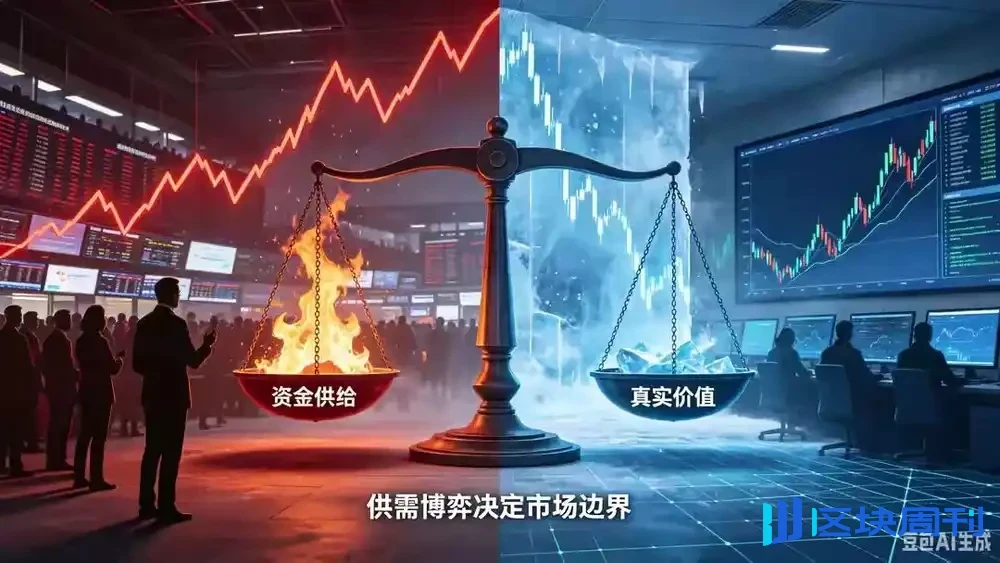
I personally do not speculate in stocks; I only observe the underlying logic of the economy and capital. In my view, no matter how trading tools iterate or how advanced algorithm models become, the stock market is essentially still a game of supply and demand. Quantitative trading can amplify short-term fluctuations, but it cannot change the underlying pricing logic. Whether buyer-dominated or seller-dominated, a one-sided imbalanced market cannot last long. This year, there have been multiple cases of hard tech new stocks 'surging at the open, then valuations continuously falling,' which is a realistic portrayal of the intense supply-demand game.

The stark contrast between the primary and secondary markets ultimately comes down to the fundamental issue of the real economy.
No matter how financial tools iterate, no matter how many novel business models the internet spawns, the essence of the financial system is to serve the real economy. ChangXin Memory has received high market recognition because it has achieved solid breakthroughs at the industrial level. We need more such industrial benchmarks, but we cannot expect ChangXin everywhere.
On August 19, 'the first stock of humanoid robots,' Unitree Robotics, listed on the STAR Market. It opened at 1,100 yuan per share, surging 629.44% from the issue price of 150.80 yuan, and its total market value once soared to 444.9 billion yuan. A day later, the stock closed at 687 yuan, down 18.70%, with market value falling below 300 billion yuan. Within two days, market value evaporated by more than 160 billion yuan.
This is not an isolated case. In the same week, Pinzhun Laser, in the quantum and semiconductor laser track, also listed, 'opening at a stage high' and then quickly falling back.
'Peak at listing' - this is not a joke; it is happening.
Comparing Unitree with ChangXin Technology, which IPO'd a month earlier, the difference is even more obvious. On July 27, ChangXin Technology's stock closed at 49 yuan on its first day, up 465.82% from the issue price of 8.66 yuan, with a total market value of 3.28 trillion yuan, surpassing ICBC to top the A-share market. The full-day turnover was 141.187 billion yuan, setting a new record for a single day's trading of an individual A-share stock.
Both surged, but the cores are completely different. ChangXin Technology's revenue in the first quarter of 2026 was 50.8 billion yuan, with net profit attributable to the parent of 24.76 billion yuan; Unitree's first-half revenue was about 1.152 billion yuan, with net profit attributable to the parent of 274 million yuan. Unitree's static P/E ratio is as high as 1,228 times, while ChangXin's dynamic P/E ratio is only 38.86 times.
One speaks with profits, the other is priced by dreams.

Money in the primary market is concentrating on a few star projects. There are still a bunch queuing for listing: Yangtze Memory's IPO has been accepted, planning to raise 33 billion yuan; Enflame Technology has been registered and effective, planning to raise 6 billion yuan; LandSpace is in the inquiry stage; Kunlunxin has completed filing for guidance; DeepSeek is reportedly starting IPO preparations.
Each one is 'hard technology,' each one is a 'national heavy weapon.' But how much can the capital market digest?
China's economy cannot have only one ChangXin. But it also cannot have only a pile of 'peak at listing' phenomenal companies. With each round of theme frenzy, social financial resources and public opinion attention concentrate on star targets. Each time there is a first-day frenzy followed by a second-day decline, what is consumed is not only social funds but also the public's expectations and patience for domestic hard technology.
And those high-quality startup teams that deeply cultivate niche tracks, lack traffic stories, and have weak discourse power are the truly excellent enterprises that need to be seen and need capital irrigation. They have long been submerged outside the spotlight, unable to obtain capital resources matching their own value, and may be being drowned by this game of passing the parcel.
The registration system opened up the listing channel for sci-tech innovation enterprises, with the original intention of paving the way for industrial breakthrough, not building a stage for theme speculation. Capital's pursuit of profit is its nature, but patient capital is not free charity; it seeks to accompany industrial growth, not to bet on a trend for quick cash-out.
The wind by the sea in Qingdao is quite strong. Blowing on it, people also become a bit clearer. As we talked further, the topics became heavier and heavier - is capital a booster for industry, or chips at a gambling table? Patient capital has been advocated for so long, why is the market still playing the game of quick in and quick out?
The answer is not in our hands. But the question itself is already worth serious consideration by everyone.
After all, a financial game without the support of the real industry is ultimately just a game of passing the parcel. And the drumbeat will always stop.
When the tide recedes, not everyone still has their pants on.
This article is from the WeChat public account: Sky's Casual Talk , author: Sky