In brief
- OpenDesign Arena scored DeepSeek V4.1 Flash at 81.2 out of 100 on real-world design tasks, 98% of GPT-6 Astra's 82.7, while charging $0.023 per finished design against Astra's $1.61.
- Of the 13 models tested—including Claude Fable 5.1, Grok 4.6, and Qwen 3.8-Max—11 scored lower than DeepSeek's model and cost more to run. Only GPT-6 Astra scored higher.
- DeepSeek's technical paper for V4.1 Flash shows the model activates just 8 billion of its 552 billion parameters to read a prompt, the design choice behind its low price.
OpenDesign, the company behind the benchmark site OpenDesign Arena, ran 13 AI models through the same batch of design tasks this week. The top scorer was OpenAI's GPT-6 Astra. But DeepSeek's newest model, V4.1 Flash, reached 98% of that top score while charging about 1.4% of the top price.
OpenDesign Arena scores models on everyday design work—building web apps, dashboards, mobile screens, and landing pages—out of 100 points. Thirty of those points check whether the output actually meets the brief; the other 70 grade design quality on layout, hierarchy, color, and style fit.
It's built to answer a narrower question than most AI leaderboards ask: Which model should a working web designer actually use tomorrow.
On that scale, GPT-6 Astra averaged 82.7 points, taking 11.1 minutes and $1.61 per finished design. DeepSeek V4.1 Flash scored 81.2, finished the job in 5.3 minutes, and cost $0.023. Claude Fable 5.1 came in at 80.3, took 12.8 minutes, and cost $3.66.
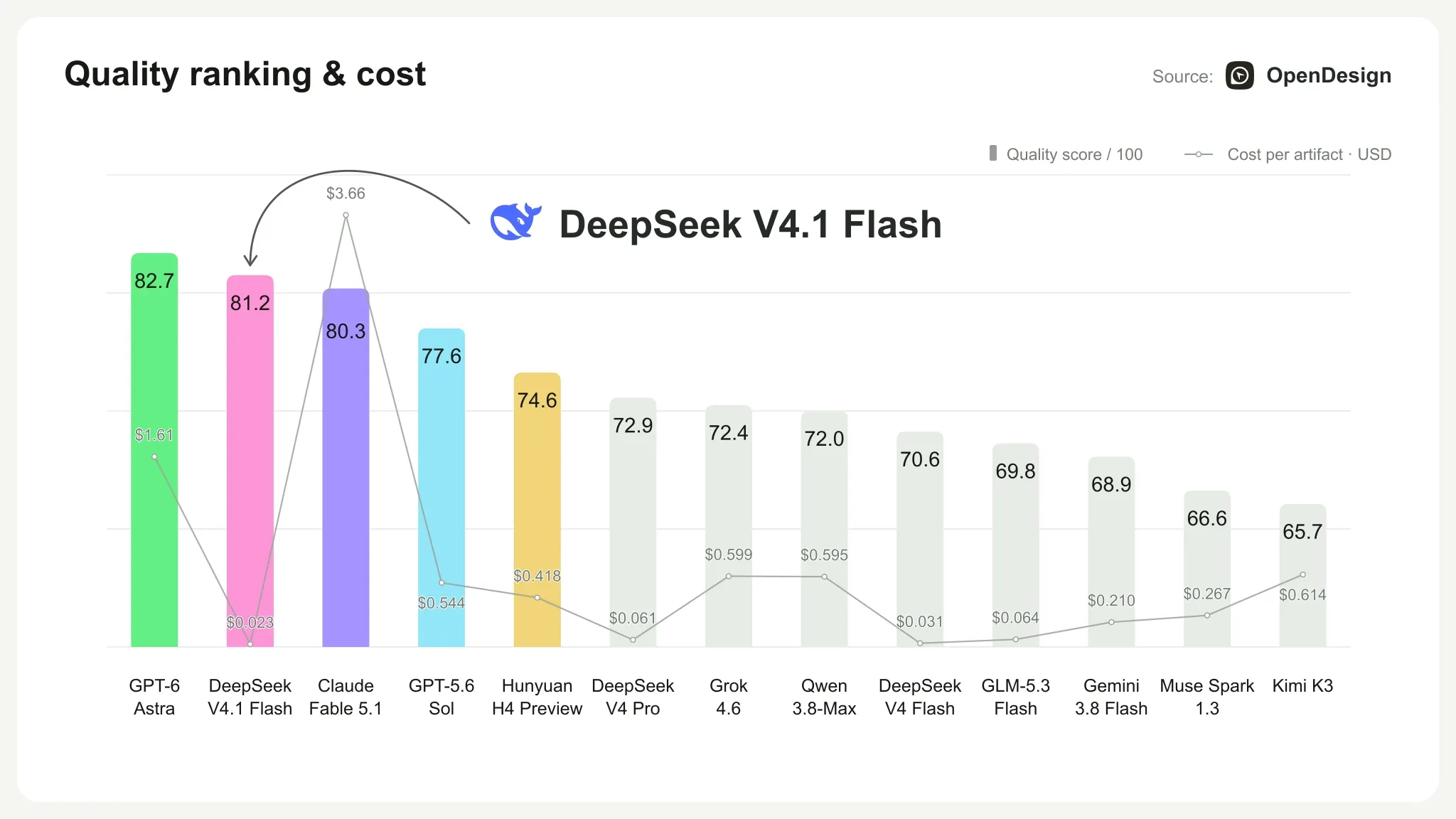
Every other model OpenDesign tested—Grok 4.6, Qwen 3.8-Max, Kimi K3, GLM-5.3 Flash, and Gemini 3.8 Flash among them—scored lower than DeepSeek V4.1 Flash and cost more to run. That's 11 of the 13 models tested. Only GPT-6 Astra beat it outright, and only by a point and a half.
DeepSeek's technical report for V4.1 Flash explains where the savings come from. The model carries 552 billion parameters total—the internal settings a model tunes during training to store what it has learned—but wakes up only 8 billion of them to read an incoming prompt and 16 billion to write the response. DeepSeek calls this a Causal Encoder-Decoder design, and it's the same trick behind the model's fast completion times.
This isn't DeepSeek's first pass at closing a capability gap on the cheap. Weeks earlier, the company's V4 Pro model landed within 5% of Claude Fable 5 on a separate benchmark comparison while charging a fraction of Fable's rate. DeepSeek has also been recruiting engineers in Beijing to build its own Code Harness, aiming to own the full agentic stack instead of just supplying the model underneath it.
OpenDesign's testing setup narrows what these numbers can prove. A model's output only gets scored if it renders as a working webpage in the first place; anything blank, broken, or cut off scores zero and doesn't get retested. That means the benchmark measures reliable, everyday design output, not general reasoning or coding skill.
GPT-6 Astra, which OpenAI released on September 3, already carries a reputation for doing a bit of everything—laying out a circuit board, drafting a tax return, building a 3D scene—but early testers flagged it as a weaker writer than the model it replaced. Its price and pace on OpenDesign's chart fit that same generalist design: slower and pricier than DeepSeek's cheaper entry, but still the highest scorer in the field.
DeepSeek V4.1 Flash's delivery rate—the share of outputs OpenDesign judged ready to hand off without revision—came in at 57.7%. GPT-6 Astra's delivery rate was 60%. Claude Fable 5.1's was 56.7%.