Influencer marketing spent years rewarding scale. Bigger follower counts meant bigger budgets, bigger reach and, in theory, bigger results.
The 2026 data is pushing brands toward a different conclusion: smaller creators can often be more useful precisely because their audiences are smaller.
Semrush currently estimates about 2,400 monthly U.S. searches for “micro influencers,” 880 for “micro influencer marketing,” 590 for “nano influencers,” and 880 for “influencer marketing trends.” Those terms are not only commercially relevant; several sit in relatively approachable keyword-difficulty ranges compared with broader marketing topics.
The search interest matches what current industry reports are showing. Smaller creators are becoming less of a budget alternative and more of a deliberate strategy.
Smaller creators are leading engagement
Social Cat’s 2026 Influencer Marketing Report analyzed more than 100,000 influencer posts and found that engagement rates declined as creator size increased. Nano creators averaged a 2.61% engagement rate, while micro creators averaged 1.68%. Mid-tier creators averaged 1.08%, with macro creators lower still.
The report also found something even more useful for brands: niche alignment mattered. Campaigns with stronger creator-brand alignment delivered higher engagement and roughly 77% higher average views than misaligned campaigns.
That helps explain why a creator with 12,000 highly relevant followers can outperform someone with 500,000 people who only loosely care about the product.
Sprout Social’s 2026 Influencer Marketing Report points in the same direction from the consumer side. Only 17% of surveyed consumers said they check follower count before deciding whether to engage with a creator. Subject relevance and content style mattered more.
The old shortcut — “large audience equals influence” — is becoming less reliable.
Brands are expanding down-market on purpose
The shift is also visible in brand planning.
Influencer Marketing Hub’s 2026 benchmark report found that more than half of respondents planned to expand or begin working with nano creators, and a similar share planned to expand or start working with micro creators. UGC creators also showed strong expansion intent.
This is not difficult to understand from a media-buying perspective.
A single large creator can create a huge burst of awareness. But a group of smaller creators can give a brand multiple messages, multiple niches, multiple communities, and multiple chances to discover which creative actually works.
The economics can also be easier to control. Collabstr’s 2026 marketplace report found that 80% of collaborations on its platform cost under $300, highlighting how much creator marketing activity now sits below celebrity-level budgets.
That makes experimentation possible at a much larger scale.
The real advantage is trust density
Smaller creators are not automatically better. Plenty of small accounts have weak content, fake engagement, or audiences that do not convert.
The advantage appears when size and relevance intersect.
A creator with 8,000 followers who talks about sim-racing hardware every week can be unusually valuable to a wheel manufacturer. A GTA roleplay creator with 20,000 deeply engaged followers may be a better fit for a gaming-adjacent campaign than a general entertainment account with 2 million followers.
The audience understands why that creator is talking about the product.
That is what gives micro and nano creators “trust density”: a higher percentage of the audience may actually care about the same narrow subject that attracted the brand.
CreatorIQ’s August 2026 State of Creators study makes the tension even clearer. The company found that economic opportunity is still concentrated among a small minority of creators, with 67% of surveyed creators earning less than $10,000 annually from content creation. Brands say they value authenticity and engagement, while the market still often rewards reach.
That gap creates room for better campaign systems.
Gaming is almost designed for micro-creator campaigns
Gaming communities naturally break into niches.
A major release like GTA VI does not create one audience. It creates car creators, roleplayers, speedrunners, hardware channels, music channels, fashion edits, meme accounts, guide makers, modding communities, and virtual photographers.
A brand trying to reach “GTA 6 players” can either buy one giant creator or work with a portfolio of specialists who each own a different slice of the culture.
The second strategy is harder operationally, but it can also be much more precise.
That precision matters because recommendation feeds have weakened the relationship between follower count and distribution. A small account can still reach well beyond its follower base when the content fits what people are actively watching or searching for.
That gives brands another reason to evaluate the work itself instead of treating follower count as the product.
The scaling problem is coordination
The downside of working with many smaller creators is simple: somebody has to manage them.
A 20-creator campaign can mean 20 briefs, 20 sets of questions, 20 submissions, 20 payment conversations, and 20 separate decisions about whether the work meets the requirements.
That is where the economics of micro-influencer marketing can break down. The media may be affordable, but the administration is not free.
The market therefore needs more than discovery tools. It needs systems that can standardize creator work without making every campaign feel robotic.
Where Wanted Network fits
Wanted Network is being built around that coordination problem.
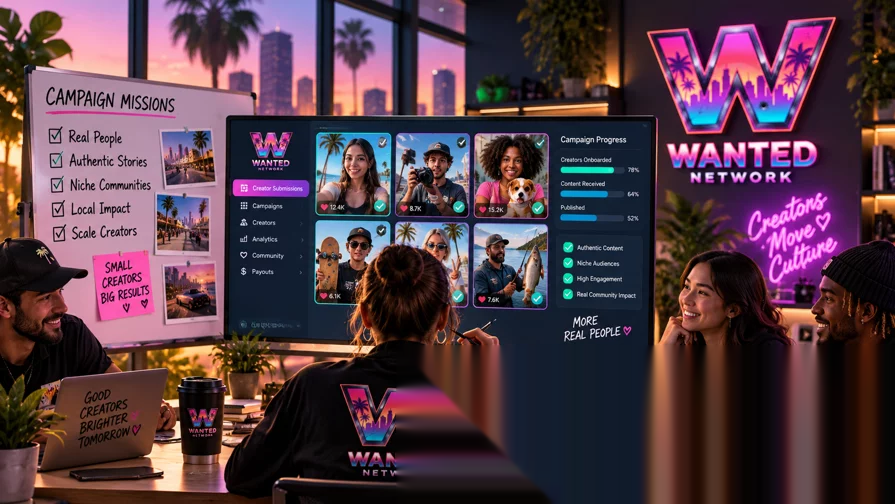
Its Missions model lets a campaign define an objective, submission requirements, and a reward opportunity in one repeatable structure. Instead of treating every small creator as a custom one-off negotiation, multiple creators can participate against the same brief.
Creators can build reputation through Heat, while qualifying activity can earn WNTD-powered rewards. Over time, that reputation layer can become more useful than follower count alone because it gives the network a history of completed work and participation.
On the advertiser side, Wanted Network’s longer-term model is designed to connect campaign demand to WNTD utility. That means the token’s role is tied to actual creator activity rather than being inserted into the content simply because the platform is crypto-native.
For gaming campaigns, the fit is especially obvious. A hardware company could run a Mission for 20 niche creators instead of betting its entire campaign on one celebrity account. A game-adjacent brand could test five creative directions across different communities and learn which one travels.
The opportunity is not “replace big influencers.” It makes the long tail easier to use.
The creator economy is starting to look more like a network
The biggest change in 2026 may be that creator marketing is becoming less obsessed with finding one perfect spokesperson.
Brands increasingly need portfolios of creators: some for reach, some for credibility, some for conversion, and some for creative testing.
Micro and nano creators are valuable because they make those portfolios more granular.
That is also why the infrastructure around creators matters more. Once a brand works with dozens or hundreds of people, the hard part stops being “find an influencer.” The hard part becomes briefing, measuring, verifying and paying a distributed workforce of creators without losing the authenticity that made them valuable in the first place.
Smaller creators are not winning because small is automatically better.
They are winning because relevance, trust, and repeatable execution are becoming measurable advantages.
Wanted Network
Website — https://wantednetwork.io
Discord — https://discord.gg/wantednetwork