Two thresholds decide whether you are ranked at all, one formula decides where you land on the second board, and a tier table decides how much money exists to be shared. This is the rule set of Bitbase's dual leaderboard futures competition read in the order it actually applies to you, with the payout figures for every tier.
Getting onto a board
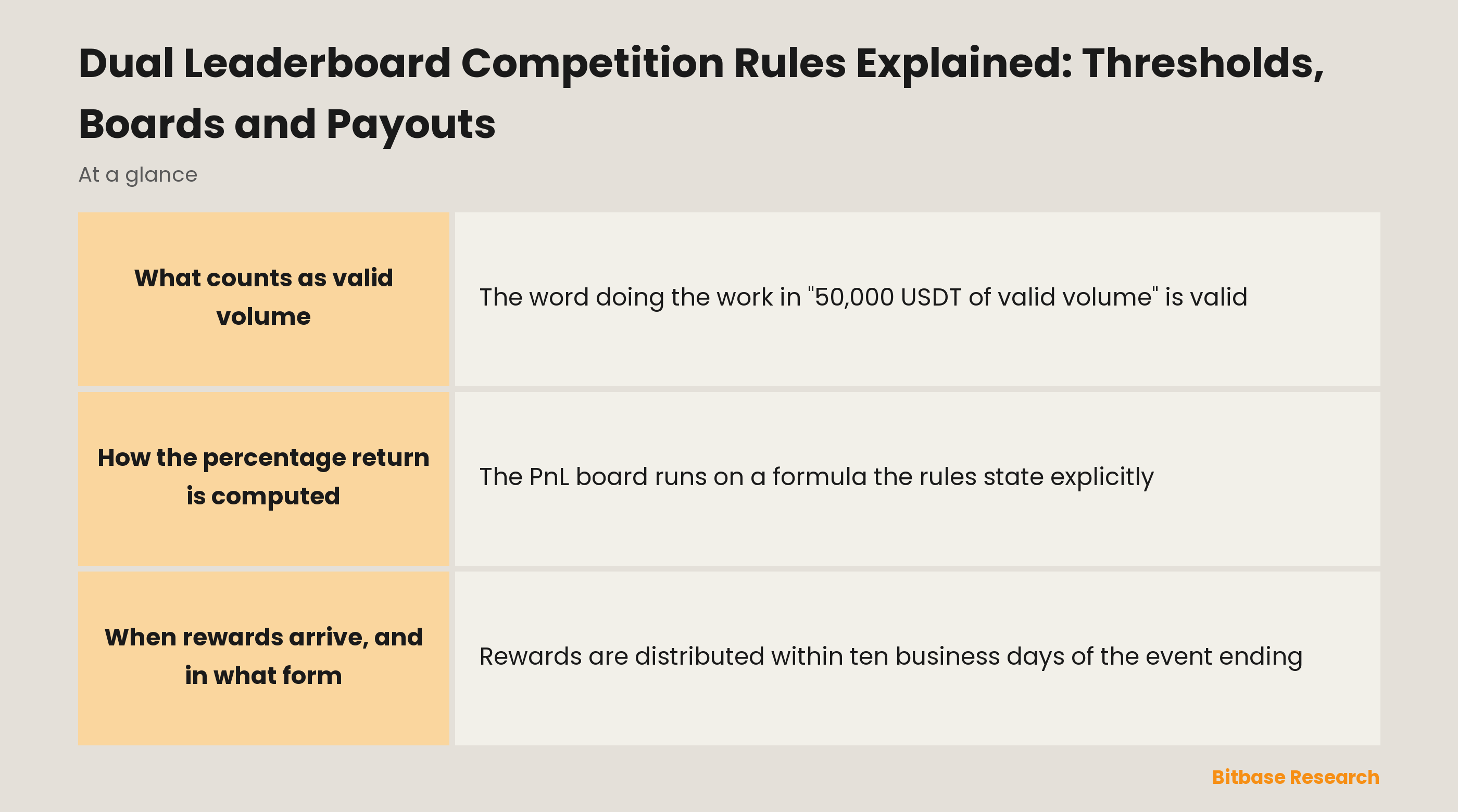
Ranking is not automatic for participants. There is a floor, and it is the same figure for both boards: 50,000 USDT of valid futures volume during the event. Below it you are entered but unranked, and unranked means unrewarded.
The PnL percentage board adds a second condition on top of that one. It also requires at least five valid position openings. Both conditions have to hold, so a large single position that clears the volume floor in one trade qualifies for the volume board and not for the other one.
| Board | Volume floor | Extra condition | Ranks paid |
|---|---|---|---|
| Trading volume | 50,000 USDT | None | 1–500 |
| PnL percentage | 50,000 USDT | At least 5 valid openings | 1–200 |
What counts as valid volume
The word doing the work in "50,000 USDT of valid volume" is *valid*. Four categories are excluded, and the exclusions are arithmetic rather than accusation: they describe what the counter does not add up.
API trades do not count. Orders with zero fees do not count. Volume generated using futures bonuses or futures trial funds does not count, which is also why a reward from this event cannot be recycled into ranking in the next one. And orders held for less than three minutes do not count.
That last exclusion is the one that changes behaviour most. A position opened and closed inside three minutes contributes nothing to your total no matter how large it was, so volume built from very fast round trips does not accumulate. Two people trading the same notional can end the event with entirely different valid totals depending on how long their positions stayed open, which is worth understanding before treating volume as a simple count.
How the percentage return is computed
The PnL board runs on a formula the rules state explicitly, and reading it carefully matters because it is not the same as the return figure a portfolio screen shows you.
Return percentage is profit divided by the sum of two things, the futures account equity at the start of the event and the net transfers into the futures account during it, multiplied by 100. Profit itself is equity at the end of the event, minus equity at the start, plus transfers out during the event, minus transfers in during it.
The structure of that denominator is the point, and it is closer to the cost basis idea than to a raw profit figure. Adding funds mid-event increases what you are measured against, so topping up does not flatter the percentage. And because transfers out are added back into profit while transfers in are subtracted, moving money in or out during the event does not create or destroy profit on paper. The formula is built to make the ranking reflect trading rather than cash management.
If two participants settle with the same percentage, the tie breaks on valid event volume, highest first.
The unlock tiers, and what each one pays
The prize pool has a ceiling of 300,000 USDT, and how much of it exists depends on the combined futures volume of everyone in the competition. Each unlocked tier splits 80% to the volume board and 20% to the PnL board.
| Combined volume | Total unlocked | Volume board | PnL board |
|---|---|---|---|
| 500 million USDT | 15,000 | 12,000 | 3,000 |
| 1 billion USDT | 30,000 | 24,000 | 6,000 |
| 2 billion USDT | 60,000 | 48,000 | 12,000 |
| 5 billion USDT | 150,000 | 120,000 | 30,000 |
| 10 billion USDT | 300,000 | 240,000 | 60,000 |
Below 500 million USDT combined, nothing unlocks. The tiers are steps rather than a sliding scale, so the pool sits at one figure until the next threshold is crossed.
The payout tables
Within each tier the pool is divided by rank. The two boards use different rank bands, and the volume board pays a hundred places deeper.
Trading volume board, in USDT per participant:
| Rank | 500M tier | 1B tier | 2B tier | 5B tier | 10B tier |
|---|---|---|---|---|---|
| 1 | 1,200 | 2,400 | 4,800 | 12,000 | 24,000 |
| 2 | 1,080 | 2,160 | 4,320 | 10,800 | 21,600 |
| 3 | 720 | 1,440 | 2,880 | 7,200 | 14,400 |
| 4 | 600 | 1,200 | 2,400 | 6,000 | 12,000 |
| 5 | 480 | 960 | 1,920 | 4,800 | 9,600 |
| 6 | 420 | 840 | 1,680 | 4,200 | 8,400 |
| 7 | 360 | 720 | 1,440 | 3,600 | 7,200 |
| 8 | 240 | 480 | 960 | 2,400 | 4,800 |
| 9 | 180 | 360 | 720 | 1,800 | 3,600 |
| 10 | 120 | 240 | 480 | 1,140 | 2,280 |
| 11–30 | 89 | 178 | 356 | 900 | 1,800 |
| 31–100 | 26 | 52 | 104 | 258 | 516 |
| 101–200 | 18 | 36 | 72 | 180 | 360 |
| 201–500 | 4 | 8 | 16 | 40 | 80 |
PnL percentage board, in USDT per participant:
| Rank | 500M tier | 1B tier | 2B tier | 5B tier | 10B tier |
|---|---|---|---|---|---|
| 1 | 300 | 600 | 1,200 | 3,000 | 6,000 |
| 2 | 270 | 540 | 1,080 | 2,700 | 5,400 |
| 3 | 240 | 480 | 960 | 2,400 | 4,800 |
| 4 | 180 | 360 | 720 | 1,800 | 3,600 |
| 5 | 150 | 300 | 600 | 1,500 | 3,000 |
| 6 | 135 | 270 | 540 | 1,350 | 2,700 |
| 7 | 120 | 240 | 480 | 1,200 | 2,400 |
| 8 | 105 | 210 | 420 | 1,050 | 2,100 |
| 9 | 90 | 180 | 360 | 900 | 1,800 |
| 10 | 60 | 110 | 220 | 550 | 1,170 |
| 11–30 | 23 | 45 | 90 | 225 | 450 |
| 31–100 | 7 | 13 | 26 | 65 | 129 |
| 101–200 | 4 | 9 | 18 | 45 | 90 |
Placing on both boards pays the higher of the two amounts, not the sum. Board rewards do stack with the daily draw, which is settled separately.
When rewards arrive, and in what form
Rewards are distributed within ten business days of the event ending, and they arrive as futures trial funds rather than as a balance you can withdraw. Trial funds carry a 50% deduction ratio and require matching assets in the futures account at a one-to-one ratio, which puts them closer to a margin requirement than to a payout. Once received they appear in the coupon centre.
Reading a payout figure from the tables above as cash therefore overstates it. The tables give the size of the credit, and the conditions on that credit are part of the reward rather than fine print underneath it. Questions about rules or rewards go to official customer support.
The bottom line
The rule set resolves into a short sequence. Clear 50,000 USDT of valid volume, remembering that API trades, zero-fee orders, bonus-funded volume and sub-three-minute positions are not counted. Add five valid openings to reach the second board. Watch the combined field volume, because it decides which tier's payout column applies. Then read whatever figure you land on as a trial fund credit with a 50% deduction ratio, not as USDT.
The full terms are published on the event page and are the authoritative version, including the clause that final rankings and reward eligibility rest on Bitbase's own review. If you are weighing whether to take part at all, the wider guide to the competition covers eligibility and the daily draw. To keep learning the fundamentals, follow more from Bitbase Academy.
Related reading
Other Bitbase articles on this topic:
- Dual Leaderboard Competition: What the Standings Say Four Days In
- Normal Versus Abusive Trading in a Contest: Two Lists That Are Not the Same
- Inside Futures Team Pro: BWTC's Main Stage, and How a Team Competes
- Bitbase Proof of Reserves: What It Publishes and How to Check Your Own Balance
- Liquidity Mining Dilution: Why the Same APR Pays You Less
Disclaimer: This article is educational content from Bitbase Academy, provided for information only. It does not constitute investment, trading, tax, or financial advice. Crypto assets are volatile; assess your own risk. Written as of September 2026; refer to the latest official information.
References
[1] Bitbase, dual leaderboard futures trading competition, official rules and event page www.bitbase.com