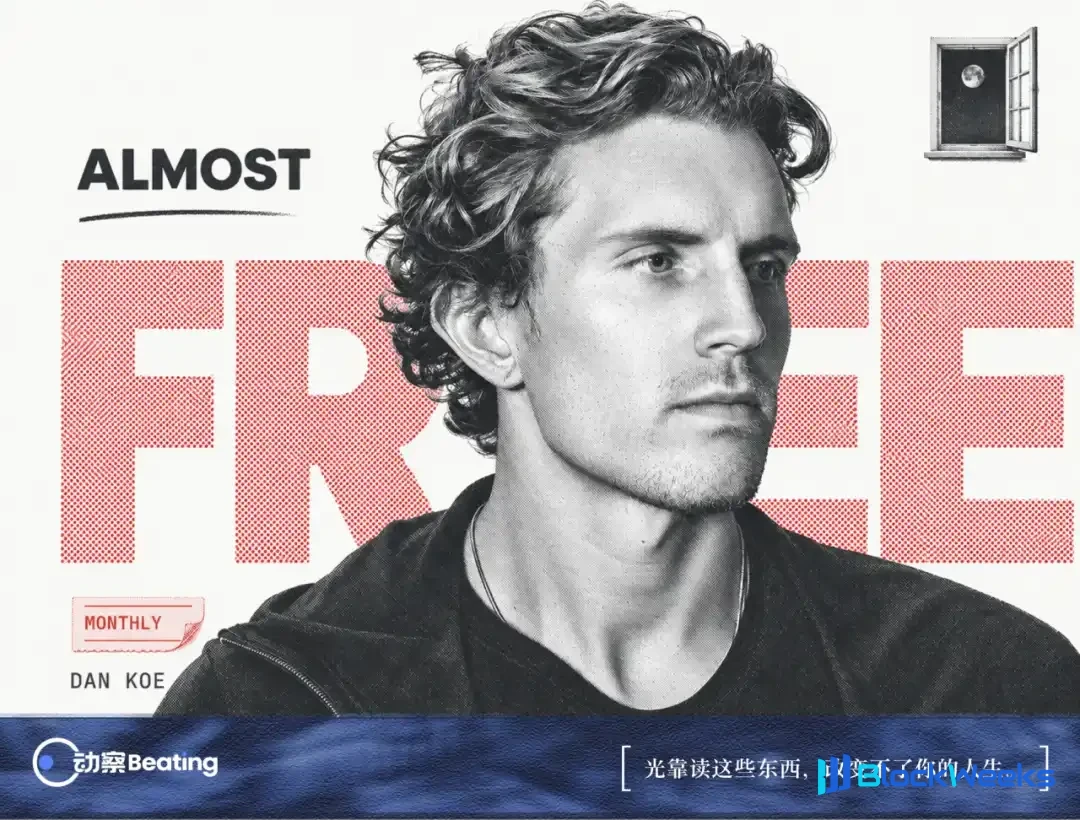
Dan Koe published another article, "The most lucrative AI business to start in 2027".

Original post of Dan Koe's new article | Image source: X
He said that the most lucrative AI business in 2027 is to be a "one-person creative team" for others: interview clients, use AI to go through all their past hit content, and produce enough content for half a year. For the first client, charging $2,500 to $5,000 per month is more realistic.
At the end of the article, he is selling a $49 writing workshop.
This is the 27th article he has published this year. It has been almost ten months since the article that broke him out of his niche.
Dan Koe, born in 1996, is American. He talks about personal growth and one-person companies on X, YouTube, and Instagram. On Instagram alone, he has 1.7 million followers.
The article that broke him out was published on January 12, 2026, "How to fix your entire life in 1 day", fix your entire life in one day. As of now, its exposure on X is 250 million.
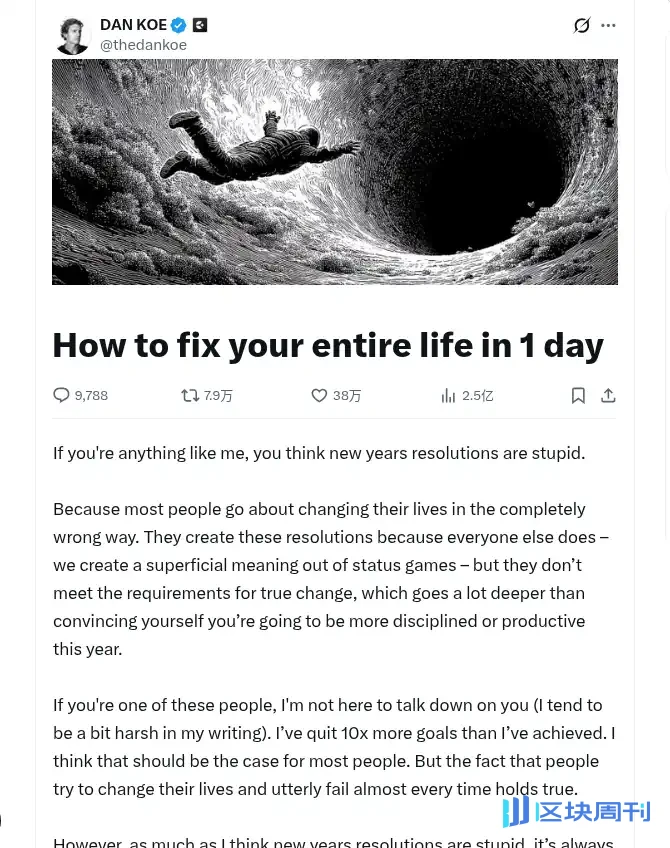
Original post of the viral article | Image source: X
After the article went viral, the Chinese internet quickly picked it up: bilingual versions, ten-thousand-word deep reads, "I followed it for 30 days". He began to be called "the godfather of one-person companies".
From May 2021 to today, he has published 262 articles on his newsletter, more than 800,000 English words, about one and a half copies of War and Peace. I read them all, one by one.
The earliest one was published on May 12, 2021, titled "Why Self-Help Is Ruining Your Life".
Self-Help is a dedicated category in the English-speaking world. From Carnegie's How to Win Friends and Influence People to The 7 Habits of Highly Effective People, any book, course, or speech that teaches people to change themselves counts. In the Chinese context, it roughly means the collective term for success literature and chicken soup for the soul. If the title were translated into Chinese, it would be something like "Why Chicken Soup and Success Literature Are Ruining Your Life".
He said that many people read such books only for the dopamine of the moment of reading. He calls this mental masturbation. He said that just reading these things cannot change your life.
Now, at the bottom of this article's page, there are links to his book and paid membership.
A person who started by criticizing success literature became, five years later, one of the most successful success writers of this era. What happened in between? Why these five years, why him, why do so many people need him?
Sunday School
Dan Koe rarely talks directly about his family, but fragments from more than two hundred articles are enough to piece together an outline.
He grew up in the Church of Jesus Christ of Latter-day Saints, commonly known as Mormonism. On Sundays, he wore black dress pants and a white shirt, tied the tie his father gave him, and went to church, singing "I Am a Child of God" in Sunday School (the Sunday class the church holds for children).
Latter-day Saints. Latter days originally means "the last days". This church believes that people can progress continuously in eternity until they become gods.
The fifth president, Lorenzo Snow, had a famous saying: "As man now is, God once was; as God now is, man may be."
This doctrine failed to convince that child.
He later wrote that as a child he "loved to judge people" and always felt that the people around him had been brainwashed. In church, he asked friends whether they truly believed, and the other person would instinctively shrink back, a "glitch" flashing in their eyes, as if their thoughts had been bounced back to the set of claims instilled by their parents. When he asked adults, the answer was similar: "Just have faith."
He set a rule for himself: go against everyone else.
Before college, his parents divorced, and the family's finances suddenly became tight. At eighteen, he was asked to choose a major he would do for forty years. Years later, he began an article with this sentence: "I was lied to as a child. I have a feeling you were too."
During his five years at Arizona State University, he changed majors about five times and also made many attempts at internet entrepreneurship, except that each attempt was shorter-lived than the last. He sent 50 emails for a Facebook ads agency and signed not a single client; a rave clothing (the kind worn at electronic music festivals) online store spent $100 on ads and sold only one sequined bra.
At his worst, he crammed into a house with seven other guys, pushed rent down to three or four hundred dollars a month, worked odd jobs at a print shop, and was $8,000 in debt. After five years, he had no degree and instead had tens of thousands of dollars in student loans. In his autobiography, he used only one word to describe that moment: doomed.
What pulled him out of the mud was Eckhart Tolle's The Power of Now. During those years he also left the church, studied religion, read anti-religion books, and finally turned to Ken Wilber and Spiral Dynamics, two sets of theories that divide human consciousness into several levels and climb upward level by level, calling God "the source".
When he had nowhere to turn, he did something he later kept telling others not to do: he got a job.
At a web design company, he understood how an agency operates. After work, he took freelance jobs building sales landing pages for people, called funnels in English, with quotes rising from $1,500 per order all the way to $2,500 to $5,000. Once he had enough clients, he quit.
He later recalled that his original wish was just to be able to afford a Chipotle meal every noon.
That is an American Mexican fast-food chain. In China, it would roughly be like achieving Shaxian freedom.
In The Varieties of Religious Experience, William James divides people into "once-born" and "twice-born". Once-born people are naturally optimistic and go with the flow; twice-born people must first fall into the abyss, experience division and despair, and then turn their lives around through some power. Twice-born people often become the most fervent missionaries.
Dan Koe later summarized changing one's life into three stages: dissonance, uncertainty, discovery. That article with 250 million exposures is meant to take readers through these three steps in one day: in the morning, answer fifteen questions, write down an "anti-vision", that is, the kind of life you least want to live, and then let that pain push you forward.
Awareness of sin, crisis, grace. In other words, this is a conversion.
The Trend
His preaching began on Twitter in 2019.
The timing was surprisingly good. A few months later the pandemic came, and everyone was trapped in front of screens; in November 2021, 4.5 million Americans quit their jobs voluntarily in a single month, and the "Great Resignation" became the narrative of the year. Before that, Tim Ferriss's The 4-Hour Workweek and Naval's line "productize yourself" had already turned escaping the cubicle into a generational dream.
Lei Jun said that even a pig can fly if it stands in the path of the wind. The words are crude, but the principle is not.
Of course, Dan Koe has his craft: his content frameworks are clear, his sentences short, his hooks precise, his output steady. He took Tolle, Naval, Ferriss, and flow theory apart and reassembled them, outputting at high frequency during the years when the Twitter algorithm was most generous. When he had three to five hundred followers, he made his first course, teaching people to do freelance work, and it sold for about $3,000 a month.
Income rose quickly. By his account, he earned $100,000 in 2020; in 2022, his monthly income reached $50,000 for the first time; in August 2023, he wrote that by age 26 he had a million dollars in liquid assets, "until I put half of it into a new company."
The more money he made, the more fully formed the doctrine he preached became. The clearest example is an article he published in February 2022 about psychedelic mushrooms.
During that period, he microdosed psilocybin once or twice a week. Once, after taking it, he bought a pound of honeycomb at a farmers' market and followed it down a chain of thought—how honey comes to be, what relationship bees have with plants—until, at the end, he thought up a business.
He calls this the "iceberg of opportunity," divided downward into four stages: appreciation, understanding, mastery, monetization. The first three stages are the foundation of The Power of Now—put down the noise in your head, return to the present, be curious like a child. The last stage is the feel he developed at a web design company: almost anything can be turned into income, made into a product, then scaled into a one-person business.
In a single article, spirituality and business connected. The former is responsible for making you believe; the latter is responsible for making you pay.
Later, he compressed this whole thing into a mantra: "Solve your own problems and sell the solution"—solve your own problems, then sell the solution.
It sounds impeccable. But applied to him, this sentence is a bit like an ouroboros.
His early problem was "how to make money online," and the solution he sold was "teaching you to make money online." After buyers learn it, the most natural way out is to keep selling courses online.
That same year, his words grew heavier.
In April, someone mocked young people who spend money on online courses to "escape the matrix." "The matrix" comes from The Matrix; in English success-culture circles it refers to the nine-to-five system, and the loudest person shouting this slogan was Andrew Tate, an influencer famous for misogynistic remarks.
Dan Koe responded that he didn't like Tate, but spending $50 to learn "time-tested monetizable skills" is better than spending $40,000 on an outdated degree.
In July, he wrote that 95% of nine-to-five jobs fit the definition of slavery, and ended by adapting the words from the cross: "Forgive them, for they know not what they do."
In November, he wrote "Making Money Is Spiritual." The article laid out a list of "immoral skills": sales, marketing, persuasion, hypnosis, influence, and game. Game is slang from the English pickup community, referring to a whole set of techniques for seducing the opposite sex; the abbreviation for this community is PUA.
In his view, the most successful people are all those who study immoral means and then use them in a moral way. In parentheses after the list, he also noted that he teaches all of these in his course Digital Economics, except hypnosis.
As for why one must learn them, his reason is that if good people don't do business, bad people will take the place; making money is reversing entropy.
More than a hundred years ago, Weber wrote The Protestant Ethic and the Spirit of Capitalism, explaining how Calvinist believers saw worldly success as a sign of grace, and thus asceticism, diligence, and accumulation inadvertently nurtured capitalism.
With Dan Koe, even that thin veil is torn through: success no longer has to pretend to be merely a sign of grace.
Making money itself is the practice.
Homiletics
In Christian theology there is a specialized discipline called homiletics, which studies how to preach a sermon movingly enough.
Dan Koe's homiletics can be seen from his word choice. In 800,000 words, "you" appears 29,212 times, while "we" appears only 3,290 times. The most frequent three-word combination is "you don't," 1,346 times; "most people" is written 766 times.
He rarely says "we." He speaks to "you."
On July 3, 2026, he simply wrote a tutorial saying that the most profitable skill of the 21st century is not AI, but understanding human nature. There are three strings taut in the human heart—survival, identity, progress—corresponding to five levers: point out a threat, mirror identity, exclude some people, depict transformation, give the first step.
Apply these five levers to his own headlines, and they fit almost perfectly. "You have about 36 months left" points out a threat; "if you have multiple interests" mirrors identity; "why most people can't do it" excludes others; "fix your entire life" depicts transformation; "in one day" is the first step.
Seven weeks later, he published another piece: "Give Me 20 Minutes and I'll Make You Impossible to Manipulate."
In Han Feizi, the man from Chu praised his spear and then praised his shield. A bystander asked just one question: "What if I use your spear to pierce your shield?"
The man could not answer.
His most-liked piece on Substack is called "How to Express Yourself Intelligently." He says that as a child he was always drawn to people who "sounded smart," even though "most of the time I couldn't understand what they were saying"; and that most of his success over the years is due to saying valuable ideas in a way that makes people want to listen.
What he sells has never been profundity that can't be understood, but the feeling of profundity that can be understood.
Producing the feeling of profundity relies on an assembly line.
In October 2025, on an entrepreneurship podcast, he broke down his workflow. For topics, he only picks validated ones—either his own tweets with the best data or the highest-performing videos in the same field; a prompt called "Viral Deconstructor" feeds three viral pieces to the model, extracts the structure, hook, and psychological triggers, and spits out a template with blanks to fill; another prompt interviews him like a reporter first, fills the material into the template, and produces three versions at once.
The products on the assembly line follow the market.
First, topics. Calculated per 10,000 English words, "AI" rose from less than 1 time in 2023 to 35 times in 2026; "focus" fell from 20 times in 2022 to 7, and the man who wrote The Art of Focus talks about focus less and less. "One-person company" also dropped to one or two times; by the time the Chinese internet started calling him the "godfather of the one-person company," he himself had stopped using the term much.
Then, headlines. A blog's URL is fixed at publication, and changing the headline doesn't affect the URL, so the original headline is preserved: "AI Will Never Replace True Creators," while the URL says "most creators will fail"; "The Two-Hour Morning Routine That Changed My Life," while the URL says "the million-dollar morning routine."
Then, viewpoints. More precisely, different packaging of the same viewpoint.
There is an old rule in self-media called niche down, equivalent to the Chinese "do a vertical niche": choose a narrow field and a fixed audience, and talk about only one thing. What Dan Koe has repeatedly said for five years is exactly the opposite: don't choose a niche; you yourself are the niche. He has said this from 2022 to 2026, under at least six different headlines.

"You Are The Niche" roadmap | Image source: X
Only the hook has never changed.
"99%" appears 91 times in his articles, and at least 11 headlines carry it or "top 1%": more efficient than 99% of people, ahead of 99% of people, better at using AI than 99% of people.
If every reader has surpassed 99% of people, where did the 99% go?
Deadlines are also hooks. How long does it take to change your life? In his headlines he has given one year, six months, ninety days, thirty days, two weeks, seven days, and finally shortened it to one day.
There is another kind of hook: announcing that something is dead. Personal branding, the internet, deep creation, the nine-to-five, information products, influencers—all have died once in his headlines. In the October 2026 piece "Influencers Are Dead," the first half announces that influencers are dead, and the second half recommends his own software Eden and a 30-day creator course.
NPC
Behind the rhetoric lies a complete worldview.
In August 2025, he released HUMAN 3.0, with the subtitle "A Map to Reaching the Top 1%." Life is divided into four quadrants—mind, body, spirit, and career—each with three levels. In the mind quadrant, these three levels have more colloquial names: NPC, Player, Creator.

NPC is his favorite word. In his book "You Were Not Born an NPC," the very first story he tells is about the "lag" in the eyes of those friends at church.
Three levels, one upward path, a summit only a few can reach. In Latter-day Saint doctrine, heaven is also divided into three kingdoms: the celestial, terrestrial, and telestial. I'm not sure whether this correspondence is intentional.
The Calvinist believers Weber described could never be certain whether they were chosen by God, so they worked desperately, treating success as a sign of grace. Readers of HUMAN 3.0 carry the same anxiety—unable to determine whether they are among the 1%, they can only keep reading, keep learning, keep subscribing.
Every purchase is a sign of grace.
The term NPC has another clever aspect: it turns everyone around you into scenery. Parents, colleagues, friends who urge you not to quit your job—all become nameless extras on your main quest. And on the backend data dashboard, that newly awakened "Player" is nothing more than a line of conversion rate.

In April 2026, he coined another term, "Identity-Lifestyle Fit," saying it's the same thing as PMF in startups—except the product is you, and the market is your lifestyle.
When a person becomes a product, the life they're living naturally becomes a prison to escape.
Content that teaches people to escape the algorithm happens to be exactly what the algorithm loves to push.
In September, he wrote "You need to be delusional if you want to succeed"—if you want to succeed, you need a bit of delusion. That phrase he didn't believe back then, "Just have faith," came out of his own mouth more than a decade later, dressed in new clothes.
The slogan he sells to readers is "be yourself," but the method he teaches is to dissect why others went viral, then have AI copy it. In February 2025, he also wrote an article titled "The Internet Is Dead, and We Killed It."
The internet, presumably, died just like that.
Tithing
The Latter-day Saint church requires believers to pay one-tenth of their income, called tithing. The creator economy's tithing is the monthly subscription.
Free tweets, videos, and articles sit at the top of the funnel; layer by layer downward are the $27-a-month community, the $150 writing course, and the high-ticket programs costing thousands of dollars.
In July 2023, a creator named Josh Walker asked 20 peers familiar with Dan Koe to explain what he actually makes money from. Someone said, "He's selling dreams at scale." Another said that for many people, scrolling through Dan Koe's articles is a kind of "refined procrastination"—blood pumping while reading, nothing changed after finishing. Did you learn anything? Sure you did.
In June 2024, he wrote "The Three Stages of Monetization (Why Most Creators Are Actually Poor)," drawing a funnel: 100% of people start, 1% persist, and of that 1%, only 1% truly succeed. Why are the rest poor? His diagnosis is skill issue.
In the same article, he also gave a concrete target: to replace a $56,000-a-year job, you need to earn about $4,700 a month. At $150 per product, that's 31 sales a month—roughly one order a day; at a 2.5% landing page conversion rate, you need 1,240 visitors a month.
But where do those 1,240 visitors come from? At the same time, how many others are holding the same template, competing for the same batch of visitors? The article doesn't say a word about it.
A 2023 Morning Consult survey showed that 57% of American Gen Z want to be influencers, and 30% of them are willing to pay out of their own pockets for it. In a market where 30% of producers are willing to buy their own tickets, what's the most reliable business? No need to spell it out.
In the new article on November 3, he casually mentioned that another business-teaching influencer, Alex Hormozi, spends over a million dollars a month paying creators to promote his paid community platform Skool.
The shovel sellers are advertising for the shovel sellers.
Speaking of selling shovels, the most widely told story from the 1848 California Gold Rush is that of Samuel Brannan. It's said he first bought up all the gold pans around San Francisco, then held up a bottle of gold dust on the street shouting that gold had been found. He bought pans at 20 cents and sold them for $15, making $36,000 in nine weeks and becoming California's first millionaire.
Coincidentally, Brannan was also a Latter-day Saint. Two years before that story, it was he who chartered a ship called the "Brooklyn," carrying a boatload of New York believers around Cape Horn to San Francisco, then still called Yerba Buena.
But the second half of the story is that in 1889, Brannan died near San Diego, nearly penniless, unable to even afford his own funeral. His body lay in a morgue for over a year, unclaimed.
Shovels have cycles too.
$3 Million
He also tried another path.
In October 2023, he announced he was pouring every penny into a new company, Kortex, a "revolutionary" writing software—"say goodbye to second brains like Notion and Obsidian." In February 2024, he specifically wrote that Kortex's team was "all contractors and creators, we have no employees"; in April he published another piece, "My Startup Made $759,900 in 6 Months (Without Officially Launching)."
The ending was written by co-founder Matthew Ao.
According to his January 2026 retrospective, the project launched in July 2023, peaked at around 12 team members, took no funding; MRR once hit $60,000, but growth stalled and churn was high. Over two years, roughly $3 million was burned.
The first reason Ao listed was that users had no sufficient reason to leave Notion and Obsidian; second, before having any users, they built their own billing, deployment, and authentication—the identity system alone consumed hundreds of thousands of dollars in engineering time.
In November 2025, Dan Koe posted a video titled "Kortex: The $3 Million Mistake." The product was torn down and rebuilt, renamed Eden. Over Black Friday weekend, Eden earned $250,000. Ao added in his retrospective that this was thanks to Dan's fans, not proof of finding PMF.

Eden Black Friday promotional video cover | Image source: X
The trouble wasn't over. Eden charged a fixed monthly fee on the front end and paid per API call on the back end. As traffic grew, costs at one point reached $1,000 every 30 minutes. At one point the company only had enough money to last two weeks, and the team was cut by more than half.
This is the difference between two kinds of business.
Writing an article for ten thousand people to read and for a hundred million people to read costs almost the same; building an AI software product means every additional user adds another computing bill. The marginal cost of the content business is close to zero, and so is its moat; the software business has a moat, and it also has costs.
A person who evangelizes the one-person company, once he goes to do something with a real barrier to entry, immediately needs a dozen people and several million dollars, and then, like thousands of ordinary startups, stumbles on product, organization, and engineering.
None of this was covered in his course.
Now, he has written "The Most Profitable AI Business of 2027," and the answer is doing content outsourcing for others, for $2,500 to $5,000 a month.
This is exactly the price he charged for a single funnel gig around 2019, before he quit his job. In 2024, he still called this kind of service business a "second nine-to-five."
Seven years, and he has come full circle. Except this time, the starting point has been packaged as the destination.
Doomsday
Line up his headlines from the past two years.
At the end of 2024, AGI will make you irrelevant. In May 2025, AI is coming to take your job; in July, you have about 36 months left; on December 31, you have about 24 months left to learn these skills. In January 2026, don't waste the next two to three years, this is your last advantage.
The countdown keeps getting shorter.
Why did this particular play sell best in these two years? Because this time, the doomsday is not entirely unfounded.
On April 30, 2026, writer Jasmine Sun published an opinion piece in The New York Times, "Silicon Valley Is Preparing for a Permanent Underclass." She wrote that young people in their twenties in Silicon Valley joke half-seriously that they must make their fortune before a certain window closes, otherwise once AI takes over labor, class mobility will freeze.
The data also confirms this unease. The Stanford paper "Canaries in the Coal Mine" found that among occupations most affected by AI, employment for young people aged 22 to 25 fell relatively by 13%.
Such moments are actually not unfamiliar to us. From Chen Anzhi and "Rich Dad Poor Dad," to "financial freedom" columns and "personal IP" boot camps, to Li Yizhou's 199-yuan AI course in 2023, which according to Feigua Data sold about 250,000 sets in a year with sales of about 50 million yuan, and was taken down across the internet in February 2024.
Discovery, canonization, copying, course-selling, going out of style, moving to the next one. Naval went through it once, Tim Ferriss went through it once, and this round, it's Dan Koe's turn.
The leeks can never be fully harvested, because every batch thinks it is the sickle.
Doomsday has always been the best sales pitch.
The Iron House
The sociologist C. Wright Mills gave an example: in a city of one hundred thousand people, if only one person is unemployed, that is his personal trouble; in a country with a labor force of fifty million, if fifteen million are unemployed, that is a public issue, and you cannot find the answer in the character of any single individual.
What Dan Koe's articles do is exactly the reverse operation.
Public issues, in his writing, become: your identity hasn't been upgraded, your anti-vision isn't painful enough, you haven't finished answering those fifteen questions in the morning. In September 2025, he wrote "What Is Actually Wrong With People Today?", attributing social fracture to people "retreating to a lower level of consciousness," with one subheading titled "How People With Extremely Low Intelligence Think."
Byung-Chul Han says in "The Burnout Society" that people today are no longer exploited by others, but exploit themselves, and still think this is freedom. The one-person company: the boss is you, the employee is you, and the supervisor is also you. The so-called one-person company, in many cases, simply compresses all the risks of a company into one person's body.
That is how he himself has lived.
Once, friends planned for months to go to Seattle together to celebrate his birthday. After a weekend of sleeping in and getting nothing done, he was "furious." After going home he "disappeared," replying to no one's messages and saying no to all invitations. He said discipline makes him happy.
Xiang Biao calls this state "suspension": a person's mind hangs entirely on an imagined future, with neither investment in nor care for the life under their feet, and the "nearby" around them disappears along with it. The ideal Tuesday three years from now, the anti-vision five years from now, the 36-month window: life is lived as a countdown sheet, and the day in front of you is merely the fare to that day.
In his articles, the "nearby" occasionally calls.
In August 2024, he wrote that every time his mother called, she would ask: "Did you do anything fun this weekend?" He almost always answered: "No, same as usual." His mother would say: "You should get out more, you're still young." At the time he thought maybe something was wrong with him.
In September 2025, he said that this week he "walked a lot, did a lot of work, went to the gym many times," and his mother urged him to rest. He wrote in the article that balance is for mediocre people.
By the article with 250 million impressions, his mother was still urging him to go out and have fun. He wrote that he held back and did not tell her: "If I weren't happy, why would I live like this?"
Earlier on, he had hesitated too.
In November 2021, he wrote that when he went home for the holidays, his mind was full of what to eat, how much money was spent, and when he could go back to keep working, and he could even imagine himself internally judging his family's "ordinary people" behavior. He said that when he went home later that day, he would consciously spend good time with them.
That was the third article he wrote.
Over the following five years, he spent most of his energy shouting at others to wake up from the dream.
In 1922, Lu Xun wrote in the preface to "Call to Arms" about an iron house with no windows, impossible to break, in which many people were sleeping soundly and would soon suffocate. You shout loudly and wake a few who are more awake, "making these unfortunate few suffer the agony of a death that cannot be saved—do you think you are doing right by them?"
In the end, Lu Xun still shouted.
The next year, he lectured at Beijing Women's Higher Normal School on "What Happens After Nora Leaves," saying that the most painful thing in life is to wake from a dream and find there is no road to take. The dreamer is happy; if no road can be seen, the most important thing is not to wake him. After Nora leaves, she either falls or returns, unless she has money in her pocket.
"Freedom cannot be bought with money, but it can be sold for money."
A hundred years later, the iron house has a new name: the matrix.
Those who wake others no longer hesitate about whether to shout, because shouting itself has become a business. They tell every awakened person that the window exists, right here, for a monthly subscription of a few dozen dollars, or you can attend a $49 workshop.
Paint a moon on the lonely night sky, paint a large window on the iron house.
Five years ago, in his first article, he wrote that merely reading these things cannot change your life.
At the very bottom of the November 3 article "The Most Profitable AI Business of 2027," there was, as usual, the line Substack attaches to every article, inviting you to keep reading:
Ready for more?