


Author: Principia Research
In June 2026, a somewhat awkward refund incident unexpectedly tore open a crack in the great migration of global capital market infrastructure.
At that time, Musk's SpaceX was landing on Nasdaq. To capture the crypto world's frenzied demand for this century-defining tech stock, Binance Wallet, together with third-party tokenization platform xStocks, launched an on-chain IPO subscription event called SPCXx. On-chain data recorded a stunning scene: within just a few days, 27,689 independent wallet addresses poured in, committing as much as $557 million in USDC.
However, the outcome was a bucket of cold water. Because Wall Street's traditional primary market underwriting syndicate is highly closed, upstream third-party asset providers simply could not obtain sufficient underlying physical SpaceX shares. Binance ultimately had to announce the cancellation of the event, return the $557 million via the original route, and urgently used the SPCXB token issued by its own Abu Dhabi entity to airdrop $1 million to users as consolation.
Most bystanders regarded this as an ordinary operational interlude; but if you pull the camera back and piece together Binance's series of capital, licensing, prospectus filing, and team recruitment actions in the Abu Dhabi Global Market (ADGM) from 2025 to the end of 2026, you will see a completely different picture:
That returned $557 million proved that on-chain funds are extremely hungry for high-quality equity assets; and the supply cutoff of third-party channels made Binance completely determined that, rather than serving as a traffic gateway for small external RWA packagers, it would personally build in Abu Dhabi an "on-chain stock exchange" with complete underwriting, clearing, custody, and trading licenses.
Why Abu Dhabi? The Dual Anchors of Personnel and Sovereign Capital
The crypto industry has never lacked slogans about "putting stocks on-chain." As early as 2021, Binance and FTX tried early stock tokens, but quickly failed under the siege of European and American regulators. Five years later, why can Binance this time openly build a full set of securities infrastructure? The answer is hidden in the personnel DNA and sovereign ledger of Abu Dhabi (ADGM).
The first anchor is the institutional imprint of its leader. Binance's current co-CEO Richard Teng (who has served as Co-CEO together with He Yi since the end of 2025) is not a crypto entrepreneur of rough origins. Before joining Binance, he served as Chief Regulatory Officer at the Singapore Exchange (SGX), and then from 2015 to 2021 headed the ADGM Financial Services Regulatory Authority (FSRA) for six years. Today's ADGM regulatory framework for digital assets and ledger-based securities, regarded by global institutions as a gold standard, was to a large extent the institutional cornerstone he personally laid during his tenure.
The second anchor is the binding of interests with sovereign capital. In March 2025, MGX, a sovereign AI and technology investment institution chaired by Sheikh Tahnoon bin Zayed Al Nahyan, a core member of the Abu Dhabi royal family, injected $2 billion in stablecoins into Binance in exchange for a minority stake. This was the first time since Binance's founding that it introduced an external institutional shareholder.
This $2 billion transaction rewrote Binance's underlying character: it is no longer just a crypto company wandering among offshore islands, but has formally embedded itself into the UAE's national fintech and capital market landscape. Just nine months later (approved in December 2025, formally effective on January 5, 2026), Binance announced that Binance.com's global operating structure would leave the Cayman Islands and move entirely under the ADGM regulatory umbrella.
Dissecting Abu Dhabi's Compliance "Four-Piece Set"
If you look through the public license register and prospectus disclosure documents of the ADGM Financial Services Regulatory Authority (FSRA), we will find that what Binance is doing in Abu Dhabi is not conventional "crypto exchange compliance" (applying for an ordinary VASP virtual asset service provider license and being done), but rather strictly following the divisional standards of traditional financial market infrastructure (FMI) in London or New York, with Irish holding parent Binance Holdings (IE) Limited wholly funding a closed-loop matrix of "three licensed institutions + one issuance SPV + one on-chain service agent":
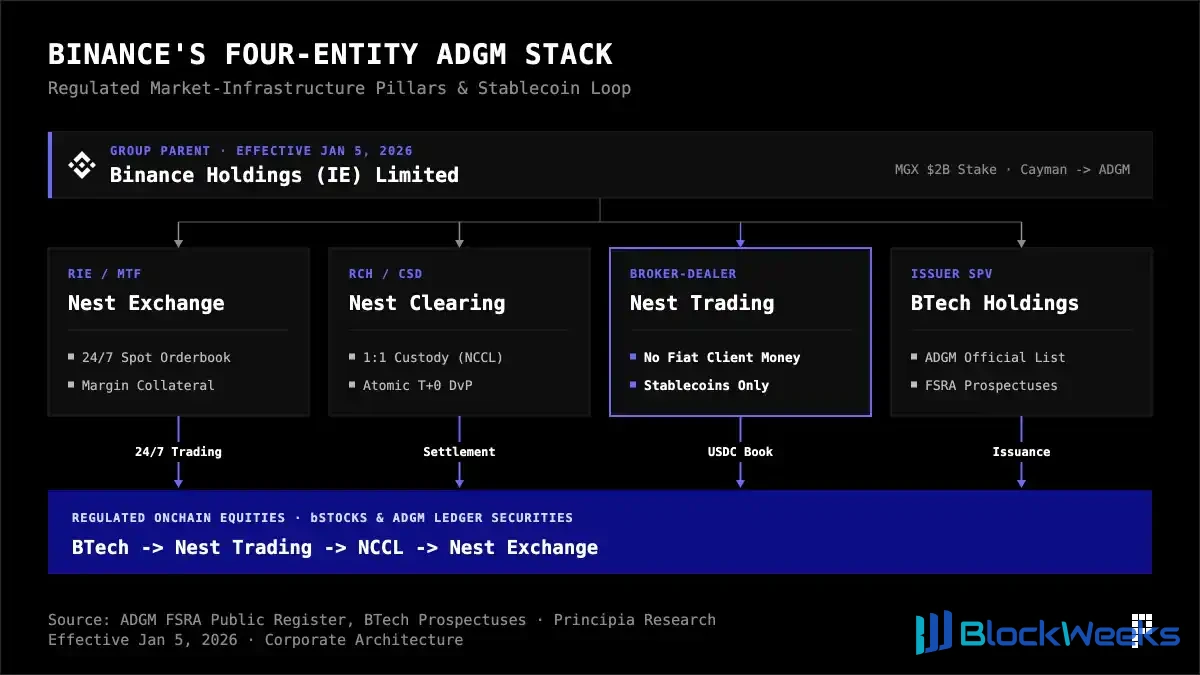
How exquisite is this architecture? A comparison with traditional Wall Street makes it clear:
- Nest Exchange Limited holds the Recognised Investment Exchange (RIE) and Multilateral Trading Facility (MTF) licenses; it plays the role of Nasdaq or the NYSE;
- Nest Clearing and Custody Limited (NCCL) holds the Recognised Clearing House (RCH) and Central Securities Depository (CSD) licenses; it plays the role of the US Depository Trust & Clearing Corporation (DTCC);
- Nest Trading Limited holds a broker-dealer license, approved to deal as principal, deal as agent, and arrange deals in investments. It plays the role of investment bank underwriting and distribution;
- BTech Holdings Limited (together with minting and disclosure agent BTech Services Limited) is specifically responsible for submitting prospectuses to the FSRA and applying for entry into the ADGM official list.
The "abnormal" details in the licenses expose the true intention: on the FSRA public register, Nest Trading Limited's license carries two intriguing restrictive conditions: first, it is strictly prohibited from holding or controlling traditional client fiat money (Client Money); second, its fund service authority is strictly limited to "recognised fiat-pegged tokens (such as USDC)." In the eyes of traditional brokers, this is a castrating restriction; but from the perspective of on-chain capital markets, this is precisely a native design tailored for On-chain IPO. It directly cuts off lengthy bank wire transfers and fiat custody accounts from the legal foundation, locking in a pure on-chain closed loop of "compliant stablecoin subscription payment + central depository (NCCL) on-chain T+0 delivery versus payment (DvP) atomic settlement."
At the same time, Binance's recruitment demands in the UAE also confirm this judgment: its official recruitment system recently quietly posted "0-to-1 Equity Capital Markets (traditional investment bank IPO underwriting department)" BD and research analyst positions, with responsibilities plainly stating "identify and engage with prospective issuers and investment banks, conduct issuer due diligence, build transaction pricing models, and submit investment committee memoranda." If it were merely continuing to buy US stocks in the secondary market for mapping, there would be no need to build an investment banking team that directly interfaces with prospective listed companies.
From US Stock Porter to a Weekly Regulatory Assembly Line
Before formally entering primary market IPO underwriting, Binance in the second half of 2026 used its own tokenized securities product bStocks to complete the closed loop of "regulatory and infrastructure stress testing" in ADGM.
On June 11, 2026, under the joint handling of international law firm Gibson Dunn and Middle East law firm Al Tamimi & Co., the first batch of bStocks issued by BTech Holdings was formally approved for inclusion in the ADGM Official List and opened on Nest Exchange. This was the first time in Abu Dhabi's history that tokenized digital securities running on a public chain (BNB Smart Chain, BEP-20 / BEP-677 standards) were included in the official securities list.
But this raises the most core market question: Tesla, Nvidia, and other US stock shares are clearly locked in the US DTCC system, so on what basis does ADGM say it is "1:1 custody"?
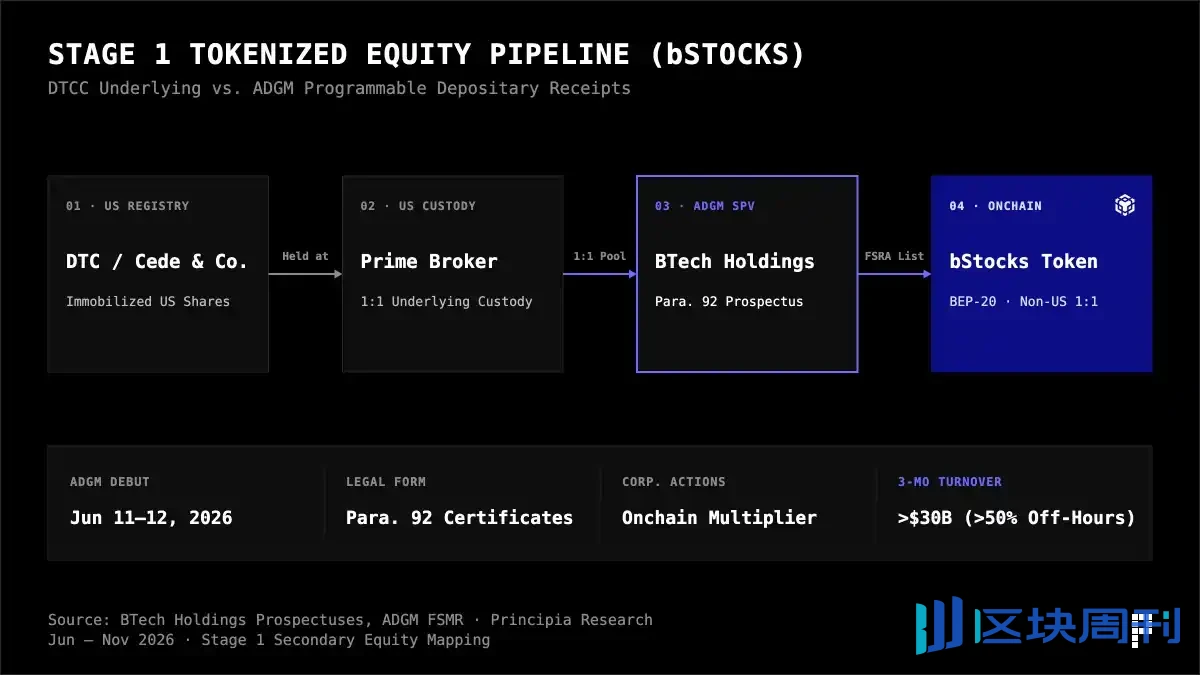
The answer lies in the honesty and penetration of legal characterization: in the first stage (tokenizing existing stocks in the secondary market), the real stocks indeed never left the US DTCC system. Under the ADGM Financial Services and Markets Regulations (FSMR Schedule 1 paragraph 92), bStocks' legal identity is a "certificate representing particular financial instruments," essentially an on-chain depositary receipt. The ADGM Regulatory Authority does not "endorse" the existence of assets for issuers, but by approving prospectuses, it turns 1:1 full segregated custody, regular reconciliation, and proof of reserves into statutory disclosure and contractual obligations with severe criminal and civil liability; and at the technical level, BTech Services uses a multiplier adjustment mechanism built into the contract to turn stock splits and net cash dividend reinvestment into on-chain automated components that require no token swap.
What is even more intriguing is the pace of approval acceleration over the following five months. In the traditional securities market, approving a prospectus often takes months, which simply cannot keep up with an IPO roadshow that has only a two-week window; but looking through ADGM's official admission announcements from June to November 2026, BTech Holdings managed to turn this regulatory channel into a "weekly-update-level assembly line":
- Early July: Italian tech group Bending Spoons had just rung the bell on Nasdaq on July 1 (ticker BSP, priced at $29), and BTech quickly approved an independent prospectus and launched BSPB, while also enabling Binance full-position and portfolio margin (Cross / Portfolio Margin) collateral functionality, rehearsing "ultra-fast follow-up on IPO recent listings + collateralization of derivative assets";
- Late July to August: approved the 3x long Nasdaq ETF (TQQQ) and the high-volatility target GameStop (GME), running through complex leverage structures and high-volatility risk control templates;
- September: listed Hims & Hers and Salesforce on the 9th, CEA Industries on the 14th, and Forward Industries on the 29th. Not only was the approval interval shortened to 5 to 15 days, but small- and mid-cap crypto treasury companies (DAT) were included for the first time, proving that non-blue-chip small and mid-cap stocks can also pass review quickly;
- October to early November: on October 13-14, approved BlackBerry, MongoDB, Penguin Solutions, and the volatility index ETF (UVXY) in a single batch; just 6 days later (October 20), approved Berkshire (BRKB); and on November 6, rapidly approved the supplementary prospectus for the 2x long Intel ETF (INTW).
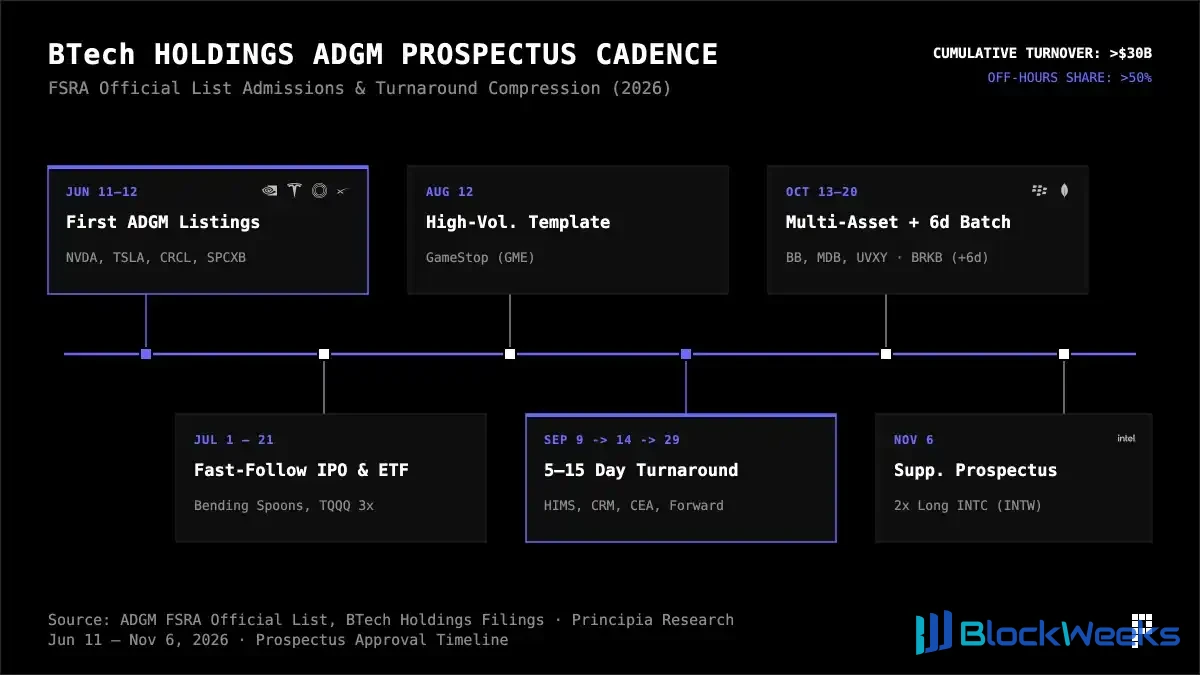
In just three short months (as of early September 2026), bStocks' cumulative trading volume directly broke through $30 billion, and more than 50% of trading volume occurred during U.S. stock market closure hours (Asia-Pacific daytime, Middle East session, and weekends). The pipeline, liquidity, market makers, and regulatory tacit understanding are all in place; the only remaining piece of the puzzle is the leap from "secondary-market mapping certificates" to "primary-market native on-chain IPOs."
The IPO Dilemma and the Reordering of Global Exchange Liquidity
Why are retail investors and issuers around the world all looking for a "third channel"? According to full empirical data from the Principia data terminal, allocation in traditional capital markets has become unbalanced, while the liquidity siphon effect of crypto trading platforms is obvious.
The Structural Plunder of Traditional IPOså
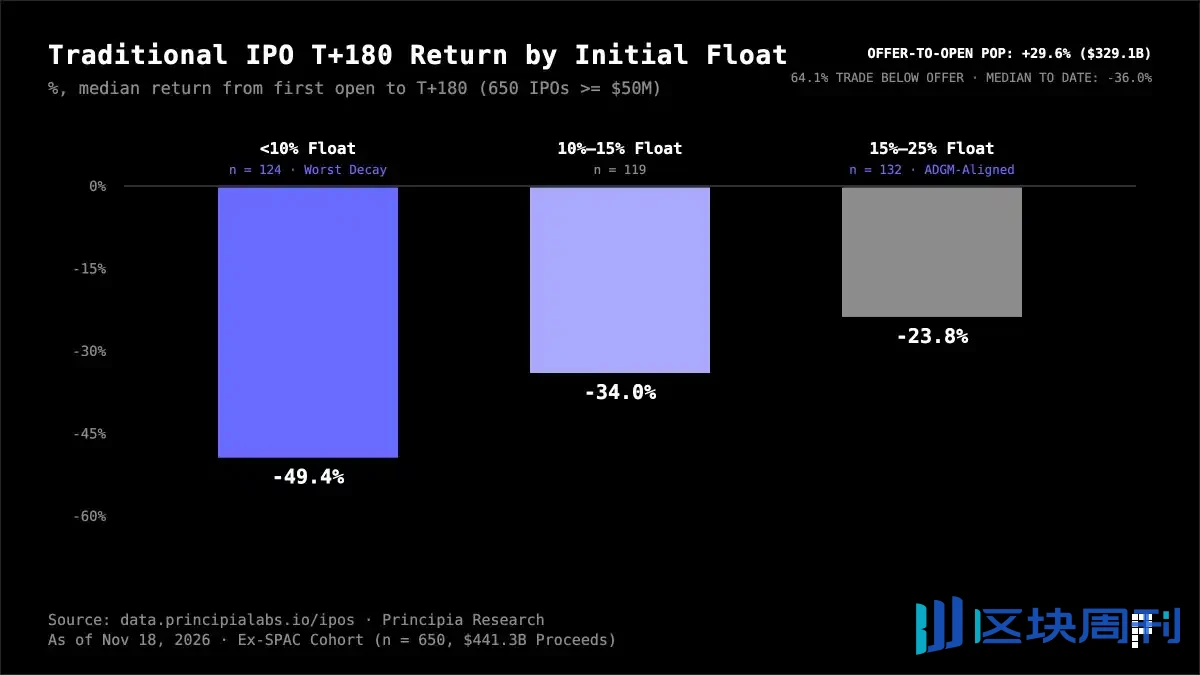
Among the 650 traditional IPOs tracked by Principia (raising ≥ $50 million, excluding SPACs, with total proceeds of $441.33 billion), two sets of highly jarring data emerge:
- The split between first-day surges and retail investors taking over: traditional IPOs had an average gap-up gain of +29.6% from offer price to first-day opening price, and "money left on the table" calculated at first-day closing prices reached $329.14 billion. This almost risk-free primary-market premium was almost entirely allocated by Wall Street investment banks to old institutional clients. But once retail investors in the public market entered after the first-day open, 64.1% of companies ultimately fell below their offer price, and the median return from first-day open to now plunged to -36.0%.
- The "slow bleeding" pattern of low float: tracking the median drawdown after opening for these 650 IPOs grouped by initial free float ratio, the pattern is strikingly consistent:
- <10% ultra-low float (124 IPOs): median drawdown on the 180th day after listing was as high as -49.4% (still -44.4% to date);
- 10% to 15% float (119 IPOs): median drawdown on the 180th day was -34.0%;
- 15% to 25% float (132 IPOs): median drawdown on the 180th day narrowed to -23.8%, directly halving the decline of the <10% group;
- At the same time, around the 180-day lock-up cliff (n=319), low-float stocks (Float <15%) suffer the most severe -10.5% selling pressure shock.
This set of empirical data not only explains why on-chain funds frantically poured $557 million into grabbing primary-market allocations when SpaceX listed (because only by getting the Offer Price can one avoid the -36.0% structural bag-holding trap of the secondary market), but also statistically confirms the scientific basis of ADGM MKT Rule 2.3.10's mandatory requirement of 15% to 20% genuine public shareholding.
Where Does Binance's True Scale Stand?
Many traditional finance practitioners subconsciously believe that "crypto exchanges' trading volume is far below that of mainstream stock exchanges." The truth is far more shocking than the stereotype:
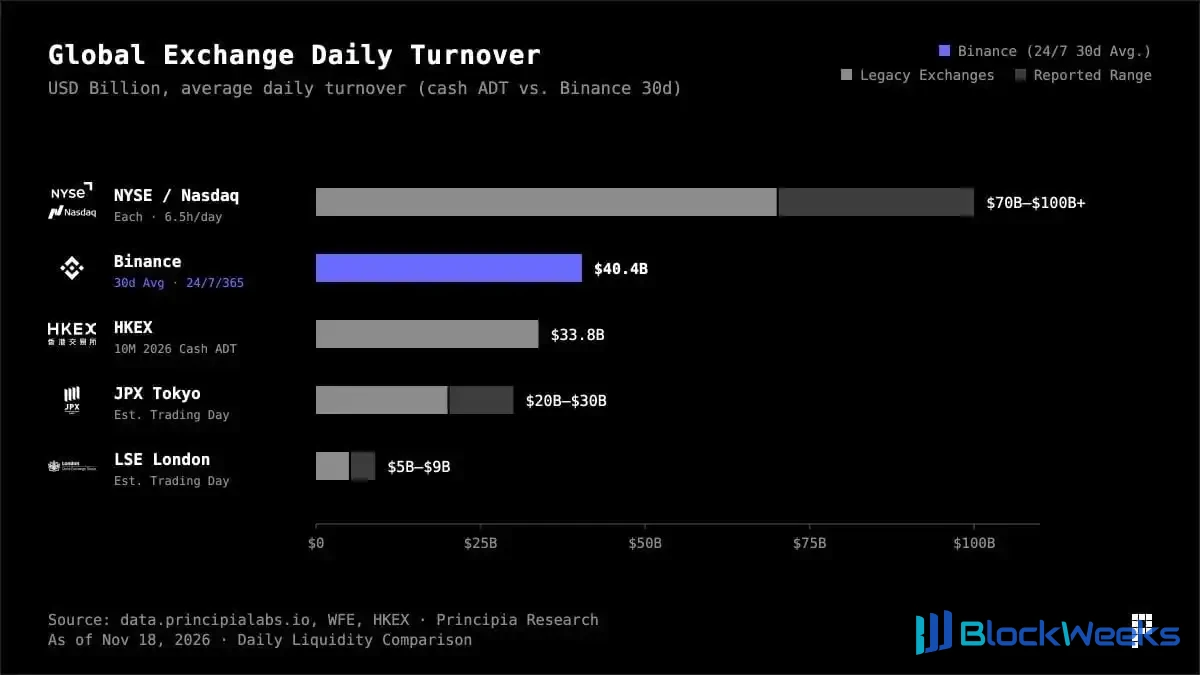
In full-year 2025, Binance's trading volume exceeded $7.1 trillion (on the same level as HKEX's $7.88 trillion). Binance's full-year 2025 spot volume has already closed in on HKEX, and its combined liquidity and 30-day average daily trading volume have surpassed HKEX's spot average daily level.
Even more noteworthy is the dedicated tokenized stocks/ETFs/commodities track we compiled (as of November 18, 2026, total network tokenized market cap of $8.59 billion, 804 active targets, covering 187 trading venues worldwide):
▪ Across the entire track, 24-hour spot trading was $1.79 billion, derivatives trading was $50.52 billion (derivatives were 28.3 times spot), and open interest was $11.22 billion;
▪ Among them, Binance alone accounted for 41% of global trading share (24-hour RWA spot $470.6 million + derivatives $20.90 billion + open interest $3.47 billion, with spot reserves as high as $112.71 billion), 4.3 times the size of the second-place OKX (9.5% share).
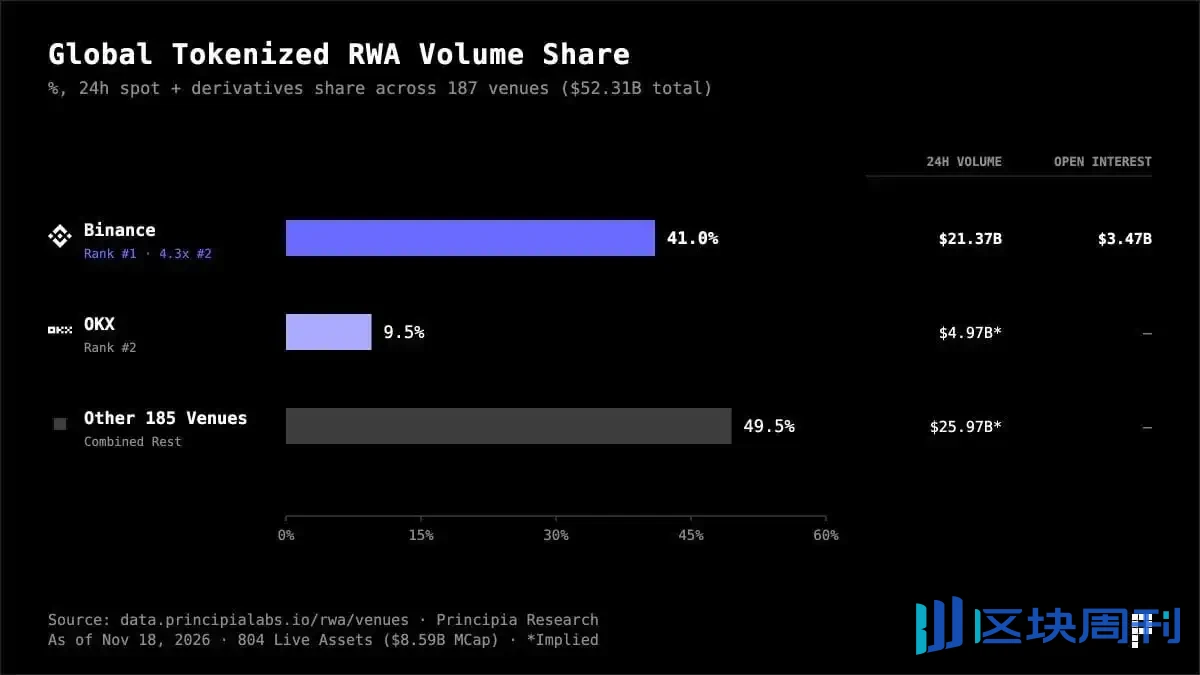
When a super exchange that operates 24/7/365, has a 30-day average daily trading volume exceeding $40.4 billion, and holds a 41% share of global tokenized assets officially obtains a full legal stock exchange and broker-dealer license in ADGM, its dimensional strike against traditional regional exchanges has only just begun.
Small and Mid-Cap Issuers Forgotten by Wall Street
In the second half of 2026, CZ publicly asserted,
CZ (@cz_binance): "IPOs will move on chain."
Binance Research successively released heavyweight reports such as "From IPO to Internet Capital Markets," pushing the global on-chain equity market into a head-on confrontation among three routes:
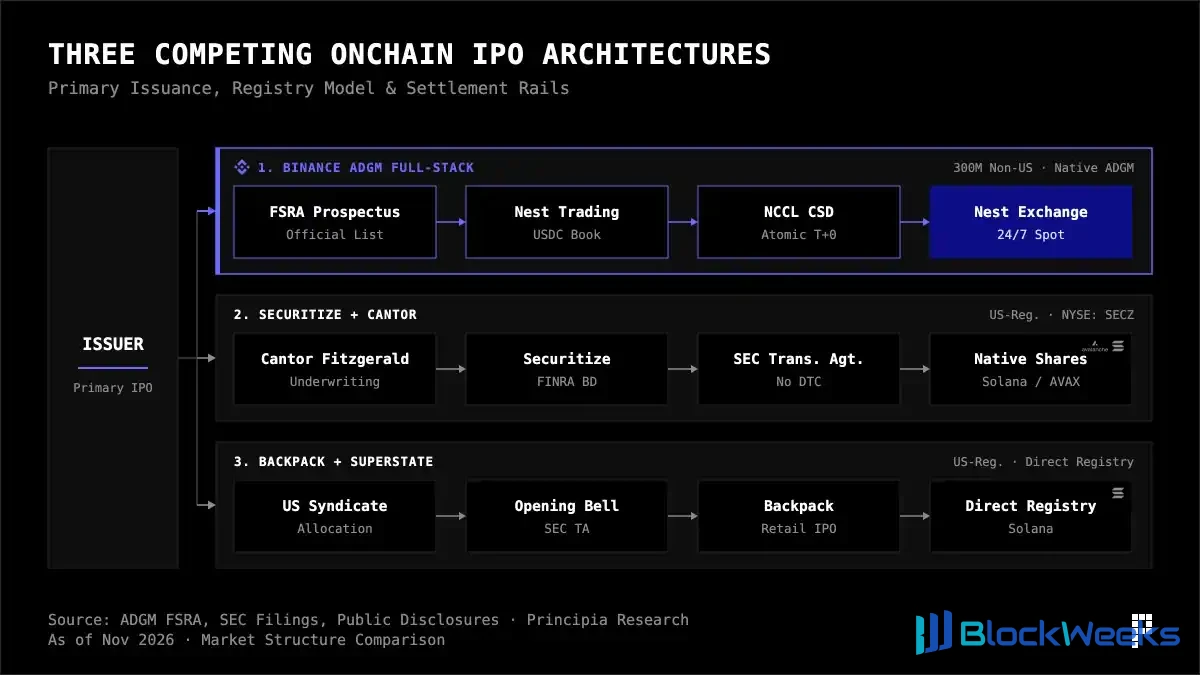
If these three routes are compared together, many people will fall into a misconception: they assume that Binance will go and compete with Wall Street for the lead underwriting rights of SpaceX or Anthropic (ticker ANT), which is in the midst of a $74 billion fundraising sprint.
On the contrary, the real main battlefield that can make Binance's ADGM on-chain IPO platform truly explode is not the giant behemoths worth tens of billions of dollars at all, but the "mid-sized cash-cow orphan band" with valuations below $3 billion.
A highly realistic microstructural accounting of the capital markets makes this clear:
The "structural outcasts" of traditional stock markets vs. the institutional dividends of ADGM
On today's Nasdaq or HKEX, a high-quality company with annual net profit of $3 million to $30 million and a valuation of $100 million to $800 million (whether it is an overseas AI application, a cross-border payment fintech, a game publisher, or high-cash-flow crypto infrastructure) is in an extremely awkward position:
- Going to the U.S. stock market is too expensive and no one pays attention: Goldman Sachs and Morgan Stanley basically do not take IPOs below $1 billion; if you go to second- and third-tier small investment banks, the hard costs of lawyers, auditing, and compliance alone before listing will burn $2 million to $3 million, and 7% underwriting fees will be stripped away; after listing, there is no Wall Street research coverage, institutions do not buy, and maintaining compliance every year costs another $1.5 million;
- Going to Hong Kong stocks/SGX turns them into "zombie stocks": although HKEX's overall average daily turnover is as high as $23.2 billion to $33.8 billion, the vast majority of turnover is drained by top-weighted names such as Tencent and Alibaba; mid-sized tech stocks have their valuations suppressed at single-digit P/E ratios all year round, and average daily turnover often falls to tens of thousands of dollars, completely losing the functions of refinancing and shareholder exit.
If this company instead pursues an ADGM native primary listing, the threshold and costs will undergo a cliff-like restructuring:
- Statutory access is clear and moderate: under ADGM MKT Rule 2.3.15 (profit test), as long as cumulative operating profit over the past 3 years reaches $1 million and consolidated profit over the most recent 12 months reaches $500,000 (unprofitable tech enterprises may even switch to the MKT 2.3.16 assets/market cap test: total market cap of $10 million, tangible net assets of $3 million, and pro forma working capital of $1.5 million), the official listing directory threshold can be legally crossed;
- Official fees are almost zero: the prospectus approval fee paid to the ADGM Regulatory Authority ($20,000) plus the official directory admission fee ($3,000) totals only $23,000; even including international law firms, auditing, and market structure advisors, the total hard cost before ringing the bell is only one-quarter to one-third of that of the U.S. stock market.
New wealth effect
What is even more ingenious is the size matching. According to the tiered public shareholding rules of ADGM MKT Rule 2.3.10:
- Issuers with a market cap below $500 million must have a statutory public float ratio (Public Float) of ≥ 20%;
- Issuers with a market cap of $500 million to $1 billion must have a statutory public float ratio of ≥ 15%.
This means that when a small- to mid-sized company valued at $100 million to $800 million comes to ADGM for a native on-chain IPO, its first-day public fundraising and free float will land exactly between $20 million and $120 million in USDC. For traditional stock markets, this is merely an ignored micro-cap stock; but for the Binance ecosystem, with 300 million registered users and 30-day average total turnover as high as $40.4 billion, an initial circulating market cap of $20 million to $120 million is precisely the "golden sweet spot" that can easily generate multiple times oversubscription, will not drain on-exchange liquidity, and can also produce extremely high 24/7 turnover rates.
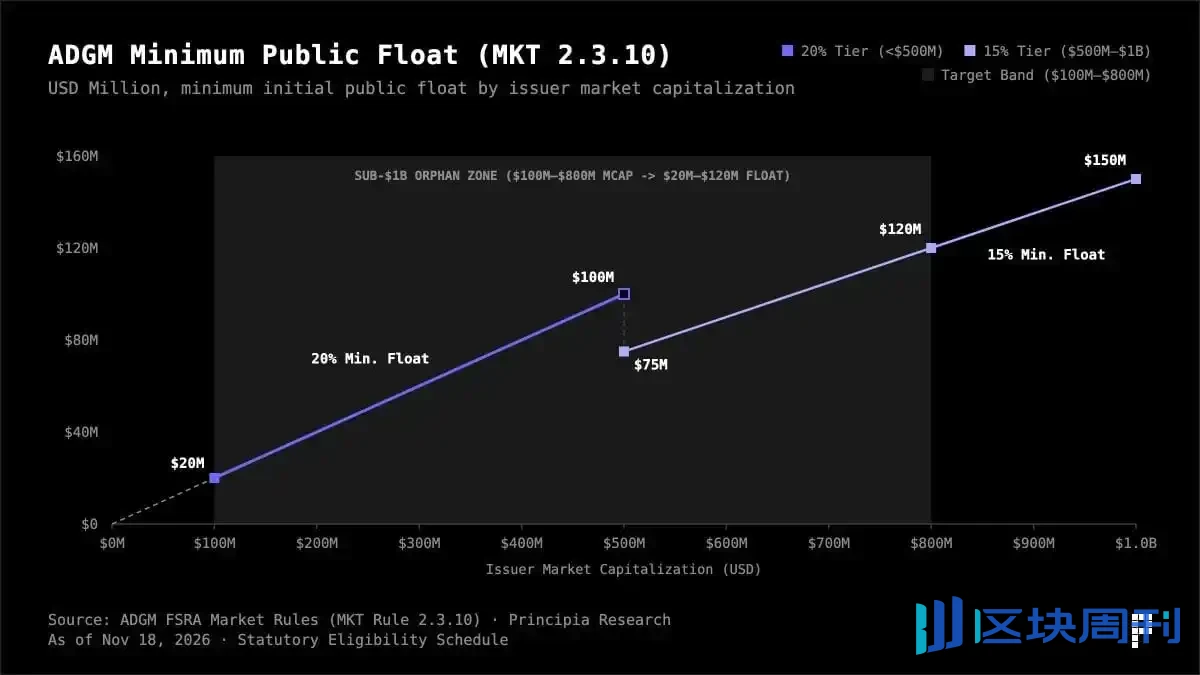
A paradigm reshuffle from "pseudo-circulation" to "true public shareholding": for practitioners accustomed to Web3 token issuance, On-chain IPO will bring a thorough reshaping of the rules. In past token offerings, project teams were accustomed to stuffing "tokens lent to market makers + team/ecosystem incentive pools + unlocked foundation shares" all into the initial circulating supply to make up the numbers; but under the securities regulations of ADGM MKT Rule 2.3.10(3), holdings by directors and related parties, employee stock ownership plan (ESOP) trust pools, shareholders holding more than 5%, and non-bought-out market-making borrowed shares are explicitly excluded from "public shareholding." Only shares genuinely subscribed with real money by external unrelated investors (or unlocked shares held by independent minority shareholders before listing) count, and this completely ends the much-criticized chronic problems of the crypto market: "high FDV, fake circulation, soft rug pulls."
Will Binance one day also sit down at the table itself?
Around Binance's series of major moves in Abu Dhabi, another more imaginative conjecture has always circulated in the industry: in addition to building an On-chain IPO underwriting platform for others, will Binance itself (or its Abu Dhabi segment) also hold a native on-chain IPO in ADGM?
Objectively speaking, co-CEO Richard Teng has publicly stated multiple times between 2025 and 2026 that Binance has abundant cash flow and no financing IPO plans in the short term. If one looks at the underlying equity structure disclosed in the BTech Holdings prospectus, the Irish parent company Binance Holdings (IE) Limited is still controlled by founder Changpeng Zhao (CZ) as controlling shareholder and ultimate beneficial owner (UBO). If the group as a whole wanted to directly publicly issue ordinary shares, short-term resistance would still be enormous, whether in terms of the sensitivity of disclosing globally consolidated financial statements or the baggage of historical compliance.
But "the group as a whole not going public" does not prevent "a licensed segment being spun off for a trial."
Do not forget two changes that are already happening: first, the $2 billion sovereign shareholder MGX, which entered in 2025, naturally has institutional demands for a medium- to long-term valuation yardstick and capitalized exit; second, in July 2026, on the day U.S. tokenization giant Securitize listed on the New York Stock Exchange (NYSE: SECZ), it simultaneously issued its own shares natively on the Solana and Avalanche public chains, proving to the world the feasibility of on-chain public equity.
By contrast, Binance's four ADGM entities (the Nest trading and clearing system and the bStocks business segment) have already been operating independently and compliantly under strict FSRA audit since January 2026, having shed historical offshore baggage and holding real trading cash flow at an annualized scale of hundreds of billions of dollars. If one day in the future Binance chooses to package a certain regulated financial business or joint venture segment in Abu Dhabi separately and launch a dual-listed native On-chain IPO on the Abu Dhabi Securities Exchange (ADX) and its own Nest Exchange, then whether as an explanation to sovereign shareholders or to establish authority for its own on-chain capital market, it would be a logical and brilliant stroke.
The birth of a new species is often accompanied by the rise of a new ecosystem
Looking back over the past decade, the crypto capital market has gone through a violently swinging pendulum: from the unregulated wildcat ICOs of 2017, to the deformed "high-valuation VC coins" of 2021 to 2025, and finally in 2026 swinging back to the intersection of "real corporate cash flow + statutory securities prospectus + 24/7 stablecoin on-chain settlement."
The infrastructure Binance has laid out in ADGM—"exchange + central depository + stablecoin broker + modular prospectus"—is essentially opening a third public capital formation channel (on-chain capital market) for global growth enterprises outside Wall Street and HKEX.
And in this industrial chain that is taking shape, the opportunities far from belong only to the exchange itself. After all, when the bell of the stock exchange rings for the first time on an all-weather, sleepless blockchain ledger, all pricing languages, underwriting paradigms, and liquidity rules will be rewritten, and new wealth effects may also quietly arrive. Binance's next goal is to serve 3 billion people, and this will be a brave attempt sufficient to change the existing rules of human finance.