

Banking giant Standard Chartered has unexpectedly shifted its attention away from the market's traditional heavyweights — Bitcoin and Ethereum — toward Arbitrum's native utility token, ARB, issuing a report with a long-term forecast for the asset.
The bank's analysts built a detailed mathematical model for the asset and forecast a 7,000% rise by the end of 2030 — from the current $0.14 to $10.
The research shows that ARB's fundamental valuation is changing dramatically as the market moves past the peak of major unlocks and traditional finance (TradFi) pours into the asset-tokenization sector.
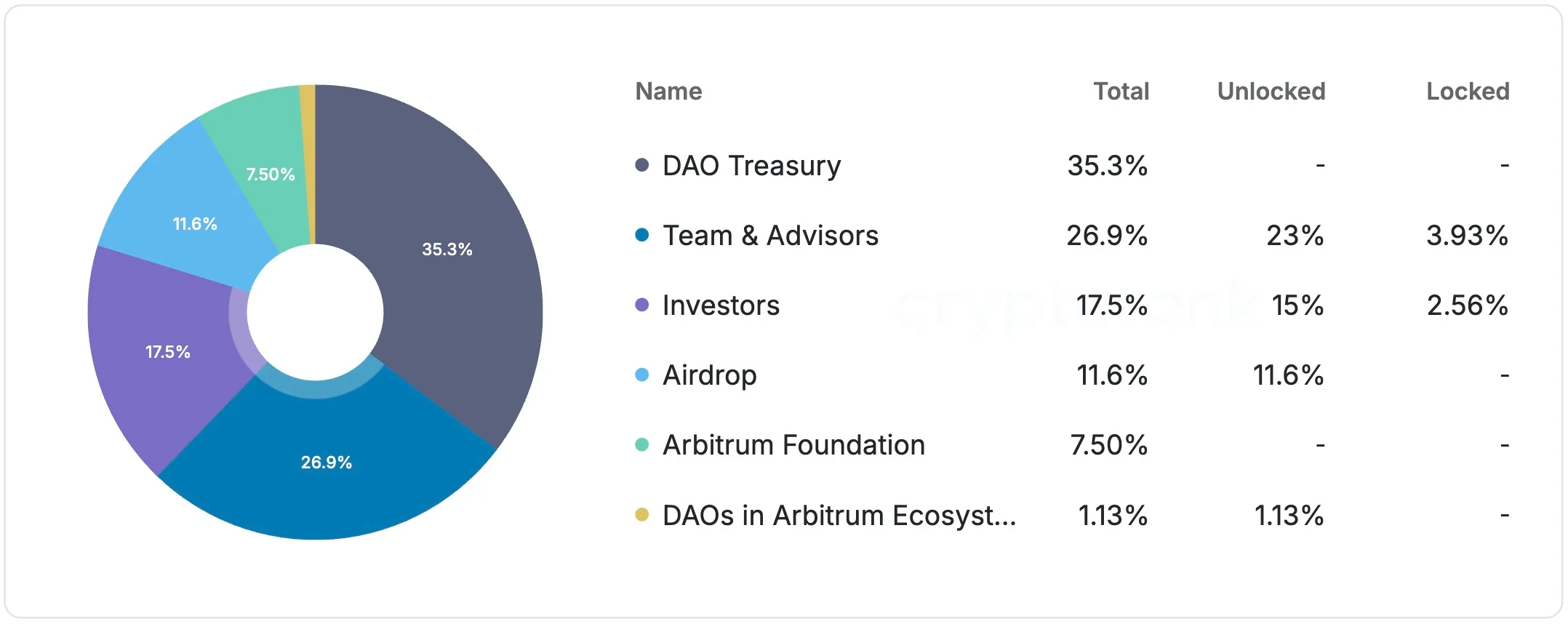
Over the past two years, tokenomics inflation has driven ARB's price down by 90%. Its supply has grown to 5.8 billion tokens (58.45% of the total issuance), while selling pressure is still being felt today as a linear unlock of 14.4 million ARB ($2.0 million) enters the market.
However, the unlock schedule is entering a flatter phase: the period of large, price-destructive cliff unlocks is over.
Arbitrum fell for two years due to inflation, but a contract with Robinhood changed everything
The main driver of the blockchain's new economy has been its integration with Robinhood Chain. In September 2026, Arbitrum's monthly revenue soared to $5 million, a fivefold increase, while daily transaction fees on the subchain exceeded $8 million at peak times. The bank expects the global volume of tokenized assets to reach $4 trillion by 2028, providing Arbitrum with a steady inflow of capital.
Standard Chartered emphasizes that the token's potential far exceeds the market's projected performance: "This would far outperform our projected price growth for ETH and BTC over our forecast horizon."
The market reacted to the bank's prediction immediately. Today, ARB prices posted an 8.5% impulse move on lower time frames, setting a local high at $0.14350. Despite profit-taking by speculators, the price is holding above the key support level of $0.13800, forming a bullish engulfing reversal pattern on higher time frames.
At the same time, the bank's analysts urge investors to remain pragmatic, explicitly pointing to the vulnerability of the current structure: "The ARB token currently has no direct way of accruing value."
Key risks to the asset also include competition from Coinbase's Base network and heavy regulatory pressure from the CLARITY Act and the SEC.