



Too Long; Didn't Read [TL;DR]
- XRP spiked to $1.41 on Ripple ecosystem news, then reversed inside its symmetrical triangle and trapped retail buyers.
- The XRP Ledger's Batch V1.1 upgrade reached 77.1% validator support, one vote short of the 80% needed to trigger its 14-day activation countdown.
- Bitcoin (BTC) fell 1.68% to $76,868 and Ethereum (ETH) dropped 1.56% to $2,475.03 as risk-off positioning built ahead of the upcoming Fed decision.
- Other flashpoints include CoinEx's full shutdown, Balancer's proposed DAO dissolution, a Gnosis Safe exploit intercepted by a MEV bot, and Standard Chartered's $10 target on Arbitrum (ARB).
The cryptocurrency market shifted into defensive mode on the morning of September 15, 2026, amid a sharp contraction in institutional liquidity. Bitcoin (BTC) corrected by 1.68% to $76,868, running into dense limit-order resistance. Ethereum (ETH) fell 1.56% to $2,475.03 after profit-taking at a local peak of $2,520. The decline synchronized with traditional markets: the S&P 500 slipped to 7,619.97, while the U.S. Dollar Index (DXY) strengthened to 99.607.
The current pullback is confirmed by Santiment's on-chain data: over the past three weeks, whales holding 10–10,000 BTC reduced their holdings by 0.20%, shifting volumes toward retail addresses (+0.09%), which points to an overheated local top. At the same time, U.S. spot funds recorded daily outflows of 937.8 BTC from Bitcoin ETFs and 74,500 ETH from Ethereum ETFs.
The main reason for the de-risking is the approaching 48-hour macroeconomic window: today's procedural U.S. Senate vote on the CLARITY Act and tomorrow's Federal Reserve rate decision.
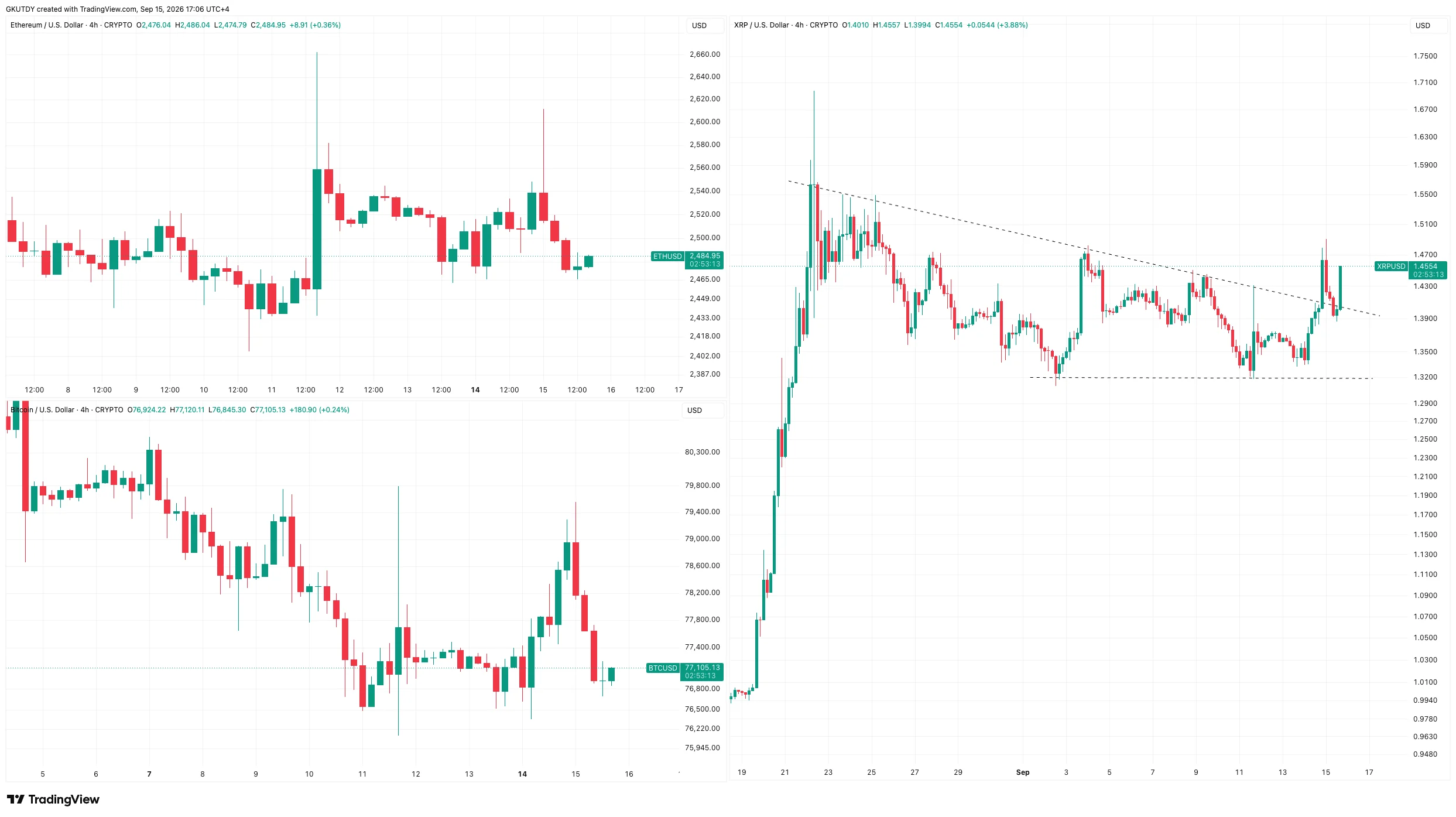
Amid the anticipation, retail capital attempted to pump XRP on the back of positive news from the Ripple ecosystem, but the momentum fizzled out. The token's price made a sharp fakeout to $1.41 and returned inside the symmetrical triangle, leaving buyers technically trapped.
How expectations pushed XRP into a fakeout while the XRPL upgrade stalled one step away from launch
It was against the backdrop of these elevated expectations that the emotional morning surge in XRP trading activity faded, while the development of the underlying infrastructure remained the asset's key long-term lever. While the chart was printing a fakeout, the decentralized XRP Ledger (XRPL) network remained on the verge of activating the major Batch V1.1 upgrade, designed to restructure multi-step transactions.
The upgrade introduces a mechanism for "atomic" operations, allowing up to eight related transactions to be bundled into a single indivisible block: they either all execute together or are fully canceled if one fails. RippleX engineers confirmed that commercial integrations built around this functionality are already at the contract stage.
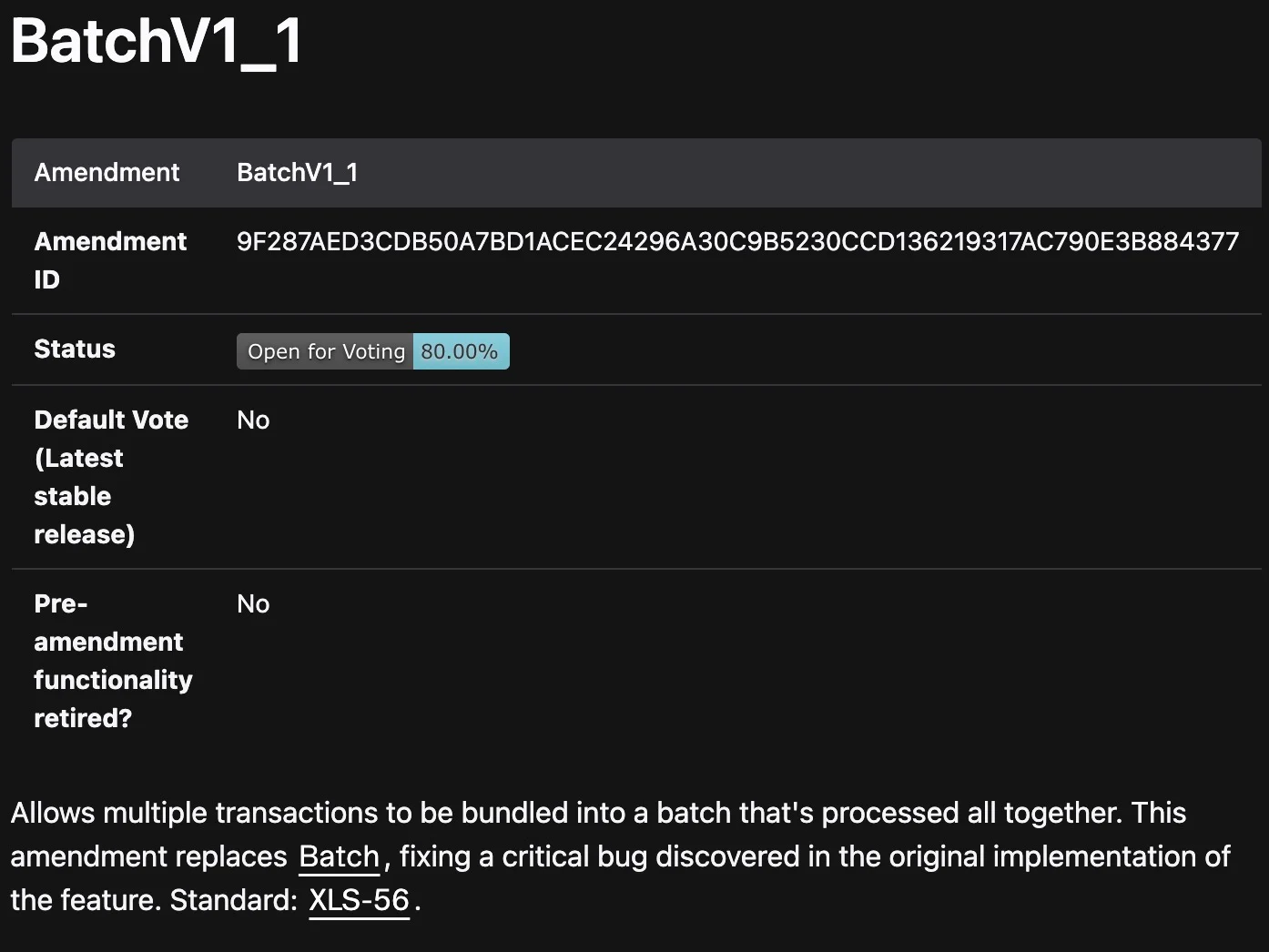
However, the launch has stalled exactly one step away from activation: for the code to take effect, it requires approval from 80% of trusted blockchain validators. According to the morning network snapshot, the proposal was supported by 27 out of 35 node operators (77.1%). The project is just one vote short of triggering the mandatory 14-day countdown.
This delay at the finish line is driven by three security factors:
- V1.0 failure: The original Batch V1.0 code was completely withdrawn due to a critical bug in the signature verification mechanism.
- Package of 11 vulnerabilities: In the current xrpld 3.3.0 software, engineers fixed 11 serious vulnerabilities, including a Common Prefix vulnerability that allowed someone else's signatures to be reused for unauthorized spending.
- Multi-layer audit: The updated Batch V1.1 architecture underwent independent reviews by Halborn and third-party specialists, prompting validators to take a wait-and-see approach.
While validators continue checking the code, the speculative momentum has evaporated, returning XRP to its previous trading range. At the same time, the institutional sector demonstrated independence: spot XRP ETFs recorded a net daily inflow of $11.51 million, increasing net AUM to $1.22 billion.
Split in Washington crushed the chances of regulatory relief — where should investors look for an entry point?
While traders deal with technical traps in altcoins, overall cryptocurrency market liquidity has been severely constrained by regulatory factors in Washington and the worsening situation in the U.S. bond market. The Digital Asset Market Clarity Act (CLARITY Act), designed to divide authority between the SEC and CFTC, establish altcoins such as XRP, SOL, and LTC as digital commodities, and legalize stablecoins, has encountered seemingly insurmountable political resistance.
Republicans led by Senator Cynthia Lummis introduced 126 compromise amendments to the text, including ethics rules for government officials and self-custody protections, while Treasury Secretary Scott Bessent officially backed the bill. Nevertheless, senators abandoned the compromise and blocked the current version over weak anti-corruption provisions.
The split immediately crushed the chances of the bill passing in 2026, with Polymarket odds falling to 18%. To clear the cloture hurdle today, the bill requires 60 votes, forcing Republicans to attract at least seven Democratic votes.
Additional pressure on buyers came from the U.S. debt market: the 10-year Treasury yield jumped to 5.03%, its highest level since July 2007, while the 30-year yield exceeded 5.4%, its highest since 2004. High government bond yields redirect capital directly away from the cryptocurrency sector. Major players are moving into defensive positions ahead of tomorrow's Federal Reserve decision, where the probability of a 25-basis-point rate hike is estimated at 85–90%.
A conservative consensus is forming in the market — a simultaneous failure of the CLARITY Act and hawkish rhetoric from the regulator could trigger a decline toward new local lows in October–November. That is where, at the bottom of a potential final capitulation within the current broader cycle, investors should look for an ideal entry point ahead of a potential recovery in late autumn.
Crypto market outlook: What should crypto holders watch?
The internal Web3 infrastructure during the morning session is undergoing a harsh purge of illiquid projects and a targeted flight of capital into Layer-2 solutions amid a systemic shortage of exchange liquidity.
With selling pressure and major exploits increasing, crypto holders should take additional precautions and pay close attention to the following critical events of the day:
- CoinEx shutdown: The exchange is completely winding down operations due to declining spot trading volumes and compliance costs; withdrawals under Proof-of-Reserves remain open until December 22. This precedent is worth watching because it reflects the pressure on mid-sized platforms.
- Balancer liquidation: The protocol proposed dissolving the DAO and distributing the remaining treasury ($9 million) due to a growing operating deficit. A signal for holders to assess the real profitability of platforms.
- Malicious code in Uniswap v4: An audit by 0x found that 54.2% of hooks in the upcoming v4 upgrade contain hidden fees of up to 18%, triggering heated disputes among developers. This requires maximum caution with future swaps.
- Gnosis Safe hack: An overnight $7.73 million wallet exploit caused by an Aave error was thwarted by the 'yoink' MEV bot, which managed to intercept $7.8 million. A reminder of the need to monitor smart-contract authorization permissions.
- Revolut extortion: Hackers are demanding 10,000 BTC for 147 GB of stolen customer personal data. Revolut says accounts are safe, but holders should check their KYC data.
- Lazarus Group dump: Wallets linked to the North Korean hacking group dumped an equivalent volume of assets at a price of $2,500, adding pressure on Ethereum. An indicator of who is keeping ETH trapped in a sideways range.
- Arbitrum coverage launch: Standard Chartered initiated coverage of the token with a long-term target of $10 by 2030 amid a daily inflow of $96 million into real-world asset (RWA) tokenization funds. This is the sector currently attracting the dominant share of institutional capital.