










Every Monday, Wednesday, and Friday, we focus on the crypto market, Japan, South Korea, A-shares, and Hong Kong stocks, reviewing the market with data and seizing opportunities with trends, produced by PANews.
BTC Battles at the $81,500 Institutional Lifeline, Mining Companies' AI Pivot Struggles to Shake Hashrate Fundamentals
Dragged down by Trump's harsh rhetoric toward Iran and a sharp selloff in US tech stocks, Bitcoin plunged nearly 3% from a high of $84,800 last night, briefly falling below $81,000, and is currently catching its breath near $81,500.
The $80,000 to $81,500 range is currently the "lifeline" that the whole market is watching closely. Glassnode data shows that this is not only the largest bid wall for Binance spot, but also the average cost basis for US spot ETFs ($81,500) and listed treasury companies ($80,200), as well as a key 50-day moving average level. Multiple traders warn that once the daily line breaks below the 50-day moving average, based on experience from previous instances this year, it often triggers a deep drop of 10% to 35%, directly testing the bull market support band.
Additionally, trader Bayard found that Binance retail investors are blindly buying the dip (long ratio surged from 50% to 66%), but large holders are reducing positions, and Coinbase is showing a negative premium. Before firmly holding the $82,600 to $83,400 resistance zone, the price is highly likely to probe downward toward the $78,000 to $80,900 support. Analyst Michaël van de Poppe and Litecoin Pool founder Jiang Zhuoer are also bearish on the short-to-medium term, believing that the price failed to hold $84,300 and will likely fall toward $77,000 to $80,000 in the coming days to clear long leverage; however, CryptoReviewing and Doctor Profit remain optimistic, pointing out that above $84,800 to $87,500 there are larger short stop-loss orders and early buyers' break-even lines, and once breached, it will trigger a "short squeeze rally" targeting $94,000.
US Bitcoin ETFs saw a net outflow of $635 million on Thursday (the largest single-day bleed since June), directly turning October's cumulative inflows negative. A DWF Labs report notes that Wall Street institutions are not "diamond hands" — in seven of the past eight market crashes, they chose to sell when BTC fell more than 7% from its high. However, due to more mature hedging tools such as futures and options, Bitcoin's decline has slowed compared to previous years. On the other hand, CryptoQuant data shows that although five listed mining companies saw mining output plunge 47% due to signing over $50 billion in AI contracts, thanks to supplementation from private and overseas miners, total network hashrate has rebounded 11.7% from its August low, approaching an all-time high, indicating that the Bitcoin network no longer needs to overly rely on Wall Street mining companies.
Whether Bitcoin can break the deadlock next depends entirely on the macro inflation picture and two key dates. Currently, Middle East conflict has pushed Brent crude above $113, and the inflationary pressure from high oil prices is tightly choking market liquidity. Investors need to closely watch tonight's US inflation expectations data and the Fed's interest rate decision on October 28 (if macro conditions deteriorate and BTC falls below $80,000, it could drop toward the market's true average price of $77,600); additionally, on November 11, MSCI will announce its index removal list. If major treasury holder MicroStrategy (Strategy) is removed from the index and triggers passive fund selling, the corporate coin-buying wave could suffer a severe blow.
Today's Highlights:
- Venus stops supporting opBNB, Optimism, and Unichain
- Capricorn (APR) unlocks approximately 147 million tokens, worth about $17.14 million
- SOON (SOON) unlocks approximately 20.24 million tokens, worth about $6.3 million
- Upbit 24-hour trading volume ranking: IRYS, AXIS, XRP, BTC, GTC
- Bitcoin spot ETF: -$635 million
- Ethereum spot ETF: -$111 million
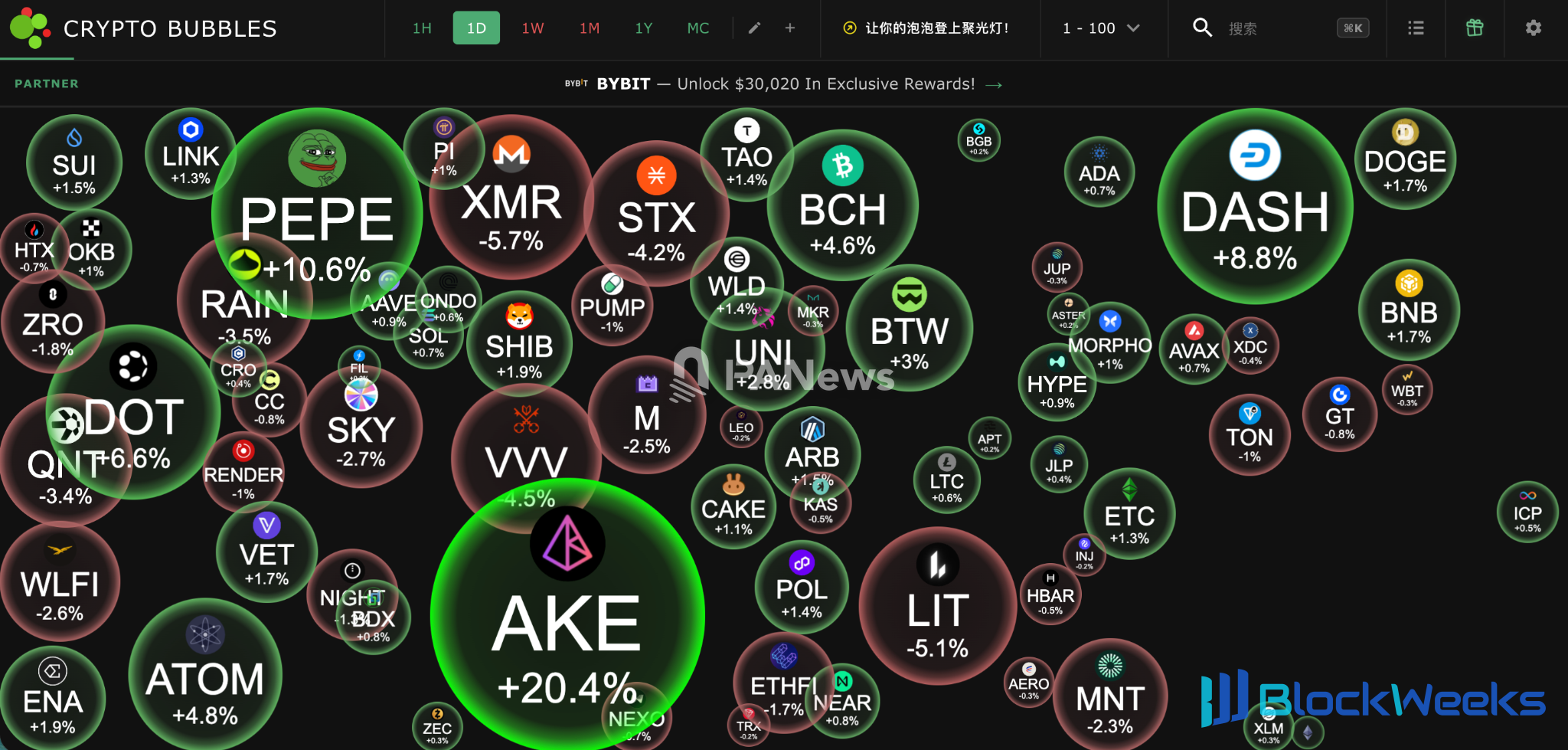
Today's top gainers among the top 100 coins by market cap: AKE up 36.8%, PEPE up 13.2%, DASH up 12.8%, DOT up 9.8%, ATOM up 9.6%.
Nasdaq Futures Rebound, Memory Chip Stocks Surge in Overnight Session

In pre-market US trading, Nasdaq index futures rebounded somewhat, with the memory sector that fell sharply yesterday rebounding the most in the overnight session — SK Hynix surged over 5%, while SanDisk and Micron both rose over 2.5%.
Faced with this turmoil, Wall Street heavyweights are completely split on next year's outlook. Bears like Citadel's Griffin warn that the AI industry harbors $2 trillion in hidden debt, and a bubble burst would send the S&P plunging 30%. Legendary investor Paul Tudor Jones compared the current situation to the eve of the 1999 dot-com bubble, announcing that due to concerns about mega IPOs like OpenAI draining liquidity and the US debt crisis, he will "short US stocks all year" in 2027 and go long crude oil. But bulls remain adamant — Blackstone's president insists AI demand is real, while Pershing Square's Ackman declared that as long as war and oil prices cool down, "2027 will be stunning for US stocks," not only supporting Meta and Netflix (up 3.09%) on dips but also boldly claiming Fannie Mae and Freddie Mac (up 14.83%) could rise tenfold; UBS also reminds that US stock short positions have piled up to historic highs, and an upward "short squeeze rally" could occur at any time, recommending shorting cloud giants and buying the dip in chip stocks.
Korean Stocks So Cheap They Set a Global Record, A-shares and Hong Kong Stocks Stage a Dramatic Counterattack Under the Cloud of Japan Rate Hikes
Turning to Asia-Pacific, South Korean stocks caught a breather today after Thursday's sharp selloff, with the KOSPI rebounding from lows to close up 0.30%, mainly because the Bank of Korea governor expressed support for a stronger won, stabilizing foreign investor confidence. Bloomberg data shows Korean stocks' forward P/E has fallen to 4.2 times, making it the first trillion-dollar market globally to fall below 5 times P/E since records began in 2006; faced with such a rare "bargain price," UBS declared that Asian stocks are extremely oversold and it's time to shift from defense to "offensive dip-buying," driving chip giant SK Hynix — which plunged 8% yesterday — to rebound 4.42% today, Samsung Biologics to surge 7.71%, Samsung Electronics to edge up 0.47%, with only traditional industrial stocks like POSCO (down 3.67%) still declining.

In contrast, Japanese stocks are being suffocated by the central bank's rate hike expectations, with the Nikkei 225 closing down 0.34% today (down 4.03% for the week). This morning, Japan reported that September core CPI rose to 2.4%, breaking above the central bank's target for the first time in nine months, and Bloomberg further reported that the Bank of Japan will maintain its rapid rate hike path with December being a key juncture, spurring the yen to surge in early trading and triggering concerns about position unwinding. Under this pressure, rate-sensitive Japanese tech and financial heavyweight stocks broadly weakened — Hitachi plunged 4.37%, SoftBank fell 3.73%, Mizuho Financial dropped 2.35%, with only domestic-demand stocks like Chugai Pharmaceutical (up 2.74%) and Uniqlo parent Fast Retailing (up 1.58%) rising against the trend.

On the Hong Kong stock market side, after experiencing extreme selling on Thursday, today it welcomed a rebound. The Hang Seng Index closed up 0.69%, and the Hang Seng Tech Index surged 2.05%. UBS analysis pointed out that the RSI indicator of the Hang Seng Tech Index had previously fallen to an "extremely oversold" level of 27. Strong technical rebound demand combined with favorable domestic AI news effectively boosted market sentiment for bottom-fishing. On the board, AI application and hard tech sectors led the gains: AI startup MiniMax, whose open-source new model has significant cost advantages and was viewed favorably by Morgan Stanley, saw its stock price soar 16.74%.

The A-share market today staged an thrilling "epic deep-V" major reversal. The ChiNext Index soared from an early decline of more than 3% all the way to close up 4.16% (with an intraday amplitude of more than 7%), the Shanghai Composite Index closed up 0.89%, the Shenzhen Component Index rose 2.79%, the STAR 50 surged 3.04%, more than 4,500 stocks across the market rose, and trading volume exceeded 1.97 trillion yuan. This violent rally was partly because the CSI 300 Index touched a historic oversold range and received strong support from moving averages, and partly because, in response to the United States' plan to restrict biotechnology investment, China's Ministry of Foreign Affairs stated firmly that it "will take necessary measures to safeguard its rights and interests," igniting bullish enthusiasm for the "domestic substitution" main line.
On individual stocks, "lithium battery leader" CATL surged nearly 8%, sounding the horn for a counterattack. The robotics concept set off a wave of limit-up stocks. Robot developer Unitree Robotics hit the 20cm limit-up, with a cumulative gain of more than 54% over six days, and more than 20 stocks including Wanxiang Qianchao were locked at limit-up. The domestic computing power chip sector strongly recovered, with CanSemi Technology at limit-up, and integrated circuit design companies MetaX and Moore Threads surging more than 10%. In addition, brokerage and financial stocks such as Hualin Securities and Dazhihui at limit-up assisted, further pushing up the A-share counterattack rally.