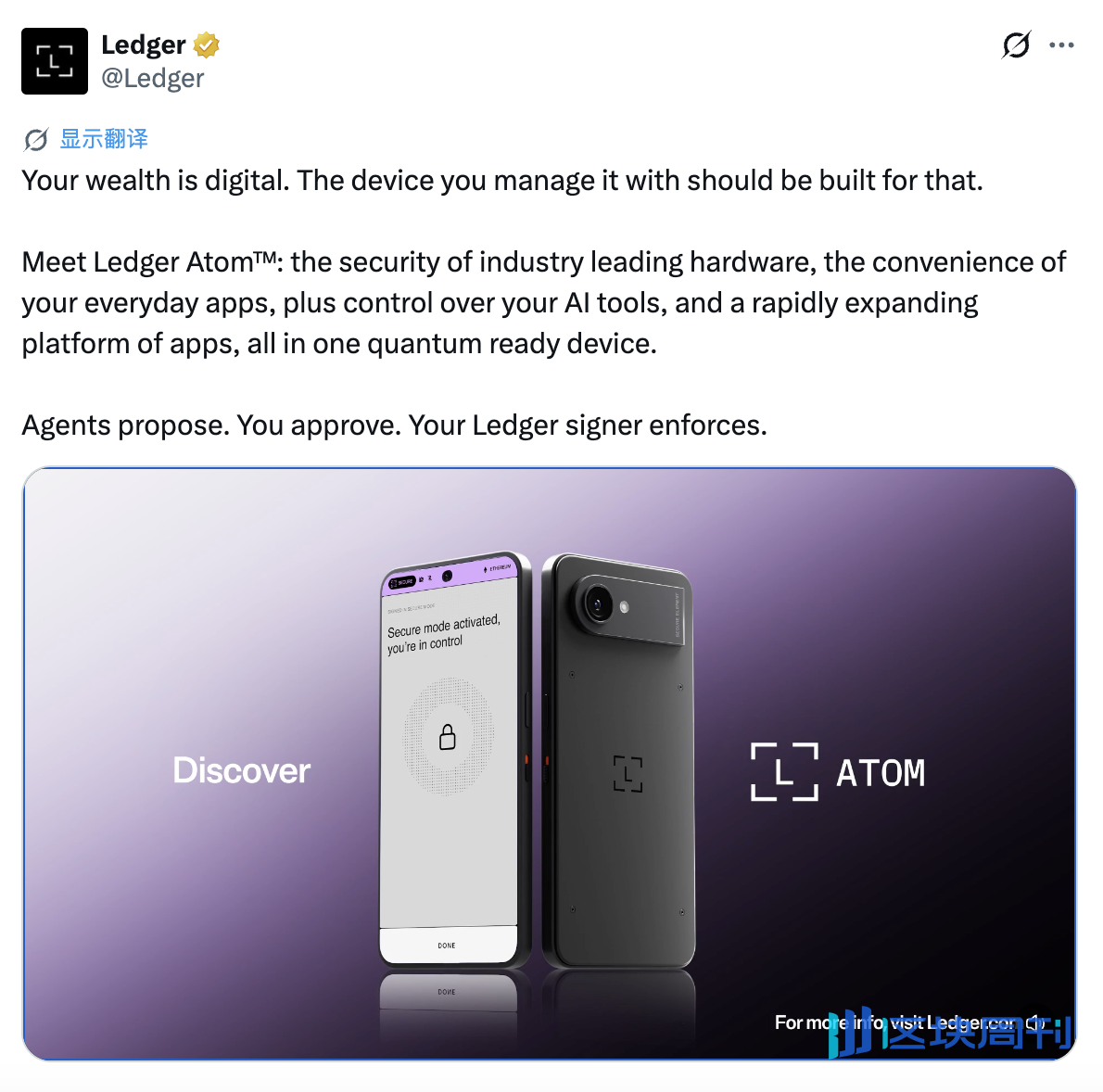
On October 16, Ledger released the phone-style hardware wallet Atom, with a founding edition pre-order price of $849 and an expected regular edition price of $899, planned for official release in mid-2027. Ledger states that Atom protects assets through a dual operating system, an independent security chip, hardware-level screen isolation, and tamper-resistant design, and allows AI Agents to prepare transactions, but sensitive operations still require user confirmation on the secure screen. The device does not support voice calls or text messages, and initially it is planned to be sold only through Ledger's official website.
Atom has sparked controversy even before launch. The article points out that Ledger's authorized distributor channel CryptoBilis in Southeast Asia previously experienced a supply chain attack in which devices were implanted with malicious hardware, causing nearly $100 million in user losses; Ledger says the attack originated from a local distribution channel and has suspended sales through the relevant channel, but the handling and compensation plan for affected users' losses has not yet been clarified. The new product's pricing, conspicuous brand logo, and the personal coercion risk that hardware wallets are difficult to prevent have also been questioned by the community. CertiK disclosed that in the first half of 2026, 52 verified wrench attacks targeting cryptocurrency holders were recorded, with losses amounting to $124.1 million.
Author: Nancy, PANews
The security alarm has not yet been lifted, yet veteran hardware wallet manufacturer Ledger chose this moment to launch a new product, Atom, with great fanfare.
This smartphone-like hardware wallet uses a dual operating system, privacy protection, tamper-resistant and tamper-evident design, and AI Agent and other product designs as selling points, attempting to restore market trust and thereby gain more attention, but the market does not seem to buy it.
Before Atom was officially launched, it had already sparked community controversy, and even attracted considerable ridicule, due to its launch timing and product design.
Launching the phone-style hardware wallet Atom, with tamper-resistant design and AI Agent as highlights
On October 16, Ledger announced the launch of the phone-style hardware wallet Ledger Atom. This product is close to a smartphone in appearance and operating experience, but it is not a traditional phone; rather, it is a device that integrates everyday applications, crypto asset management, and hardware security functions.
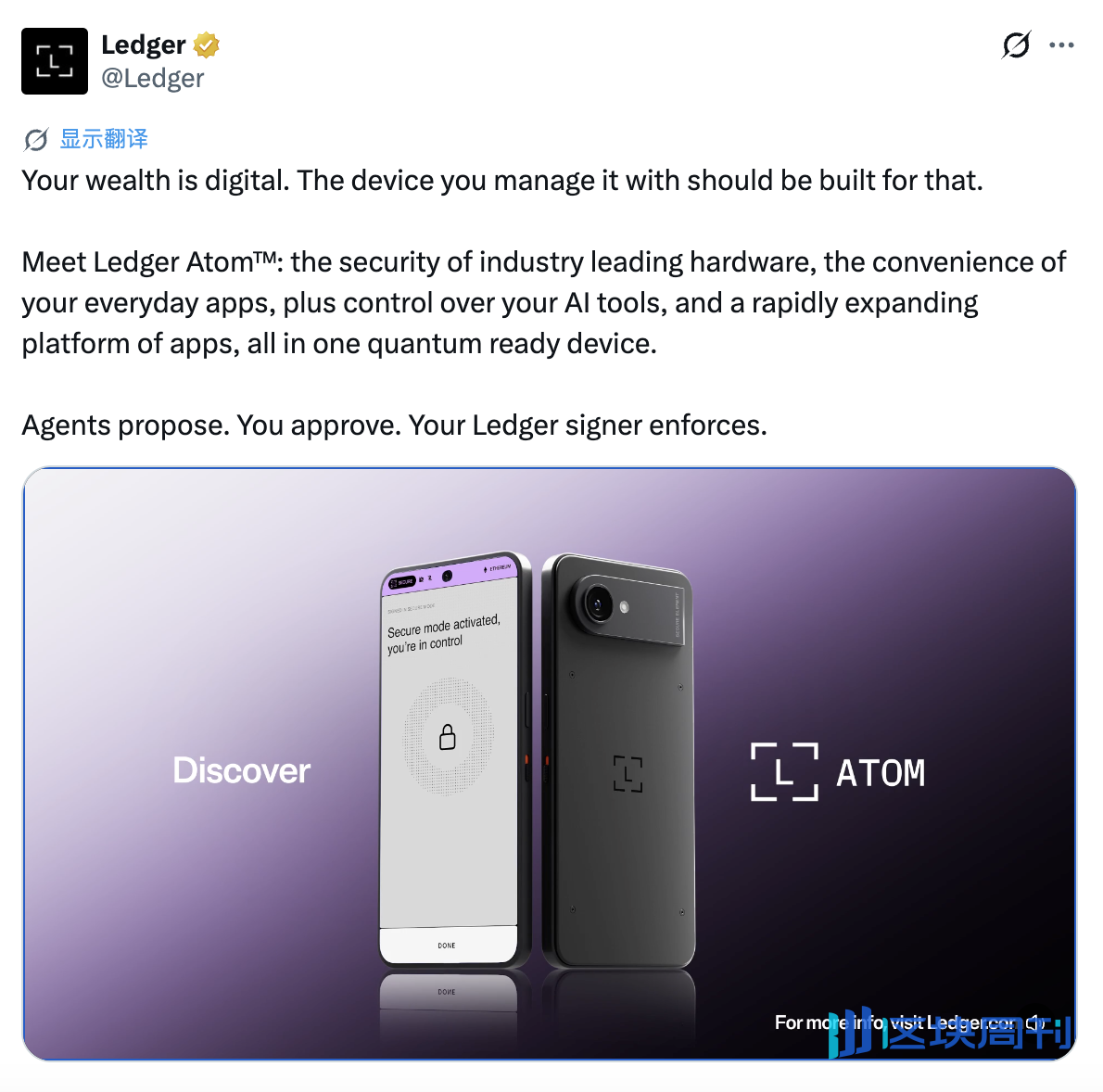
The founding edition pre-order price is $849, and users can pre-order by paying a refundable deposit of $100; the regular edition is expected to be priced at $899 and is planned for official release in mid-2027.
Ledger Atom does not support full phone communication functions. According to official disclosures, the device only supports mobile data services and can connect to the internet via 4G/5G networks, but does not support cellular voice calls, including VoLTE, VoNR, and VoWiFi, nor does it support text messages. Even if a SIM card or eSIM card is installed and the device is within network coverage, users cannot use the device to call emergency services, such as 112 or 911.
In terms of security architecture, Ledger Atom adopts a dual operating system design, separating everyday applications from sensitive operations involving asset security, in order to reduce the risk of malware tampering with transaction information or inducing users to sign malicious transactions. Among them, the standard mode based on the Android Open Source Project (AOSP) is responsible for running everyday applications and online services such as WhatsApp, Instagram, and TikTok; Ledger OS runs in an independent security chip environment and specifically handles sensitive operations such as private key storage, transaction signing, AI Agent authorization, and identity verification. When users initiate a transaction, they can verify the transaction details through the secure screen and complete the signature after confirming that everything is correct.
It is worth noting that although the two operating systems share the same screen, Ledger still attempts to achieve isolation at the hardware level. According to the official statement, the device controls access permissions to the screen and touchscreen through an FPGA hardware multiplexer. When the device enters secure mode, the FPGA cuts off the standard mode's access to the screen and touchscreen. Theoretically, even if the standard mode is completely controlled by malware, attackers cannot use that mode to forge or tamper with the transaction approval interface that users see, let alone use it to steal private keys or inject click operations.
Privacy protection is also a key design focus of Ledger Atom. The device is equipped with a physical privacy switch that can cut off power to the camera and microphone at the circuit level; after entering secure mode, these sensors are also automatically disabled. The device also supports post-quantum cryptography solutions compliant with NIST standards, attempting to prepare in advance for possible future quantum computing threats.
In response to the recently exposed risk of hardware wallet devices being tampered with, Ledger has added multiple protection mechanisms to Atom, claiming it is its most advanced anti-tampering and anti-disassembly solution to date. The device places protective covers around key sensitive components and is equipped with sensors to detect whether the screen or back cover has been removed; the product packaging is also specially designed to identify whether it has ever been opened. At the same time, the tamper detection system is equipped with an independent battery, so it can continue to operate even when the device is powered off.
In addition to hardware security, Ledger has also introduced AI Agents into the asset management process. Its Ledger Agent Intent allows AI Agents including OpenClaw to monitor the market, prepare transactions, and provide operational suggestions, but does not grant them access to private keys. All requests involving fund transfers or other sensitive operations must ultimately be physically confirmed by the user through the secure screen of Ledger Atom before execution. In other words, users can use AI to assist with analysis and prepare operations, but ultimate control over assets remains in the user's hands.
In terms of the application ecosystem, Ledger Atom will have Ledger Wallet built in, supporting crypto asset management and transaction signing. In addition, Ledger also announced a partnership with Solana Mobile to bring the Seeker application to the device; at the same time, it has partnered with Cyber50 to explore using Ledger Atom and its hardware-level security technology to further enhance communication security and privacy protection.
In terms of sales channels, in order to reduce the risk of supply chain attacks similar to those exposed in the recent CryptoBilis incident, Ledger plans to sell Atom initially only through its official website, not through third-party seller channels. As for the device upgrade issue for existing users, Ledger said it currently has no plans to launch a trade-in program for customers affected by this incident, but has not ruled out the possibility of launching upgrade promotions in the future.
Security trust has not yet been repaired, and Ledger's rush to launch a new product raises questions
However, before Ledger Atom was officially launched, it had already caused community dissatisfaction.
On the one hand, the trust crisis facing Ledger has still not subsided. Previously, a hardware wallet supply chain attack was exposed in the channel of Ledger's authorized distributor in Southeast Asia, CryptoBilis, in which the devices involved were implanted with malicious hardware, causing nearly $100 million in user losses.
In response, Ledger has suspended product sales through relevant authorized channels in Southeast Asia and Hong Kong, and stated that the attack originated from local distribution channels, rather than vulnerabilities in the company's chips, operating system, or servers. According to Ledger's disclosure, a highly organized criminal group spent months purchasing genuine devices, disassembling them and adding customized hidden components, attempting to steal the recovery mnemonic generated by users during initialization, and then putting the tampered devices back into the market through Southeast Asian distributors. The attackers were also said to have invested millions of dollars to build a logistics network, mnemonic collection servers, and infrastructure for stealing funds and money laundering, ultimately stealing user assets through coordinated operations.
Although Ledger has responded to the incident, the supply chain attack response issue that users care about most has still not been clearly resolved. At the same time, the official side has so far not given a clear answer on how to handle the asset losses of affected users and whether to provide clear compensation or device replacement plans. At this point in time, Ledger has not prioritized responding to users' most urgent demands, but instead attempted to reshape the product's security image by launching Atom with hardware isolation and tamper-resistant mechanisms, which naturally makes it difficult to dispel outside doubts. For current users, rather than launching a new product, properly handling the existing security incident first and responding to victims' demands may be the key to repairing trust.
On the other hand, although Ledger Atom has stronger software isolation and remote attack protection, it still faces security risks from the real world. Compared with traditional hardware wallets, Atom has an appearance and operating experience close to a smartphone, but the conspicuous Ledger brand logo may also make it a target for potential criminals, and the community has even joked that it is a "walking ATM."
This concern is not unfounded. In recent years, wrench attacks targeting cryptocurrency holders have become increasingly frequent. Unlike remote hacker attacks, such crimes directly target the victims themselves, forcing them to hand over private keys or transfer assets on the spot through violent assault, kidnapping, torture, or threats to life. According to previous disclosures by security firm CertiK, in the first half of 2026 there were 52 verified wrench attack incidents, with recorded losses reaching $124.1 million; the number of incidents increased by 33.3% year-on-year, while losses rose to 11.8 times the same period previously.

In addition, the pricing of Ledger Atom has also sparked controversy. Its price is considered to be far higher than most of Ledger's existing hardware wallet products, and even close to many mid-to-high-end smartphones. The company has explicitly stated that Atom is not a smartphone in the traditional sense, and its functional positioning is clearly different from conventional phones, so many users say they are unwilling to pay for this security premium.
Ultimately, in the crypto market, security has always been the core value of hardware wallets, and technical upgrades and product form innovation alone are not enough to win user trust. Especially at a time when the Ledger security incident remains controversial and user trust still needs to be repaired, only by directly responding to user demands and effectively resolving security risks can market confidence be rebuilt.