
Written by: 100y
Compiled by: Chopper, Foresight News
If one were to pick the hottest new blockchain project of 2026, Robinhood Chain would most likely be everyone's answer. Even as the crypto market remained sluggish and Robinhood's own crypto business continued to come under pressure—with crypto revenue as a share of total revenue falling from 27.2% in Q1 2025 to 12.6% in Q1 2026—Robinhood still boldly launched Robinhood Chain on July 1, 2026.
Robinhood Chain's grand vision was to build an on-chain financial ecosystem centered on tokenized stocks. But not long after launch, meme
coin launchpads such as Noxa and tokens like Cashcat captured the market's attention, and Robinhood's original grand vision of building an ecosystem around real-world assets (RWA) seemed to pale in the speculative frenzy.
Later, launchpads such as LONG and Pons introduced a novel model: pairing meme coins with tokenized stocks. Trading volume then exploded, and in cases related to stocks such as HIMS and AMC, the violent volatility generated by meme coins driving tokenized stocks even反过来 affected prices in the traditional stock market.
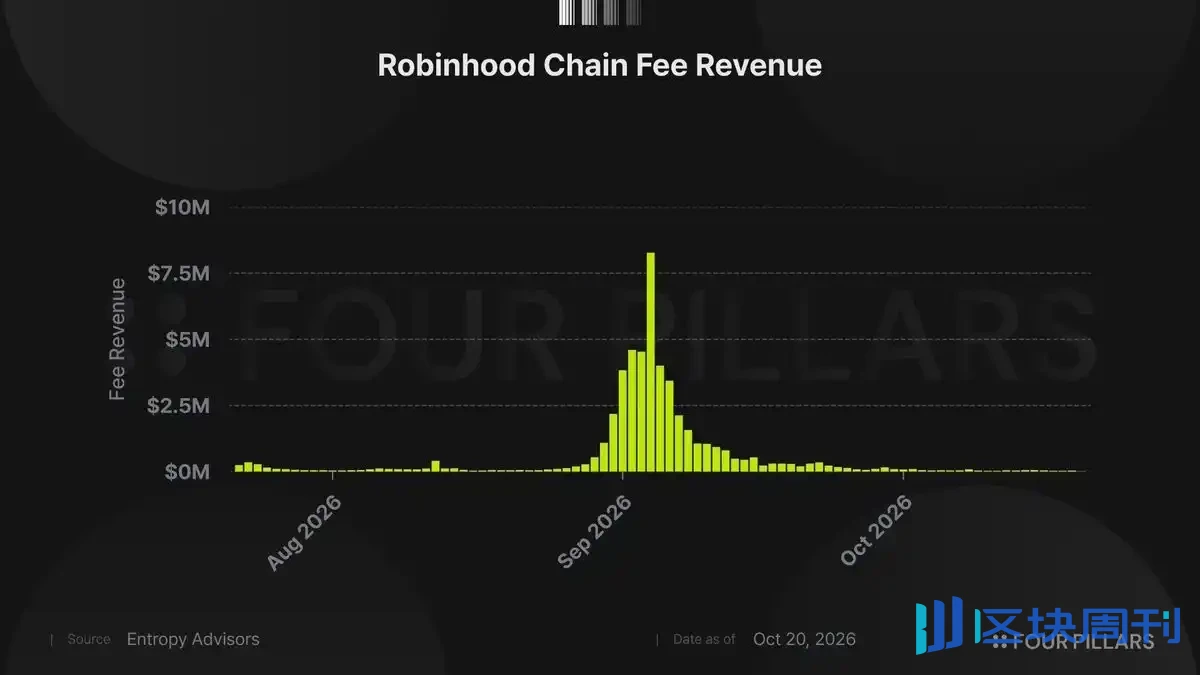
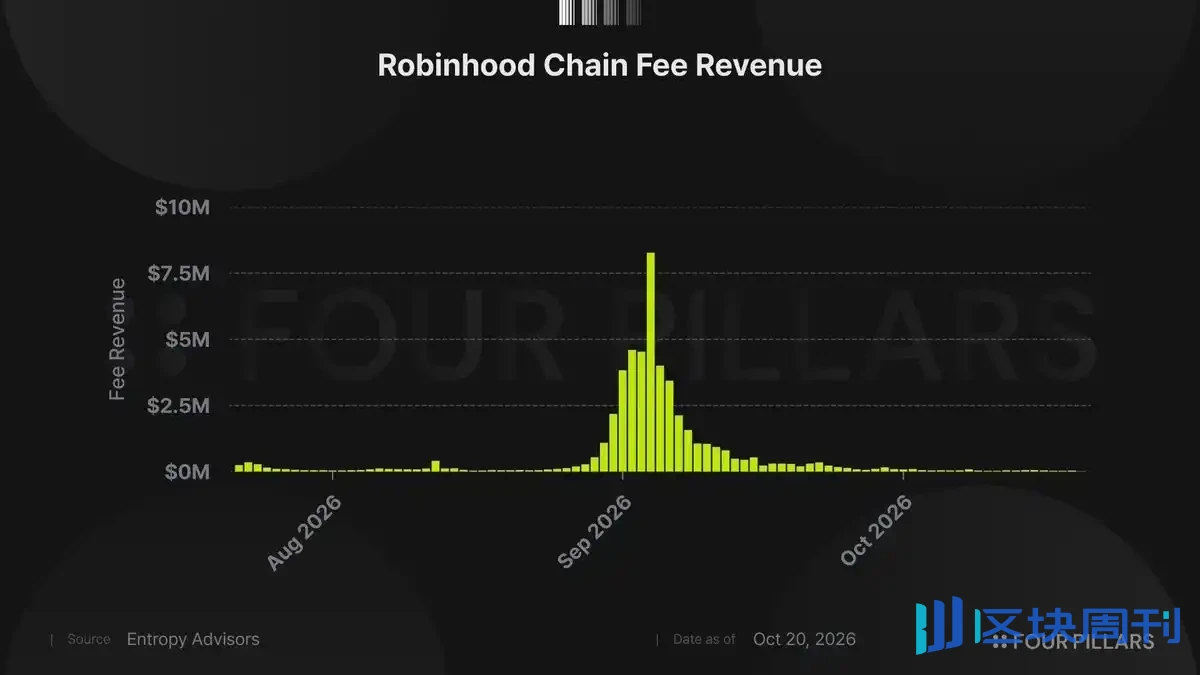
On September 4, 2026, Robinhood Chain generated an astonishing $8.27 million in network fees in a single day. For reference, Robinhood's entire crypto business generated total revenue of about $100 million in Q2 2026, making the chain's single-day fee performance quite impressive.
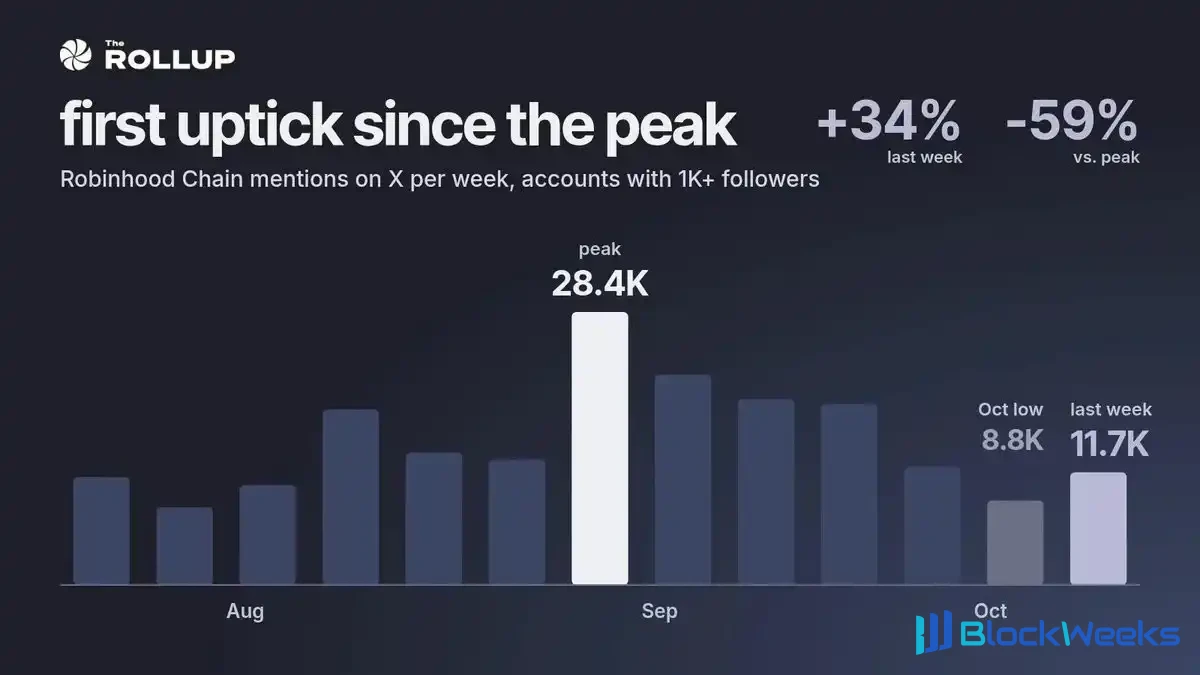
Source: @therollupco
But this carnival did not last long. Against the backdrop of a poor macroeconomic environment and a weakening crypto market, Robinhood Chain's meme coin frenzy gradually cooled. Network congestion subsided, and fee revenue fell back as quickly as it had surged. By mid-October, single-day network fees had dropped to the $30,000 to $40,000 range, less than 1% of the September 4 peak.
Has Robinhood Chain really become obsolete overnight? Let us take a deeper look at the real state of its ecosystem.
An In-Depth Look at Robinhood Chain
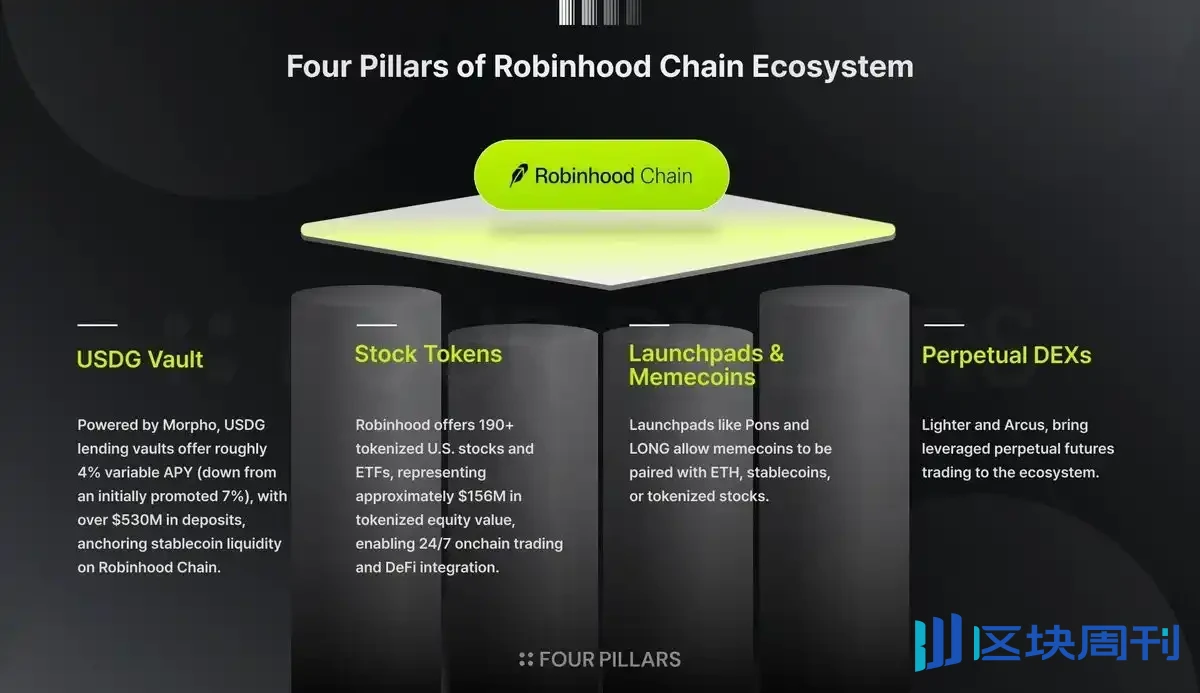
The Robinhood Chain ecosystem is supported mainly by four pillars, namely:
- Steakhouse USDG vault
- Stock tokens
- Launchpad platforms and meme coins
- Decentralized perpetual contract exchanges
Steakhouse USDG Vault

Robinhood Chain's total value locked is about $1.1 billion, and one vault alone accounts for nearly half of that share: the Steakhouse USDG vault operated by Steakhouse Financial. Users can deposit USDG into the Morpho lending market to earn lending interest, and the vault currently has about $540 million in locked value.
Interestingly, unlike the network metrics seen earlier, the USDG vault's locked value has been rising steadily, mainly because the yield is quite attractive. To attract users and expand locked value, Robinhood offers existing platform users an annualized yield of up to 7%, plus additional incentives. Most other on-chain Morpho stablecoin vaults offer annualized yields of only 3%-5%, making a 7% yield highly attractive to investors.

Looking at the distribution of vault deposit addresses, funds are concentrated in the hands of large holders, but about 75,000 wallets have already participated in deposits. It is worth noting that the largest depositor is the protocol NetNet, a protocol that uses USDG as its reserve asset. If this is taken into account, the actual number of wallets indirectly participating in the USDG vault would be considerably higher.
In the crypto community, Robinhood Chain is seen as a playground for speculative players trading meme coins. But beneath the surface, it is quietly accumulating passive investment users through the USDG vault.
Stock Tokens

Robinhood Chain was positioned from the start around building an ecosystem for real-world assets (RWA), with tokenized stocks as a top priority. In line with this vision, stock and ETF tokens account for more than half of all on-chain real-world asset token issuance, followed by commodity and U.S. Treasury token tokens.
The value of tokenized stocks rose sharply in early September. As mentioned earlier, this was mainly driven by massive trading of stock tokens paired with meme coins, and the market needed to mint a large number of new stock tokens to meet demand. Although the meme coin craze has cooled somewhat, the large number of newly minted stock tokens has not been redeemed, and circulating value has remained relatively stable. The roughly $150 million in stock and real-world asset tokens on Robinhood Chain can lay a solid liquidity foundation for the ecosystem's next stage of development.
Launchpad Platforms and Meme Coins

Starting with Noxa, followed by Pons and then LONG, meme coin launchpads have played a pivotal role in building the Robinhood Chain ecosystem. Under the traditional model, meme coins issued by such platforms are generally paired with native assets of public chains such as ETH and SOL. Robinhood Chain brings a completely new approach: meme coins are paired directly with tokenized stocks, igniting the meme coin market on this public chain.
If you look only at the network fee chart, you might think the Robinhood Chain meme coin trading ecosystem has completely died. But spot DEX trading volume tells a different story. On September 4, the day of the fee peak, spot trading volume reached $3.27 billion; after the heat faded, trading volume on October 7 still reached $3.24 billion, and the chain's daily spot trading volume is currently stable in the $600 million to $700 million range.
More importantly, meme coin-related trading has not disappeared. Meme coin trading volume continues to account for more than half of total spot DEX trading volume. The meme coin ecosystem that many thought had gone cold has in fact not died.
Perpetual Contract DEXs

Robinhood Chain aims to build a tokenized stock ecosystem, and it also has a highly active perpetual contract DEX ecosystem where users can trade real-world assets and various other instruments. The two leading perpetual contract DEXs in the ecosystem are Lighter and Arcus, both of which Robinhood has strategically invested in and continues to support. Lighter's trading functionality is integrated directly into the Robinhood wallet, while Arcus serves as a liquidity partner for spot tokenized stock trading.
If meme coins drove Robinhood Chain's first wave of growth, the perpetual contract sector is most likely to lead the second wave. Both Lighter and Arcus are using points programs to aggressively attract traders, and both trading volume and open interest are continuing to rise. If these two protocols can attract more users and successfully carry out airdrops, Robinhood Chain could be poised for a new golden period of development.
What Robinhood Chain Needs to Achieve Its Next Breakthrough
The impression that Robinhood Chain is "about to die" stems largely from the stark contrast created by the surge in network fees during the congestion peak in September 2026. Robinhood Chain uses the Arbitrum tech stack, and its fee pricing mechanism stipulates that when network load exceeds target processing capacity, the base fee rises exponentially.
At the same time, core ecosystem metrics such as USDG vault locked value, circulating supply of stock tokens, and meme coin trading volume have shown strong resilience and have not suffered the same collapse as fee revenue. In fact, looking at the perpetual contract DEX sector, Robinhood Chain has the potential to usher in a second explosive growth phase.
In my view, for Robinhood Chain to enter its next golden cycle, multiple conditions need to be met simultaneously:
- Ecosystem metrics: Core metrics representing passive investors and active traders, including USDG vault locked value, circulating stock token supply, and meme coin trading volume, need to remain at healthy levels to lay a solid foundation for Robinhood Chain's next growth cycle.
- Success of perpetual contract DEXs: Robinhood ecosystem's leading perpetual contract DEXs, such as Lighter and Arcus, need to continue attracting traders and liquidity through points programs. More importantly, after the TGE and airdrop are over, the protocols must still maintain genuine active trading volume.
- Ecosystem support: Compared with other layer-1 and layer-2 chains, Robinhood Chain's ecosystem and developer support is noticeably lacking. Although the Arbitrum Foundation has launched several official programs since early 2026 to support the Robinhood ecosystem, no comparable support programs independently operated by Robinhood have been found so far. On the investment side, only two investments, Lighter and Arcus, have been confirmed. Of course, the effectiveness of ecosystem and developer support programs is itself a matter of debate. But if designed well, such programs can help Robinhood Chain attract higher-quality decentralized applications and ultimately improve the user experience.
- Native innovation: Robinhood Chain's early success came largely from genuinely novel ideas, such as stock tokens paired with meme coins and stock token airdrops. Current core ecosystem metrics remain solid, and perpetual contract DEXs are expected to pave the way for a new growth cycle. If new projects or financial primitives that do not exist on other chains can emerge, they will become a powerful catalyst for igniting the next golden era.
Robinhood Chain is not dead; it is simply waiting for its next breakthrough. If you missed Robinhood Chain's first growth wave, now may be a good time to pay attention to it again.