



This Issue's Highlights
The statistical period covered by this weekly newsletter is October 23, 2026 - October 30, 2026.
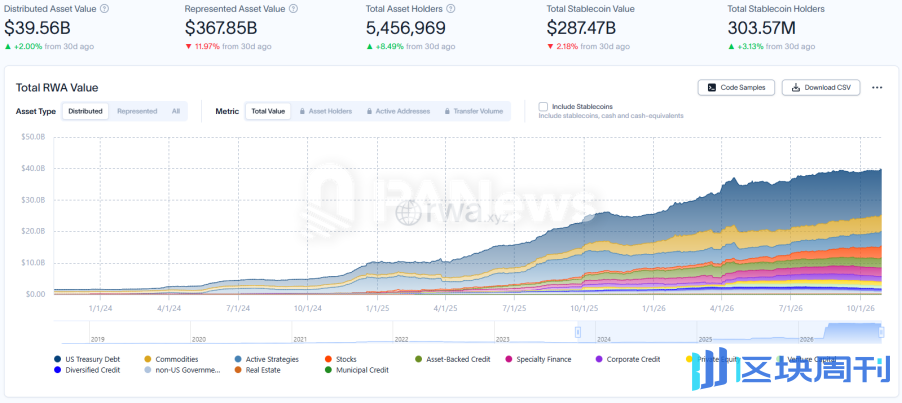
This week, the total on-chain market capitalization of RWA rebounded to 39.56 billion USD, up 2% month-on-month, with asset holders reaching 5.457 million, up 8.49% month-on-month, as asset scale and user base expanded in tandem; the total market capitalization of stablecoins fell back to 287.47 billion USD, monthly transfer volume surged 38.53% month-on-month, the total number of holders rose to 304 million, and monthly active addresses showed a marginal decline, presenting a pattern of contracting total supply and existing users dominating on-chain transactions.
On the regulatory front, the U.S. SEC for the first time included tokenization in the high-risk review scope for clearing agencies in fiscal year 2027; Canada released a draft stablecoin regulation prohibiting issuers from paying interest and setting out hard requirements on reserves and redemption; the central banks of Singapore, Malaysia, and Thailand jointly launched the BLOOM cross-border digital currency settlement program.
In Hong Kong, the LME is exploring tokenized financing of metal inventories in Hong Kong warehouses, the Anchorpoint initiative led by Standard Chartered launched a retail stablecoin, and the compliant tokenized gold XAUa landed on the Sui public blockchain.
On the project front, DTCC's tokenization service officially launched, initially supporting 34 securities and achieving 1:1 on-chain mapping of traditional DTC-custodied assets, forming a sharp route competition with OKX-ICE's third-party tokenized U.S. equities model; Canton Network's TSV LLC is expected to become the first platform to complete tokenized U.S. equities trading under the SEC's innovation exemption framework, while the OKX-ICE project faced public opposition from a total of 38 listed companies including Walmart and Eli Lilly exercising their right to object.
Data Perspective
RWA Sector Overview
The latest data disclosed by RWA.xyz shows that as of October 30, 2026, the total on-chain market capitalization of RWA reached 39.56 billion USD, an increase of 2% compared with the same period last month. The total number of asset holders climbed to 5.457 million, up 8.49% compared with the same period last month, with the holder base expanding in tandem, presenting the characteristics of "moderate scale increase and continuously strengthening user participation."
Stablecoin Market
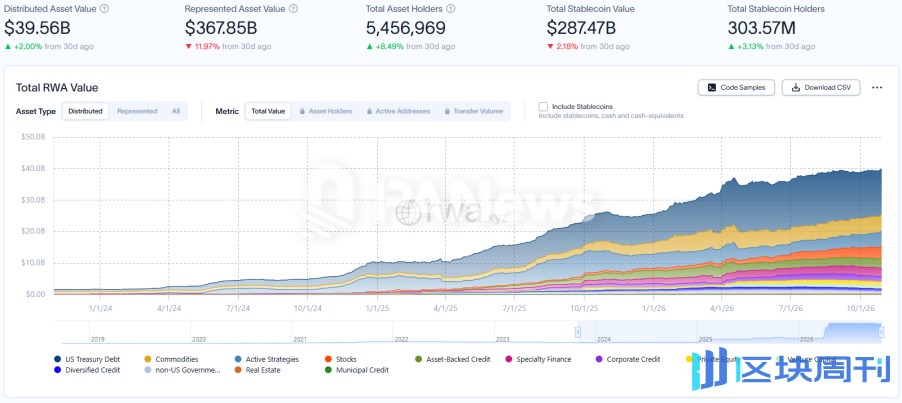
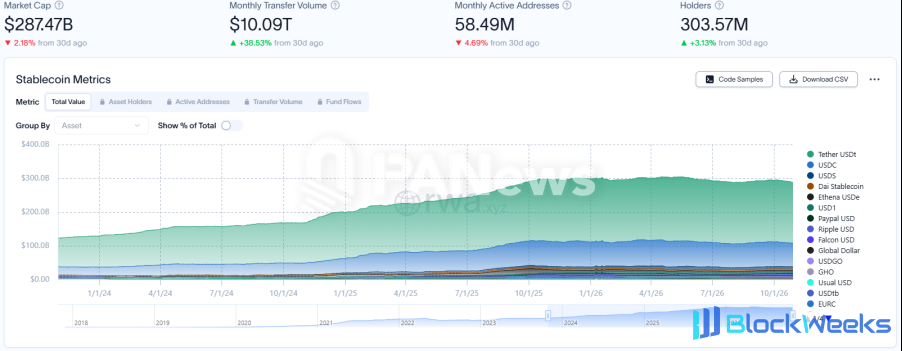
The total market capitalization of stablecoins reached 287.47 billion USD, down 2.16% compared with the same period last month; monthly transfer volume was 10.09 trillion USD, up sharply by 38.53% compared with the same period last month; the total number of monthly active addresses was 58.49 million, down 4.69% compared with the same period last month; the total number of holders reached 304 million, up 3.13% compared with the same period last month. The stablecoin sector presents a divergent pattern of "slight contraction in total supply, significant increase in on-chain transfer transaction activity, marginal decline in the number of active addresses, and continuous expansion of the coin-holding user base," reflecting that stablecoin capital flows and transaction demand have somewhat recovered, but the marginal weakening of newly active participants means that existing users' trading behavior is driving the scale of on-chain transfers higher.
The leading stablecoins are USDT, USDC, and USDS, among which USDT's market capitalization decreased by 1.87% compared with the same period last month; USDC's market capitalization declined by 3.72% compared with the same period last month; USDS's market capitalization decreased by 2.6% compared with the same period last month.
Regulatory News
U.S. SEC Lists Tokenization for the First Time as a Key Risk Review Area for Clearing Agencies in Fiscal Year 2027
According to Unchained, in its fiscal year 2027 review priorities document, the U.S. SEC for the first time listed tokenization as a high-risk review area for clearing agencies; the relevant documents for 2025 and 2026 had not mentioned tokenization.
Canada Releases Draft Stablecoin Regulation, Prohibiting Issuers from Paying Yield
According to CoinDesk, the Canadian government published a draft of the "Stablecoin Regulations" and launched a 60-day public consultation, with a deadline of December 23. The draft prohibits issuers from paying interest or yield to holders directly or through third parties, but allows use-related rewards; non-bank issuers must hold reserves no less than the circulating amount and deposit them with qualified Canadian custodians; issuers must complete redemption within 3 business days, with no minimum redemption amount, and a cap of 1% on redemption fees. The draft aims to implement the Stablecoin Act passed this year and is planned to take effect in autumn 2027.
Central Banks of Singapore, Malaysia, and Thailand Join Forces to Advance Cross-Border Digital Currency Settlement; Ripple, Visa, and Others Participate in the BLOOM Program
The Monetary Authority of Singapore (MAS) announced that Bank Negara Malaysia (BNM) and the Bank of Thailand (BOT) have joined the BLOOM (Borderless, Liquid, Open, Online, Multi-currency) program as policy-making institution members. The three parties will work with industry participants in their respective jurisdictions to promote the establishment of a common framework for cross-border digital currency use, covering the acceptance, exchange, and settlement of different forms of digital currency across different institutions, networks, and jurisdictions.
BLOOM is a public-private partnership program aimed at promoting the application of digital currencies in cross-border financial activities, involving scenarios such as tokenized deposits, regulated stablecoins, and settlement across payment networks. New participants include Airwallex, Mastercard, Maybank, Monee, Nium, Ripple, ShopeePay, Visa, and the World Bank Group.
South Korea's Financial Services Commission to Study Allowing Crypto Exchanges to Participate in the STO Market
According to EDaily, South Korea's Financial Services Commission stated that it will study plans to allow cryptocurrency exchanges to participate in the security token offering (STO) market, including issues such as market environment, investor protection, integration of the licensing system, and concurrent business permits. Lee Eok-won (이억원), Chairman of South Korea's Financial Services Commission, said he agrees with the proposal to use existing exchanges' technology and trading infrastructure to develop the STO market, emphasizing the need to integrate existing exchanges' technology and trading infrastructure into the token securities market.
Latvia Plans to Launch an RWA Tokenization Regulatory Framework in the First Half of 2027, with Commercial Real Estate and Government Bonds as Priorities
According to CoinDesk, Latvia's Minister of Economics Viktors Valainis said that the country plans to launch a regulatory framework for real-world asset (RWA) tokenization in the first half of 2027, with commercial real estate likely to become the first application scenario, and government bonds also included in priority considerations. Currently, the Ministry of Economics is working with the central bank, the Ministry of Finance, and industry representatives to formulate relevant plans, but the assessment of legal adjustments originally scheduled to be completed by October 1 this year is still ongoing.
Local Observations
London Metal Exchange Explores Tokenizing Metal Inventories in Hong Kong Warehouses for Loan Collateral Financing
According to Reuters, the London Metal Exchange (LME), owned by Hong Kong Exchanges and Clearing, plans to convert metals in its Hong Kong warehouses into digital assets that can be used for financing. Three people familiar with the matter said the plan is related to Hong Kong's five-year plan to expand its commodity trading hub and is expected to attract investors, traders, and financiers and bring new revenue sources to the LME. The LME said it is in the early stages of exploring the tokenization of non-warrant metal inventories to support corporate financing and plans to hold an invitation-only industry roundtable in early November.
Hong Kong's plan states that it will leverage its advantage as an approved delivery point in the LME's global warehouse network to promote the coordinated development of commodity trading, risk management, and financing businesses. Hong Kong Exchanges and Clearing is also testing the conversion of carbon credits into digital tokens to enable rapid settlement.
Anchorpoint Initiative Led by Standard Chartered Launches Retail Stablecoin
According to the South China Morning Post, Anchorpoint, a stablecoin issuance joint venture led by Standard Chartered, said it plans to launch a retail-facing stablecoin on a public blockchain and emphasized that it will adopt a "prudent" approach.
Hong Kong-regulated tokenized gold XAUa launches on the Sui blockchain
Hong Kong-regulated tokenized gold XAUa has launched on Sui. The token is minted based on Sui's Permissioned Asset Standard (PAS), issued by AlphaToken, and distributed to on-chain users by TBook. Each XAUa is backed by physical gold stored in Hong Kong, and holding and purchasing require meeting eligibility requirements. Under PAS rules, the issuer writes compliance rules into a Policy, and every transfer must first pass Policy verification before settlement; transfers that fail are rejected and balances do not change. TBook has migrated and rebuilt its vault issuance platform onto PAS, and subsequent RWA issuers can directly issue vaults with similar compliance controls on Sui.
Salaries of faculty and staff at multiple universities in Jiangsu will be paid through digital RMB wallets
According to notices from the finance offices of Nantong University and Yangzhou University on WeChat public accounts, following a notice from the Jiangsu Provincial Department of Finance, starting from November 2026, the salaries of staff on the regular payroll and personnel agency staff at the two universities will be paid through digital RMB wallets.
Nantong University requires relevant personnel to complete the opening and upgrading of digital RMB wallets by October 30; salaries and performance pay are paid via two cards, and wallets must be opened for both cards. Yangzhou University requires relevant personnel to complete the opening and upgrading of digital RMB wallets by October 23, and on October 24 will uniformly retrieve wallet account information from four banks for payroll disbursement integration testing.
Project Progress
DTCC tokenization service goes live, initially supporting 34 securities
According to the DTCC website, the U.S. Depository Trust & Clearing Corporation DTCC announced that its DTCC Tokenization Service has gone live, with the first batch of tokenizable securities being 34. Tokens are backed 1:1 by securities held in DTC custody, and holders enjoy the same legal rights and economic interests as the underlying securities. Traditional markets and on-chain use the same CUSIP code, and DTC-registered wallets can transfer peer-to-peer 24/7. The service has built-in compliance controls and can track ownership in near real time. The first batch of wallet and application partners includes BitGo, Blockdaemon, Fireblocks, HashKey, Kaleido, Prometheum, Talos, Temple, and Tradeweb. DTC custodies approximately $30 trillion in assets.
Janus Henderson launches tokenized Nasdaq 100 index fund JQQQ, issued on the Stellar chain based on Centrifuge technology
According to unfolded, Janus Henderson has launched the tokenized fund JQQQ, the first tokenized fund authorized by the Nasdaq 100 Index. JQQQ is issued on the Stellar chain based on Centrifuge technology and is only available to eligible non-U.S. professional investors, with a minimum investment of $100,000. Nasdaq expanded the scope of index licensing earlier in 2026. JQQQ has not yet disclosed assets under management or trading volume.
Canton Network tokenized securities trading platform TSV plans to trade CNTN tokenized stock as early as November 2
According to CoinDesk, TSV LLC, a tokenized stock trading platform based on Canton Network, plans to begin trading tokenized stock of Canton Strategic Holdings (CNTN) as early as November 2. The company adopts an issuer-led tokenization model and has commissioned SEC-registered on-chain transfer agent Fairmint to issue tokens and maintain official ownership records, thereby avoiding the 30-day issuer objection period required for third-party tokenization. This move is expected to allow TSV to complete the first tokenized U.S. stock trade under the U.S. SEC's "innovation exemption" framework ahead of the joint platform of OKX and ICE (the parent company of the New York Stock Exchange).
Mirae Asset Securities partners with Grvt to issue tokenized financing notes
According to Chainwire, the Hong Kong subsidiary of South Korea's Mirae Asset Securities arranged the issuance of tokenized financing notes under a structured note program of an affiliate, subscribed by on-chain trading platform Grvt. Grvt plans to use the related exposure for its yield product Grvt Earn, subject to applicable requirements. The two parties said they will subsequently explore products such as tokenized Treasuries, corporate bonds, and ETFs without commitment, subject to regulatory approval. As of September 2026, Mirae Asset Financial Group managed more than $1 trillion in global client assets. Grvt launched in 2024 and has cumulatively served more than 198,000 wallets, with peak total value locked (TVL) of $109 million.
Soneium plans to issue ecosystem token SONEIUM and advance entertainment IP tokenization
According to an official Soneium announcement, the Ethereum Layer 2 network plans to issue an ecosystem native token SONEIUM to connect creators, intellectual property (IP) holders, developers, fans, and investors. Specific token information and token generation event (TGE) arrangements will be announced later, and the token has not yet been issued.
Soneium also announced its on-chain entertainment economy plan, using Soneium Portal as the discovery and participation platform for IP tokenization projects. The first IP token project is the Japanese character Moriusa, and subsequently it will launch IP Vault for royalty assets and tokenized IP bonds backed by entertainment businesses, and cooperate with DayOneDream to bring K-pop concert business royalties on-chain. Soneium also plans to adjust the network's base Gas fees to support network resilience and sustainable operation.
SBI reaches strategic cooperation with Cross River's parent company, plans to set up a joint venture in Japan to advance RWA tokenization
According to an announcement on the Cross River website, SBI Holdings has signed a strategic cooperation memorandum with CRB Group, the parent company of Cross River Bank, and plans to establish a joint venture in Japan to explore tokenized products for real-world assets (RWA) such as loan receivables, cross-border payments, and AI agent transaction payment infrastructure. SBI also plans to make a strategic investment in CRB Group, and the two parties intend to discuss integrating the yen stablecoin JPYSC into the Cross River platform for institutional cross-border and tokenized asset settlement. The establishment of the joint venture and related cooperation still require the signing of final agreements and necessary regulatory approvals.
BlackRock signs memorandum with SBI and Startale to explore connecting tokenized funds with yen stablecoin
According to The Block, BlackRock Financial Management and BlackRock Japan under BlackRock signed a memorandum of understanding with SBI Holdings and Startale Group to explore connecting tokenized money market funds with SBI's yen stablecoin JPYSC. The three parties will assess the feasibility of the connection in three areas: technical infrastructure, business and distribution, and regulatory and market development, and plan to open cooperation to Japanese and international financial institutions and enterprises. In June this year, SBI and Startale launched JPYSC, Japan's first trust bank-backed yen stablecoin, managed and issued by SBI Shinsei Trust Bank, with SBI VC Trade responsible for distribution.
BNY Mellon supports XRP and RLUSD custody, explores tokenized trade finance with Ripple
According to an official Ripple announcement, Bank of New York Mellon (BNY) has supported XRP and the U.S. dollar stablecoin RLUSD on its digital asset custody platform, and eligible institutional clients can custody, hold, and transfer related assets through the platform. Building on the existing RLUSD reserve custody and Ripple Prime custody cooperation, the two parties are further expanding their digital asset cooperation.
BNY plans to expand support for tokenized assets and investment products on the XRP Ledger (XRPL), and work with Ripple so that clients can in the future mint and redeem RLUSD directly through BNY. In addition, the two parties are exploring an XRPL-based supply chain financing solution with working capital platform C2FO to tokenize trade finance assets such as accounts receivable to broaden investor participation channels.
Ripple reaches strategic cooperation with Robinhood, RLUSD to be integrated into Robinhood's retail and institutional businesses
According to Business Wire, Ripple and Robinhood announced a strategic cooperation. Ripple's stablecoin RLUSD has launched on Robinhood Chain and Bitstamp by Robinhood and is expected to land on the Robinhood App within the year. Robinhood will use RLUSD on XRPL for institutional settlement and integrate Ripple Treasury for treasury operations such as cash and liquidity management, payments, and risk management. In addition, Ripple Prime provides Bitstamp with lending and margin financing for about 20 digital assets and will support perpetual contract trading on Bitstamp within the year. Since its launch in December 2024, RLUSD's market capitalization has exceeded $2.5 billion.
Walmart, Eli Lilly and 3 other companies oppose OKXICE tokenized stock plan, opponents increase to 38
According to CoinDesk, Walmart, Eli Lilly, Carnival, Arcos Dorados, and Cigna have explicitly joined the ranks opposing the OKX and Intercontinental Exchange (ICE) tokenized stock trading plan. Of the initially proposed 62 companies, 38 have now publicly expressed opposition.
Under a five-year exemption granted by the U.S. Securities and Exchange Commission (SEC), relevant companies have 30 days to object to stock tokenization initiated by third parties (i.e., non-affiliates); if they remain silent during this period, such trading is deemed permitted by default, and there is no subsequent mechanism to withdraw permission.
U.S. stock token trading platform MSX lists 4 new U.S. stock tokens
U.S. stock token trading platform MSX has listed spot and contract trading for U.S. cybersecurity company $TENB, SaaS platform NOW, multinational soft drink giant KO, and international payment brand $V.
Financing News
Aviva Investors launches tokenized shares of sterling liquidity fund on XRPL, secures £50 million investment
According to Ripple's official announcement, Aviva Investors has launched a tokenized share class of its sterling liquidity fund on the XRP Ledger (XRPL), with Aviva investing £50 million (approximately $66 million). The fund's overall assets under management are approximately £22 billion, and this figure is not the scale of this on-chain launch. Following the launch of tokenized shares of its dollar liquidity fund in July, the combined investment in Aviva Investors' two tokenized share classes has exceeded £86 million (approximately $116 million).
The new shares adopt a "digital twin" model, representing holdings on-chain while retaining the original off-chain fund structure as well as its investment objectives, risk characteristics, liquidity and regulatory protections. Eligible investors holding digital wallets can participate, and the fund's assets remain custodied by BNY Mellon, with Komainu and Licuido providing digital asset custody and tokenization infrastructure support respectively.
Insights Roundup
Full-page ads open fire, 33 giants join forces to snipe, why tokenized US stocks are hitting the brakes from issuers
PANews summary: OKXICE plans to list third-party tokenized US stocks under the SEC's five-year innovation exemption framework, and 33 listed companies have exercised their 30-day objection right to express opposition, involving a total market capitalization of approximately $17 trillion, but this veto only targets this specific platform and is not a wholesale rejection of tokenization. Companies are concerned about risks such as price volatility and investor confusion over product attribution.
DTC, a subsidiary of DTCC, has launched a 1:1 securities tokenization service that retains traditional securities rights and has gained access from numerous institutions, forming a route rivalry with OKXICE's third-party model; Nasdaq also does not recognize the trading mechanism under this exemption. The conservative nonprofit organization CSLF placed a full-page ad in The Wall Street Journal urging listed companies to exercise their exit rights, and its background connection to the industry association SIFMA has sparked market speculation, with industry controversy focusing on tokenization's infrastructure, regulation and investor protection.
When a stock has multiple versions: Securitize and the next competition in stock tokenization
PANews summary: Securitize has launched Securitize Stocks, listing 12 US stock tokens on Solana. It adopts a UCC Article 8 securities entitlement architecture, which differs from the legal structures of Binance bStocks and Robinhood stock tokens; upon meeting conditions, they can be converted into shares on the issuer's shareholder register, while the latter two only provide economic returns, and conversion is limited to brokerage accounts.
Binance and Robinhood account for the vast majority of on-chain tokenized stock trading volume, while Securitize's retail traffic is weak. Its goal is not just trading business, but to build a neutral asset foundation layer, providing exchanges and brokerages with a full suite of infrastructure services such as issuance, registration and custody, paving the way for issuer-led tokenization in the future. Whether this model can work still depends on listed company participation and the scale of the trading network.