
Author: Chamath Palihapitiya, Founder of Social Capital
Compiled by: Gu Yu, ChainCatcher
A month ago on the Moonshots podcast, someone asked me for my views on cryptocurrency, against the backdrop of the rapid rise of superintelligence.
I said that cryptocurrency and Bitcoin have a ceiling.
That comment triggered a strong reaction, so I asked my team to review my reasoning, cross-check it with experts, and share a complete answer with our paid readers.
I hope you enjoy this holiday read.
Nothing on the internet is truly 100% secure.
A digital system is considered "secure" only because the fastest known method of breaking it currently requires an impractically long time to complete.
Based on everything mathematicians currently know, recovering a private key from a public key today requires an astronomical number of computational steps.
But new mathematics—revealed by rapidly digging out the mathematics underlying a problem—could bring entirely new methods that reduce the work required to pick a lock by many orders of magnitude.
And so, the impractical could suddenly become practical.
How a 129-digit lock made of two prime numbers was broken in 1994:
The core idea of public-key cryptography is: making a lock is easy, but for someone who does not know the key, reversing the process is computationally extremely expensive.
For example, multiplying two prime numbers, 53 × 61 = 3,233, is easy, but the reverse process (factoring) is hard. If you only see the product (3,233), the simplest way to find 53 and 61 is to divide the product by 2, 3, 5, 7, and so on in turn, until some number divides it with no remainder, which takes 16 attempts.
Now imagine a 600-digit number.
At 600 digits, even using the best known methods to find those prime numbers, the time required would exceed the runtime of any computer.
RSA, invented in 1977, is built precisely on this idea. Bitcoin's signatures are built on another mathematical problem, based on elliptic curves rather than prime numbers, but the core idea is the same.
In 1977, one of RSA's inventors estimated that factoring a 125-digit product would take 40 quadrillion years. But in 1994, volunteers factored a 129-digit product in eight months, roughly 17 orders of magnitude faster, even though the number was larger. This was thanks to a method invented in 1981, as well as far more powerful computing.
In other words, the security level of digital systems assumes that the tapestry of mathematical and computational knowledge grows slowly enough that it takes years or even decades to eventually discover new techniques that are orders of magnitude more effective.
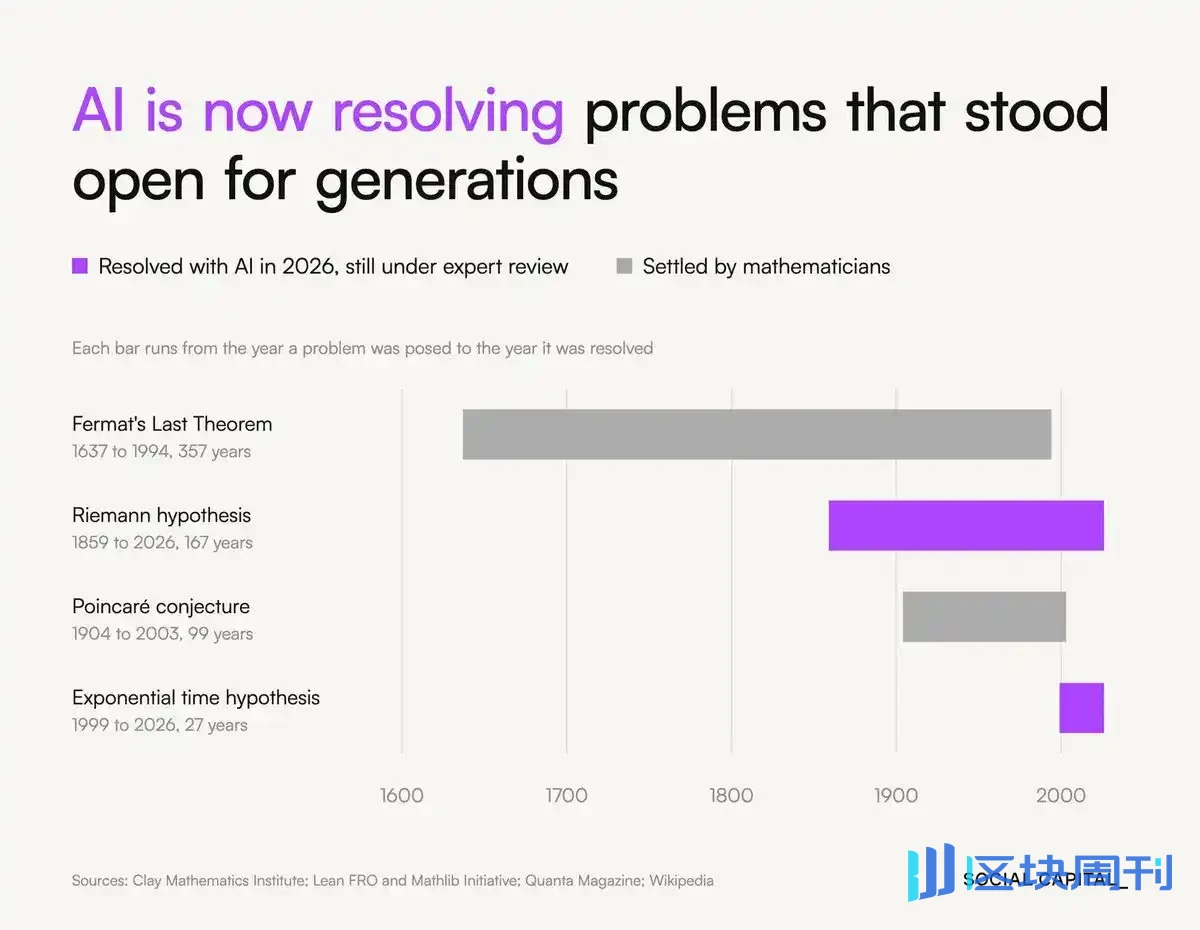
This assumption may be crumbling. Large numbers of AI agents working in coordination have now set to work on previously extremely difficult mathematical problems, such as the Riemann Hypothesis, and a 27-year-old conjecture in computer science about how quickly certain problems can be solved (the Exponential Time Hypothesis).
Although these two problems are not directly related to Bitcoin, the key point is: AI agents are working with mathematicians to solve problems that even top mathematicians failed to solve for generations, and checking every step with software capable of verifying their proofs.
This is a period of alien mathematics. Not necessarily because the proofs are long, but because they contain so many ideas that no one anticipated. Claude, working with mathematician Levent Alpöge, produced a proof of the Riemann Hypothesis in about six weeks.

AI agents have also begun to study cryptography directly. In July 2026, Anthropic reported that Claude Mythos Preview, running largely autonomously for about a week, produced an attack against a simplified version of the AES-128 cipher (7 of its 10 rounds) that ran 200 to 800 times faster than the previous best result. Anthropic said this result has no practical impact on systems in use today.
This shows that if there are techniques capable of breaking modern cryptography far faster, the mathematics behind them may be discovered in the near future, rather than the decades later assumed by the teams that design today's security systems.
Almost everything above applies to digital security in general, from banks to messaging apps. Bitcoin is in a sense the most typical test of this risk, because Bitcoin executes itself entirely through code, and nothing backs Bitcoin other than the code that validates it.
Will large numbers of superintelligent AI agents inevitably break Bitcoin? If so, is there a way to patch Bitcoin so that it can withstand these attacks?
To answer these questions, we will first review how Bitcoin's security is designed, look at what it would take to break each aspect of Bitcoin's design, and then discuss whether Bitcoin can be patched to address this risk.
How Bitcoin is designed
From a cryptographic perspective, what is ingenious about Bitcoin's design?
First, Bitcoin did not introduce a new kind of cryptographic lock.
Every lock Bitcoin uses was created decades ago, and they are the same kinds of locks (cryptographic hash functions, such as SHA-256, and digital signatures, such as ECDSA, both explained later). These locks are still used across the entire internet today, to confirm who sent a message between phones, to prove that a bank's website is genuine, and to check that software updates really come from their makers.
Bitcoin's genius lies in the clever orchestration of various locks, combined with a rigorously logical process that specifies how Bitcoin rewards the computers that continuously maintain the ledger, thereby enabling strangers to agree on and trust a shared ledger over time without a bank.
This system has three key aspects:
1) The orchestration of locks
2) The locks within that orchestration
3) The process by which computers continuously maintain the ledger (proof of work)
We will analyze (1), (2), and (3) one by one, and explore whether AI agents could break each aspect of this system.