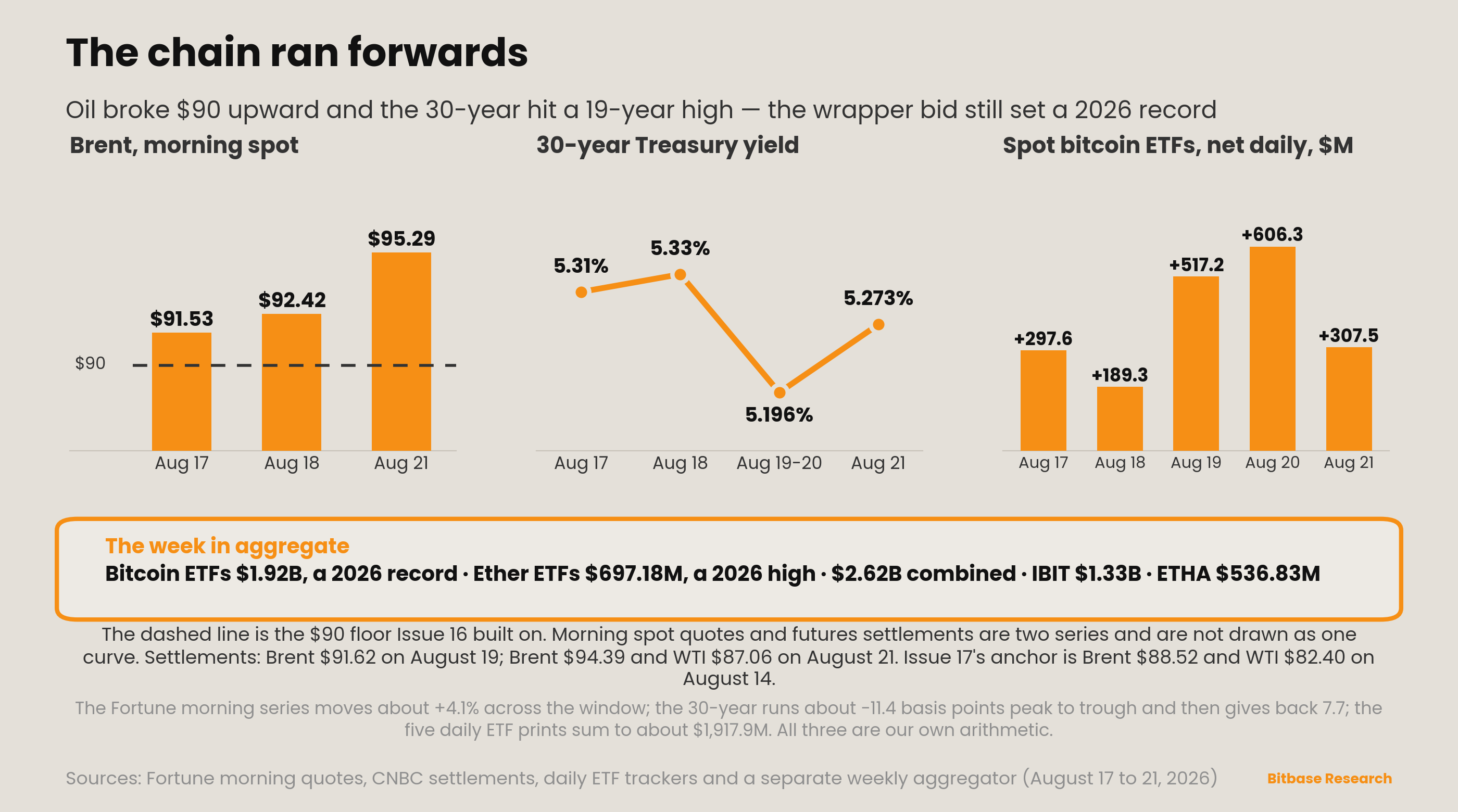
Issue 17 closed by saying that a relationship which only works in one direction is not a transmission channel but a coincidence with good timing. This week ran the same chain forwards, at speed, and the last link disobeyed again—in the opposite direction. The June 17 US–Iran Memorandum of Understanding expired on Monday, August 17, the first day of this window, and oil went up through the $90 line Issue 16 built an entire issue on [1]. Brent traded at $91.53 on Monday morning and $95.29 by Friday, with September futures settling at $94.39 on August 21 [2][5][6].
The long end did what a supply shock plus a debt problem is supposed to make it do. The 30-year Treasury yield topped 5.31% on August 17 and 5.33% on August 18, a 19-year high on both days [7][8]. Then the Treasury Department intervened, announcing it would at least double its long-end buybacks, and the 30-year fell 9 basis points to 5.196% [9][10].
And then bitcoin had its best week since March 2023. BTC opened August 17 at $62,829.64—on a day whose headline coverage was about analysts questioning the timing of the bear-market bottom—and opened August 21 at $73,013, roughly 22% higher on the week [25][26][27]. Spot bitcoin ETFs took in $1.92 billion, a 2026 record [23].
Issue 16's chain said oil up means front end hawkish means wrapper bid down. Every input was present and the output was the largest inflow of the year. The series should stop treating the chain as a live hypothesis.
Week of August 17 to August 23, 2026
Bitbase Research · August 24, 2026
The one chart that matters
The trigger was a date on a calendar, not a surprise. The 14-point Memorandum of Understanding signed by Masoud Pezeshkian and Donald Trump on June 17 opened a 60-day negotiating period and promised safe passage through the Strait of Hormuz. It expired on Monday, August 17 [1]. It had already failed in substance—Trump called it "over" on July 7, and Iran's foreign ministry said that because of violations "no talks were initiated" [1]. What expired was not a working agreement but the last piece of paper anyone could point at.
Oil priced that. Brent was $91.53 on Monday morning and $92.42 on Tuesday, up 86 and 89 cents [2][3]. On August 19 futures rose more than 1% as Hormuz export prospects darkened, settling at $91.62, the same day the United Arab Emirates halted all trade with Iran after fresh missile fire in the Gulf [4][39]. By Friday, Brent settled at $94.39 and WTI at $87.06 after Pezeshkian said Tehran wanted the war concluded [5]; Friday's morning spot quote was $95.29, against $89.12 a month earlier [6]. Issue 16's floor broke upward, four weeks after Issue 17 reported it breaking downward.
The long end responded as the textbook says, and the named drivers were not only oil: a global bond selloff, stalled Iran talks, fears of persistent inflation, uncertainty about policy under Chair Kevin Warsh, and a national debt approaching $40 trillion after $1.8 trillion was added in fiscal 2026 [7][8]. Japan's 10-year hit a 30-year high; the German 30-year its highest since 2011 [8].
Then the Treasury did something Issue 16's framework has no slot for. Between August 19 and 20 it announced that long-end liquidity-support buybacks in the 10-to-20-year and 20-to-30-year sectors would rise from a maximum of $2 billion per operation to at least $4 billion, effective September 9 through November 4 [9][10]. The 30-year fell to 5.196% and the 10-year to 4.647%, with analysts putting the annual run-rate at $128 billion, roughly 30% of issuance [9]. By Friday the move had largely reversed—5.273% and about 4.74%—a peak-to-trough of about 11.4 basis points followed by a give-back of 7.7 on our own arithmetic [11].
The wrapper bid went vertical: spot bitcoin ETFs printed +$297.6 million, +$189.3 million, +$517.2 million, +$606.3 million and +$307.5 million, summing to about $1,917.9 million on our arithmetic [22]. A separate aggregator put the week at $1.92 billion for bitcoin and $697.18 million for ether, $2.62 billion combined and the best week of 2026 for both [23]. Those two figures agree to within two million dollars—the only place in this issue where two independent trackers check each other.
This week's structural signal
The thresholds this series has been marking for four issues are set on the part of the curve that did not move.
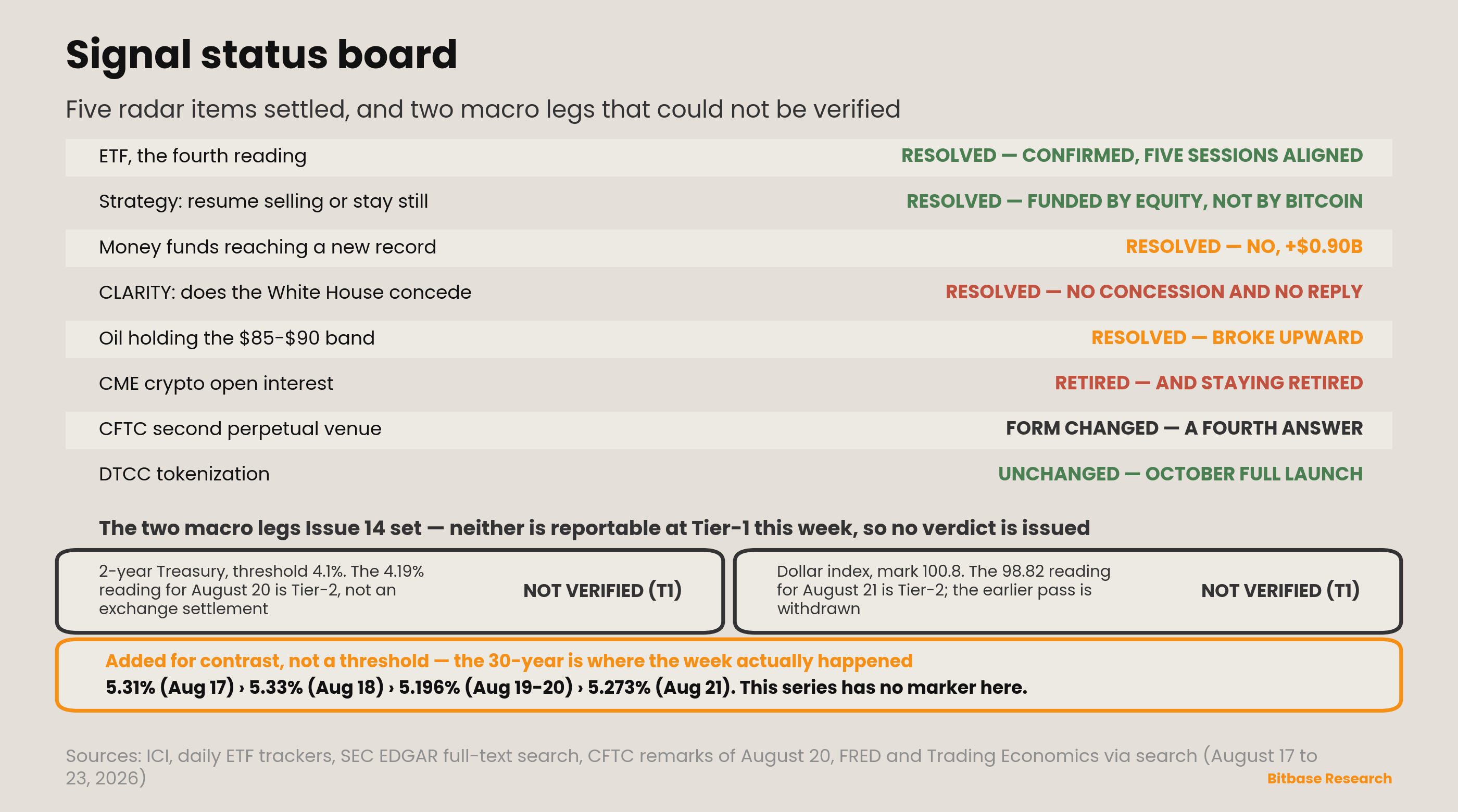
Issue 14 set two markers: the two-year Treasury near 4.1% and the dollar index near 100.8. Neither can be reported to the standard this series requires, so no pass or fail is issued on them. The readings that exist—4.19% for August 20, about 98.82 for August 21—reach us through search-level retrieval of secondary publishers, and every primary route failed [12][13]. Both legs are recorded as not verified to Tier-1, and the pass on the dollar is withdrawn. Issue 17 downgraded the dollar leg alone on this ground.
On the readings such as they are, the two-year moved two basis points in a week when the 30-year travelled more than twenty in both directions. The front end had nothing to say, and the series has no marker where the action was. Yahoo Finance wrote that Treasury repurchases "inject liquidity into financial markets and suppress long-term bond yields," to the benefit of "cryptocurrencies and other volatile assets" [26]. CoinDesk reported XRP heading for its biggest weekly gain in 21 months on "curve control" hopes [28].
This is a real finding and it costs the series something to state. This week all three links ran forwards and the wrapper bid posted its best week of the year. A mechanism that fails when its inputs reverse and fails again when they run in the intended direction is not a mechanism. What moved the tape was the expected supply of long-duration government paper and a set of policy signals, neither of which appears in Issue 16's framework.
A competing explanation deserves equal billing: CoinDesk described the move as a "squeeze-led" rally in which bitcoin and ether bears were decimated [28]. A record inflow week and a short squeeze are not the same claim, and both are reported by named outlets about the same five days.
Dual-track scoreboard
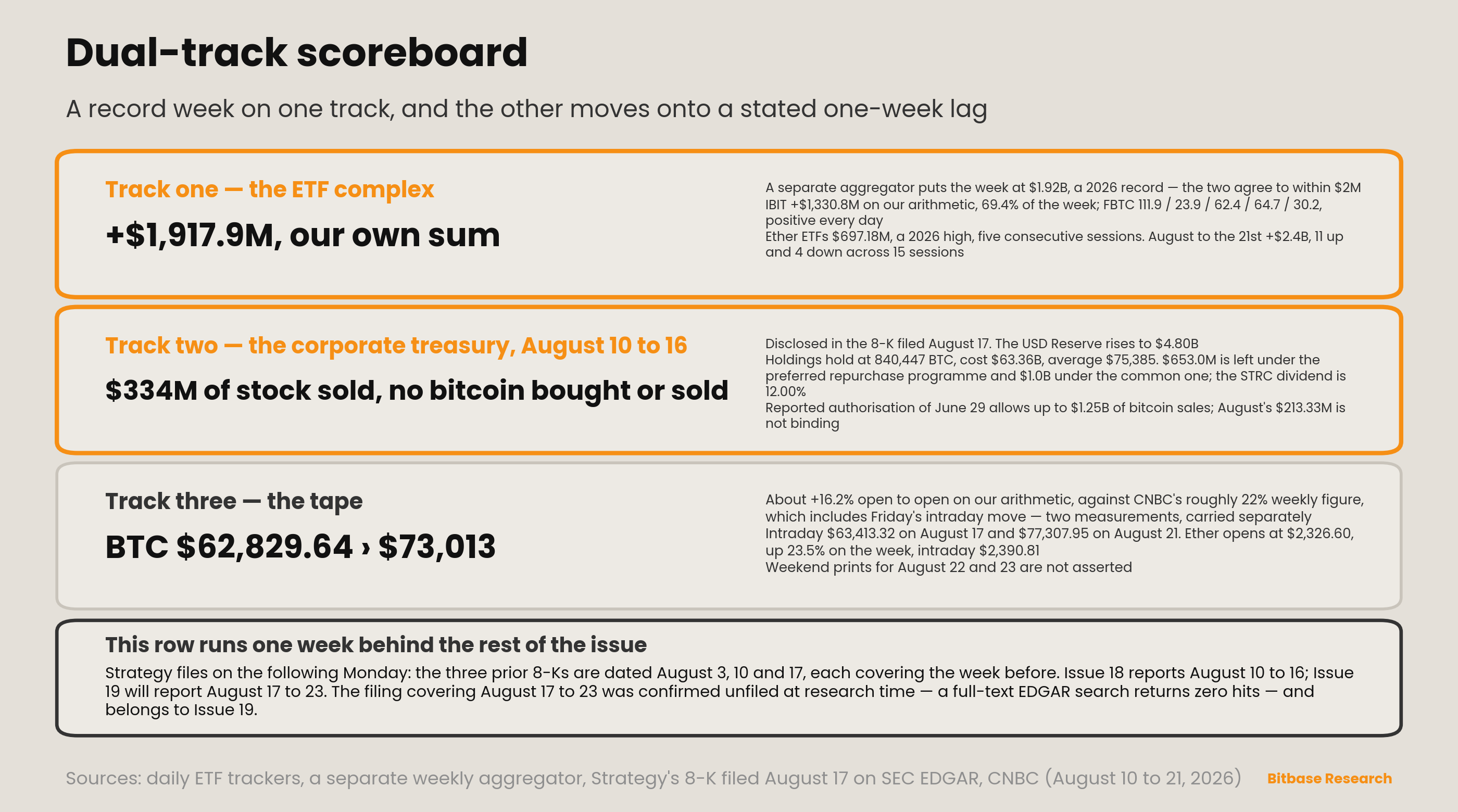
Track one—the ETF complex answered Issue 17's question, and answered the harder version of it too. Issue 17 asked whether the fourth reading would confirm or reverse again, and told this issue to watch whether IBIT and FBTC moved together, because rotating concentration behaves differently from concentration sitting still. They moved together for all five sessions. FBTC printed 111.9, 23.9, 62.4, 64.7 and 30.2 million, positive every day; IBIT printed 160.2, 143.6, 284.7, 503.0 and 239.3, summing to about $1,330.8 million on our arithmetic, or 69.4% of the week [22]. The aggregate source independently reports IBIT at $1.33 billion and ETHA at $536.83 million, with ether products recording five consecutive sessions of net inflows [23][24].
Track two changes its clock this issue, and the change is permanent. Strategy discloses each week on the following Monday—the three prior 8-Ks are dated August 3, 10 and 17, each covering the week before—so the filing for any Market Insights window lands on or after that issue's publication day [31]. Repeating it weekly would hand readers a standing empty box. From here the track is stated one week in arrears: Issue 18 reports August 10 to 16, Issue 19 will report August 17 to 23. That row now trails the rest of the issue by seven days.
On that clock, Issue 17's test has an answer. For August 10 to 16, disclosed in the 8-K filed August 17, Strategy sold $334 million of MSTR common stock, made no bitcoin purchases and no bitcoin sales, and took its USD Reserve to $4.80 billion [32][33]. Holdings held at 840,447 BTC, cost $63.36 billion, average $75,385, with $653.0 million left under the Digital Credit Securities Repurchase Program and the STRC dividend at 12.00% annualised [32]. The preferred dividend and the repurchase obligation were funded out of equity, not out of bitcoin—and reporting on the June 29 authorisation describes room to sell up to $1.25 billion of bitcoin for those purposes, against which August's $213.33 million is not binding, so this was a choice and not a constraint [33].
Issue 17 already carried that filing as in-window activity disclosed out of window, so this row overlaps it once and then does not recur. The filing covering August 17 to 23 was confirmed unfiled at research time—a full-text EDGAR search for form 8-K under CIK 0001050446 across August 18 to 25 returns zero hits—and belongs to Issue 19 [31].
Track three is the tape. BTC opened the window at $62,829.64 on August 17 [25]. The headline on that Monday's coverage was about analysts questioning when the bear-market bottom would arrive. Four sessions later BTC opened at $73,013 and traded to $77,307.95; ether opened at $2,326.60, up 23.5% on the week [26]. That is roughly +16.2% for BTC open-to-open on our arithmetic, against CNBC's 22% weekly figure, which includes Friday's intraday move—two measurements, carried separately [27]. Robinhood rose nearly 14% and Coinbase 8% [27]. Weekend prints for August 22 and 23 are not asserted.
On the radar—week of August 24 to August 30
The forward calendar has one item that dominates it, and it is the first time this series has had to write about a central-bank event whose formal subject is crypto. The Jackson Hole symposium runs August 27 to 29, hosted by the Kansas City Fed, with Warsh's first keynote as Chair on Friday, August 28 [37][38]. The theme is "Financial Innovation: Implications for Payments and Policy"—the first time in the symposium's history that digital payments sit at the organising centre, before roughly 120 officials from more than 70 countries [38]. First, what does he say about the long end? The July minutes released this week showed participants judging that "policy tightening would likely be necessary if inflation did not decline" [19][20]. A hawkish keynote lands on a curve the Treasury just spent an operation trying to flatten.
Second, does he address meeting frequency in public? The minutes record him opening a discussion of cutting the FOMC from eight meetings a year to six, because this "would allow more information to accumulate between meetings than under current practice" [19]. That is an institutional proposal disclosed through minutes rather than announced, and Jackson Hole is where it either gets argued or gets dropped.
Third, does September pricing hold? CME FedWatch was read at 68.4% for no change on August 20, against 60% on August 7 [21]. Different publishers, different snapshots, so not one curve—but the drift is toward holding, and a hawkish keynote reverses it.
Fourth, the Strategy filing covering August 17 to 23 lands on August 24 and is the first report Issue 19 makes under the lagged clock. A record-inflow week with BTC near $77,000 is the most favourable possible environment for funding those obligations out of equity, which makes a sale the more informative outcome.
Fifth, does the buyback effect survive contact with supply? The 30-year gave back most of its rally inside two sessions [11]. If a doubled operation buys only two days of relief, the liquidity story used to explain this rally has a very short half-life—and September 9 is when the operations, not the announcement, begin.
Signal tracking update
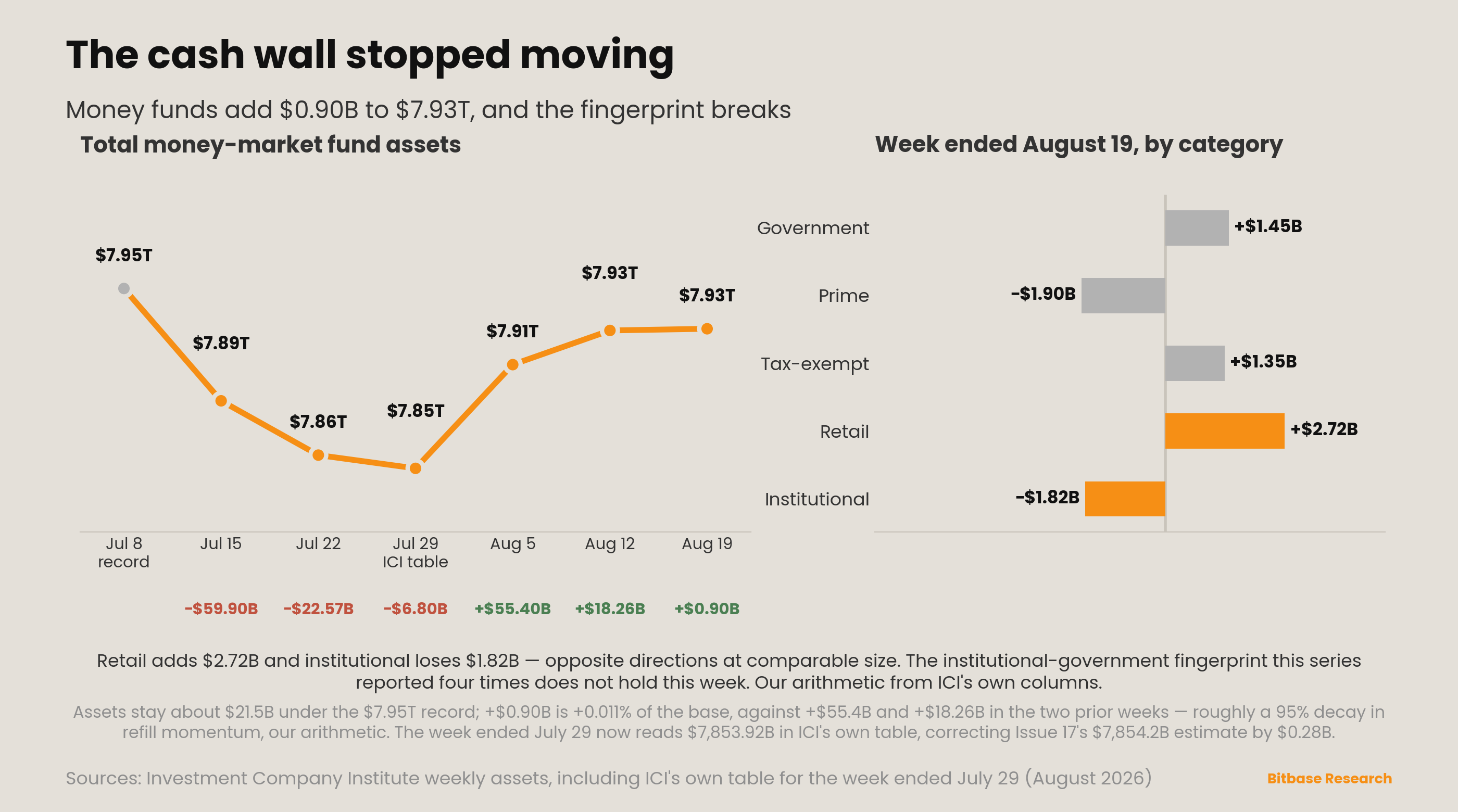
SIGNAL — Deep Dive 1 Part 1: "MMF asset scale inflection point." STATUS: STALLED—neither confirmed nor retired. It ran out of momentum. Issue 17 wrote that two more weeks like the previous two would carry assets through the record and retire the inflection framework rather than downgrade it. Per the Investment Company Institute, total money-market-fund assets rose $900 million to $7.93 trillion for the week ended Wednesday, August 19; government funds added $1.45 billion, prime lost $1.90 billion, tax-exempt added $1.35 billion [29]. The previous two weeks were +$55.4 billion and +$18.26 billion. This one was +$0.90 billion—roughly a 95% decay in refill momentum across two weeks, on our arithmetic. Assets remain about $21.5 billion below the $7.95 trillion record Issue 16 reported for the week ended July 8; this week's change is +0.011% of the base.
The composition breaks a fingerprint this series has reported four times. Retail assets rose $2.72 billion to $3.11 trillion, with retail government up $1.91 billion and retail prime down $373 million [29]. Institutional assets fell $1.82 billion to $4.82 trillion, on our arithmetic from the ICI table's own columns [29]. Issue 16 reported institutional government funds accounting for roughly 96% of a decline; Issue 17 reported the same share of an increase. This week the two sides pointed in opposite directions at comparable size and cancelled. It is a week in which nothing happened, and the framework has now had one of those.
One correction to the record: the week ended July 29, which Issue 17 could only carry at approximately $7,854.2 billion via a Crane Data account, reads $7,853.92 billion in ICI's own table—off by $0.28 billion, so the number is now official [30].
SIGNAL — Deep Dive 1 Part 6: "CME crypto-derivatives open interest." STATUS: RETIRED, and staying retired. Issue 17 closed a seven-issue data gap by concluding that this criterion cannot be tracked on a Tier-1 basis. This issue neither revives it nor reopens the gap count.
SIGNAL — Deep Dive 1 Part 6: "Whether the CFTC licenses more venues for perpetual-swap-style products." STATUS: The question changed shape again, and a fourth answer appeared. Issue 16 framed this as a binary—second licensee, or moat around the first mover. Issue 17 added a third path, an offshore venue paired with an onshore broker, after the May 29 staff letter categorising certain Deribit FZE perpetuals as foreign futures under Regulation 30.1 [34]. This week supplied a fourth. On August 20 Chairman Mike Selig said he had "directed the CFTC staff to begin exploring rules to codify a CFTC market structure for crypto assets using the agency's existing authorities," and would do so "if Clarity continues to stall because of Democrat obstruction"—a "crypto asset market" registration category analogous to designated contract markets [18]. Still no second onshore licensee, but the answer space now holds a whole new registration class contingent on Congress failing: a change in status, not zero movement.
SIGNAL — Deep Dive 1 Parts 3 and 6: "Tokenized RWA as common collateral infrastructure." STATUS: Unchanged; October full launch. No new disclosure inside this window across dtcc.com and repeated targeted searches. The standing facts are the confirmed October 2026 launch, the July 15 production trades using DTC-tokenized assets, and DTCC's roughly $114 trillion of securities under custody [35][36]. This is the second-to-last issue that should carry it. The issue covering October settles it.
New dimension—the week the executive branch stopped waiting for Congress
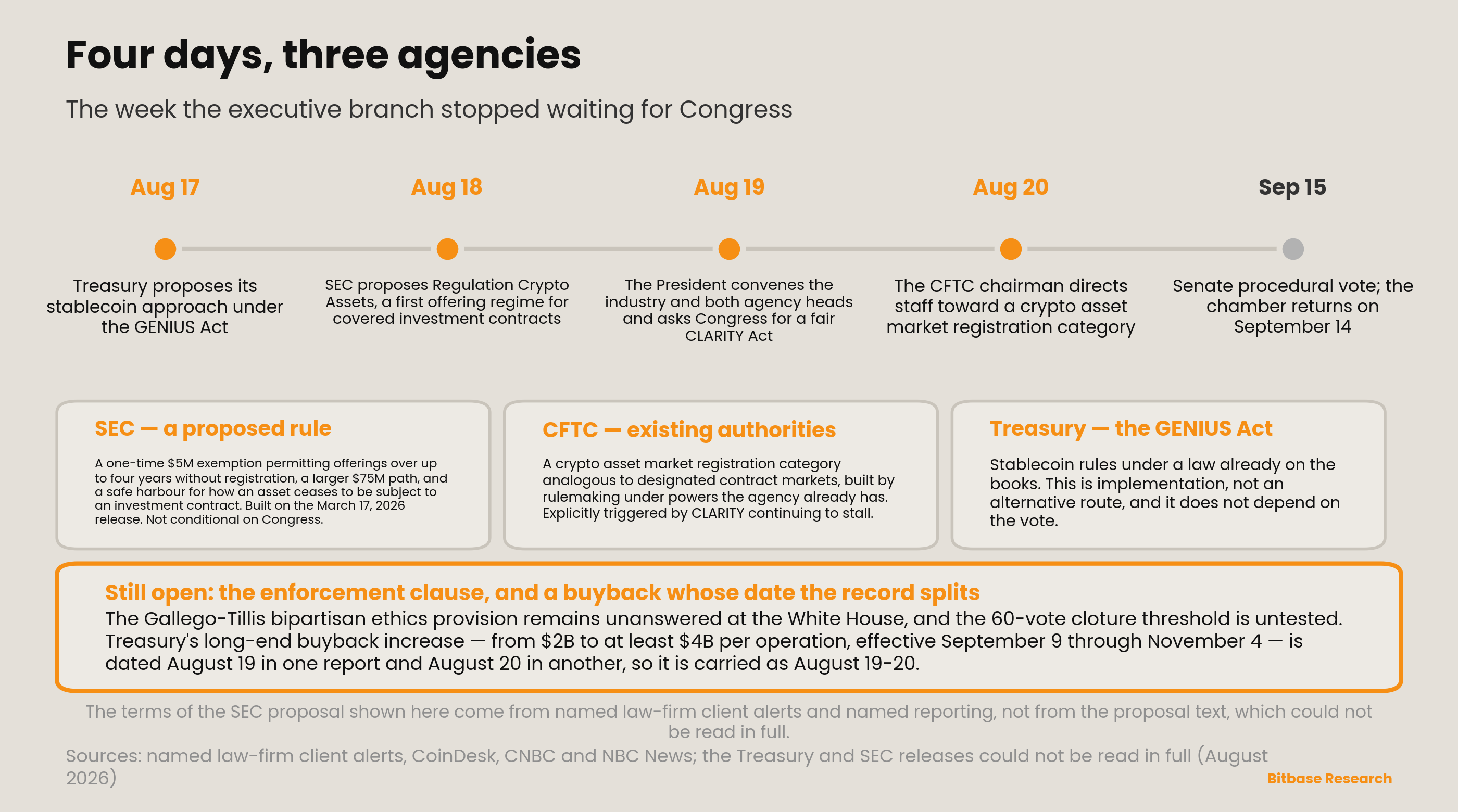
Issue 17 ended its market-structure section by saying the unresolved enforcement clause had stopped being a negotiation and become a calendar. The calendar has not moved. What moved is that three agencies stopped treating it as the only route.
On August 17 the Treasury Department proposed its approach to stablecoins under the GENIUS Act [14]. On August 18 the SEC proposed Regulation Crypto Assets, its first offering regime built specifically for what the release calls "covered investment contracts" [15]. It includes a one-time, non-exclusive $5 million exemption permitting offerings over up to four years without Securities Act registration, a larger $75 million path, and a safe harbour explaining how a crypto asset becomes subject to an investment contract and, more importantly, how it ceases to be—all built on the March 17, 2026 interpretive release that distinguished digital commodities, collectibles, tools, payment stablecoins and securities [15][16]. On August 20 the CFTC chairman directed staff toward a parallel regime of his own [18].
In between, on August 19, the President convened the industry and both agency heads at the White House and asked Congress for the thing none of this replaces. Trump called for "a fair version" of the Digital Asset Market Clarity Act, "very, very powerful structured legislation which will keep us ahead of China, keep us ahead of everyone else" [17]. Coinbase's Brian Armstrong, Gemini's Winklevoss twins, Kraken's Arjun Sethi, Robinhood's Vlad Tenev, Ripple's Brad Garlinghouse and Chainlink Labs' Sergey Nazarov attended alongside SEC Chairman Paul Atkins and Selig [17]. Atkins was explicit that his own rulemaking is not a substitute: "the most important priority is for Congress to send the Clarity Act to your desk" [17]. Selig agreed in almost the same breath as his contingency threat: "passing Clarity is the surest way that we can prevent another Gary Gensler from running a rogue campaign of lawfare" [18].
Issue 17's radar asked whether the White House would concede on the state-attorneys-general enforcement question during the recess. It did not concede and did not reply. The revised bipartisan ethics provision from Ruben Gallego and Thom Tillis remains unanswered at the White House, which CoinDesk lists as one of the largest outstanding issues [18]. The procedural vote stays on September 15; the Senate returns September 14 with a three-week window before a recess running to the November elections [17][18].
The new dimension is what that combination means for how this series reads regulatory risk. For four issues the market-structure story was one binary with one date attached; this week it became three parallel tracks with different failure modes. The SEC path does not depend on Congress; the Treasury path implements a law already on the books; the CFTC path is explicitly conditional on Congress failing, which makes it the strangest—a regulator publicly pre-committing to act if the legislature does not, which lowers the cost of legislative failure at exactly the moment the sponsors need that cost to feel high. And the tape read all of it as bullish in the same week the bill made no progress at all.
Caveats
The two macro legs are the weakest numbers in this issue and they carry a judgment. The two-year at 4.19% comes from a FRED series read via search and the dollar index at 98.82 from Trading Economics; neither is an exchange settlement price, and attempts to retrieve the Treasury daily yield curve for August and the H.15 release for August 21 returned empty responses. Advisor Perspectives, the source Issue 17 used, published a snapshot dated August 14 and none for August 21. A separate named technical note puts the dollar index at 99.60 in the same month [13]. Both legs are therefore recorded as not verified to Tier-1: Section 2 withdraws the pass and Chart 5 carries no verdict on either.
Two primary documents central to this issue were located but could not be read in full. The Treasury press release on the buyback increase and the SEC's Regulation Crypto Assets proposal both returned empty bodies on direct retrieval, so the buyback parameters are carried from CNBC and NBC News and the SEC terms from law-firm client alerts plus CoinDesk [9][10][15][16]. This issue keeps the facts and labels the sourcing: the proposal's terms here are summaries, not rule text. The buyback announcement date appears as August 19 in one CNBC piece and August 20 in another, and the release itself could not be read, so it is written as spanning both [9][11].
Two handoff dates from Issue 17 were wrong and are corrected here. It passed forward a SEC proposed rule dated August 19 and a presidential statement dated August 20; both events are real, both dates off by one. The SEC proposal is August 18 on Morrison Foerster's dating and CoinDesk's own URL slug, and the White House event is August 19 [15][17].
Oil is quoted on two incompatible series and the article uses both deliberately. CNBC settlements and Fortune morning spot quotes disagree for the same days—$94.39 against $95.29 on August 21 [4][5][6]. The narrative uses settlements; the week's percentage move uses only the Fortune series against itself. They are not connected into one curve anywhere.
The size of bitcoin's week has four incompatible descriptions in named coverage—CNBC's roughly 22% and "biggest since March 2023," Bloomberg's more than two years with its Spanish edition saying more than three, Advisor Perspectives' over three years, and CoinDesk's nearly 25% [27][40][28]. This issue asserts only CNBC's figure and comparison. Ether ETF single-day numbers are similarly unusable—$221 million on August 20, $185 million on August 21, and a separate $189 million ten-month high reconciling with neither—so only the direction and the five-session streak are asserted [24].
Three remaining boundaries. The Hormuz transit gap Issue 17 flagged is still open; no dated vessel counts were obtained and none appear here. The FOMC minutes straddle two issues—the meeting was July 28 to 29, already cited in Issue 17, the release August 19—so only release-day content is used. And the exact date of the September FOMC decision is not asserted; one preview implies September 16, which this issue declines to carry as fact [38].
Related reading
Other Bitbase articles on this topic:
Disclaimer: This article is market commentary from Bitbase Research, provided for information only. The views are those of Bitbase Research as of the date of writing and do not constitute investment, trading, tax, or financial advice, nor an offer or solicitation to trade. Data in this issue is current as of August 23, 2026; markets and disclosures may change, so refer to the latest information from authoritative sources. Trading crypto assets and leveraged products carries significant risk, including the possible loss of your capital.
References
[1] Al Jazeera, US-Iran Memorandum of Understanding expires: how and why it fell apart, August 17, 2026. aljazeera.com
[2] Current price of oil as of August 17, 2026. fortune.com
[3] Current price of oil as of August 18, 2026. fortune.com
[4] Oil prices rise more than 1% as Middle East crisis escalates, August 19, 2026. cnbc.com
[5] Oil prices are little changed after Iran's president indicates Tehran wants war to end soon, August 21, 2026. cnbc.com
[6] Current price of oil as of August 21, 2026. fortune.com
[7] 30-year Treasury yield tops 5.31%, the highest in 19 years, August 17, 2026. cnbc.com
[8] 30-year Treasury yield tops 5.33%, a new 19-year high, on inflation and spending concerns, August 18, 2026. cnbc.com
[9] Treasury doubles debt buybacks as Bessent moves to steady the bond market, August 19, 2026. cnbc.com
[10] U.S. Department of the Treasury, Treasury announces increased sizes of nominal long-end liquidity support buybacks beginning September 9. home.treasury.gov
[11] Longer-dated Treasury yields rise as Bessent's bond buyback rally fizzles out, August 21, 2026. cnbc.com
[12] Federal Reserve Bank of St. Louis, FRED series DGS2, market yield on U.S. Treasury securities at 2-year constant maturity. fred.stlouisfed.org
[13] United States dollar index quote page. tradingeconomics.com
[14] U.S. Treasury Department proposes GENIUS Act stablecoin rule, August 17, 2026. coindesk.com
[15] Morrison Foerster, SEC proposes new Regulation Crypto Assets, August 19, 2026. mofo.com
[16] Greenberg Traurig, SEC proposes Regulation Crypto Assets, creating tailored crypto offering exemptions and an investment contract safe harbor. gtlaw.com
[17] Trump pushes Congress to move on the Clarity Act during White House crypto event, August 19, 2026. coindesk.com
[18] U.S. CFTC chief puts staff on notice to create crypto regulations if the Clarity Act fails, August 20, 2026. coindesk.com
[19] Federal Reserve, minutes of the Federal Open Market Committee, July 28-29, 2026. federalreserve.gov
[20] Fed July 2026 FOMC minutes: rate hike debate details, August 19, 2026. qz.com
[21] Market pricing suggests a 68% chance the Fed holds rates in September. kucoin.com
[22] Bitcoin ETF flows: August 2026 daily table and net totals. tftc.io
[23] Bitcoin and Ethereum ETFs posted their best weekly performance of 2026, with $2.62B in inflows. incrypted.com
[24] Ethereum spot ETFs see $185M net inflow on August 21, a fifth consecutive day of inflows. kucoin.com
[25] Bitcoin and ethereum prices today, Monday, August 17, 2026: crypto prices down slightly as analysts question the timing of the bear market bottom. finance.yahoo.com
[26] Bitcoin and ethereum prices today, Friday, August 21, 2026: cryptos continue rally sparked by the Treasury repurchase announcement. finance.yahoo.com
[27] Bitcoin surges 22% for the week as investor optimism floods back, August 21, 2026. cnbc.com
[28] XRP on track for biggest weekly gain in 21 months as Treasury buyback spurs curve control hopes, August 23, 2026. coindesk.com
[29] Investment Company Institute, money market fund assets weekly release. ici.org
[30] ICI: money market fund assets continue to rise in August, August 13, 2026. prnewswire.com
[31] U.S. Securities and Exchange Commission, EDGAR full-text search, form 8-K filings for CIK 0001050446, filing dates August 18 to 25, 2026. sec.gov
[32] U.S. Securities and Exchange Commission, Strategy Inc, form 8-K, report date August 17, 2026. sec.gov
[33] Strategy sells $334 million in MSTR shares, makes no bitcoin purchases or sales as USD reserve hits $4.8 billion, August 17, 2026. theblock.co
[34] Commodity Futures Trading Commission, release 9241-26, May 29, 2026. cftc.gov
[35] DTCC advances development of new tokenization service, convenes 50+ firms to drive digital assets adoption, May 4, 2026. dtcc.com
[36] DTCC sets October launch for tokenized securities platform in Wall Street blockchain push, May 4, 2026. coindesk.com
[37] Federal Reserve Bank of Kansas City, Jackson Hole Economic Symposium. kansascityfed.org
[38] Jackson Hole 2026: what to watch when Warsh steps to the podium Friday, August 21, 2026. techtimes.com
[39] UAE halts all trade with Iran after new missile fire in the Gulf, August 19, 2026. fortune.com
[40] Bitcoin leaps past $75,000 as crypto rally continues in Asia, August 21, 2026. bloomberg.com