Issue 19 closed on a week in which the Senate sat for 67 seconds and the only thing that moved was 14 basis points at the front end. This week the Senate came back for real — five issues of the Congressional Record, 334 pages, 2,886,642 characters — and spent none of it on the bill this series has been tracking [1]. Across those 334 pages the terms market structure, CLARITY Act, GENIUS Act, stablecoin, blockchain and bitcoin appear zero times. The single legislative mention of digital assets in the entire window is H.R. 10199, a bill to prohibit the President, the Vice President, Members of Congress and senior officials from owning or trading stocks, digital assets and prediction market contracts [1].
And the thing that actually moved price was a conditional sentence read as a commitment. On Thursday, September 3 at 8:30 a.m., Governor Christopher Waller told a Reuters interview that if disinflation continues in the data due over the next two weeks, he would be inclined to support holding the federal funds rate at its current setting [2]. Bitcoin rose 5.09% that day, its only session larger than the whole week's 3.43%, on the window's heaviest volume [3]. The same speech says that if the August data show the improvement was fleeting, it may be appropriate to raise the policy rate at the September 15–16 meeting, and that "if inflation comes in hot, I would consider a rate hike" [2]. The word cut does not appear in the speech. Hike appears twice, and only one of the two is about the path ahead: the other sits in a 2021–22 retrospective on forward guidance.
Then Waller spent the second half of the speech explaining that this is exactly the mistake. His words: "I communicate that IF the data comes in a particular way, THEN I will advocate for policy to be set a particular way. The key point here is that this it is not a commitment to a policy action—it is a conditional policy statement" [2]. He compared his reaction function to a home-plate umpire's strike zone. The market read one branch.
The next morning the other branch got its data. August payrolls came in at +162,000 with unemployment unchanged at 4.1%, and — the part that matters — July was revised from −23,000 to +21,000 and June from +20,000 to +31,000, putting the two months 55,000 higher than previously reported [4]. The negative print that a hold could have rested on was revised away. The two-year rose 3 basis points and bitcoin fell 1.99% [5][3].
One more thing happened on September 3, and it was not on any published schedule. Treasury bought back $12.5bn of 1-month-to-2-year paper against $28.272bn offered, taking the entire cap [6]. The previous operation in that bucket, on August 6, had a $4bn maximum. The cap went up 3.125 times. Issue 19 asked whether Treasury's promised updated buyback schedule would appear before the operations it governs; the schedule posted at Treasury's own URL is still the August 5 version [7]. What arrived first was the operation.
Week of August 31 to September 6, 2026
Bitbase Research · September 7, 2026
The one chart that matters
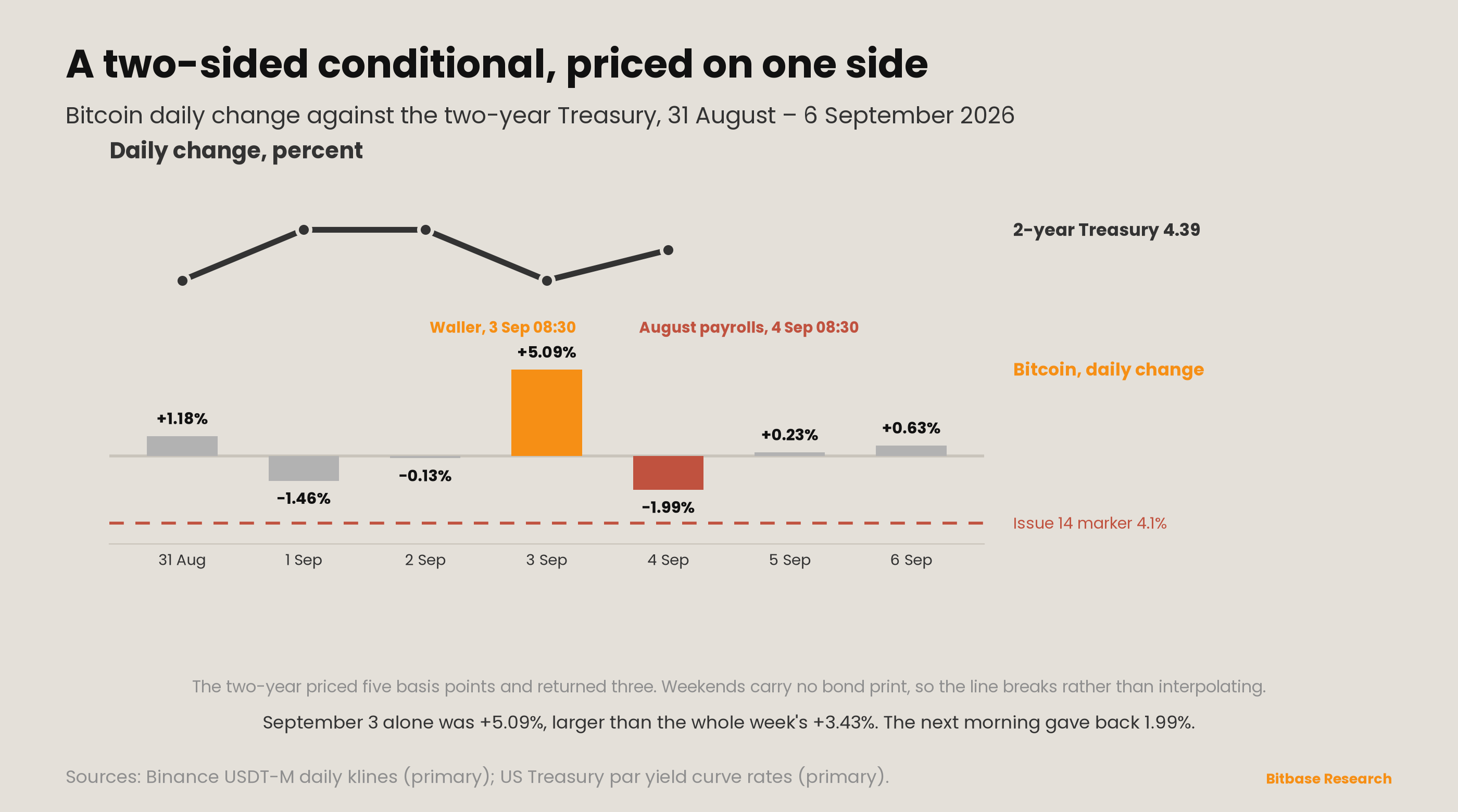
The window's price action fits in two sessions. Bitcoin opened the week at 77,634.60 and closed it at 80,301.10, up 3.43% [3]. September 3 alone was +5.09% — larger than the entire week — on 239,736 BTC of volume, 1.74 times the window's daily average [3]. Every other session in the window nets negative.
The full window, in closes, daily percentage changes and volume [3]:
| Session | Close | Change | Volume (BTC) |
|---|---|---|---|
| August 31 | 78,549.60 | +1.18% | 129,517 |
| September 1 | 77,400.10 | −1.46% | 151,358 |
| September 2 | 77,300.00 | −0.13% | 142,109 |
| September 3 | 81,230.70 | +5.09% | 239,736 |
| September 4 | 79,616.10 | −1.99% | 194,863 |
| September 5 | 79,797.70 | +0.23% | 47,709 |
| September 6 | 80,301.10 | +0.63% | 61,314 |
The two-year Treasury tells the same story in a smaller unit and with less noise. It sat at 4.39% on September 1 and 2, fell to 4.34% on the Waller session, and returned to 4.37% after payrolls [5]. Five basis points priced in, three given back the next morning. Bitcoin priced 5.09% in and gave back 1.99%.
Two readings are available and only one is supportable. The unsupportable one is that the market learned the Fed will hold. The speech does not say that; it says what would produce a hold and what would produce a hike, and the labour data that arrived the next morning pointed at the second branch. What is supportable is narrower and more useful: the market priced the branch it preferred, and the front end corrected faster and by less than the crypto price did.
Issue 14's two-year marker at 4.1% is now failed for a second consecutive window, and by a wider distance. The lowest reading in this window is 4.34%, 24 basis points above the marker; Issue 19 recorded 4.34% at its close [5]. The marker has not been reached on any session since it was set.
This week's structural signal
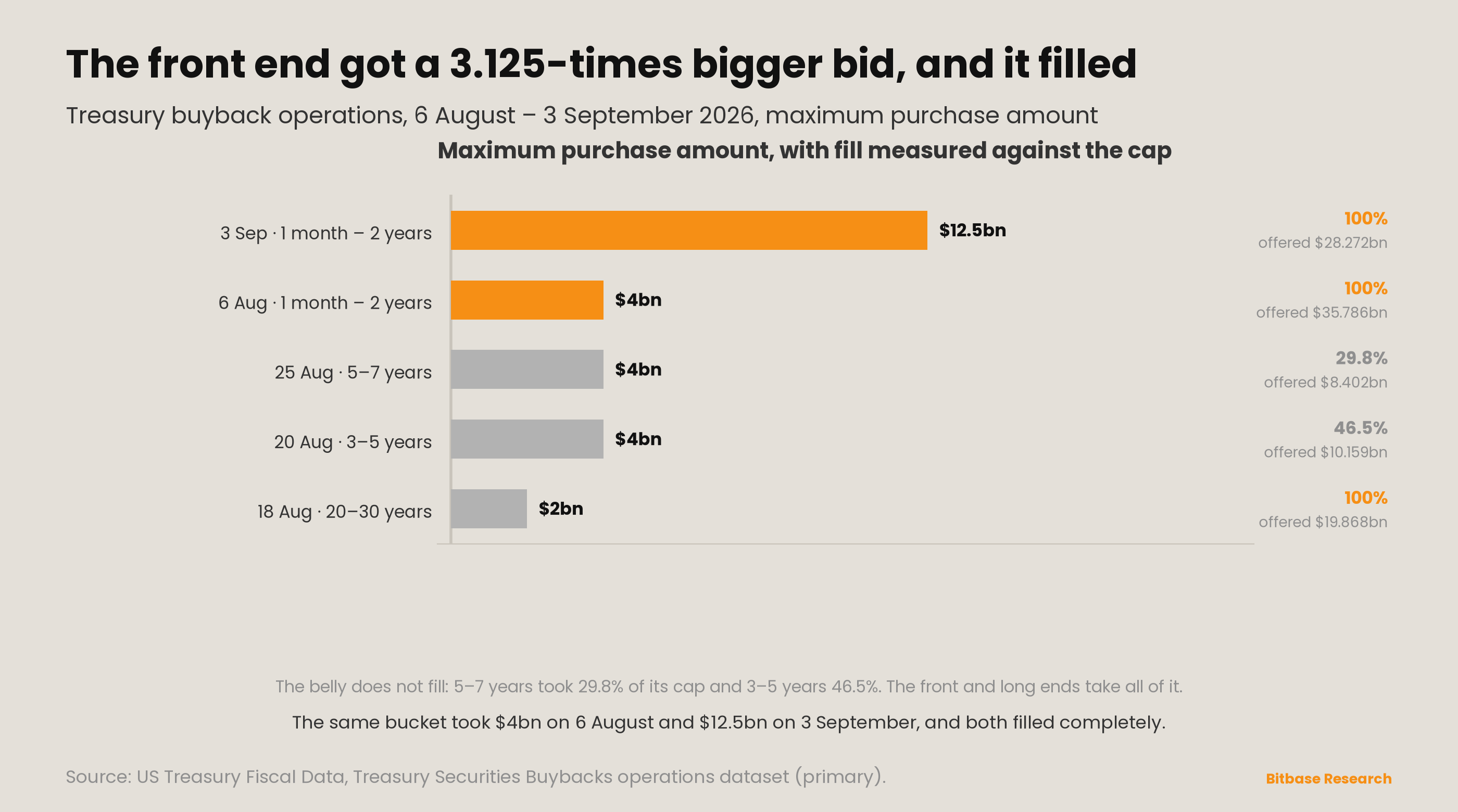
Treasury's buyback programme ran exactly one operation inside the window, and it is the largest single-bucket cap this series has recorded. September 3, 1-month-to-2-year, $12.5bn maximum, $28.272bn offered, $12.5bn accepted [6].
The five most recent operations, with fill measured against the cap rather than against offers [6]:
| Operation | Bucket | Maximum | Offered | Accepted | Fill |
|---|---|---|---|---|---|
| September 3 | 1Mo–2Y | $12.5bn | $28.272bn | $12.5bn | 100% |
| August 25 | 5Y–7Y | $4bn | $8.402bn | $1.191bn | 29.8% |
| August 20 | 3Y–5Y | $4bn | $10.159bn | $1.86bn | 46.5% |
| August 18 | 20Y–30Y | $2bn | $19.868bn | $2bn | 100% |
| August 6 | 1Mo–2Y | $4bn | $35.786bn | $4bn | 100% |
Issue 19 established that the long end is heavily oversubscribed and the belly is not, using the August 18 and August 25 operations. This window adds the front end to the oversubscribed column and shows Treasury sizing into it. The same bucket that took $4bn on August 6 took $12.5bn on September 3, and both filled completely.
The timing deserves a sentence and no more than a sentence. The buyback and the Waller speech fell on the same day, and this series will not assert a causal link between them. What can be said is arithmetic: the front end received a $12.5bn official bid and a dovish reading of a Fed governor within the same session, and the two-year fell 5 basis points. Which of the two did the work is not separable from the data available here.
What is separable is the schedule question, and its answer is clean. Issue 19 asked whether the updated tentative buyback schedule would appear before the operations it governs. It has not: the buyback schedule posted on Treasury's quarterly refunding page is dated August 5, 2026 [7] — the same version Issue 19 read a week earlier. Issue 19 also recorded, from that schedule, a 1-month-to-2-year cash-management operation for September 9. That one falls outside this window, and it is not what ran on September 3. A scheduled operation on the ninth and an unscheduled one on the third are compatible, so this issue draws no discrepancy from the pair. What cannot be read from the posted document is whether the August 5 schedule contained the September 3 operation at all, and at what maximum.
Dual-track scoreboard
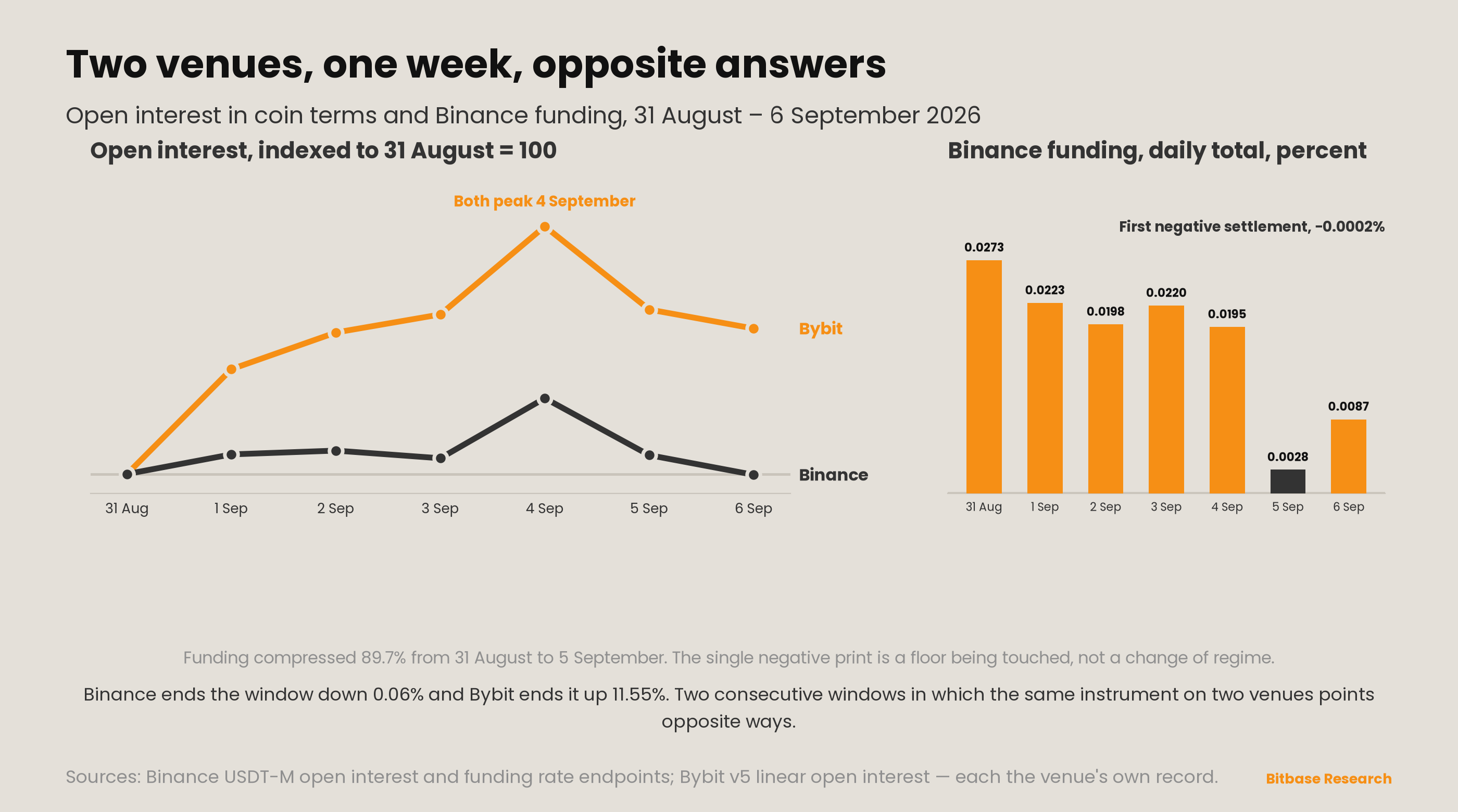
Issue 19 recorded Binance shedding 2.90% of coin-denominated open interest across the August 28 crash while Bybit added 2.01%. The divergence did not close; it widened, and this time both venues peaked on the same day.
Coin-denominated open interest in BTCUSDT perpetuals at 00:00 UTC each day [8]:
| Date | Binance (BTC) | Bybit (BTC) |
|---|---|---|
| August 31 | 106,319.88 | 48,917.36 |
| September 1 | 107,978.17 | 52,987.89 |
| September 2 | 108,296.68 | 54,412.35 |
| September 3 | 107,652.06 | 55,112.92 |
| September 4 | 112,717.54 | 58,532.60 |
| September 5 | 107,912.54 | 55,304.43 |
| September 6 | 106,255.01 | 54,566.44 |
Both peak on September 4, the payrolls session. Binance ends the window down 0.06%; Bybit ends it up 11.55% [8]. Positioning built through the rally and into the data, and then one venue gave all of it back while the other kept just under three-fifths. Two consecutive windows in which the same instrument on two venues reports opposite directions is not a rounding artefact, and it is the reason this series reports open interest in coin terms and per venue rather than as one aggregated dollar figure.
Funding compressed underneath both. Binance BTCUSDT daily funding totals fell from +0.0273% on August 31 to +0.0028% on September 5, a compression of 89.7%, and September 5 carries the first negative settlement this series has recorded on that venue at −0.0002% [9]. Issue 19 reported 21 consecutive positive settlements with no mechanical reversal. This window records 20 positive and one negative out of 21. A print of −0.0002% is not a reversal; it is a floor being touched. Reporting it as a regime change would be reading a rounding digit as a signal.
Spot ETF flows are secondary here and stay secondary: issuers publish net assets and share counts, not creations and redemptions. September 1 was −$236.5m; September 3 was +$730.8m, reported as the strongest single day of 2026; September 4 was +$174.6m [10]. August 31 and September 2 were not obtained from any source this issue is willing to cite, and the chart breaks rather than interpolates across them.
On the radar—week of September 7 to September 13
First, the August CPI is the number Waller named. He said his decision "will be heavily influenced by what we learn about August inflation" [2]. The employment half of his condition arrived firm. The inflation half arrives in this coming window, and it is the last major release before the September 15–16 FOMC.
Second, does the two-year hold 4.30% through an inflation print? It held all five sessions of this window, three of them above 4.34%. A hold through a CPI is a different test from a hold through a quiet week.
Third, Strategy's next 8-K. The filing covering August 24–30 landed on August 31 inside this window and disclosed 4,603 BTC at an average of $80,318 [11]. The filing covering the week just ended is expected around September 8 — outside this window. Issue 19 asked whether the June-to-August pause was over; one purchase does not answer it and this issue does not pretend otherwise.
Fourth, does Treasury post an updated buyback schedule, or run a second unscheduled operation? One of those two resolves the question in section 2. Both leave the August 5 document as the only published schedule.
Fifth, does the market-structure bill get floor time in a week when the chamber is sitting? This window establishes that the absence of legislative attention is no longer explained by the absence of legislative days.
Signal tracking update
Issue 19's radar asked five questions. Three settle cleanly, one settles against the expectation that framed it, and one cannot settle inside the window.
First, would the returning Senate give the market-structure bill floor time? No, and the check is a full-text scan rather than an inference. Five issues of the Congressional Record covering August 31 to September 4 were downloaded in full and scanned locally: 334 pages, 2,886,642 characters [1]. Market structure, CLARITY Act, GENIUS Act, stablecoin, blockchain, bitcoin, tokeniz and virtual currency return zero. Cryptocurrency returns two, both floor rhetoric about political donations and deregulation, neither legislative. Digital asset returns one, H.R. 10199 [1].
A methodological note, because the naive count is wrong by a factor of three and a half. Searching the substring crypto returns seven hits across the window. Five of them are cryptologic and cryptology, in a tribute to a Navy information-warfare officer. A substring count would report that Congress mentioned crypto seven times in a week when the real figure is two rhetorical mentions and one bill designed to stop officials holding it. This series counts whole words and lists its false positives.
Second, would the updated buyback schedule appear before the operations it governs? No. The posted schedule remains the August 5 version [7], and a $12.5bn operation ran on September 3. Section 2 has the detail, including what the posted schedule does and does not settle.
Third, would the money-market composition hold or revert? It reverted, and the headline went up sevenfold again. For the week ended September 2, ICI reports total assets of $7.979tn, up $44.75bn: government funds +$38.80bn, prime +$4.92bn, tax-exempt +$1.03bn, retail +$11.10bn and institutional +$33.66bn [12]. The three fund-type legs sum to the headline exactly; the retail and institutional legs sum to $44.76bn, a $0.01bn rounding difference ICI does not reconcile. Issue 19 reported retail −$3.39bn and institutional +$9.51bn for the prior week. The retail leg has now reversed sign in three consecutive weeks: +$2.72bn, −$3.39bn, +$11.10bn. The headline itself has gone +$0.90bn, +$6.11bn, +$44.75bn.
One marker note that requires care. Total assets of $7.979tn now exceed the $7.95tn figure this series has carried as a record since Issue 14. Issue 19 recorded that the record is no longer independently re-verifiable from the publisher, because ICI's page carries only a rolling three-week table. So the supportable statement is that the current level is above the number this series has been carrying, not that a record has been set.
Fourth, did the two-year hold above 4.30%? Yes, on all five sessions [5]. Readings: 4.34, 4.39, 4.39, 4.34, 4.37. This is the cleanest pass on the radar and it is Tier-1.
Fifth, did Strategy buy again? Not inside the window, and the question stands. The August 31 filing discloses the purchase for August 24–30: 4,603 BTC for $369.7m at an average of $80,318, taking holdings to 845,050 BTC at an aggregate $63.73bn and an average cost of $75,412 [11].
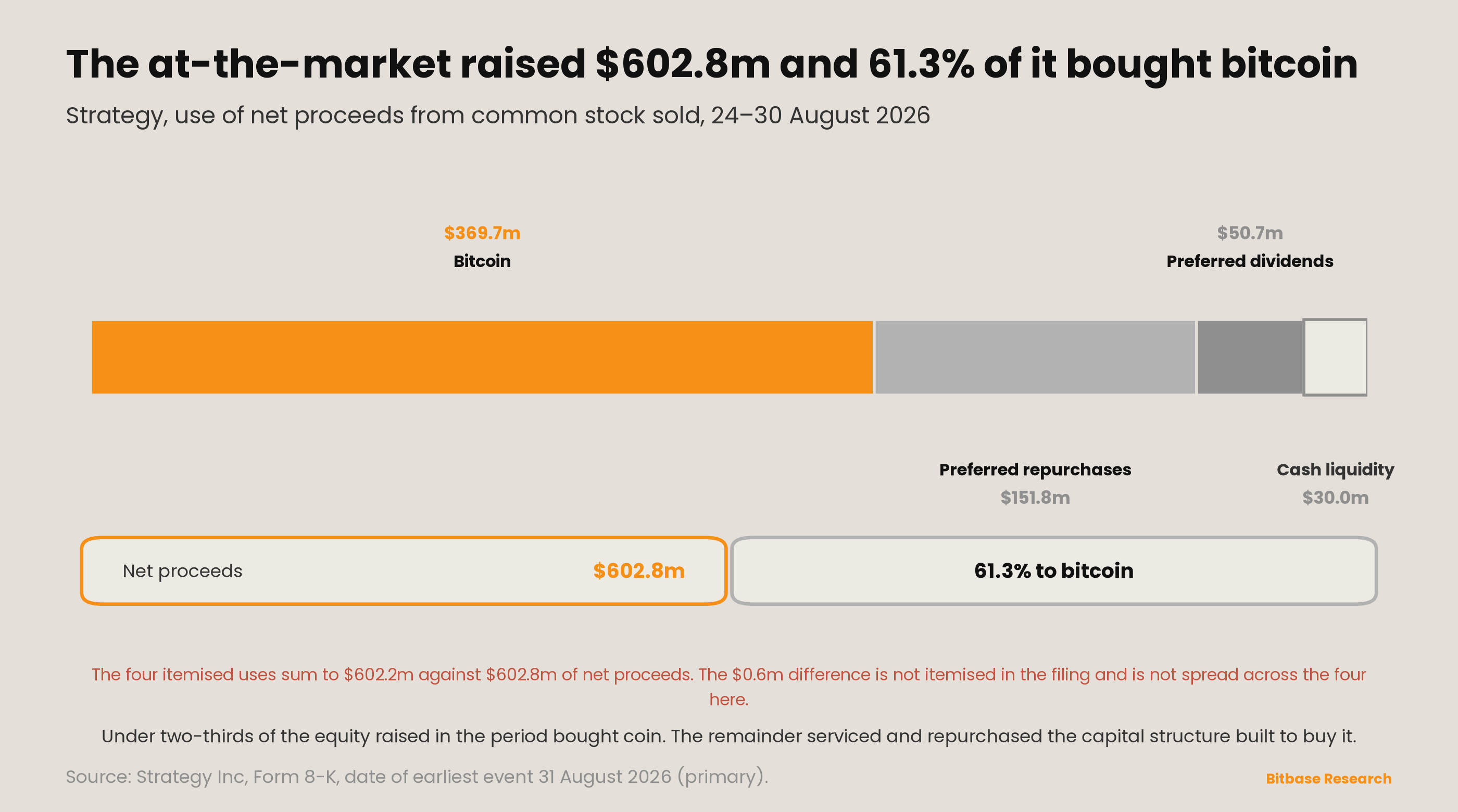
The filing's own allocation table is the more interesting disclosure. Strategy sold 4,531,421 shares of common stock for $602.8m in net proceeds, and directed $369.7m to bitcoin, $50.7m to preferred dividends, $151.8m to preferred stock repurchases and $30.0m to cash liquidity, with $19,090.8m of capacity remaining [11]. The four itemised uses sum to $602.2m against $602.8m of net proceeds; the $0.6m difference is not itemised in the filing and is not spread across the four here. Under two-thirds of the equity raised in the period bought coin. The remainder serviced and repurchased the capital structure built to buy it. Note also that the purchase price of $80,318 sits above the company's own $75,412 average cost, so this acquisition raised the average rather than lowering it.
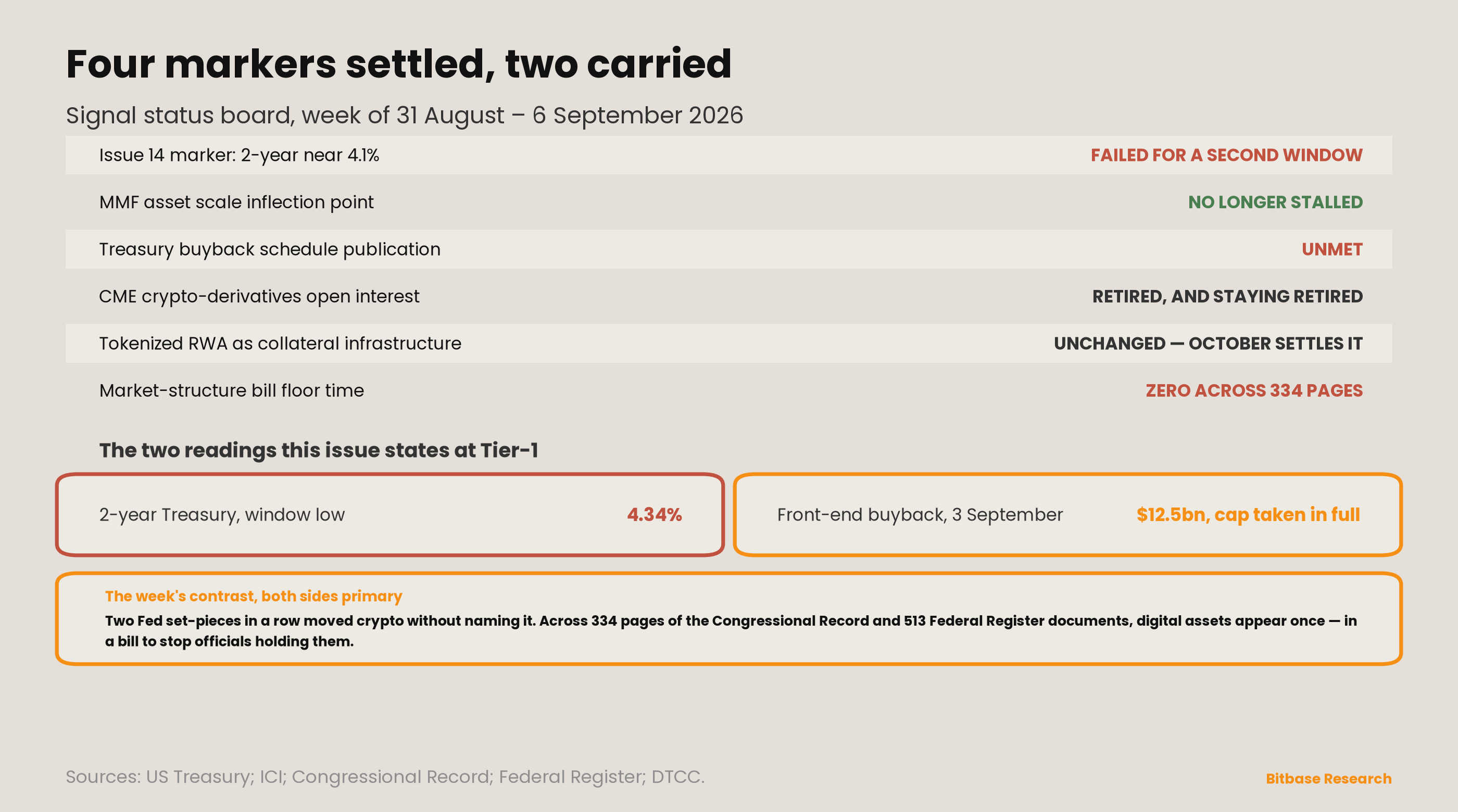
SIGNAL — Issue 14 two-year marker at 4.1%. STATUS: FAILED for a second window, Tier-1, and by a wider margin. Closest approach 4.34%, 24 basis points above.
SIGNAL — Deep Dive 1 Part 1, "MMF asset scale inflection point." STATUS: No longer stalled. +$44.75bn on the week, both legs positive, level above the carried record but the record itself not re-verifiable.
SIGNAL — Treasury buyback schedule publication. STATUS: UNMET. August 5 version still posted; operations running ahead of it.
SIGNAL — Deep Dive 1 Part 6, "CME crypto-derivatives open interest." STATUS: RETIRED, and staying retired.
SIGNAL — Tokenised RWA as common collateral infrastructure. STATUS: UNCHANGED; October settles it. No new DTCC disclosure inside the window.
New dimension—two consecutive Fed set-pieces moved crypto without naming it
Issue 19 established that the Chair's August 28 Jackson Hole keynote contained zero occurrences of stablecoin, payment, payments or digital, at a symposium convened on payments. This window produces the same result on a different speaker at a different venue with a different subject.
Waller's September 3 remarks contain zero occurrences of stablecoin, crypto, digital, bitcoin and tokeniz [2]. The speech moved bitcoin 5.09% in a session. Two consecutive Fed set-pieces have now moved crypto prices materially while saying nothing about crypto at all.
The mechanism is not mysterious and that is the point. Neither speech was about the asset; both were about the rate path, and the asset trades the rate path. What the pair establishes is that in the current regime the marginal crypto price is being set by the front end of the Treasury curve rather than by anything crypto-specific — which is the same conclusion the Federal Register enumeration reaches from the opposite direction. 513 documents were published inside the window and none of them mentions cryptocurrency or digital assets [13]. The same query widened to all of 2026 returns six, which is how this issue knows the query works rather than merely returns nothing [13]. All six predate the window, including the SEC's Regulation Crypto Assets proposal of August 21.
There is a second, sharper observation available in the Waller text and this series has not seen it stated elsewhere. He explicitly ranks his own three communication types and puts forward guidance last, endorsing the Chair's position that it "isn't appropriate now" [2]. He then illustrates its power with the 2021–22 episode in which the two-year Treasury rose 200 basis points before the policy rate left the effective lower bound. A governor who has just declined to give forward guidance, describing an episode where forward guidance moved the two-year 200 basis points, then moved it 5 basis points with a conditional. The market supplied the guidance he withheld.
Caveats
The causal claim in section 1 is deliberately weak and should stay weak. A speech at 8:30 a.m. and a 5.09% session are contemporaneous, not proven causal. Three other things happened the same day: a $12.5bn Treasury operation, a reported $730.8m ETF inflow, and — per secondary reporting this issue does not cite for anything load-bearing — a cluster of short liquidations. Any of these could carry part of the move and the data here cannot apportion them.
Three quantities in this issue are secondary and are labelled where they appear. Spot ETF daily flows, in full. The characterisation of September 3 as 2026's strongest ETF day. And the absence of ETF figures for August 31 and September 2, which is a gap in this issue's sourcing rather than a zero.
One quantity is unresolved and named as such. Whether the August 5 buyback schedule contained the September 3 operation, and at what maximum, could not be read from the posted document.
One provenance discrepancy is recorded rather than reconciled. GovInfo lists five Congressional Record issues in the window; congress.gov's API returns three for September and omits September 3. This issue works from the five whose full-issue PDFs downloaded successfully, September 3 included at 464,100 bytes.
And one figure is a coincidence that will read as meaning if it is not flagged. Bitcoin closed the window at 80,301.10 against Strategy's disclosed average purchase price of $80,318 — a difference of 0.02%. There is no mechanism connecting those two numbers and none is implied.
Related reading
Other Bitbase articles on this topic:
Disclaimer: This article is market commentary from Bitbase Research, provided for information only. The views are those of Bitbase Research as of the date of writing and do not constitute investment, trading, tax, or financial advice, nor an offer or solicitation to trade. Data in this issue is current as of September 6, 2026; markets and disclosures may change, so refer to the latest information from authoritative sources. Trading crypto assets and leveraged products carries significant risk, including the possible loss of your capital.
References
[1] Congressional Record, Volume 172, Issues 137–141, August 31–September 4, 2026; full-issue PDFs retrieved and scanned locally. congress.gov
[2] Governor Christopher J. Waller, "The Economic Outlook and Some Comments on My Policy Communication," at the Reuters NEXT Newsmaker Interview, Washington, D.C., September 3, 2026. federalreserve.gov
[3] Binance USDT-M futures, BTCUSDT daily klines, UTC. fapi.binance.com
[4] US Bureau of Labor Statistics, The Employment Situation — August 2026, released September 4, 2026. bls.gov
[5] US Treasury, Daily Treasury Par Yield Curve Rates, 2026. home.treasury.gov
[6] US Treasury Fiscal Data, Treasury Securities Buybacks operations dataset. fiscaldata.treasury.gov
[7] US Treasury, Most Recent Quarterly Refunding Documents, buyback schedule posted August 5, 2026. home.treasury.gov
[8] Binance USDT-M open interest history endpoint and Bybit v5 linear open interest endpoint, daily 00:00 UTC snapshots. fapi.binance.com · api.bybit.com
[9] Binance USDT-M funding rate endpoint, BTCUSDT perpetual, eight-hour settlements. fapi.binance.com
[10] Spot bitcoin ETF daily net flows, secondary reporting. SECONDARY
[11] Strategy Inc, Form 8-K, date of earliest event August 31, 2026, covering August 24–30, 2026. sec.gov
[12] Investment Company Institute, Money Market Fund Assets, week ended September 2, 2026. ici.org
[13] Federal Register API, full enumeration of documents published August 31–September 6, 2026, and the same term query widened to 2026. federalregister.gov