3ULL is the native gas coin of the PLAYA3ULL GAMES Mainnet, a dedicated Avalanche-based chain run by the games company of the same name, and w3ULL is the wrapped representation of that coin on Avalanche and other networks. This article separates those two assets, covers only the mechanics the documentation currently ships, reports what the chain and the w3ULL market looked like on 15 August 2026, and ends with a checklist you can run yourself.
What Is PLAYA3ULL GAMES and 3ULL?
PLAYA3ULL GAMES is a games company that also operates its own blockchain, not a protocol foundation. The documentation states plainly that the project has migrated from the Avalanche C-Chain to its own blockchain, called the PLAYA3ULL GAMES Mainnet, and introduced a new coin on that mainnet named 3ULL. The network page gives the parameters: chain ID 3011, RPC endpoint api.mainnet.playa3ull.games, currency symbol 3ULL, and three block explorers, the first of which is 3011.routescan.io. The websocket endpoint is marked currently disabled.
Two names therefore describe two different things. 3ULL is the native coin of chain 3011: it pays gas there and, like any native coin, has no contract address at all. w3ULL is an ERC-20 token representing the same unit on what the documentation calls foreign chains, naming Avalanche, Ethereum and Polygon. On Avalanche the w3ULL contract is 0xa77e70d0Af1Ac7fF86726740dB1Bd065c3566937, and the project's FAQ tells bridged users to add exactly that address to see their balance.
A third name is still in circulation, and it is retired. The official Important Information page states under the heading Update on 3ULL v2 that 3ULL v2 on the Avalanche network is no longer in use. The old Avalanche token contract 0x9e15f045e44ea5a80e7Fbc193A35287712Cc5569 has not disappeared: it is still deployed, still shows holders, and still turns up in third-party scanner pages and in at least one stale trading pair. Treat anything that resolves to that address as a leftover, not as the asset described here.
What Problem PLAYA3ULL GAMES Tries to Solve
Before a studio runs its own chain, a blockchain game is a tenant. Its token is one ERC-20 among thousands, its players need someone else's gas coin before they can act, and the indexing and file storage a game client needs are bought from third parties. None of that is fatal, but all of it sits outside the studio's control.
The project's stated answer is to own the stack. Its documentation describes an Avalanche L1 underneath the PLAYA3ULL GAMES Blockchain, a coin that is the gas of that chain rather than a passenger on another one, and a Master Node Network supplying decentralised blockchain indexing, querying and IPFS storage for NFT metadata and images. That is the project's framing of its own design goal. It relocates the dependency rather than removing it: the chain still runs on Avalanche L1 tooling, and a reader still has to trust the node set and the company operating it.
How the PLAYA3ULL GAMES Mainnet Works
The mainnet is an EVM chain built as an Avalanche L1 and configured like any custom network: chain ID 3011, the published RPC endpoint, the symbol 3ULL and an explorer URL, added manually or through the automatic prompt in the project's dApp. The documentation says the project officially supports MetaMask only, and it carries an explicit warning that Trust Wallet can hold assets on the network but cannot interact with the dApp.
The Master Node Network is the part that works for the games. The tokenomics page describes a network designed to comprise 50,000 nodes, and the contract table lists a Node contract as the Master Node NFT that controls the public coin supply. Operators are told a minimum uptime of roughly eight hours a day is expected per node, and that failing to meet it can forfeit that node's rewards, which are redistributed to owners who do. The services those nodes are meant to sell are still labelled Coming Soon, and the ecosystem page states that the project is not currently taking third-party Avalanche L1 validators.
The bridge is what produces w3ULL. The documentation splits the world into the native chain, meaning the PLAYA3ULL GAMES Chain, and foreign chains such as Avalanche, Ethereum and Polygon. The mainnet bridge at app.playa3ull.games/bridge is marked Active, and the flow is one wallet transaction on the source side followed by an automatic step that credits the destination. Bridging out of the native chain is what turns native 3ULL into the wrapped token; bridging back reverses it.
What 3ULL Does in the System
3ULL pays for transactions on chain 3011 and carries the network's issuance schedule. The tokenomics page states a total of 50 billion 3ULL on the PLAYA3ULL GAMES Blockchain and a release of 13,698,630 coins per day, split evenly between node owners, who share half equally, and the company, which uses the other half for operations and game development. As active node count rises, each owner's share falls proportionally. Node licences are sold on a ladder, the first 100 at 100 US dollars each and rising by 100 dollars per further 100 nodes. Those are the project's own published figures, with no independent verification.
Burning comes in two distinct flavours, and the difference matters. Gas fees are sent to the 0x1 address, which the coin burn page frames as extending the life of node rewards by removing coins from circulation without lowering the cap. Ten percent of ecosystem earnings, such as marketplace fees and first-party NFT sales, is sent to 0x0 and does lower the 50 billion cap. The contract table at docs.playa3ull.games/chain/contract-addresses names five contracts, including a TreasuryManager that receives marketplace and first-party sales income and burns ten percent on withdrawal, and links each address to the chain 3011 explorer.
One thing 3ULL does not do is appear on the price pages that carry its ticker. The 3ULL entry on CoinGecko carries that platform's own note that the listing migrated from the old contract to 0xa77e70d0Af1Ac7fF86726740dB1Bd065c3566937, which is the w3ULL contract on Avalanche. A quote shown under the name 3ULL on a market-data site is therefore tracking the wrapped ERC-20 on Avalanche, not the native coin on chain 3011, and the supply figure beside it describes that wrapped token rather than the mainnet's own issuance.
PLAYA3ULL GAMES Ecosystem and Adoption Today
What the ecosystem contains is easy to enumerate and hard to size. The documentation covers a dApp with a marketplace, an OTC portal and the bridge, an on-chain HODL event contract, and NFT lines including Very Important 3ULL, 3ULL PFP, NEXUS and NEXUS reward chests, plus a tutorial section for the ORDINEM game. None of that establishes how many people use any of it, so the useful figures are the ones you can read off the chain and off a market.
The chain is running, and it is close to idle. Reading the Routescan API for chain 3011 on 15 August 2026, the hundred most recent blocks span from 9 August to 15 August, a window of about five and three quarter days. Ninety-seven of those blocks contain a single transaction and three contain two, for 103 transactions across the whole sample, and the longest gap between adjacent blocks inside that window runs past ten hours. A chain that produces blocks is not the same as a chain that is used.
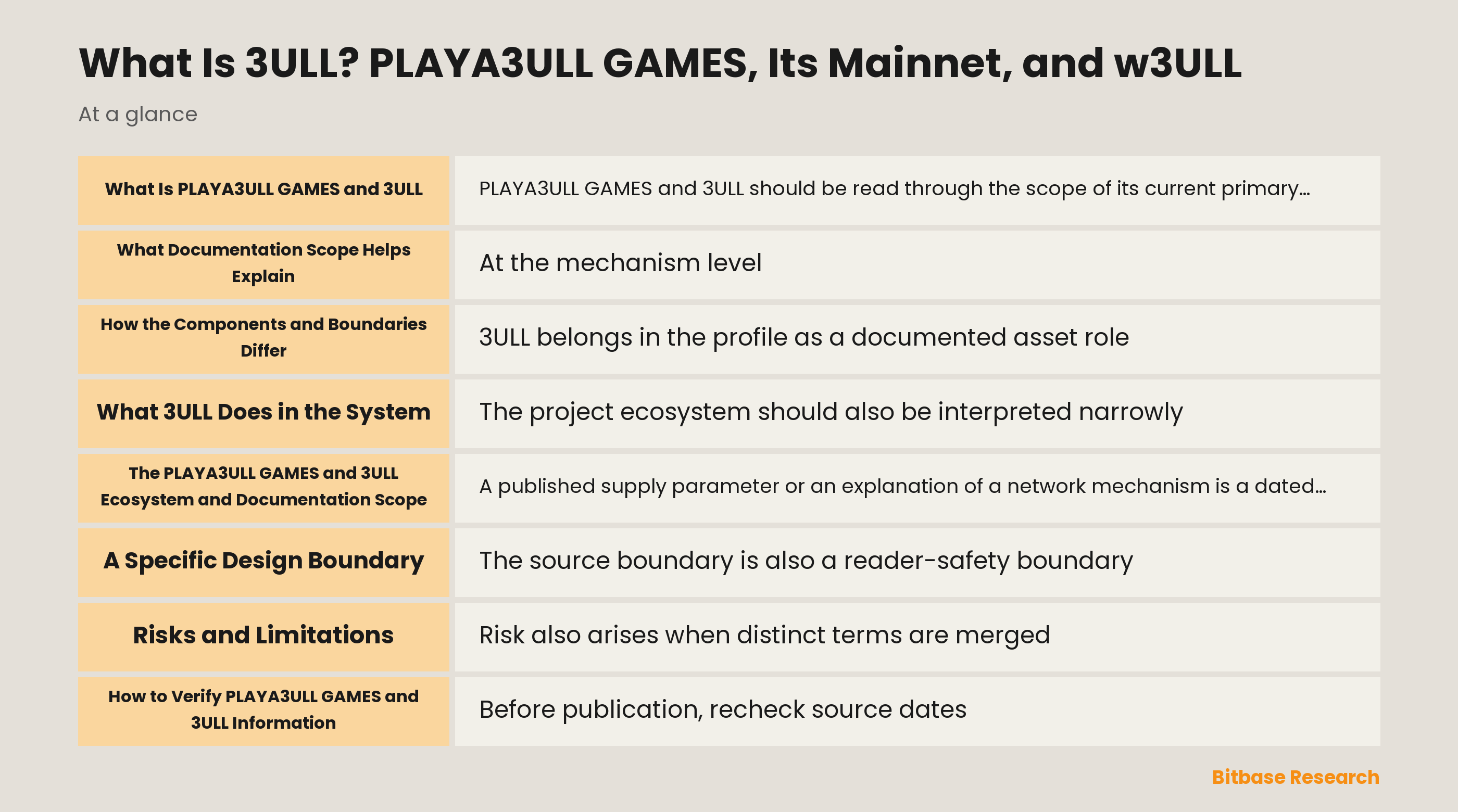
The market for the wrapped token is correspondingly thin. On DexScreener on 15 August 2026 the w3ULL contract on Avalanche showed three pools: the main TraderJoe pair against wrapped AVAX with 44,485 US dollars of liquidity and 325 dollars of trading over twenty-four hours, a second pair holding roughly 2,300 dollars, and a third under 100 dollars. On the same day CoinGecko showed four centralised markets for the ticker whose two-percent order-book depth was measured in hundreds of dollars per side, with the largest single venue carrying about 45 percent of the reported daily volume.
How PLAYA3ULL GAMES Differs from a Game Token on a Shared Chain
The first mechanical difference is where the fee goes. A game token on a shared chain is an ERC-20: users pay gas in a coin the studio does not issue, and the fee leaves the game's economy. Here the coin being spent is the chain's gas, and the fee is routed to the 0x1 address to be recycled into the reward schedule rather than paid out to an unrelated validator set. The cost is the mirror image: the representation tradable elsewhere is a wrapped receipt, and every cross-chain step adds a bridge to the trust list.
The second is who may participate, and at which layer. Issuance participation is bought: a master node licence is an NFT with a documented uptime duty and a designed ceiling of 50,000 nodes, and per-node rewards fall as more licences activate. Chain validation is separate, and the ecosystem page states that third-party Avalanche L1 validators are not currently being accepted. Many shared-chain game tokens invert this, with open validation and no node licence. These are different trust assumptions and failure surfaces, not a ranking.
Risks and Limitations
Identity risk comes first because it costs money immediately. The retired 3ULL v2 contract on Avalanche is still on-chain and still surfaces in scanners, wallet token lists and at least one abandoned pool, so anything quoted against 0x9e15f045e44ea5a80e7Fbc193A35287712Cc5569 is not the asset the current documentation describes. The live wrapped token has a different address per network, and the official links page points at both an Avalanche contract and a separate Ethereum token address, so an address quoted without its network is not an answer. Add the aggregator problem: a page headed 3ULL is tracking w3ULL on Avalanche, so neither its quote nor its supply number describes the native coin on chain 3011.
Activity and liquidity are the second cluster, and the figures above are the risk statement. A chain carrying roughly a hundred transactions across nearly six days generates almost no fee revenue, which undercuts the part of the design meant to sustain node rewards once issuance ends; the tokenomics page itself says chain fees are being accumulated rather than paid out. On the market side, a main pool holding 44,485 dollars with 325 dollars of daily turnover, and order books whose two-percent depth is in the hundreds of dollars, mean a position of any size cannot be assumed to exit near a screen quote. The project's links page routes to exchanges through affiliate registration links, which is not evidence that a pair is live; this article makes no claim about which venues still list the asset.
The rest is code, execution, concentration and regulation. No audit covering the current mainnet contract table was found this round: the project's public audit history lists two audits, the most recent delivered on 23 May 2023, and the scope named there is bridge and wrapped-token source files rather than the contracts the documentation publishes today, so treat the published coverage as partial. Half of daily issuance goes to the company by design, master node services are still marked Coming Soon, third-party validators are not accepted, the websocket endpoint is disabled and one wallet is officially supported, so a single operator remains load-bearing. Rules for game tokens, NFT sales and node licences differ sharply by jurisdiction, and this article makes no claim about how any of these assets is classified anywhere.
How to Verify PLAYA3ULL GAMES and 3ULL
Start from the domain, not from a search result. Type playa3ull.games and docs.playa3ull.games into the address bar yourself, and use the official site as the origin for every other link, including social accounts and exchange links; only the direction running outward from the official domain counts as evidence. Compare any domain character by character, and stop if a page reached from an advertisement or a message asks you to connect a wallet to claim anything.
Pin the network before you pin the address. The mainnet is chain ID 3011 with the symbol 3ULL and the RPC endpoint on the documentation's mainnet page, and its explorer is 3011.routescan.io. Because the native coin has no contract address, any address handed to you belongs to a wrapped representation and the network has to travel with it: 0xa77e70d0Af1Ac7fF86726740dB1Bd065c3566937 is the Avalanche one, while the official links page separately points at an Ethereum token address.
Then read the contract table and check it on the chain. The page at docs.playa3ull.games/chain/contract-addresses lists five contracts with their purposes, including the Node NFT, the two supply controllers and the TreasuryManager whose documented behaviour is to burn ten percent on withdrawal, and each entry links straight to the chain 3011 explorer. Open them there, confirm the deployment, and read the balances of the 0x0 and 0x1 addresses on the chain itself rather than trusting an aggregator's supply field, which describes the wrapped token on another network.
Finally, grade the claims by their source. Emission figures, node counts and node pricing are the project's own numbers with no third-party verification, so record the page and the date whenever you reuse them. For audits, find the report on the auditing firm's own site and check its delivery date and file list against the contracts you care about; a badge on a project page is weaker evidence than the report. For exchange availability, check the venue's own announcement or market page rather than a links page whose trading entries are affiliate registration links, and re-pull chain activity and pool depth on the day you publish.
Conclusion
PLAYA3ULL GAMES is a games company running its own EVM chain, chain ID 3011, where 3ULL is the native gas coin and w3ULL is the wrapped representation of that coin on Avalanche and other networks. The coin pays fees and carries a published issuance and burn schedule, including a TreasuryManager that burns ten percent on withdrawal and a separate permanent burn that lowers the 50 billion cap. As of 15 August 2026 the chain produces blocks but carries almost no transactions, and the 3ULL entry on market-data sites tracks that wrapped token rather than the native coin. Read the mainnet page for the chain parameters, take addresses from the official contract table, and confirm each one on the chain 3011 explorer before relying on anything here.
Related market pages
Bitbase pages for the tokens named in this article:
- 3ULL: View price
Related reading
Other Bitbase articles on this topic:
- What Is Azuki? An NFT Collection, IP, and Holder-Rights Boundaries
- What Is Habbo NFT? A Boundary-Based Guide to Habbo Collectibles
Disclaimer: This article is educational content from Bitbase Academy, provided for information only. It explains what a project does and what role its token plays in that system; it does not constitute investment, trading, tax, or financial advice, and it is neither a recommendation nor an endorsement of any project or token. Bitbase has not carried out due diligence on the project described here, and mentioning it does not mean Bitbase lists or supports the asset. Crypto assets carry significant risk, including price volatility, thin liquidity, smart-contract failure, regulatory uncertainty, and the possible loss of their entire value. Its contracts have not been publicly audited, or the published audit covers only part of the code. Written as of August 2026; a project's status, tokenomics, team, and contracts can change at any time. Verify everything yourself through official channels, the contract address, and a block explorer, and beware of imitation sites and phishing links.
References
[1] PLAYA3ULL GAMES, official documentation: Important Information (native blockchain, w3ULL as token representation, 3ULL v2 on Avalanche no longer in use) docs.playa3ull.games
[2] PLAYA3ULL GAMES, official documentation: Mainnet (chain ID 3011, RPC endpoint, currency symbol, block explorers) docs.playa3ull.games
[3] PLAYA3ULL GAMES, official documentation: Contract Addresses (Node, SupplyController, ProtocolSupply, HODL Event, TreasuryManager with 10 percent burn on withdrawal) docs.playa3ull.games
[4] PLAYA3ULL GAMES, official documentation: Tokenomics (50 billion total, 13,698,630 coins released per day, node count design and node price ladder) docs.playa3ull.games
[5] PLAYA3ULL GAMES, official documentation: Coin Burn (gas fees to 0x1, ten percent of ecosystem earnings to 0x0, treasury manager behaviour) docs.playa3ull.games
[6] PLAYA3ULL GAMES, official documentation: Official Links (website, dApp, explorer, whitepaper, Avalanche and Ethereum token pages, audit link) docs.playa3ull.games
[7] PLAYA3ULL GAMES, official documentation: Avalanche L1 (states that third-party Avalanche L1 validators are not currently accepted) docs.playa3ull.games
[8] Routescan block API for chain 3011, block list read 15 August 2026 (block timestamps and transaction counts) api.routescan.io
[9] DexScreener token API for w3ULL on Avalanche, read 15 August 2026 (pool liquidity and 24-hour volume) api.dexscreener.com
[10] CoinGecko page for the 3ULL ticker, read 15 August 2026 (platform note that the listing migrated to the Avalanche w3ULL contract; centralised market list and order-book depth) coingecko.com