Its one hundred members are chosen by where they list and by what they are not: the Nasdaq-100 holds the largest Nasdaq-listed companies that the industry classification does not place in the financial sector. NQ is the CME futures contract written on that index, MNQ is the Micro contract, ten times smaller, and both settle in cash against a single opening calculation four times a year. What follows is how the index is defined, what the contract inherits from it, and the stretch of every day when the contract trades and the index is not being published at all.
The Index NQ Is Written On
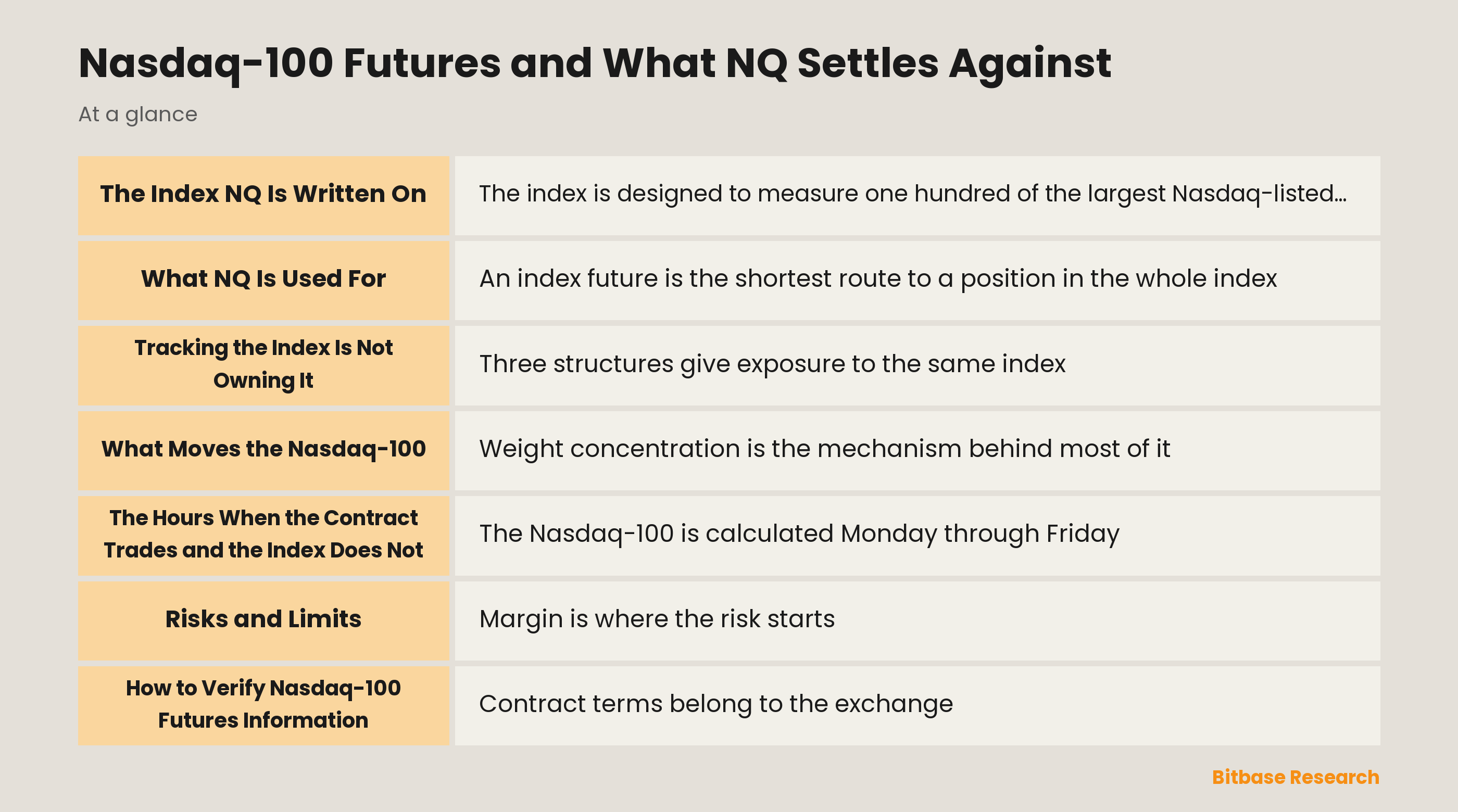
The index is designed to measure one hundred of the largest Nasdaq-listed non-financial companies, and it weights them by a modified capitalisation scheme rather than a plain one. Two conditions decide who is in it, and neither of them asks what a company does.
The first condition is a listing requirement. A member has to be primarily listed on a US Nasdaq-affiliated exchange, which makes the index a slice of one exchange's roster rather than a reading of the US market. The second condition is an industry exclusion, decided by the ICB classification scheme: anything filed under the Financial Industry is barred, and real estate investment trusts and special purpose acquisition companies are ruled out by security type as well. Calling the result a technology index describes what those two conditions happen to produce rather than what they say.
One hundred companies is also not the same as one hundred securities. Multiple share classes issued by the same company are each eligible, so one company can occupy two lines, and an expedited-addition provision lets a large newcomer join without displacing anyone, which can carry the count above one hundred until the next scheduled event. The membership is reviewed once a year with a December effective date, and the weights are adjusted at three further points in the year.
What NQ Is Used For
An index future is the shortest route to a position in the whole index. Assembling the underlying would mean a hundred holdings kept in the right proportions through every revision of the membership; the contract replaces that work with a single line, sized by its multiplier.
Hedging is the other standard use. A book concentrated in large US growth names can be offset by a short position in a contract that responds to the same conditions, without selling the holdings themselves and without the decisions that selling would force.
The two sizes exist so that the position can be scaled. The E-mini is worth $20 per index point and the Micro is worth $2 per point, which changes the smallest position that can be carried without changing anything about how the contract works. A trader who wants a tenth of the exposure trades MNQ rather than a fraction of NQ, because fractions of a futures contract do not exist.
Tracking the Index Is Not Owning It
Three structures give exposure to the same index, and they are not substitutes for one another.
A fund share is ownership of a portfolio. The fund holds the constituents, the share has no expiry and no margin requirement, and it trades in the exchange session. What the Nasdaq-100 tracking fund is, and what it becomes on a crypto venue, is a separate subject covered in the QQQ profile.
A dated future holds nothing. It is an agreement about the level of the index at a future date, entered on margin, marked to market daily and closed out in cash. No dividends are paid on it, because there are no shares inside it, although expected dividends are one of the inputs to the price at which it trades relative to the index itself.
A perpetual holds nothing either, and it also removes the expiry date. In place of a series of dated contracts it uses a periodic funding payment between the two sides of the market, so its cost accumulates by the hour rather than at fixed dates.
What Moves the Nasdaq-100
Weight concentration is the mechanism behind most of it. Under a modified capitalisation scheme the largest members carry the bulk of the index, so a small number of earnings dates behave like index-wide events, and the guidance of one company can set the direction of a contract written on a hundred of them. The methodology puts a ceiling on how much any single company may carry and on the combined weight of the biggest ones, and breaching a ceiling between scheduled events can force a special rebalance: weights cut for a mechanical reason rather than because anyone re-rated a business.
Index maintenance is a dated event rather than a surprise. Reference dates, announcement dates and effective dates for the annual review and the quarterly weight adjustments are all published in advance, and the funds built on the index have to follow them, so the flow around those dates is known to be coming.
Scheduled macro releases move the whole index at once, and the ones that land outside the cash session move it in a particular way, because the contract prices them while the constituent shares are not trading at all. The move exists in the futures market first, and the index records it only when the underlying market reopens.
One driver has nothing to do with the companies. The price of a dated contract embeds the cost of carrying the position to expiry, so the distance between the contract and the index moves with interest rate expectations on its own.
The Hours When the Contract Trades and the Index Does Not
The Nasdaq-100 is calculated Monday through Friday, and not on days when US markets are closed. Its value is published once a second through the session, and it stops for the day shortly after the cash close. The contract does not stop: NQ trades from Sunday evening through Friday afternoon, US time, with a short daily maintenance break.
For most of any given day, then, the contract quotes a market whose underlying index is not being calculated. What the overnight price expresses is an expectation of where the index will be when it is next computed, not a measurement of where it is. This is why the gap a cash-market participant meets at the open has already been traded: overnight, in the futures, at a time when the constituent shares themselves were unavailable.
The one index value a contract ever settles against is an opening print, not a close. On the third Friday of the expiry month the index is computed as a Special Opening Quotation, assembled from the opening prices of the constituents as each of them opens for trading, so the last price at which the contract changes hands is never the price it settles at.
Risks and Limits
Margin is where the risk starts. Leverage means the notional value under the position is a multiple of the cash held against it, and the daily settlement of gains and losses converts an adverse move into money that has to be there that day.
Holding through an expiry is a decision rather than a default. Final settlement will close the position in cash on its own schedule, and staying in the market past that date requires opening the following contract while the depth in the two of them is shifting.
Weekends interrupt a session that otherwise runs almost without pause. Whatever happens between the Friday close and the Sunday reopen arrives at once in the first prints, at levels nobody had the chance to trade through.
The composition can change underneath a position. Membership and weights are set by rule and revised on a published calendar, and a concentration breach can bring a revision forward, so the index a position was opened against is not necessarily the index it settles against.
Financing is a cost that direction does not offset. Carrying a dated contract to expiry has that cost embedded in its price, and it is paid whether or not the view turns out to be right.
How to Verify Nasdaq-100 Futures Information
Contract terms belong to the exchange. CME maintains a product page for each of the two contract sizes, carrying the multiplier, the minimum tick, the listed months, the last trading day, the final settlement procedure and the session schedule. Margin appears in the same place, is revised often, and sets only a floor: a broker is free to ask for more than the exchange does.
Index rules belong to Nasdaq. Its published methodology for the index sets out who qualifies, how far a single weight is allowed to go and when the composition is revised, and changes are announced before they take effect rather than reported afterwards.
For equity-linked products listed on a crypto venue, the tokenized stock lineup shows what that venue carries. Whatever is going to be traded, the binding description of it is the specification issued for that instrument on that venue.
Conclusion
NQ settles in cash, expires quarterly, and rests on an index whose membership is decided by a listing venue and an industry exclusion rather than by any judgement about what the companies do. Three properties do most of the explaining: the notional under the position is a multiple of the money behind it, the settlement value is an opening calculation rather than a close, and for most hours of the week the index it tracks is not being calculated. MNQ scales the first of those down. The other two hold at any size.
Related reading
Other Bitbase articles on this topic:
- How to Trade CRCL: The Company That Issues USDC
- How to Buy CRM: Two Routes to Salesforce Stock on Bitbase
- How to Trade DIA, the Dow Jones Industrial Average ETF
- RARI After the Rarible Sale: What the Foundation and the Token Still Govern
Disclaimer: This article is educational content from Bitbase Academy, provided for information only. It explains what a company or fund does and how the instruments referenced here differ from one another; it does not constitute investment, trading, tax, or financial advice, and it is neither a recommendation nor an endorsement of any security, token, or trading strategy. A tokenized stock is issued by a third party and is designed to give economic exposure to an underlying asset: it is not a share, it carries no shareholder rights, and it depends on the issuer's structure, eligibility rules, and redemption terms, which the issuer can change. Perpetual futures are leveraged derivatives that hold no underlying asset and can be liquidated, and trading hours, product availability, and eligibility differ by instrument and by jurisdiction and can change at any time. Written as of September 2026; verify everything yourself through company filings, the issuer's own documentation, and the product pages of the venue you trade on.
References
[1] CME Group: E-mini Nasdaq-100 futures contract specifications www.cmegroup.com
[2] CME Group: Micro E-mini Nasdaq-100 futures contract specifications www.cmegroup.com
[3] Nasdaq: Nasdaq-100 Index methodology indexes.nasdaq.com