Sorting the semiconductor industry by market size comes last in the construction of SOXX. What comes first is a decision about which businesses belong to that industry at all, and the fund's prospectus hands that decision to a classification schema run by the index provider rather than to BlackRock. Thirty names survive both steps, the fund tracks them with a sample rather than a full copy, and the Bitbase price page for this ticker carries a Dinari tokenized ETF label whose terms are Dinari's own.
What Is the iShares Semiconductor ETF (SOXX)?
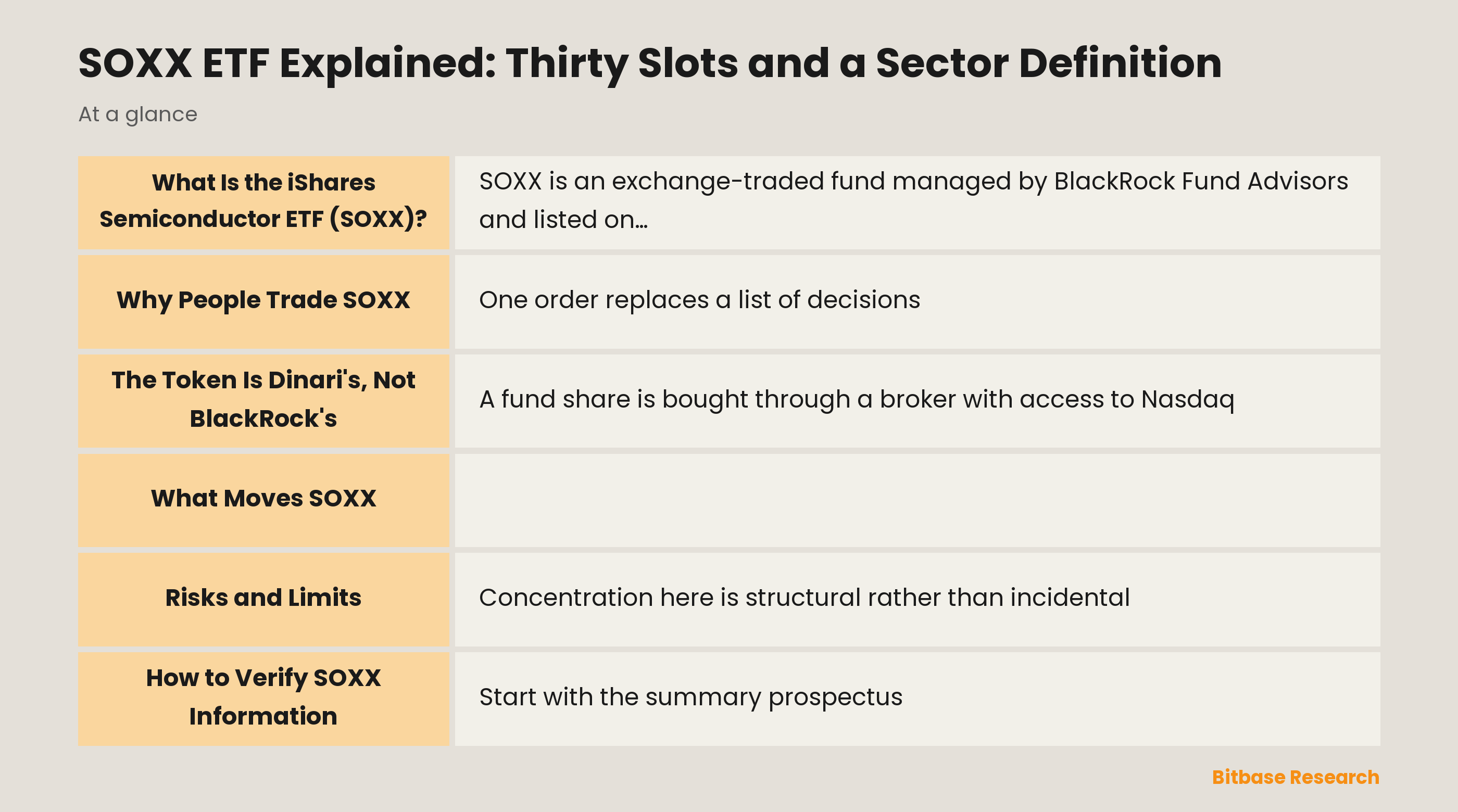
SOXX is an exchange-traded fund managed by BlackRock Fund Advisors and listed on Nasdaq. Its summary prospectus states the objective plainly: the fund "seeks to track the investment results of an index composed of U.S.-listed equities in the semiconductor sector."
The index does the selecting. The prospectus names it as the NYSE Semiconductor Index, "which measures the performance of the equity securities of the 30 largest U.S.-listed companies that are classified according to the ICE Uniform Sector Classification schema within the semiconductors industry". Two rules are stacked in that sentence. A classification decides who is eligible; a size ranking decides which of the eligible take the thirty slots.
What counts as the industry is written down, and it is wider than the everyday use of the word. The prospectus says it includes companies that "either manufacture materials that have electrical conductivity (semiconductors) to be used in electronic applications or utilize LED and OLED technology", and "also includes companies that provide services or equipment associated with semiconductors such as packaging and testing". Display technology and back-end assembly sit inside the definition alongside chip design.
The fund does not promise to hold all of it. BlackRock "uses a representative sampling indexing strategy", defined in the prospectus as "investing in a representative sample of securities or other instruments intended to collectively have an investment profile similar to that of an applicable underlying index." What is committed is a floor rather than a copy: "Under normal circumstances, the Fund will not invest less than 80% of the value of its net assets, plus the amount of any borrowings for investment purposes, in components of its Underlying Index."
Why People Trade SOXX
One order replaces a list of decisions. Someone who wants exposure to semiconductors without choosing between a designer, a foundry and an equipment maker holds the basket and lets the index rule settle the membership.
The width of the definition is part of what is being bought, and it cuts both ways. Because the classification reaches display technology and back-end services, this is not a pure position in leading-edge logic; because the slots stop at thirty and go out by size, it is not a survey of the whole industry either.
The link to crypto is not written into the fund. The index rule references no digital assets, so any connection a holder trades on is their own thesis about shared demand for computing hardware, not something the prospectus supplies.
The Token Is Dinari's, Not BlackRock's
A fund share is bought through a broker with access to Nasdaq. It makes you a shareholder in the fund, and the fund holds the companies. One wrapper stands between you and the businesses.
A tokenized version adds a second wrapper, built by somebody else entirely. The Bitbase price page for this ticker carries a Dinari tokenized ETF label, and Dinari's documentation is where the terms live. A dShare is described there as "a token 1:1 backed by a security, commonly a U.S. equity", created or destroyed only after the corresponding brokerage order has been filled through Alpaca. Trading runs in windows rather than one continuous session: the regular US session, pre-market and after-hours periods that take limit orders only, an overnight window on the same terms, and a separate on-chain window covering weekends for a subset of tickers, where liquidity is thinner. A market order sent outside the regular session is handled as a marketable limit order, and may fill in full, in part, or not at all. Dividends are calculated once the underlying cash arrives and paid out as USD+ to holders of the dShare itself, with a minimum below which nothing is distributed. Who may hold the token is set in that documentation, not by BlackRock and not by the exchange.
A perpetual futures contract is a third structure, and it holds nothing at all. It tracks a price with leverage, pays or charges funding, and can be liquidated. Which of these surfaces exists for any given ticker is a property of the venue rather than of the fund, and the tokenized equity lineup is where that is kept current.
What Moves SOXX
Rank changes that nobody at the company decided. With exactly thirty slots handed out by size, an addition is a whole slot and so is a deletion. A business can report nothing at all and still enter or leave because the companies around it moved. That is arithmetic about the ranking, and it reaches the fund all the same.
A reclassification. Membership begins with how the ICE Uniform Sector Classification schema files a company. One refiled out of semiconductors leaves the eligible universe whatever it sells, and one refiled in becomes eligible without changing anything it does. That schema belongs to the index provider, so the lever sits outside the companies and the sponsor alike.
The cycle the prospectus warns about. The risk disclosure is specific: "The semiconductor industry is characterized by rapid technological change and product obsolescence, cyclical market patterns, price erosion, periods of over-capacity and production shortages, variations in manufacturing costs and yields, and significant expenditures for capital equipment and product development." Those variables do not arrive together, and a basket spanning design, equipment and back-end services can hold companies at opposite ends of one cycle.
The distance between the fund and its index. A sampling strategy and an investment floor, rather than a replication promise, leave the holdings and the index constituents as two lists that need not match exactly. What separates the fund's return from the index's is tracking error, and sampling is one of the things that produces it.
Risks and Limits
Concentration here is structural rather than incidental. The fund "is classified as 'non-diversified'", which the prospectus explains means it "may invest a greater percentage of its assets in securities or other instruments representing a small number of issuers or counterparties." Thirty slots inside one industry is a narrow base, and reading the fund as a diversified holding misreads what it is.
The rulebook itself can be replaced. The prospectus records that this fund's benchmark has already changed once: "The NYSE Semiconductor Index (Spliced) reflects the performance of the PHLX Semiconductor Sector Index through June 20, 2021 and the NYSE Semiconductor Index thereafter." Reading the current methodology tells you the rule in force now, not the rule that will be in force later.
Two funds can carry the same sector label and hold different companies, because the label is not what selects them. Bitbase carries a second semiconductor fund under its own ticker, and the question to put to either is which index sits behind it.
The token adds issuer risk on top of fund risk. What a dShare is worth depends on Dinari's arrangement continuing to work, and its backing, sessions, dividend route and eligibility are terms Dinari sets and can change. None of that is governed by BlackRock or by the index provider.
Sessions do not line up. The fund's own market prices during Nasdaq hours, while the token's windows run past them and, for some tickers, across the weekend on-chain. News arriving while the primary market is shut moves the token against a reference price that has stopped updating, and orders placed in those windows are limit orders that may go unfilled.
How to Verify SOXX Information
Start with the summary prospectus. BlackRock files it with the SEC and it is public on EDGAR: the objective, the index name, the classification schema, the sampling language and the investment floor are all there in the fund's own words, with a filing date attached.
Go to the index side for membership questions. ICE Data Indices is named in the prospectus as the index provider, so the methodology and review calendar for the NYSE Semiconductor Index belong to it, not to BlackRock. Why a company is or is not in this fund is answered there.
Check the date on any performance chart. Because the benchmark changed in June 2021, a long-run comparison against "its index" measures this fund against two indexes joined end to end, which is what the prospectus flags by calling that series spliced. The sponsor's fund page carries holdings as of a stated date, and that date deserves as much attention as the list beside it.
For the token, read Dinari's documentation. Backing, the role of the brokerage, the trading windows, how orders are handled outside the regular session, dividends and eligibility are defined there. On Bitbase, the price page is the reference for this ticker.
Conclusion
SOXX holds thirty semiconductor companies picked by two rules that belong to other people, and BlackRock then tracks that list with a sample rather than a copy. On Bitbase the ticker carries a Dinari tokenized ETF label, and what that token is, when it trades and who may hold it are answered in Dinari's documents rather than in the fund's. Working out which document governs the thing you actually hold is the first question to settle, not the last.
Related market pages
Bitbase pages for the tokenized stocks named in this article:
- SOXX: View price
Related reading
Other Bitbase articles on this topic:
- How to Trade MA: Mastercard, the Network Behind the Card
- How to Trade MARA: A Bitcoin Miner That Also Holds Bitcoin
- How to Buy META: The Tokenized Stock and the Perpetual
Disclaimer: This article is educational content from Bitbase Academy, provided for information only. It explains what a company or fund does and how the instruments referenced here differ from one another; it does not constitute investment, trading, tax, or financial advice, and it is neither a recommendation nor an endorsement of any security, token, or trading strategy. A tokenized stock is issued by a third party and is designed to give economic exposure to an underlying asset: it is not a share, it carries no shareholder rights, and it depends on the issuer's structure, eligibility rules, and redemption terms, which the issuer can change. Perpetual futures are leveraged derivatives that hold no underlying asset and can be liquidated, and trading hours, product availability, and eligibility differ by instrument and by jurisdiction and can change at any time. Written as of September 2026; verify everything yourself through company filings, the issuer's own documentation, and the product pages of the venue you trade on.
References
[1] iShares Semiconductor ETF summary prospectus (Form 497K), July 31, 2026: objective, the NYSE Semiconductor Index, the ICE Uniform Sector Classification schema, representative sampling, the 80% policy and the spliced-index note www.sec.gov
[2] iShares Semiconductor ETF summary prospectus (Form 497K), July 2025: the semiconductor industry risk paragraph and the non-diversification risk paragraph, quoted in full www.sec.gov
[3] iShares Semiconductor ETF fund page: the Nasdaq listing, the current index name and the holdings count as of a stated date www.ishares.com
[4] Dinari documentation, What is a dShare: the 1:1 backing, and creation and redemption only after the corresponding brokerage order fills through Alpaca docs.dinari.com