A company that spent its first decade selling hashrate now describes itself as an energy infrastructure platform, and that change is where the confusion about HUT starts. Hut 8 Corp. trades on Nasdaq and the Toronto Stock Exchange, consolidates a separately listed bitcoin miner it does not wholly own, and on Bitbase appears not as a share but as a token issued by Robinhood. This profile covers what the company owns, what actually moves it, and how the token differs from the stock.
What Is Hut 8 Corp. (HUT)?
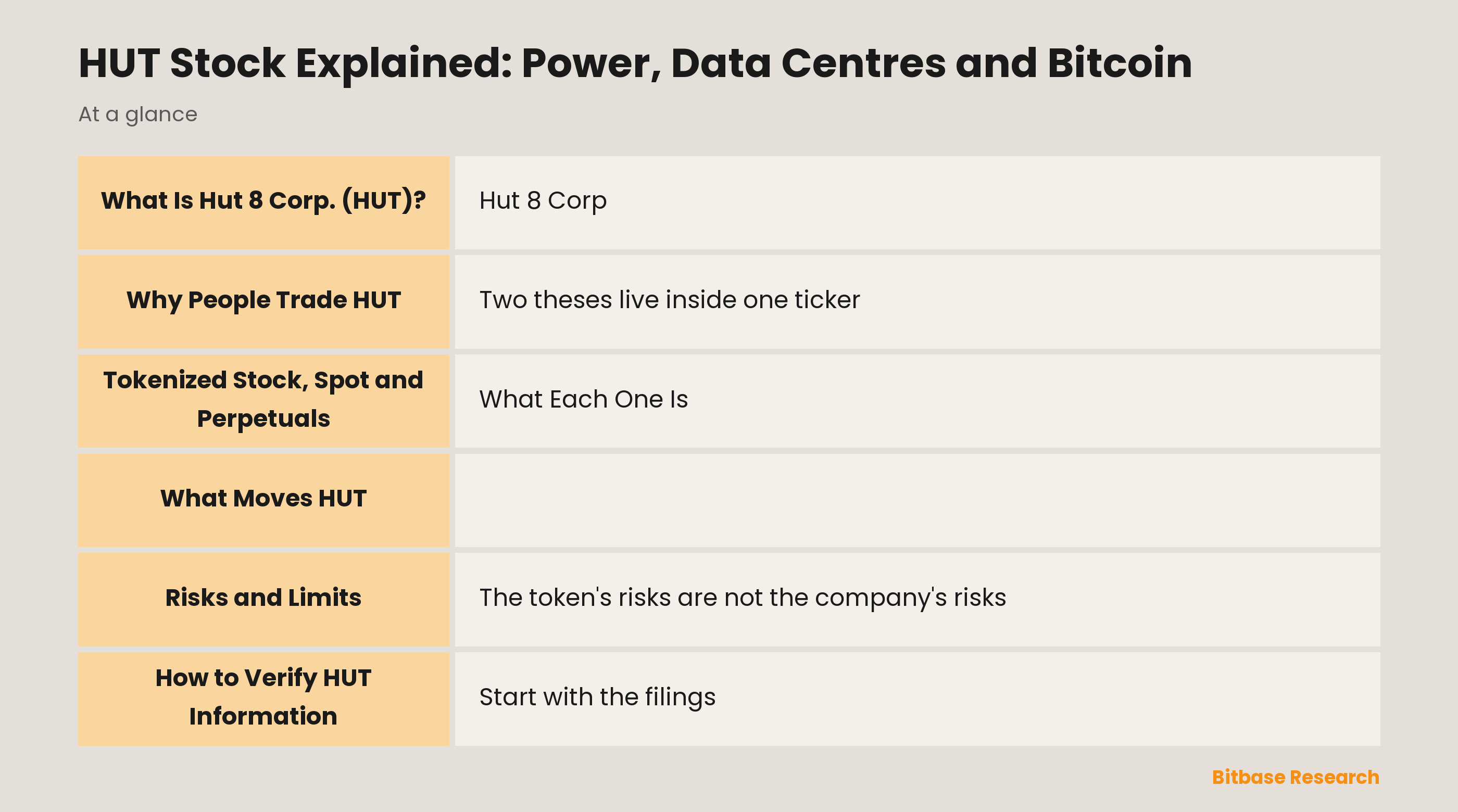
Hut 8 Corp. is a US-domiciled company formed on November 30, 2023, when Hut 8 Mining Corp and U.S. Data Mining Group, Inc., doing business as US Bitcoin Corp, combined in what the two sides called an all-stock merger of equals. The combined shares began trading on Nasdaq and the Toronto Stock Exchange under the ticker HUT in early December of that year, and the head office is in Miami.
The company now describes itself as "an energy infrastructure platform integrating power, digital infrastructure, and compute at scale to fuel next-generation, energy-intensive technologies such as AI, high-performance computing, and ASIC compute." The phrase covers a lot of ground, and it maps onto three reportable segments that are the clearest way into the business.
Power acquires, develops and manages the electrical assets everything else depends on: interconnects, substations, switchyards, generation and the systems that tie them together. Digital Infrastructure designs, builds and operates the facilities that sit on top of that power, purpose-built for energy-intensive workloads. Compute owns and operates the businesses that fill those facilities with specialised hardware. Read in order, the three describe a chain the company assembled end to end: secure the megawatts, build the shell, then decide what runs inside it.
The last decision is where Hut 8 has changed most. Its mining fleet no longer sits on the balance sheet as a wholly-owned operation. In 2025 the company contributed substantially all of its wholly-owned miners into what became American Bitcoin Corp, taking a controlling equity and voting stake in exchange; American Bitcoin then went public through a stock-for-stock merger with Gryphon Digital Mining and now trades on Nasdaq under its own ticker. Hut 8 consolidates it as a majority-owned subsidiary, with third parties holding the remainder. A HUT shareholder therefore owns a controlling interest in a listed miner rather than owning the miner itself, and that distinction runs through everything below.
Why People Trade HUT
Two theses live inside one ticker, and a position in HUT is a position on both of them at once.
The first is infrastructure. The Digital Infrastructure business converts energised capacity into long-dated leases, and the company describes those leases as triple-net and take-or-pay, signed with investment-grade counterparties and produced by a power-first development model it calls repeatable across tenants and geographies. Read that way, HUT is a developer of computing capacity whose value is a pipeline of megawatts plus the contracts attached to them.
The second is bitcoin. Through the consolidated stake in American Bitcoin, the company retains exposure to bitcoin mining economics, and traders who want that exposure inside an ordinary brokerage account, without a wallet or a custody arrangement, have long reached for miner equities to get it. The reasoning is operating leverage: a miner's costs are largely fixed over short horizons while its revenue tracks a volatile commodity, so a move in the coin is supposed to arrive at the equity magnified. Whether it arrives magnified in any particular stretch is an empirical question, not a property of the structure.
The third reason is that the two theses argue with each other. A period where lease signings go well and bitcoin goes badly, or the reverse, produces a stock that is genuinely hard to price, and instruments that are hard to price attract volume.
Tokenized Stock, Spot and Perpetuals: What Each One Is
Three structures can carry the letters HUT, and they are not variations on a single product.
A share is the registered instrument. Bought through a broker on Nasdaq or the Toronto Stock Exchange, it makes you a shareholder of Hut 8 Corp., with whatever rights that carries.
A stock token is something else. The Bitbase price page for this ticker lists Hut 8 Corp. as a Robinhood Token, and Robinhood's own description of the product is unusually blunt: its classic stock tokens "are derivative contracts between you and Robinhood," priced at the prices of the underlying securities "without granting rights to them." The underlying assets are owned by Robinhood and held with a US-licensed institution, and the token grants no rights to the underlying shares. Where an underlying pays a dividend, Robinhood passes a corresponding amount to eligible holders in cash. Trading runs from Monday at two in the morning Central European time to Saturday at the same hour, which is longer than an exchange session and shorter than a continuous market. The issuer is Robinhood Europe, UAB, supervised by the Bank of Lithuania, and the product is offered to eligible investors in the European Union.
That deserves restating, because the vocabulary invites the wrong assumption. This is not a share held on your behalf, and it is not the same legal form as the tokenized stocks other issuers put on a similar page. Issuers differ in exactly the places that matter, and the terms deciding what you hold come from the issuer's documentation rather than the venue's listing.
A perpetual futures contract is a third structure again. It holds nothing at all: no share, no token, no claim on the company. It tracks a price with leverage, settles in stablecoin, pays or receives funding between longs and shorts, and can be liquidated. Which of these surfaces exists for any given ticker differs by name, and the tokenized stock listings page is where to check rather than assume.
What Moves HUT
Lease announcements move it in steps. Because the Digital Infrastructure model converts capacity into contracted revenue one agreement at a time, a single signature can reprice the whole pipeline behind it. The market is not marking a slow operating trend; it is updating a probability that the remaining megawatts get contracted on comparable terms.
Power comes first, so power timing dominates. The scarce input is neither land nor capital but energised capacity: interconnection agreements, substation work, and the date a site can actually draw load. Slipping energisation dates push out delivery, and delivery dates are what the leases are written against. This driver has no analogue in an asset-light technology company, and it is why the company's own description puts Power ahead of the other two segments.
Bitcoin still matters, but it now arrives through a filter. With mining housed in a consolidated subsidiary that third parties partly own, the coin's price reaches Hut 8's reported results indirectly, and reaches a shareholder's economics more indirectly still. The halving remains the structural event for that part of the business, cutting the block subsidy and compressing the margin between energy cost and mining revenue. Anyone modelling HUT as a straightforward levered bitcoin position is modelling the company it used to be.
The consolidated stake has its own quote. Because American Bitcoin trades separately, part of Hut 8's value carries a public mark that can move on a day when nothing has happened at Hut 8 at all.
Financing has two possible homes here. Computing capacity is built before it earns, so the buildout is funded ahead of revenue, and this structure gives that money two places to land. Capital raised at Hut 8 as equity dilutes existing holders directly. Capital raised at American Bitcoin leaves the parent's share count untouched and thins its stake in the miner instead. Only the reports say which.
Risks and Limits
The token's risks are not the company's risks. Holding a Robinhood stock token means holding a contract with Robinhood; its value depends on the issuer's structure and on terms the issuer sets and can change, and eligibility is defined by the issuer's jurisdiction rather than by the exchange where the underlying trades. No shareholder claim on Hut 8 sits behind it.
Session structure creates gap risk in both directions. The token quotes for five days of each week while Nasdaq and the Toronto Stock Exchange run ordinary sessions, so news can be priced into the token while the primary market is shut. There is also a weekly window when the token itself does not trade, and a position held across that window cannot be adjusted.
Perpetuals add a running cost and a forced exit. Funding accrues in whichever direction the crowd sits, and a directionally correct position held long enough can still lose to it. Leverage shortens the distance to liquidation, and equity-referenced contracts can gap around scheduled corporate events in a way continuous crypto markets often do not.
The company's own risks are concentrated and specific. Lease revenue depends on a small number of large counterparties. Development depends on utilities, permits and equipment deliveries outside the company's control. The mining exposure depends on bitcoin and on power prices at the same time, and those two can turn against each other. And consolidated figures include a business that other shareholders partly own, so reading a top line without the minority interest overstates what a HUT share is entitled to.
How to Verify HUT Information
Start with the filings, because the structure is what makes this share unusual and the filings are where the structure is stated. The annual and quarterly reports carry the segment breakdown, the description of the American Bitcoin arrangement, and the risk factors that name the interconnection, counterparty and commodity exposures directly. The company's investor relations pages carry the same documents plus the announcements that move the stock between reports.
American Bitcoin files separately. Reading only the parent gives you the consolidated picture; reading both gives you the split between what Hut 8 owns outright and what it merely consolidates, which is the distinction this share turns on.
For the token, go to the issuer. Robinhood's European product materials are the authority on what a stock token is, what it does not grant, when it trades and who may hold it, and they are a separate document from anything the venue publishes. For the quote and the market data, the Bitbase price page for this ticker is the reference.
Conclusion
HUT is not the bitcoin miner its history suggests, and on Bitbase it is not a share. The company is an energy and computing infrastructure developer that also consolidates a separately listed miner, so a shareholder is buying a pipeline of contracted megawatts alongside a controlling interest in someone else's mining business. The instrument on the price page is a derivative contract with Robinhood that tracks the stock without conveying what the stock conveys. Both facts point the same way: work out which exposure you are actually taking before you size it, because the ticker by itself will not tell you.
Related market pages
Bitbase pages for the tokenized stocks named in this article:
- HUT: View price
Related reading
Other Bitbase articles on this topic:
- How to Trade JPM: Rates, Credit and a Tokenized Bank Stock
- How to Trade KO: Concentrate, Currency and the Dividend
- How to Trade MA: Mastercard, the Network Behind the Card
Disclaimer: This article is educational content from Bitbase Academy, provided for information only. It explains what a company or fund does and how the instruments referenced here differ from one another; it does not constitute investment, trading, tax, or financial advice, and it is neither a recommendation nor an endorsement of any security, token, or trading strategy. A tokenized stock is issued by a third party and is designed to give economic exposure to an underlying asset: it is not a share, it carries no shareholder rights, and it depends on the issuer's structure, eligibility rules, and redemption terms, which the issuer can change. Perpetual futures are leveraged derivatives that hold no underlying asset and can be liquidated, and trading hours, product availability, and eligibility differ by instrument and by jurisdiction and can change at any time. Written as of September 2026; verify everything yourself through company filings, the issuer's own documentation, and the product pages of the venue you trade on.
References
[1] Hut 8 investor relations: reports, segment disclosure and the announcements that move the stock between reports hut8.com
[2] SEC EDGAR: Hut 8 annual filings, including the segment breakdown and the risk factors on interconnection, counterparties and commodity exposure www.sec.gov
[3] Robinhood Europe: what a classic stock token is, what it does not grant, its trading hours and who may hold it robinhood.com