One of the words in this fund's name is new. Vanguard renamed it the Vanguard Morningstar Total Stock Market ETF in July 2026, after the index behind it was rebranded from CRSP to Morningstar, and Vanguard's own notice says the index construction methodology and the funds' investment objectives, strategies and policies were all left identical. Two older facts matter more than the label: this fund does not hold everything its index contains, and what is listed under VTI on a Bitbase price page is a Robinhood derivative contract rather than a share of the fund.
What Is the Vanguard Morningstar Total Stock Market ETF (VTI)?
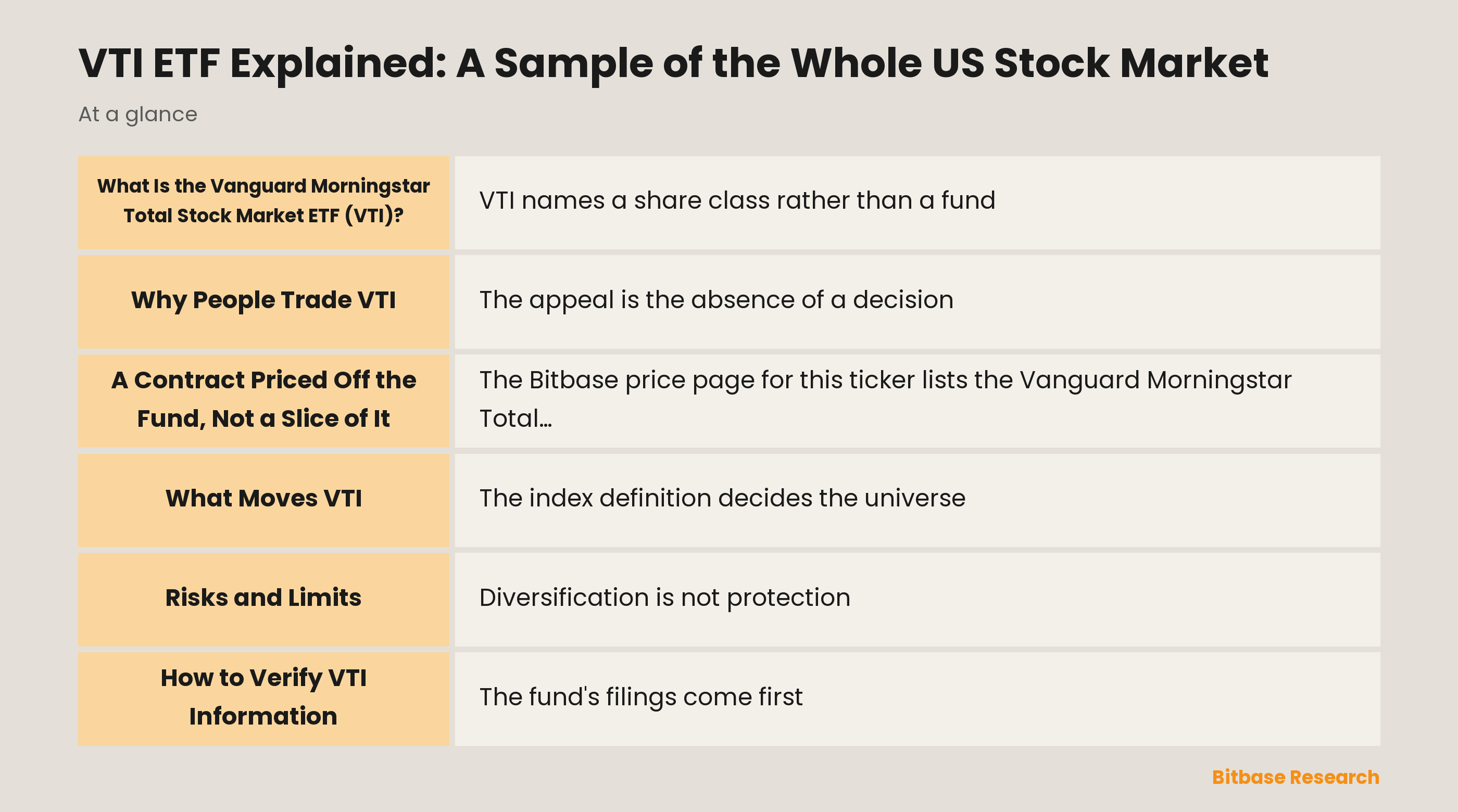
VTI names a share class rather than a fund. The summary prospectus filed in April 2026 introduces it as Vanguard Total Stock Market ETF, an exchange-traded share class of Vanguard Total Stock Market Index Fund, and describes the ETF shares themselves as exchange-traded fund shares that are not individually redeemable and are listed on NYSE Arca. Those were the names in force when the document was filed; the rename came a few months later. The portfolio belongs to the fund, and the ticker is how one class of it quotes on an exchange.
The objective fits in a clause. The fund seeks to track the performance of a benchmark index that measures the investment return of the overall stock market. Its target index represents the whole of the investable US stock market and takes in large-, mid-, small- and micro-cap stocks regularly traded on the New York Stock Exchange and Nasdaq, so the smallest listed companies sit inside the definition rather than outside it.
Then comes the sentence that decides how the fund behaves. It invests by sampling the target index, meaning that it holds a range of securities that, in the aggregate, approximates the full target index in terms of key risk factors and other characteristics. Sampling is how a portfolio tracks an index of that width without buying every line in it, and the prospectus states the consequence in its own risk language: the fund does not hold all of the securities included in the target index.
The rename came from the index provider, not from the fund. Vanguard's announcement sets the order out. Following Morningstar's rebranding of the CRSP Market Indexes to Morningstar Indexes, the CRSP US Total Market Index became the Morningstar US Total Market Index, the fund and its ETF share class took the word Morningstar into their names in July 2026, and the change does not affect the funds' investment objectives or how they are managed. Vanguard's investor notice is blunter still: the way the indexes are built remains identical.
Why People Trade VTI
The appeal is the absence of a decision. Buying this share class requires no view on sectors, no factor tilt and no opinion about any individual company. The only judgment being expressed is that owning listed US equities broadly is worth doing at all.
Breadth is the other attraction, and it is a specific kind of breadth. The target index reaches from the largest listed companies down to micro caps regularly traded on the two main US exchanges, so the position does not stop where the familiar names stop. Vanguard runs a separate tracker on the S&P 500, and choosing between the two is choosing between two index definitions rather than between two management styles.
For some holders the wrapper matters as much as the exposure. A fund share has no expiry, no funding payment and no roll date; it can be held indefinitely without any further action, and the worst it can do is fall with the market it tracks. That is a lighter set of obligations than any leveraged instrument written on the same market carries, and it suits a different purpose.
A Contract Priced Off the Fund, Not a Slice of It
The Bitbase price page for this ticker lists the Vanguard Morningstar Total Stock Market ETF as a Robinhood Token, and that second label is the part that changes what the instrument is.
A fund share is bought through a broker on the exchange where the class is listed, and holding it makes you a shareholder of the fund whose portfolio stands behind it. That is the object the prospectus describes, and the rights that come with it are the fund's to define.
What Robinhood issues is not that object. Robinhood's European site defines its Classic Stock Tokens as derivative contracts between you and Robinhood, priced at the prices of the underlying securities without granting rights to them. The underlying assets of Classic Stock Tokens are owned by Robinhood and held with a US-licensed institution, and the tokens do not grant any rights to the underlying shares or ETPs. If the underlying stock or ETP pays a dividend, Robinhood passes on a corresponding amount to eligible holders in cash, which is a payment made by the issuer under the contract rather than a distribution made by the fund. Trading runs from Monday 2 AM CET to Saturday 2 AM CET, a schedule set by the issuer rather than by the exchange where the fund's share class is listed. The issuing entity is Robinhood Europe, UAB, supervised by the Bank of Lithuania.
Reading that definition slowly is the whole exercise. The word token invites the assumption that something is being held on your behalf and that the holding is yours; the issuer's own wording says otherwise, and says it in the first sentence. The chain here runs from companies to an index, from the index to a fund, from the fund to a share class, and from that share class to a contract calculated off its price. Only the last link in that chain is Robinhood's, and it is the only link a holder of the token actually owns.
What Moves VTI
The index definition decides the universe, and Vanguard does not write it. Additions, deletions and weight changes come from the index provider under a published methodology, and the fund's job is to keep approximating the result. A change to that methodology can therefore alter what the fund is exposed to without a single company in the portfolio having done anything at all.
Sampling puts a further decision between the index and the portfolio. Because the fund does not hold all of the securities in the target index, the prospectus warns that the representative sample selected by the advisor may, in the aggregate, vary from the investment profile of the full index. That is a live driver rather than a footnote. It is the reason a total-market fund's return and its index's return are two figures rather than one, and the distance between them is what tracking error measures.
The quote and the portfolio can also come apart on any given day. Vanguard states that although the market price of an ETF share is expected to approximate its net asset value, there may be times when the market price and the NAV differ significantly. What normally closes that distance is creation and redemption, and only Authorized Participants may engage in those transactions directly with the fund. The same prospectus adds that they are not obligated to engage in them.
Breadth changes which news matters. A fund built to track the return of the overall stock market responds to whatever moves listed equities as a class — the rate environment, the earnings cycle, the general appetite for risk — far more than to any single company's results. The wider the index definition, the more the fund reads as a statement about the market itself and the less it reads as a statement about anything inside it.
Risks and Limits
Diversification is not protection. Holding a broad slice of the listed US market removes the risk of picking the wrong company and removes nothing else; a market-wide decline is precisely what this instrument is built to transmit in full.
Sampling risk belongs to the fund itself. The prospectus names it without softening: the sample may vary in aggregate from the investment profile of the full index. That is not a defect, but it does mean an investor is holding the advisor's construction of the index rather than the index.
Index dependency is structural. Vanguard follows the index instead of correcting it, so a decision taken by the index provider becomes a trade for the fund and a change of exposure for the holder, with no step in between at which anyone at Vanguard weighs the merits of the companies involved.
The Robinhood contract carries risks the fund does not. It is an obligation of an issuer, and its terms — who may hold it, how dividends are handled, when it trades, what happens in a corporate action — belong to that issuer to set and to change. Its trading week is not the fund's trading week either, so the contract can move on news while the market for the underlying share class is shut, and none of that appears anywhere in the fund's own documents.
How to Verify VTI Information
The fund's filings come first, and they are free. Vanguard Index Funds files with the SEC, and the summary prospectus for the ETF share class carries the objective, the target index, the sampling language and the risk section in the fund's own words; EDGAR full-text search finds them by fund name. Check the filing date on whichever document you open — the April 2026 summary prospectus predates the rename and uses the older index name throughout, which is a difference in labels rather than in substance.
The name change has its own paper trail. Vanguard published the list of funds whose names were changing along with the effective date, and that notice is the place to confirm which fund and which index a name now refers to, instead of inferring it from a quote page.
The index methodology is published by the index provider, separately from anything Vanguard writes. It is the document that actually determines what belongs in the portfolio, and it answers questions the prospectus only summarises.
For the token, Robinhood's own European product pages define what a Classic Stock Token is, what it grants and who may hold one; no exchange listing page is a substitute for that. For what Bitbase carries under this ticker, the price page is the reference, and Bitbase's TradFi listings show what each ticker there offers.
Conclusion
VTI is one share class of a Vanguard index fund that samples an index covering the whole investable US stock market, and in July 2026 both the fund and that index took a new name without either of them changing what it does. Every one of those clauses is doing work. Share class means the ETF and the fund are one portfolio seen from one angle. Sampling means the holdings and the index are not the same list, by design. And on Bitbase the letters lead to a Robinhood derivative contract calculated off the fund's price rather than to the fund, which is the thing to establish about this ticker before anything else, not after.
Related market pages
Bitbase pages for the tokenized stocks named in this article:
- VTI: View price
Related reading
Other Bitbase articles on this topic:
- How to Trade MARA: A Bitcoin Miner That Also Holds Bitcoin
- How to Buy META: The Tokenized Stock and the Perpetual
- How to Buy MSFT: Three Segments Behind One Ticker
Disclaimer: This article is educational content from Bitbase Academy, provided for information only. It explains what a company or fund does and how the instruments referenced here differ from one another; it does not constitute investment, trading, tax, or financial advice, and it is neither a recommendation nor an endorsement of any security, token, or trading strategy. A tokenized stock is issued by a third party and is designed to give economic exposure to an underlying asset: it is not a share, it carries no shareholder rights, and it depends on the issuer's structure, eligibility rules, and redemption terms, which the issuer can change. Perpetual futures are leveraged derivatives that hold no underlying asset and can be liquidated, and trading hours, product availability, and eligibility differ by instrument and by jurisdiction and can change at any time. Written as of September 2026; verify everything yourself through company filings, the issuer's own documentation, and the product pages of the venue you trade on.
References
[1] SEC Form 497K summary prospectus for the ETF share class: objective, target index, sampling language, creation and redemption, and the risk section www.sec.gov
[2] Vanguard press release announcing the fund name updates, the effective date, and that objectives and management are unaffected corporate.vanguard.com
[3] Vanguard investor notice listing the old and new index names and stating that the index construction methodology remains identical www.vanguardoffshore.com
[4] Robinhood Europe product page defining Classic Stock Tokens as derivative contracts, who holds the underlying, dividend handling and trading hours robinhood.com