Walmart moved its common stock from the New York Stock Exchange to the Nasdaq Global Select Market on December 9, 2025, keeping the ticker WMT and nine of its listed bonds. The retailer underneath was unchanged, including the detail that sets its rhythm: the financial year closes on January 31, so the heaviest selling season and the year-end close fall in one quarter. On Bitbase the same three letters point at a token an issuer wrote against the security, and at a contract that holds neither.
What Is Walmart (WMT)?
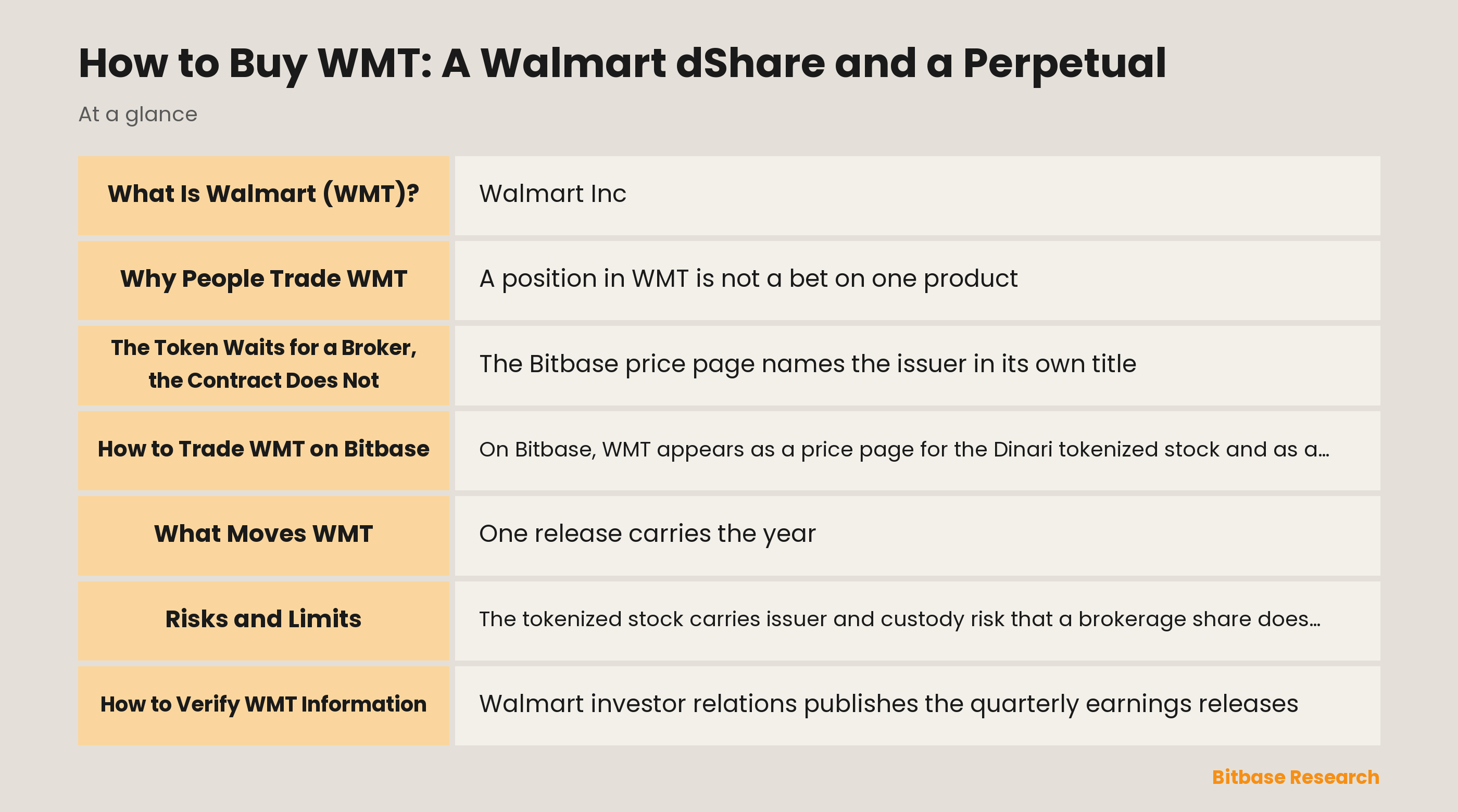
Walmart Inc. sets out the shape of its business in one line of its annual report: "Our operations are conducted in three reportable segments: Walmart U.S., Walmart International and Sam's Club U.S." Walmart U.S. is the mass merchandiser, operating under the Walmart and Walmart Neighborhood Market brands and on walmart.com; Sam's Club U.S. is "a membership-only warehouse club"; and Walmart International runs retail and wholesale formats outside the United States.
Inside Walmart U.S. the merchandise is not one catalogue. The segment "does business primarily in three strategic merchandise units" — grocery; general merchandise, covering entertainment, hardlines, fashion and home; and health and wellness, covering "pharmacy, over-the-counter drugs and other medical products, and optical services."
The revenue line is split too. Net sales and membership and other income are reported separately before total revenues, and the filing calls membership income "a significant component of the segment's operating income."
Why People Trade WMT
A position in WMT is not a bet on one product. It aggregates a mass merchandiser, an international retail and wholesale business and a membership club, and inside the domestic segment three merchandising units on different restocking schedules. One quote carries the sum.
The calendar gives that sum a shape. The annual report notes that "historically, our highest sales volume for each segment has occurred in the fourth quarter of our fiscal year," so the release that reports the busiest stretch of the year also closes the books on it.
The Token Waits for a Broker, the Contract Does Not
The Bitbase price page names the issuer in its own title: Walmart (Dinari Tokenized Stock). That name is the specification, because tokenized stocks are written by different issuers on different terms, and only Dinari's govern here.
Dinari defines a dShare as "a token 1:1 backed by a security, commonly a U.S. equity," and a token is minted or burned only after a corresponding order fills at Alpaca, the broker it routes through. The calendar is four windows rather than one: regular US market hours; pre-market and after-hours, limit orders only; an overnight session, also limit orders only; and an on-chain window that runs around the clock for a subset of tickers, with thinner liquidity. Outside regular hours a market order becomes a marketable limit order, which may not fill. Dividends reach direct holders in USD+ once the cash from the underlying has arrived.
A perpetual futures contract is assembled from the other direction. It holds no share and no token: it tracks a price, settles in stablecoin, passes funding between long and short on a schedule, and is closed by the venue when margin falls below maintenance. None of that needs a broker fill or an issuer, which is why the cost of holding a perpetual is a question about funding and margin, not about the retailer.
How to Trade WMT on Bitbase
On Bitbase, WMT appears as a price page for the Dinari tokenized stock and as a perpetual futures market.
The price page carries the quote, the chart and the market data for the token — the practical way to see how it is pricing while the Nasdaq session is closed.
The perpetual futures market is where a leveraged directional view is opened and closed out. Funding passes between the crowded side and the other on a schedule, a maintenance margin requirement sits under the position, and a liquidation level under that. Because funding accrues for as long as the contract stays open, it suits a view with a date attached. Other tickers sit alongside it on the TradFi markets page.
What Moves WMT
One release carries the year. The fiscal year ends January 31 and the highest sales volume has historically fallen in the fourth quarter, so the holiday season, the January clearing-out and the full-year close arrive together.
Membership income does not move with the shopping cart. It is reported apart from net sales and is, in the company's words, a significant component of the club segment's operating income.
Three merchandising units share one quote: a quarter carried by grocery volumes is a different quarter from one carried by fashion and home, though both land in the same Walmart U.S. line.
Currency rides with the international segment, whose sales are made in other currencies and reach a consolidated statement kept in US dollars.
Risks and Limits
The tokenized stock carries issuer and custody risk that a brokerage share does not. Its supply depends on orders filling at the broker behind it, and hours and order handling are the issuer's terms rather than the venue's — terms the issuer can change.
Hours are structural rather than incidental. Three of the four windows are tied to US market sessions, the round-the-clock on-chain window covers only a subset of tickers, and outside regular hours a market order may not fill.
The perpetual adds funding cost and forced closure. Funding accrues while the position is open, so a directionally correct trade held long enough can still finish behind.
The business risk is concentration into one stretch of the year: the filing puts the highest sales volume for each segment historically in the fourth quarter, and that quarter does not close until the end of January.
How to Verify WMT Information
Walmart investor relations publishes the quarterly earnings releases, where the split between net sales and membership and other income can be read directly. EDGAR carries the annual report on Form 10-K: the business description names the three segments and the three Walmart U.S. merchandising units, and the cover page names the exchange the common stock is registered on together with its trading symbol.
For the token, the issuer's own documentation is the authority on backing, trading windows, order handling and dividends. On Bitbase the futures market page carries the contract specifications, including funding and margin terms.
Conclusion
WMT names a retailer whose financial year ends in January, whose result blends three segments, three merchandising units and a membership line, and whose stock has been quoted on Nasdaq since December 2025. Neither instrument on Bitbase is that stock. The token exists only once an order has filled at the broker behind it; the contract needs neither broker nor issuer and stops existing when margin runs out. Choosing between them is less a question about Walmart than about whose terms you agree to be bound by.
Related market pages
Bitbase pages for the tokenized stocks named in this article:
- WMT: View price · Perpetual market
Related reading
Other Bitbase articles on this topic:
- How to Trade JPM: Rates, Credit and a Tokenized Bank Stock
- How to Trade KO: Concentrate, Currency and the Dividend
- How to Trade MA: Mastercard, the Network Behind the Card
Disclaimer: This article is educational content from Bitbase Academy, provided for information only. It explains what a company or fund does and how the instruments referenced here differ from one another; it does not constitute investment, trading, tax, or financial advice, and it is neither a recommendation nor an endorsement of any security, token, or trading strategy. A tokenized stock is issued by a third party and is designed to give economic exposure to an underlying asset: it is not a share, it carries no shareholder rights, and it depends on the issuer's structure, eligibility rules, and redemption terms, which the issuer can change. Perpetual futures are leveraged derivatives that hold no underlying asset and can be liquidated, and trading hours, product availability, and eligibility differ by instrument and by jurisdiction and can change at any time. Written as of September 2026; verify everything yourself through company filings, the issuer's own documentation, and the product pages of the venue you trade on.
References
[1] SEC EDGAR: Walmart annual reports on Form 10-K, including the segment descriptions and the cover-page listing details www.sec.gov
[2] Walmart 8-K press release: transfer of the stock exchange listing to Nasdaq, effective December 9, 2025 www.sec.gov
[3] Dinari documentation: what a dShare is, how minting and burning work, trading windows and dividends docs.dinari.com
[4] Walmart Investor Relations: quarterly earnings releases with the segment tables and income statement lines stock.walmart.com