It can be paid for power it never turns into hashrate. Riot Platforms holds long-term fixed-price electricity in Texas, hands grid operators the right to curtail part of its load for a fee, and tells investors it may elect to sell that power rather than use it, which makes switching machines off a lever in this business rather than a fault in it. On Bitbase this ticker has a price page, and the instrument quoted on it is a Robinhood token rather than a Nasdaq share.
What Is Riot Platforms (RIOT)?
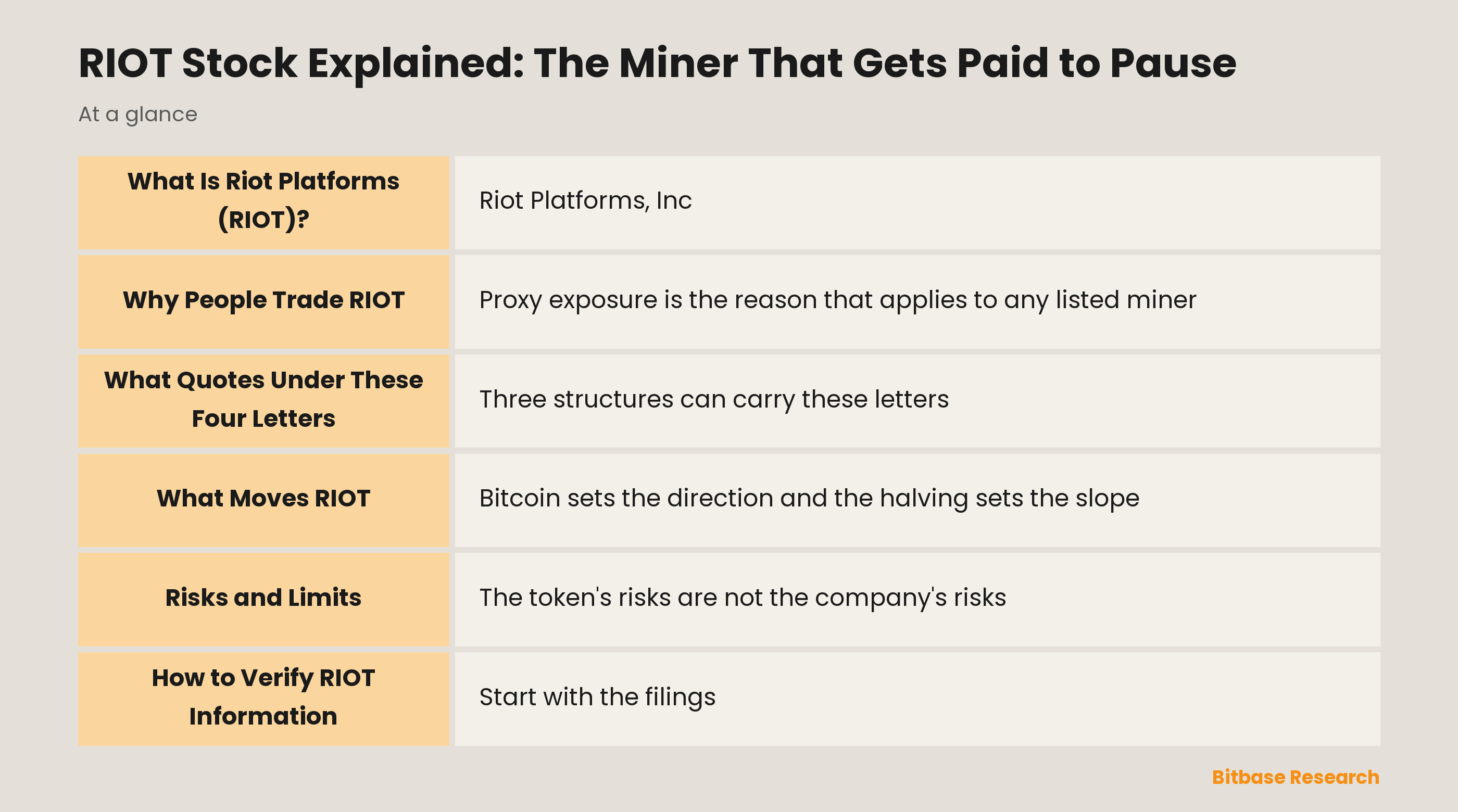
Riot Platforms, Inc. is a Nevada corporation whose common stock trades on the Nasdaq Capital Market under the symbol RIOT. Its annual report describes it as "a vertically integrated digital infrastructure company principally engaged in developing and optimizing our large-scale power assets." The power assets come first in that sentence and bitcoin does not appear in it.
Two large data centres carry that capacity, the Rockdale Facility in Rockdale, Texas and the Corsicana Facility in Navarro County, Texas, with further mining sites in Kentucky. It names two grid operators when it describes how it manages that load: the Electric Reliability Council of Texas and the Midcontinent Independent System Operator.
The reporting structure has moved with the business. The annual report covering 2025 named two reportable segments, Bitcoin Mining and Engineering. By the quarter ended March 2026 there were three: Bitcoin Mining, Data Center and Engineering, the third following a long-term data centre lease signed in January 2026 with Advanced Micro Devices at Rockdale.
Engineering is the segment that does not fit the label. It designs and manufactures power-distribution equipment and engineered-to-order electrical products, and the company describes it as serving "large-scale industrial and governmental customers" across markets including data centre, power generation, utility, water and alternative energy. Those customers buy electrical gear on procurement cycles unrelated to a block reward.
Mining itself works the way mining works. In the company's own words, "in exchange for solving a block, we receive a bitcoin reward, which we may either hold or sell on the market to generate cash to fund operations." Both branches stay open, and which one was taken in a period is a reporting question rather than a stated policy.
Why People Trade RIOT
Proxy exposure is the reason that applies to any listed miner. Listed bitcoin miners let someone hold a coin-linked position inside an ordinary brokerage account, and the operating leverage in a business with largely fixed short-run costs and revenue tracking a volatile commodity is supposed to arrive at the equity magnified. Whether it does in any particular stretch is an empirical question, not a property of the structure.
The power book is the reason that belongs to this ticker specifically. Riot's Texas load is contracted long-term at a fixed price, and the company voluntarily participates in load response programmes run by ERCOT and MISO, giving those operators the right to curtail a set portion of its load at their discretion in exchange for a fee. It has also told investors it may elect not to use that power for its own operations and to sell it in exchange for credits instead. That is an exposure a company with no contracted megawatts cannot offer.
Reallocation is the newer reason. Every developed megawatt has two possible jobs: run machines that mine, or house a tenant that wants high-density compute. The AMD lease turned that choice from a thesis into a reportable segment, and each further decision of the kind changes what the ticker is a claim on.
What Quotes Under These Four Letters
Three structures can carry these letters, and they are not versions of one product.
A share is the registered instrument. Bought through a broker on Nasdaq, it makes you a shareholder of Riot Platforms, Inc.
A stock token is a different object. The Bitbase price page for this ticker lists Riot Platforms, Inc. as a Robinhood Token, and Robinhood's own description of the product is unusually direct: its Classic Stock Tokens "are derivative contracts between you and Robinhood," priced at the prices of the underlying securities "without granting rights to them." The underlying assets are owned by Robinhood and held with a US-licensed institution. Where an underlying pays a dividend, Robinhood passes a corresponding amount to eligible holders in cash. Trading runs from Monday at two in the morning Central European time through to Saturday at the same hour. The issuer is Robinhood Europe, UAB, supervised by the Bank of Lithuania, and the product is offered to eligible investors in the European Union.
The wording matters more than it looks. Behind this token is a contract with a broker, not a share registered to you and not the legal form other issuers use for similarly named products. The terms deciding what you hold come from the issuer's documentation.
A perpetual futures contract is a third structure again. It holds nothing at all: no share, no token, no claim on the company. It tracks a price with leverage, pays or receives funding between the two sides of the book, and can be liquidated. Which of these surfaces exists for any given ticker differs by name, and the list of tokenized stocks is the place to check rather than assume.
What Moves RIOT
Bitcoin sets the direction and the halving sets the slope. The company names the periodic reduction of the block reward as a key factor in industry profitability, and it is a scheduled event that changes the revenue side of every machine at once without anything happening to the machines.
Texas power prices move this stock in a way that has no equivalent in an asset-light business. For an ordinary industrial consumer, expensive electricity is only a cost. Here it is also the price of an alternative use: when power is worth more sold or handed back than spent on hashrate, the profitable action is to stop. The fee is paid in exchange for granting the right to curtail, and the credits come from power sold rather than consumed, so a hot week on the grid is not simply a bad week for production.
Tenant and lease news reprices the asset base rather than the earnings. A signed lease converts megawatts from a commodity-linked use into contracted revenue with a named counterparty, one agreement at a time, so a single announcement changes the mix of the business rather than its latest output number.
Energisation timing sits underneath both uses. Developed capacity is what the mining fleet and any lease alike depend on, and it arrives through interconnection work, substation build-out and equipment deliveries outside the company's control.
Engineering order flow moves on its own calendar. Demand for switchgear responds to data centre and grid construction rather than to the coin, so reading the whole company as a single bitcoin-beta position misses a segment whose demand comes from somewhere else.
Risks and Limits
The token's risks are not the company's risks. Holding a Robinhood stock token means holding a contract with Robinhood: its value depends on terms the issuer sets and can change, and eligibility is defined by the issuer's jurisdiction rather than by the exchange where the underlying trades. No shareholder claim on Riot Platforms sits behind it.
Session structure creates gap risk in both directions. The token quotes for five days of each week while Nasdaq runs ordinary sessions, so news can reach the token while the primary market is shut, and there is a weekly window in which the token itself does not trade.
Perpetuals add a running cost and a forced exit. Funding accrues in whichever direction the crowd sits, so a directionally correct position held long enough can still lose to it, and leverage shortens the distance to liquidation. Equity-referenced contracts can also gap around scheduled corporate events.
The company's own risks are specific. Its power position depends on counterparties, grid rules and programme terms it does not set, and the contracts that make curtailment worth doing tie the business to a small number of grids. Development depends on utilities, permits and equipment deliveries, and a lease strategy concentrates revenue in whoever signs. Because a mined coin may be held rather than sold, the balance sheet can also carry a commodity position on top of an operating one.
How to Verify RIOT Information
Start with the filings, because the structure is what makes this share unusual and the filings are where it is stated. The annual and quarterly reports on SEC EDGAR carry the segment definitions, the power arrangements and load response programmes, and the risk factors naming interconnection, counterparty and commodity exposure. Segment counts change, so read the most recent report rather than a summary of an old one.
The company's investor relations pages carry the same documents plus the operational updates published between reports, where lease and capacity news appears first.
For the token, go to the issuer. Robinhood's European product materials are the authority on what a stock token is, what it does not grant, when it trades and who may hold it, and they are a separate document from anything the venue publishes. For the quote, the Bitbase price page is the reference.
Conclusion
Riot Platforms puts its power assets first in its own description of itself, spends much of that power on mining, and is now contracting some of it out to a tenant instead. That framing explains the parts of the stock a hashrate model cannot: why a grid emergency can help, why an electrical manufacturing segment sits inside a bitcoin company, and why one lease can matter more than a quarter of production. On the Bitbase price page for this ticker, the instrument is a derivative contract with Robinhood that tracks the share without conveying what the share conveys. Work out which exposure you are taking before you size it.
Related market pages
Bitbase pages for the tokenized stocks named in this article:
- RIOT: View price
Related reading
Other Bitbase articles on this topic:
- How to Trade MA: Mastercard, the Network Behind the Card
- How to Trade MARA: A Bitcoin Miner That Also Holds Bitcoin
- How to Buy META: The Tokenized Stock and the Perpetual
Disclaimer: This article is educational content from Bitbase Academy, provided for information only. It explains what a company or fund does and how the instruments referenced here differ from one another; it does not constitute investment, trading, tax, or financial advice, and it is neither a recommendation nor an endorsement of any security, token, or trading strategy. A tokenized stock is issued by a third party and is designed to give economic exposure to an underlying asset: it is not a share, it carries no shareholder rights, and it depends on the issuer's structure, eligibility rules, and redemption terms, which the issuer can change. Perpetual futures are leveraged derivatives that hold no underlying asset and can be liquidated, and trading hours, product availability, and eligibility differ by instrument and by jurisdiction and can change at any time. Written as of September 2026; verify everything yourself through company filings, the issuer's own documentation, and the product pages of the venue you trade on.
References
[1] Riot Platforms investor relations: filings, presentations and the operational updates published between reports www.riotplatforms.com
[2] SEC EDGAR: Riot Platforms annual filings, including the segment definitions, the power arrangements and the load response programmes www.sec.gov
[3] Robinhood Europe: what a classic stock token is, what it does not grant, its trading hours and who may hold it robinhood.com