Because VOO is built to copy rather than to choose, everything that decides what it holds is decided somewhere else. Vanguard's own summary prospectus puts that in writing: tracking its broad-based target index could leave the fund nondiversified after an index rebalance or a market move. What carries those letters on Bitbase is a Dinari tokenized ETF, whose backing, trading sessions and dividend route are set by the issuer and not by Vanguard.
What Is the Vanguard S&P 500 ETF (VOO)?
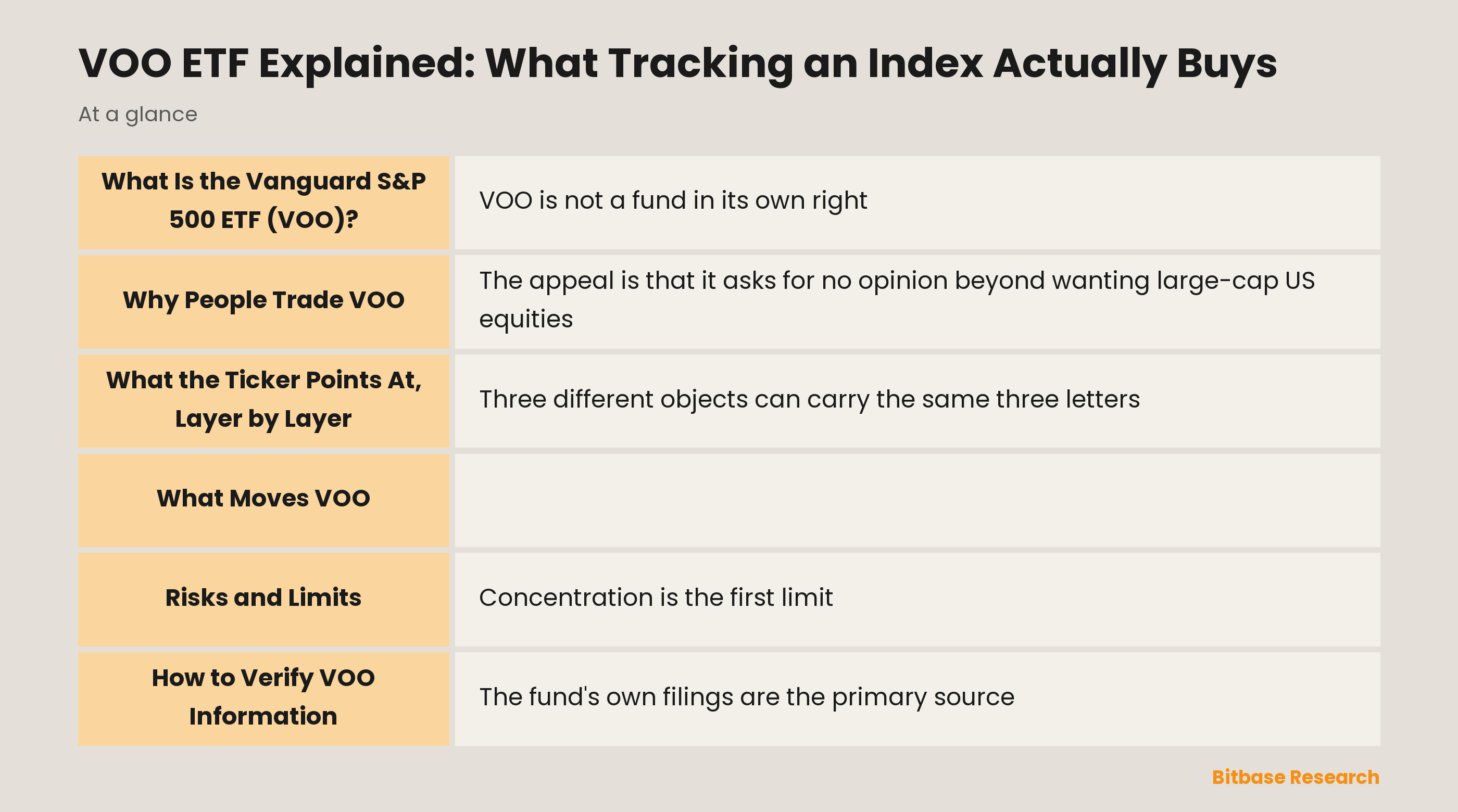
VOO is not a fund in its own right. The prospectus describes it as an exchange-traded share class of Vanguard 500 Index Fund, offered under an exemptive order from the SEC that lets the fund issue conventional mutual fund shares and ETF shares side by side. Every class of a Vanguard fund carries the same investment objective, strategies and policies; expenses are what differ between them, so their returns can differ too, and each class has its own net asset value computed from the assets allocated to that class. The ticker therefore names a share class, and the thing holding the stocks is the fund standing behind it.
What the portfolio does is stated plainly. The fund employs an indexing investment approach designed to track the S&P 500 Index — its target index — which Vanguard describes as a widely recognized benchmark of US stock market performance that is dominated by the stocks of large US companies. It replicates that index by investing all, or substantially all, of its assets in the stocks that make it up, holding each one in approximately the same proportion as its index weighting. That clause is the entire investment process: no screen, no ranking, no view.
The ETF shares are listed for trading on NYSE Arca, and individual investors may only buy and sell them on the secondary market at market prices. Creating and redeeming shares directly with the fund is reserved for a limited number of authorized participants.
Why People Trade VOO
The appeal is that it asks for no opinion beyond wanting large-cap US equities. Someone who does not want to choose sectors, factors or individual names can buy the index and stop there.
It is also the yardstick. Vanguard's own description of the target index — a widely recognized benchmark of US stock market performance — is what a fund or a strategy is being measured against when someone says it beat or trailed the market, so holding the tracker is holding the measuring stick itself.
The third reason is the shape of the instrument rather than the exposure it carries. A share of a fund has no expiry, no margin call and no roll, which separates it from stock index futures written on the same index: those are cash-settled, expire on a quarterly cycle and have to be rolled forward to be kept. The same underlying, a different set of obligations, and answers to different questions.
What the Ticker Points At, Layer by Layer
Three different objects can carry the same three letters, and only one of them is the fund.
The fund share is bought through a broker on the exchange where it is listed, and owning it makes you a shareholder of the Vanguard 500 Index Fund.
A tokenized ETF is a token issued by a third party, and here the third party is the one whose rules apply. The Bitbase price page for this ticker lists the Vanguard S&P 500 ETF as a Dinari tokenized ETF. Dinari describes its tokens as backed one-for-one by the underlying security, with tokens created or destroyed only after the corresponding brokerage order settles. It runs several sessions rather than one continuous market: regular US hours, pre-market and post-market sessions that accept limit orders only, an overnight session on the same terms, and a round-the-clock session that covers only a limited set of tickers and carries thinner liquidity. Market orders placed outside regular hours are converted into marketable limit orders, and may fill fully, partly or not at all. Dividends reaching the issuer are calculated and passed on to holders, with a minimum below which nothing is distributed.
A perpetual futures contract is the third structure, and it stands furthest from the portfolio: it holds nothing, tracks a price with leverage, never expires, and exchanges funding payments between the two sides instead of running to settlement. Holding one is a position against a counterparty, not a claim on any basket of shares.
The reading that matters: a token gives economic exposure to a fund that itself gives exposure to an index. Two structures sit between the holder and the companies, and each has a rulebook written by someone different.
What Moves VOO
Concentration inside the index moves it first, and nobody chose that concentration. Because the fund holds each stock at roughly its index weight, every holding moves the fund in proportion to that weight, so the heaviest weights count for the most, and Vanguard describes the target index itself as dominated by the stocks of large US companies. The risk disclosure is more specific: as of the fund's most recent fiscal year end, stocks of companies within the information technology sector made up a significant portion of the target index, so the performance of the index, and with it the performance of the fund, may be affected by the general condition of that sector. A product bought as the broad US market can behave like a sector position without anyone having decided to take one.
The second driver is that same fact carried to its legal conclusion. The prospectus warns that by tracking its broad-based target index, the fund could become nondiversified as defined under the Investment Company Act of 1940, through events such as an index rebalance or market movement. The same disclosure adds that the performance of nondiversified funds may be hurt by relatively few securities or even a single one. That is a fund built to hold an entire large-cap benchmark telling its investors that the benchmark may concentrate past the point where the statutory definition of diversification still applies.
Index maintenance is the third. Because the fund replicates rather than samples, decisions taken by the index provider arrive as trades the fund has to make: additions, deletions and weight changes are instructions rather than suggestions. The prospectus is explicit about who pays when that goes wrong: gains, losses or costs from an error made by the index provider are generally borne by the fund, and therefore by its shareholders.
The fourth is the distance between the quote and the portfolio. The market price of an ETF share typically approximates its net asset value, but the prospectus states that there may be times when the two differ significantly. Creation and redemption by authorized participants normally closes that distance, and the prospectus is blunt that those institutions are few and are not obligated to engage in creation or redemption transactions at all. How far the fund's return then drifts from the index's own return is tracking error, a separate measurement from the premium or discount on any given day.
Risks and Limits
Concentration is the first limit. A tracker of large-cap US companies is spread across sectors only to the extent that the index is, and the fund's own filings warn that this can stop being true through nothing more than a rebalance.
Index dependency is the second. Vanguard does not decide what belongs in the target index and does not correct it, so a methodology change alters the portfolio even when no company in it has changed.
The tokenized wrapper adds a layer that has nothing to do with the fund. A token depends on the issuer's structure, eligibility rules and redemption terms, and the issuer sets all three and can change them. Its sessions are not the fund's sessions either: a token trading while the primary market is shut can move on news the fund's own price cannot yet reflect, and the round-the-clock window reaches only some tickers.
Dividends travel by different routes. The fund distributes what its holdings pay; the token's dividend path is the issuer's, on the issuer's schedule, with a minimum below which nothing arrives. Those are two mechanisms, not one mechanism described twice.
The exposure itself hedges nothing. Holding the whole large-cap market removes single-name risk and nothing else, and a market-wide drawdown is precisely what this instrument is built to deliver in full.
How to Verify VOO Information
The fund's own filings are the primary source. The summary prospectus and the full prospectus for the Vanguard 500 Index Fund are filed with the SEC and searchable on EDGAR; the objective, the target index, the share-class structure and the risk section are there in the fund's own words rather than in someone's summary. Vanguard's product page carries the figures that change — holdings, expense ratio, distributions — and those are worth reading current rather than remembered.
The index provider publishes the methodology and announces changes to the constituent list: that is where the rules the fund obeys are written, by a different publisher from the one that runs the fund. For the token, the issuer's documentation is the authority on backing, sessions, dividends and eligibility, and it answers questions the fund's prospectus does not.
For what Bitbase carries under this ticker, the price page is the reference, and the list of tokenized stocks and ETFs shows what each ticker there offers.
Conclusion
VOO is a share class of an index fund that holds large-cap US companies in their index proportions, listed on NYSE Arca, and on Bitbase it appears as a token issued by Dinari rather than as that share. Each clause removes an assumption. Share class means the ETF and the mutual fund are one portfolio. Index proportions mean the concentration is inherited rather than selected. Tokenized means an issuer's rules sit between the holder and the fund. Knowing which of those objects is in your account is the first question about this ticker, not a detail to check afterwards.
Related market pages
Bitbase pages for the tokenized stocks named in this article:
- VOO: View price
Related reading
Other Bitbase articles on this topic:
- How to Trade MARA: A Bitcoin Miner That Also Holds Bitcoin
- How to Buy META: The Tokenized Stock and the Perpetual
- How to Buy MSFT: Three Segments Behind One Ticker
Disclaimer: This article is educational content from Bitbase Academy, provided for information only. It explains what a company or fund does and how the instruments referenced here differ from one another; it does not constitute investment, trading, tax, or financial advice, and it is neither a recommendation nor an endorsement of any security, token, or trading strategy. A tokenized stock is issued by a third party and is designed to give economic exposure to an underlying asset: it is not a share, it carries no shareholder rights, and it depends on the issuer's structure, eligibility rules, and redemption terms, which the issuer can change. Perpetual futures are leveraged derivatives that hold no underlying asset and can be liquidated, and trading hours, product availability, and eligibility differ by instrument and by jurisdiction and can change at any time. Written as of September 2026; verify everything yourself through company filings, the issuer's own documentation, and the product pages of the venue you trade on.
References
[1] Vanguard S&P 500 ETF summary prospectus, April 28, 2026: objective, target index, replication, nondiversification and ETF share trading personal1.vanguard.com
[2] Vanguard S&P 500 ETF statutory prospectus: the SEC exemptive order, share-class policies and how each class computes its own NAV fund-docs.vanguard.com
[3] Dinari documentation: what a tokenized share is, backing, sessions and who may hold it docs.dinari.com
[4] SEC investor bulletin on ETFs: creation and redemption, NAV and how ETFs differ from mutual funds www.sec.gov