Tracking a sector sounds mechanical, and with XLK the mechanics are the interesting part: an outside classification committee decides which companies count as technology, and a tax rule decides how large the biggest of them may be inside the fund. Neither decision belongs to State Street or to the companies in the portfolio, and both have changed what a holder owns without any business doing anything differently.
What Is the State Street Technology Select Sector SPDR ETF (XLK)?
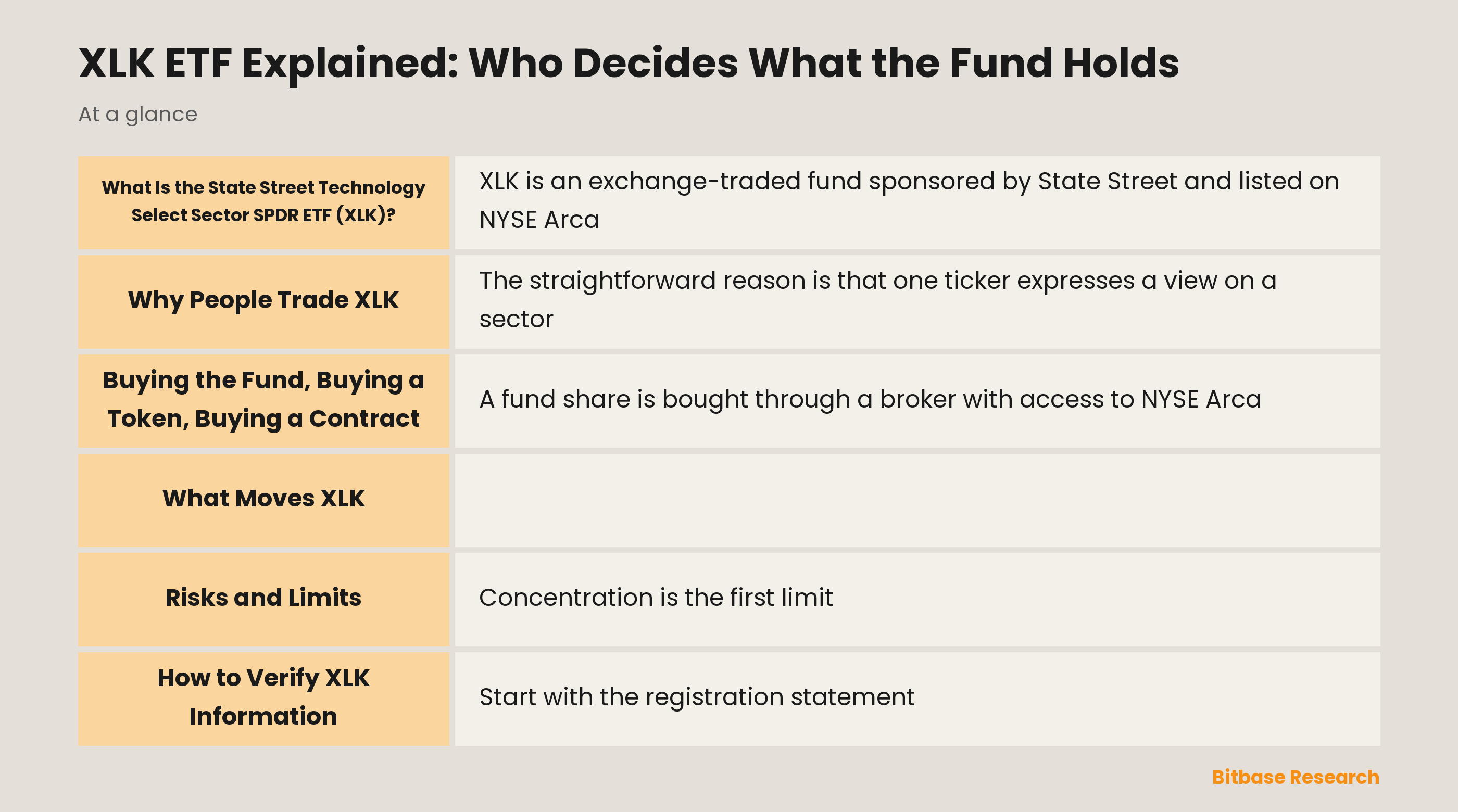
XLK is an exchange-traded fund sponsored by State Street and listed on NYSE Arca. Its prospectus states that the fund "seeks to provide investment results that, before expenses, correspond generally to the price and yield performance of publicly traded equity securities of companies in the Technology Select Sector Index."
Two filters define that index, and separating them is the whole job. The first is membership: the prospectus describes the Select Sector Indexes as built so that "each of the component securities in the Index is a constituent of the S&P 500 Index." The second is classification: the index "includes companies that have been identified as Technology companies by the Global Industry Classification Standard (GICS)." Clearing one gate is not enough. A large technology business outside the S&P 500 is absent, and so is one that GICS files under another sector.
The fund holds the index itself rather than an approximation of it. The prospectus states that it "employs a replication strategy, which means that the Fund typically invests in substantially all of the securities represented in the Index in approximately the same proportions as the Index." Replication removes one ordinary source of drift without removing them all: fees, cash balances and the timing of rebalance trades still separate a fund's return from its index, and that gap is tracking error. The rest of the wrapper is conventional, with blocks of shares created and cancelled through creation and redemption by large intermediaries, not by retail buyers.
Why People Trade XLK
The straightforward reason is that one ticker expresses a view on a sector, so someone betting on technology or hedging an existing position in it can act without choosing among the companies inside.
The subtler reason is that this fund defines technology narrowly. The GICS Information Technology sector is one of eleven, and businesses that ordinary conversation calls technology companies can sit in other sectors of the same framework. XLK is a position in the classification, not in the word.
There is also a reference use. Drawn from the S&P 500 and weighted by size, the fund serves as a yardstick for asking whether a result came from the sector or from something specific inside it.
Buying the Fund, Buying a Token, Buying a Contract
A fund share is bought through a broker with access to NYSE Arca. It makes you a shareholder in the fund, and the fund holds the underlying companies. One wrapper sits between you and the businesses.
A tokenized version is issued by a third party and adds a second wrapper. The Bitbase price page for this ticker names the issuer as Robinhood, whose structure is specific to Robinhood: its European documentation describes Classic Stock Tokens as "derivative contracts between you and Robinhood", priced at the prices of the underlying securities "without granting rights to them". The underlying assets, it states, "are owned by Robinhood and held with a US-licensed institution", and where a dividend is paid Robinhood passes a corresponding amount to eligible holders in cash. Trading runs from Monday 02:00 CET to Saturday 02:00 CET, and the offering is made by Robinhood Europe, UAB, supervised by the Bank of Lithuania. None of that carries over to another issuer's product.
A perpetual futures contract is a third structure that holds nothing at all. It tracks a price with leverage, pays or charges funding, and can be liquidated. Which tickers carry which of these surfaces is a property of the venue rather than of the fund, and the tokenized stock lineup is where that is kept current.
What Moves XLK
A rebalance the tax code forces. The prospectus states that the index is calculated on a "modified market capitalization" methodology, "which means that modifications may be made to the market capitalization weights of single stock concentrations in order to conform to the requirements of the Internal Revenue Code". When the largest constituents pull away from the rest, that rule caps them and pushes weight back down the list. Those trades land on a scheduled rebalance date rather than on news, and the companies involved did nothing to cause them.
The classification boundary. GICS is maintained jointly by MSCI and S&P Dow Jones Indices, is reviewed annually, and has redrawn this sector before. The two providers announced that the Data Processing and Outsourced Services sub-industry would be discontinued and that transaction and payment processing companies "will be reclassified to a newly created Sub-Industry called Transaction and Payment Processing Services under the Financials Sector", implemented after the close on Friday, March 17, 2023. Holders of a technology sector fund stopped owning payment processors that day without placing an order. Membership of the S&P 500 is the second such lever, and it moves for reasons unrelated to the sector.
Six industries arguing with each other. The prospectus universe covers technology hardware, storage and peripherals; software; communications equipment; semiconductors and semiconductor equipment; IT services; and electronic equipment, instruments and components. A capital spending cycle in semiconductors and subscription growth in software are different variables, and they can point in opposite directions at the same time. What the fund prints on a given day is the weighted outcome of that argument, and because the weights are top-heavy, one large constituent's results can outweigh the sector trend.
Risks and Limits
Concentration is the first limit, and it is structural rather than incidental. The prospectus notes that as a "non-diversified" fund, XLK "may hold a smaller number of portfolio securities than many other funds", so a handful of positions dominates it and treating it as a diversified holding is a category error.
The cap cuts both ways. Trimming the largest weight protects against one name becoming the fund, and it also denies uncapped exposure to the sector's biggest company.
The token adds issuer risk on top of fund risk. A contract with an issuer depends on that issuer's structure, eligibility rules and redemption terms, which the issuer sets and can change and which neither the fund nor the exchange controls. A perpetual, where one exists for a ticker, adds funding costs and liquidation on top.
Sessions do not line up. The fund prices during NYSE Arca hours, while a token window closing only from Saturday morning to Monday morning stays open when the primary market is shut. News arriving in that gap moves the token against a reference price that has stopped updating.
How to Verify XLK Information
Start with the registration statement. The trust files it with the SEC and it is public on EDGAR: the objective, the index description, the modified-market-capitalization language, the non-diversified statement and the fee schedule all live there. The sponsor's fund page carries holdings and weights as of a stated date, and the date deserves as much attention as the numbers.
For what belongs in the sector at all, go to the index side rather than the fund side. S&P Dow Jones Indices publishes the index methodology and the rebalance calendar, and with MSCI it publishes the GICS structure and the annual review that can change it. Why a company is or is not in this fund is answered there, not in the fund's own materials.
For the tokenized instrument, the issuer's own documentation is the authority on backing, dividends, sessions and who may hold it, and it is separate from anything State Street or the exchange publishes. On Bitbase, the price page is the reference for this ticker.
Conclusion
XLK is a rules-driven fund, and the rules belong to other people. A classification standard decides which companies are technology, the S&P 500 decides which of those are eligible, and the Internal Revenue Code decides how concentrated the result may become. On Bitbase the ticker appears as a Robinhood token, a contract on the price rather than a share of the fund, which is a third set of rules again. Knowing which set applies to what you hold is the first question, not the last.
Related market pages
Bitbase pages for the tokenized stocks named in this article:
- XLK: View price
Related reading
Other Bitbase articles on this topic:
- How to Buy MSFT: Three Segments Behind One Ticker
- How to Trade MSTR: Strategy and Its Bitcoin Balance Sheet
- How to Trade MU: Micron Memory, Spot and Perpetual Futures
Disclaimer: This article is educational content from Bitbase Academy, provided for information only. It explains what a company or fund does and how the instruments referenced here differ from one another; it does not constitute investment, trading, tax, or financial advice, and it is neither a recommendation nor an endorsement of any security, token, or trading strategy. A tokenized stock is issued by a third party and is designed to give economic exposure to an underlying asset: it is not a share, it carries no shareholder rights, and it depends on the issuer's structure, eligibility rules, and redemption terms, which the issuer can change. Perpetual futures are leveraged derivatives that hold no underlying asset and can be liquidated, and trading hours, product availability, and eligibility differ by instrument and by jurisdiction and can change at any time. Written as of September 2026; verify everything yourself through company filings, the issuer's own documentation, and the product pages of the venue you trade on.
References
[1] Select Sector SPDR Trust registration statement on Form 485BPOS: XLK's objective, the Technology Select Sector Index description, the modified market capitalization language and the non-diversified statement www.sec.gov
[2] State Street fund page for XLK: the fund's full legal name, the six industries in the index universe and the NYSE Arca listing www.ssga.com
[3] S&P Dow Jones Indices and MSCI announcement of the 2023 GICS structure revisions: transaction and payment processing companies reclassified into Financials, implemented after the close on 17 March 2023 press.spglobal.com
[4] Robinhood's European product page: Classic Stock Tokens described as derivative contracts, the underlying held by Robinhood, cash dividend pass-through, trading hours and the Robinhood Europe, UAB entity robinhood.com