
DoubleZero is a documented permissionless network-layer project for distributed systems, and 2Z has documented functions within that project.
What Is DoubleZero?
Official materials describe DoubleZero as a decentralized protocol and network for distributed systems, including blockchain infrastructure. Its stated focus is the network layer: the paths information follows between participating systems and the physical resources that carry, route, and process that information. This is infrastructure scope, not a claim that the project changes the rules of the systems above it.
That distinction matters because the same project can be described too broadly in a short label. DoubleZero is not presented in its primary materials as a consumer application, an execution environment, or a replacement for a chain's consensus design. It is presented as a protocol-coordinated layer intended to organize independently supplied network capacity into a wider service framework.
The project name and the ticker need separate treatment as well. DoubleZero names the protocol and network design, while 2Z is identified in official disclosure as the native token. Search phrases such as what is double zero crypto can otherwise collapse the physical network, protocol records, and token into one imprecise idea.
What Problem Does DoubleZero Address?
Distributed systems may depend on information reaching other participants with timing and handling that are sufficiently predictable for their purpose. Project materials identify route variability, congestion, duplicate traffic, and uneven physical reach as infrastructure constraints that can complicate time-sensitive communication. These are systems questions, not claims about a particular token outcome.
DoubleZero's documented response is to assemble a dedicated network layer from independently contributed physical links and packet-handling resources. The design seeks to give qualifying distributed-system traffic a layer organized around data paths, routing, and processing functions. It does not require an overview to assert that every proposed function is active or suitable for every use case.
The design goal should never be confused with an unconditional result. Conditions can vary with the state of contributed links, route policy, software releases, maintenance events, and the environment in which a path is evaluated. A careful profile describes the stated intent and also keeps room for those changing conditions.
How Does DoubleZero Work?
At the physical layer, the architecture describes contributors bringing fiber links and packet-processing hardware into a broader mesh. Each contribution remains a distinct piece of infrastructure, while protocol records and coordination components are intended to make the combined capacity intelligible as a shared network layer. This framing helps explain why physical resources matter to the project rather than appearing as a side detail.
The documentation also describes DZX junctions, which are places where paths from different contributors can be joined within the larger mesh. A junction is significant because it turns separate link contributions into a broader topology. In the project's documented model, routing and service logic can then be applied across a network structure rather than inside a single isolated link.
Controllers and agents are described as components that derive network configuration from protocol state. This relationship explains how documented records can inform physical infrastructure behavior. It does not prove that every feature, metric, or path is active in every environment, and it should not be read as a promise of particular timing, capacity, or resilience.
What Does 2Z Do in DoubleZero?
Official disclosures identify 2Z as DoubleZero's native token. The documented token roles link the economic layer to specified network service or resource functions and to token incentives for qualifying contributors whose resources support the documented system. This is a functional description of a token's role inside the architecture, not a statement about value or future demand.
It is more accurate to keep that role narrow than to use the ticker as a shortcut for the whole project. The current meaning of 2Z must be read alongside current official material on service rules, contributor incentives, supply arrangements, and the relevant onchain records. Those details can change, so an old summary should not be treated as a permanent rulebook.
One regulatory fact belongs beside that description, stated at its exact width. On 29 September 2025 the SEC's Division of Corporation Finance issued a no-action letter responding to an incoming letter dated 25 September 2025. The staff wrote that it would not recommend enforcement action to the Commission if, in reliance on counsel's opinion, Programmatic Transfers conducted in the manner and under the circumstances described in that letter are not registered under Section 5 of the Securities Act and 2Z is not registered as a class of equity securities under Section 12(g) of the Exchange Act. The letter is published on the SEC's own site and is short enough to read in full.
Supply is the other half of that role. Reporting at launch recorded a genesis supply capped at 10 billion 2Z, with modest inflation for network contributions and partial burns intended to discourage artificial traffic. Published allocation figures put the Foundation and Ecosystem share at 29 percent, Jump Crypto at 28 percent, Malbec Labs at 14 percent, institutions at 12 percent, the team at 10 percent, and contributors, builders and validators at 4, 2 and 1 percent. A third-party unlock tracker checked on 15 August 2026 showed roughly 3.5 billion 2Z released and about 6.5 billion, close to 65 percent, still locked, with the release schedule running into October 2029. Those are aggregator readings of a project disclosure, so the project's own tokenomics document and onchain records remain the authority.
DoubleZero Ecosystem and Current Adoption
The DoubleZero ecosystem includes protocol software and records, physical-network contributors, DZX junctions, and distributed-system participants that may use documented services. This is an infrastructure ecosystem. Its meaningful units include links, routing relationships, service functions, and observable records rather than a catalogue of consumer-facing features.
Official architecture material distinguishes the people and organizations that provide physical capacity and packet handling from resource contributors that support defined protocol functions. This distinction shows how a shared physical network can be assembled from separate contributions without treating it as the private installation of one operator. It also makes clear that different roles may have different current responsibilities.
Current official documentation uses the labels Testnet and Mainnet-Beta for physically distinct environments. These labels provide useful context, but they do not establish a geographic footprint, a service level, a complete feature set, or a readiness result. A publication should check the latest official status rather than infer it from a historical label.
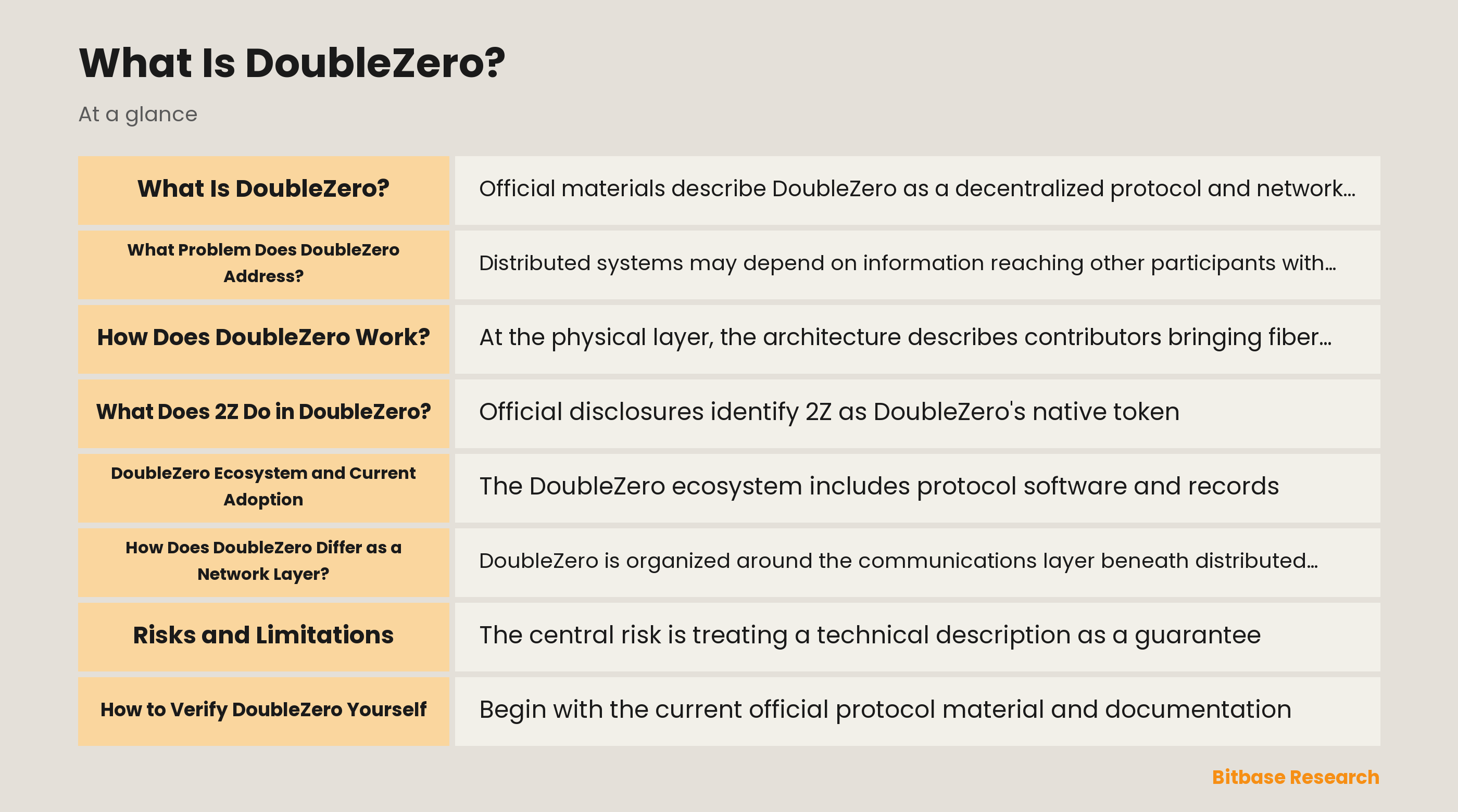
Dated figures are more useful than labels here, provided the source is named. DoubleZero announced its mainnet-beta on 2 October 2025, describing more than 70 high-performance fiber links across more than 25 global locations contributed by independent providers including Jump, RockawayX, Distributed Global, Galaxy, Jito and Cumberland/DRW. The project's own Q2 2026 network update, published on 3 July 2026, reported 21.7 billion dollars of Total Connected Value, 59 percent of Solana's mainnet stake weight routed over the network, 462 connected validators, 166 dedicated links and 10.14 Tbps of aggregate capacity. Every one of those figures is reported by the project rather than by an independent auditor, and the reading a person finds today may differ.
How Does DoubleZero Differ as a Network Layer?
DoubleZero is organized around the communications layer beneath distributed applications. Its materials emphasize contributed physical capacity, mesh junctions, packet-handling functions, and protocol-coordinated records. That scope differs from an application interface or an execution environment because the project is describing how messages can be carried and handled before other systems interpret them.
This division of responsibilities is useful for evaluating claims. A network layer can influence how information moves and is handled, while the systems that create, interpret, and finalize that information retain their own rules. Whether a particular documented function is enabled is therefore a current-state question that should be answered with current primary material.
Risks and Limitations
The central risk is treating a technical description as a guarantee. Physical links can change, operating conditions can vary, and software or routing behavior can be revised. An architectural document alone cannot demonstrate current coverage, resilience, timing characteristics, capacity, or service quality for a specific participant in a given setting.
There is also a scope risk around 2Z. Documented token functions, supply arrangements, service rules, and onchain records can change over time. A matching ticker by itself is not enough to establish that a particular record is official, that a copied identifier is correct, or that an earlier explanation still represents the current project state.
Finally, the project spans physical infrastructure and protocol coordination, so simple labels can hide important distinctions. Readers should keep the network, its contributors, the 2Z token, and the status of individual functions separate. That habit prevents a description of one component from being misread as a statement about all components.
A specific supply discrepancy sits in the public record and was not resolved in the material available for this article. DoubleZero's MiCA whitepaper stated an initial circulating supply of 700 million 2Z, or 7 percent of genesis supply, while reporting on the launch put the amount actually circulating at roughly 3.47 billion. BeInCrypto wrote on 3 October 2025 that the origin of the difference remained unclear, that the gap drew sustained criticism online, and that Arkham data showed Jump Crypto had received 2Z worth about 42.8 million dollars, of which about 20.9 million dollars had been deposited to exchanges. What that establishes is limited but real: an unexplained difference between a filed document and observed supply, and onchain transfers to exchanges. The motive behind either is not established.
The no-action letter should not be read past its own wording either. It is a staff position on enforcement action only; the Division wrote that it expresses no legal conclusion on the issues presented, that its position rests on the representations made in counsel's letter, and that any different facts or conditions might require a different conclusion. It is therefore not an approval, an endorsement, or a certification of compliance, and it does not address other forms of sale or secondary trading. Alongside that, the main environment still carries a beta designation, the token has a short history, and roughly two thirds of genesis supply remains scheduled for release over the following years. Those are three separate reasons to treat this as an early-stage project.
How to Verify DoubleZero Yourself
Begin with the current official protocol material and documentation. Check the publication date and identify whether a statement describes the architecture, a planned function, a Testnet environment, or a Mainnet-Beta environment. Direct project records provide a clearer basis for verification than copied summaries, undated screenshots, or a ticker shown without context.
For token identity, compare the token contract address or equivalent official token record from the current disclosure with a read-only block explorer. Match the official record carefully and treat disagreements as a reason to pause rather than to assume that similarly named records are equivalent. This is an observation-only check, not a guide to participation or an operational procedure.
Three of the claims above can be checked at their sources rather than through summaries. The no-action letter is published on the SEC's site under the Division of Corporation Finance's no-action letters, so its scope and its caveats can be read directly instead of through a headline. Supply and allocation should be taken from the project's published tokenomics disclosure and cross-checked against onchain records, not from an aggregator alone. And any network-scale figure, whether connected value, stake weight, validator count or link count, should be traced back to the project's own dated update or live metrics page, because those are the project's measurements rather than an independent audit.
Conclusion
DoubleZero is a documented network-layer project built around independently contributed physical capacity, protocol coordination, and the stated functions of 2Z. Its central idea is to make network infrastructure a first-class part of distributed-system design while preserving the separation between that layer and the rules used by systems above it.
Readers researching double zero tokenomics and use cases or double zero crypto should distinguish documented utility from facts that can change with the network's current state. A reliable profile names the architecture and 2Z roles precisely, avoids unsupported claims, and checks official materials again before relying on time-sensitive details.
Related market pages
Bitbase pages for the tokens named in this article:
- 2Z: View price · Spot market · Perpetual market
Related reading
Other Bitbase articles on this topic:
- What Is Jambo? Mobile Infrastructure and the J Token
Disclaimer: This article is educational content from Bitbase Academy, provided for information only. It explains what a project does and what role its token plays in that system; it does not constitute investment, trading, tax, or financial advice, and it is neither a recommendation nor an endorsement of any project or token. Bitbase has not carried out due diligence on the project described here, and mentioning it does not mean Bitbase lists or supports the asset. Crypto assets carry significant risk, including price volatility, thin liquidity, smart-contract failure, regulatory uncertainty, and the possible loss of their entire value. This project is at an early stage, and early-stage projects carry a higher risk of failing outright. Written as of August 2026; a project's status, tokenomics, team, and contracts can change at any time. Verify everything yourself through official channels, the contract address, and a block explorer, and beware of imitation sites and phishing links.
References
[1] DoubleZero Protocol Whitepaper (official) doublezero.xyz
[2] What is DoubleZero / 2Z Tokenomics Disclosure (official) doublezero.xyz
[3] Welcome to DoubleZero (official documentation) docs.malbeclabs.com
[4] DoubleZero Architecture (official documentation) docs.malbeclabs.com
[5] DoubleZero Glossary (official documentation) docs.malbeclabs.com
[6] DoubleZero Economics (official materials index) economics.doublezero.xyz
[7] SEC, Division of Corporation Finance no-action letter to DoubleZero (29 September 2025) sec.gov
[8] Blockworks, DoubleZero launches mainnet-beta and 2Z token (2 October 2025) blockworks.com
[9] BeInCrypto, DoubleZero tokenomics criticism and circulating-supply gap (3 October 2025) beincrypto.com
[10] Solana Compass, DoubleZero Q2 2026 network update as reported by the project (3 July 2026) solanacompass.com
[11] doublezero launches mainnet beta a high performance global network for distributed systems underpinned by 2z t doublezero.xyz