Jambo is a consumer hardware and software company that sells a 99-dollar Android phone, publishes an earn-and-wallet app, and issues J, a token on Solana. This article separates what actually ships today from what the project says it will do later, explains what J is used for, and ends with a checklist you can run yourself.
What Is Jambo?
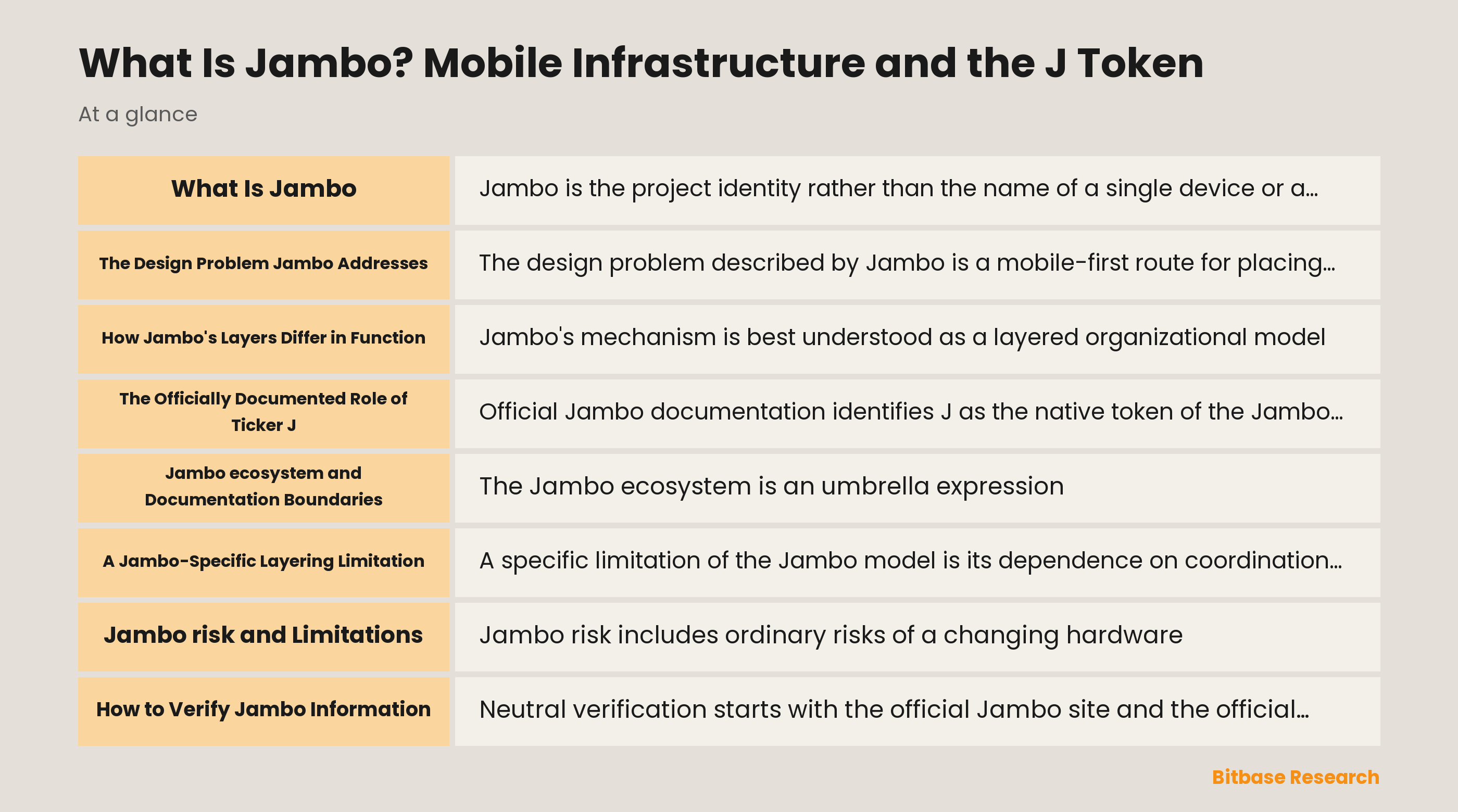
Jambo is a company and a product line, not a blockchain. It sells the JamboPhone through a storefront at jambophone.xyz, publishes an Android app on Google Play, and issues a single token on Solana. The legal entity named in both places is Hakuna Matata Chill Limited: the store footer reads "©JamboTechnology Hakuna Matata Chill Limited 2026", and the Google Play listing names the same company, with a Hong Kong address, as the developer behind the app. Both pages were retrieved on 14 August 2026.
Three things carry the Jambo name and should be kept apart. JamboPhone is hardware sold from a Shopify storefront. The Jambo app is listed on Google Play as "Jambo: Game and Earn" and contains, per the whitepaper, a quest platform called JamboPlay and a non-custodial wallet called JamboWallet. J is the token: the whitepaper calls it "the native token of the Jambo ecosystem" and gives its contract address as Jambjx1oJoZNBZiqbiF9TqgatEZPdyfvYa9WVsKNzUh. It is an ordinary SPL mint on Solana with nine decimals, and a block explorer shows the name Jambo and the symbol J.
There is no Jambo chain, no validator set, and no node software a reader can run. The official site describes the project as "Mobile Infrastructure For All" and "the world's largest on-chain mobile network"; that is the company's description of its own scope, not a measured quantity. Owning the phone, using the app and holding the token are three separate relationships, and none of them implies the others.
What Problem Does Jambo Try to Solve?
Before a project like this, getting a person in an emerging market onto a public blockchain meant stacking several purchases: a smartphone that could cost several months of local income, a separately installed wallet with a seed phrase to protect, and an account at an exchange that would ask for documents the person might not have. Each step lost users, and the drop-off compounded, so the wallet was usually the last thing installed rather than the first.
Jambo's stated answer is to move the wallet to the point of sale. Sell an inexpensive Android handset with the app store, the wallet and partner applications already installed, and the setup problem is handled by the factory image rather than by the user. The whitepaper puts it as bringing users on-chain "across 120+ countries, particularly in emerging markets" through the phone and the app. That is the project's own account of its purpose, and it describes an intention rather than a verified outcome.
It is worth noting how those self-reported figures sit against each other. The whitepaper page says 120+ countries; the official ecosystem page, retrieved the same day, says 128 countries supported, more than 60 ecosystem partners, more than 11 million active wallets and more than 85 million US dollars of ecosystem revenue. None of those numbers carries a date or a definition on the page, none is independently audited, and the two country counts do not agree. Read them as marketing copy from the party with an interest in them.
How Jambo Works Today
The parts that can be checked independently are the store, the app and the mint. Everything else on the official site is either a description of intent or a number the project supplies about itself.
The store is live. On 14 August 2026 the collection page at jambophone.xyz/collections/all was headed "4 products" while rendering three: JamboPhone (Celestial Gold), JamboPhone (Cosmic Black) and JamboPhone 2. All three showed a regular price of 99.00 US dollars and all three showed an "Add to cart" button rather than a sold-out state. The storefront home page carries the lines "WORLD'S MOST POWERFUL $99 SMARTPHONE" and "Buy now for only $99", and the footer reads "©JamboTechnology Hakuna Matata Chill Limited 2026". The mismatch between the "4 products" count and the three rendered items is minor, but it is the kind of detail worth reproducing yourself rather than taking from an article.
The app is live too. The Google Play listing for com.jambo, which the whitepaper links out to, is titled "Jambo: Game and Earn", is published by Jambo Technology, sits in the 1M+ downloads band with a 3.9 average from about 9,250 reviews (as read on 15 August 2026), and was last updated on 15 April 2026. Its description names the JamboPhone 2, an Android 14 device at 99 US dollars, the Jambo App Store, JamboPlay and JamboWallet. Google's download bands and review scores are Google's data about the listing, not the project's claims about its users.
The token side is deliberately simple. J is a plain SPL mint under the standard token program, so there is no protocol code beyond it: no staking contract, no fee contract, no governance module. Jupiter's token API, read on 14 August 2026, reports nine decimals, mint authority disabled and freeze authority disabled, which means new units cannot be minted and balances cannot be frozen by the issuer.
One product on the official navigation has not shipped. The site lists "Jarvis" as a product and links it to jambo.technology/edge; as retrieved on 14 August 2026 that page contained a heading, the phrase "an AI-hardware ecosystem", and a "Join" button, with no documentation, specification or release. Treat it as an announced direction, not a working system.
What J Does in the Jambo System
J is a utility token for rewards inside Jambo's own applications, and the whitepaper is explicit that it is nothing more than that. Its notes state that J "does not in any way represent any shareholding, ownership, participation, right, title, or interest" in the company or the distributor, and that holding it carries no promise of fees, dividends, revenue or profit of any kind. That disclaimer is the whitepaper's own wording, not this article's assessment. It is not a gas token; transactions in J pay Solana fees in SOL.
Read the mechanics page carefully and most of the design is still in the future tense. Questing is the live use: users receive J and other rewards for completing partner-funded campaigns in the app. Staking is not live, and the page says so plainly, that "staking pools will be opened later on" to grant perks and gated access. Discounts are not live either: "in the future, Jambo will implement discounts to physical products and fees for payments" for users who pay in J. Referral rewards are described the same way. So the honest summary of J today is that it is distributed by the project and traded on Solana, and that the sinks described in the documentation have not been switched on.
Supply is fixed and the split is published. The tokenomics page states a fixed supply of 1,000,000,000 J, allocated as Early Contributors 30 percent, Treasury 27 percent, Community 15 percent, Team 15 percent, Airdrop 10 percent and Liquidity Providers and Exchanges 3 percent. On-chain supply read 999,999,647 J on the Solscan token page on 14 August 2026, which is consistent with a one-billion mint and a small burn or rounding. The vesting schedule is published only as an image inside the whitepaper, with no table and no dates in text, so an unlock calendar cannot be checked against the document itself.
The one distribution event that has concluded is documented. The whitepaper's airdrop page allocates 100,000,000 J, ten percent of maximum supply, to JamboPhone 1 and JamboPhone 2 owners, active app users and Mad Lads holders, with snapshots in mid-January 2025 and a claim window open on Galxe for 30 days from 22 January 2025. That page is now headed "TGE Airdrop (Closed)", and the project says further drops would be announced through its official channels.
Jambo Ecosystem and Adoption Today
Almost every adoption number attached to Jambo comes from Jambo. The official ecosystem page, retrieved on 14 August 2026, advertises more than 60 ecosystem partners, 128 countries supported and more than 85 million US dollars of ecosystem revenue; the home page adds more than 11 million active wallets. None of these is dated, defined or audited on the page, and the same site's whitepaper gives a different country figure. Note also that most partner tiles on the ecosystem page are not links at all: they point at "#", so the page names a partner without pointing anywhere that would confirm the relationship.
A few adoption figures do come from third parties and can be reproduced. Google Play reports the 1M+ download band, a 3.9 average across roughly 9,250 reviews (as read on 15 August 2026) and a 15 April 2026 update date for the app. On the token side, Jupiter's token API reported 41,804 holding addresses on 14 August 2026. Those are narrower facts than "11 million active wallets", but they are the ones an outside reader can check.
Trading activity is the part that should be read most carefully, because it is very small. On 14 August 2026, DEX Screener listed three Solana pools for the mint. The deepest is a Raydium concentrated-liquidity J/SOL pool holding about 24,330 US dollars of liquidity, with 469 US dollars of volume over the previous 24 hours across 17 trades, nine buys and eight sells. The other two are Orca pools holding about 2,884 US dollars and about 20 US dollars. Total pooled liquidity across all three was under 28,000 US dollars on that date.
A number of claims circulate in secondary write-ups that we could not trace to any Jambo channel. Statements about a Jarvis node network in the hundreds of thousands of nodes, and about a partnership with Polygon, appear in third-party summaries and aggregator pages, but they do not appear on the official site, in the whitepaper, or on the Play listing as retrieved on 14 August 2026. A widely repeated claim that a named security firm audited Jambo's contracts traces back to an automatically generated summary on a data site, and we could not find the report on that firm's own site. Until the project publishes them, all of these are second-hand claims, not facts.
How Jambo Differs from Other Crypto Phone Projects
The first mechanical difference is where the subsidy sits. Jambo sells a low-cost Android handset through an ordinary e-commerce storefront and funds user rewards through partner-sponsored quest campaigns run inside its own app. Several other device projects sell a premium handset and attach token rewards to running software on it. Those are different business shapes with different failure modes; neither arrangement is being ranked here.
The second is how the token relates to the hardware. J is a plain SPL mint with no on-chain link to a device: there is no registry contract that records a phone, no proof that a handset performed work, and no emission contract that pays a device. Some other hardware-and-token designs put exactly that link on chain, so device ownership and token issuance can be checked in the same place. In Jambo's design, distribution runs through campaigns the company operates, which means the connection between owning a phone and receiving tokens is an operational promise rather than an on-chain rule.
Risks and Limitations
Liquidity is the first and largest practical risk. With about 24,330 US dollars in the deepest pool, under 28,000 US dollars across all three, and 469 US dollars of 24-hour volume across 17 trades on 14 August 2026, an order of a few thousand dollars is large relative to the book. At that depth, slippage on entry and exit can be severe, quoted prices can move on single trades, and there is no guarantee that a position can be closed at anything near the last screen price. Circulating scale is very small in absolute terms, so ordinary retail-sized trades dominate the tape.
Ownership is concentrated. Jupiter's token API reported top-holder concentration of about 74 percent on 14 August 2026, on that provider's own definition of the top-holder set, against 41,804 holding addresses. Separately, the published allocation gives 30 percent to Early Contributors, 27 percent to Treasury and 15 percent to the team, and the vesting schedule exists only as an image, so a reader cannot build an unlock calendar from the official document.
The official cadence and the commercial cadence do not match, and this is worth stating plainly. On 14 August 2026 the "Latest Announcements" section of jambo.technology showed 23 September 2025 as its newest item and the site footer read "© 2025 Jambo Technology", meaning the official news channel has published nothing carrying a 2026 date. Meanwhile the store footer reads 2026, the store is taking orders, and the Play listing was updated in April 2026. The commercial and app sides show 2026 activity; the official announcement channel does not. Neither observation proves anything about the other, and a reader should not treat a live storefront as evidence that the token roadmap is being worked on.
Execution risk follows from the same gap. Staking, payment discounts and the loyalty mechanics are written in the future tense in the whitepaper, and the Jarvis product page carries no product. On the consumer side, user reviews on the Play listing include complaints about withdrawal thresholds and fees making small earnings hard to move out; those are individual user statements rather than verified findings, but they describe the kind of friction that separates an advertised reward from a received one.
We found no public audit report for anything Jambo ships, from any auditing firm's own site, so this article treats the code as unaudited. The mint itself is a standard SPL token with mint and freeze authority disabled, which limits one category of issuer risk but says nothing about the off-chain systems that decide who receives rewards. Finally, on the legal side, the whitepaper states the token is "not intended to constitute securities in the British Virgin Islands, Singapore or any relevant jurisdiction". That is the issuer's own position, not a determination by any regulator, and how the token is treated where you live is a separate question.
How to Verify Jambo and J
Start from the official domain typed by hand, not from a search result or an advertisement. Type jambo.technology yourself and use it as the origin for everything else: the whitepaper on GitBook, the storefront on jambophone.xyz and the social accounts. Only the direction from the official domain outward is evidence; a site that links to the project proves nothing. Because Jambo legitimately uses several domains, the surface for lookalikes is wider than usual, so compare any domain you land on character by character, and stop immediately if a page asks you to connect a wallet to claim, migrate or verify anything.
Pin the contract next. Take the address from the whitepaper's own $J page rather than from a chart site, paste Jambjx1oJoZNBZiqbiF9TqgatEZPdyfvYa9WVsKNzUh into a Solana block explorer, and confirm four things: that the name reads Jambo and the symbol reads J, that there are nine decimals, that the supply matches what you expect from a one-billion mint, and that mint and freeze authority are disabled. A token with the same name or ticker on any other network is a different asset with a different issuer, so the network has to match before anything else does.
Read supply and unlocks from the chain and the official document, not from an aggregator. The explorer gives you supply and holder count; the whitepaper gives you the allocation split. Because the vesting schedule is published only as an image, treat any unlock date you read elsewhere as unverified until the project publishes a schedule in text, and say so in your own notes rather than repeating a number.
Check the liquidity yourself before you check anything else about the token. Open the pool page on the exchange where it trades, write down pooled liquidity, 24-hour volume, the number of trades and the date you looked, and compare the size of anything you are considering against that depth. A thin book is a fact about the asset, and it changes day to day, so a figure copied from an article, including this one, needs re-reading on the day you act.
Then check the operating status directly. Load jambophone.xyz/collections/all and count how many products render, whether each shows an add-to-cart control or a sold-out state, and what year the footer carries. Open the Play listing from the link in the whitepaper and read the developer name and the last-updated date. Look for the newest dated item in the official announcements section and note that date. For any claimed audit, find the report on the auditing firm's own site; a PDF hosted only by the project, or a summary generated automatically on a data site, is not an audit.
Conclusion
Jambo is a hardware and app company whose visible output is a 99-dollar Android phone, a rewards-and-wallet application on Google Play, and J, a plain SPL token on Solana at Jambjx1oJoZNBZiqbiF9TqgatEZPdyfvYa9WVsKNzUh with a documented fixed supply of one billion. J today is a reward token distributed through quests; the staking and discount mechanics that the whitepaper describes are written in the future tense and are not live. Nearly all of the adoption figures around the project are self-reported and undated, the on-chain liquidity is very thin, and the official announcement channel has published nothing dated 2026 even though the store and the app show 2026 activity. Take the contract address from the whitepaper, confirm it on a Solana block explorer, and read the pool depth and the store status yourself on the day you need them.
Related market pages
Bitbase pages for the tokens named in this article:
- J: View price
Related reading
Other Bitbase articles on this topic:
- What Is Perle? Human-Verified AI Data and PRL
Disclaimer: This article is educational content from Bitbase Academy, provided for information only. It explains what a project does and what role its token plays in that system; it does not constitute investment, trading, tax, or financial advice, and it is neither a recommendation nor an endorsement of any project or token. Bitbase has not carried out due diligence on the project described here, and mentioning it does not mean Bitbase lists or supports the asset. Crypto assets carry significant risk, including price volatility, thin liquidity, smart-contract failure, regulatory uncertainty, and the possible loss of their entire value. This project is at an early stage, and early-stage projects carry a higher risk of failing outright. Its contracts have not been publicly audited, or the published audit covers only part of the code. Written as of August 2026; a project's status, tokenomics, team, and contracts can change at any time. Verify everything yourself through official channels, the contract address, and a block explorer, and beware of imitation sites and phishing links.
References
[1] Jambo Technology official site (self-description, ecosystem counters, Latest Announcements, footer year) www.jambo.technology
[2] Jambo ecosystem page (60+ partners, 128 countries, ecosystem revenue; most partner tiles are not links) www.jambo.technology
[3] About Jambo, Jambo Whitepaper (120+ countries, product line, $J described as the ecosystem token) jambo.gitbook.io
[4] $J Token, Jambo Whitepaper (contract address of the SPL mint) jambo.gitbook.io
[5] $J Tokenomics, Jambo Whitepaper (fixed supply of 1,000,000,000 and the allocation split; vesting published only as an image) jambo.gitbook.io
[6] $J Token Mechanics, Jambo Whitepaper (questing live; staking and discounts in the future tense; issuer notes on rights and jurisdictions) jambo.gitbook.io
[7] JamboPhone storefront collection page (three rendered SKUs, 99.00 USD, Add to cart, legal entity in the footer) jambophone.xyz
[8] Solscan token page for the J mint (name, symbol, decimals, on-chain supply) solscan.io
[9] Google Play listing for the Jambo app (developer, download band, rating, last update, user reviews) play.google.com
[10] DEX Screener page for the J mint (pool liquidity, 24-hour volume, trade count, holder count) dexscreener.com
[11] mechanics.md jambo.gitbook.io
[12] www.jambophone.xyz www.jambophone.xyz