Linea is a public zkEVM Layer 2 network designed for Ethereum-compatible execution. Its technical protocol processes transactions, records the information needed to prove state transitions, produces zero-knowledge validity proofs, and finalizes state to Ethereum. This article distinguishes that network and protocol from the LINEA token, explains the documented roles of each, and keeps operational actions outside scope.
What Is Linea?
Linea Mainnet is the public, permissionless zkEVM network described in the current Linea documentation. A zkEVM is an execution environment designed to process Ethereum-style smart-contract transactions while using zero-knowledge proofs to show that specified execution was computed correctly. In Linea's documentation, the network processes Ethereum-compatible transactions, generates ZK proofs, and finalizes state to Ethereum. Those three elements are the useful starting point: execution happens on the Layer 2, proofs attest to the execution, and Ethereum is the finalization layer for Linea Mainnet.
The technical stack behind Linea is now called Lineth, formerly the Linea Stack. The documentation distinguishes the public Linea network from the open-source protocol stack because the same technology can support other Ethereum-compatible deployments. That distinction prevents a common category error: Linea is both the name of a public network and a context for an underlying protocol, while a particular application, contract, or token is a separate object that needs its own evidence.
For an educational profile, it is also important not to reduce Linea to a slogan about speed or cost. A rollup is a collection of components and commitments: transaction execution, block batching, execution traces, proof generation, on-chain verification, data availability, and finalization. The practical meaning of “Ethereum-compatible” depends on the exact interface, version, contracts, and application behavior being examined, not merely on a network label.
What Problem Does Linea Address?
Ethereum-compatible applications need an execution environment that can process many state changes without requiring Ethereum Layer 1 to replay each transaction as an ordinary Layer 1 transaction. The protocol description explains that Linea executes transactions, groups executed blocks into batches, and records execution traces. That design separates routine execution from the later task of demonstrating that the batch was computed according to the relevant rules.
Zero-knowledge validity proofs are central to that separation. Rather than asking a verifier to replay every transaction in a batch, the proving system uses the execution traces to generate a proof that can be checked. The proof does not erase all dependencies or make an application automatically safe; it changes what is verified at the finalization path. Data availability, the exact proof system, the verifier contracts, the configured finalization layer, and the application's own logic all remain material parts of the system.
How Does Linea Process Transactions and Prove State?
At a high level, a Linea transaction enters an Ethereum-compatible execution environment. Smart contracts run against the current network state, and each accepted transaction produces a deterministic state transition. Deterministic does not mean that a reader may infer any unspecified result in advance; it means that the protocol has rules for computing state from defined inputs. A contract still needs correct code, appropriate authorization design, and sound handling of the state that it reads.
After execution, blocks are grouped into batches and the protocol records the traces required for proof generation. A trace is not simply a user-facing history list. In this context, it is the information the proving system needs to show that the state transitions in a batch followed the execution rules. The mechanism matters because it makes the proof claim narrower and inspectable: the proof concerns defined execution, not a general promise about every application built on the network.
The final stage described in the current protocol documentation submits the information needed for data availability, verification, and finalization to the configured finalization layer. For Linea Mainnet, that layer is Ethereum. This gives the article a more precise vocabulary than “everything settles instantly”: there are distinct stages with different roles, and a careful reader should ask which stage a claim refers to, which contracts implement it, and which version of the protocol documentation supports it.
What Does LINEA Do in the Linea System?
The official ticker is `LINEA`, supported by Linea's current homepage, its dated token announcements, and the LineaScan token record linked from the Linea site. The dated 2025 tokenomics material is explicit about an important limit: ETH is used as gas on Linea, and LINEA is not the gas token. It also described no tokenholder on-chain governance at that time. Therefore the ticker section should not be read as a claim that LINEA pays execution fees or gives a universal control right over the protocol.
Readers researching linea tokenomics and use cases need to separate the network mechanism from the documented economic design. The official materials describe LINEA as an economic-coordination tool connected with ecosystem funding and a fee-related burn mechanism, while the later official year-end post says that the token had launched. The phrase linea token is consequently a label that needs date, scope, and contract verification: it should not replace the technical explanation of execution, proofs, or Ethereum finalization, and it does not justify an action by itself.
Supply and rights are the two token facts a reader can check directly, and Linea publishes both. Its own tokenomics post gives total and maximum supply as 72,009,990,000 LINEA, split 75% to an ecosystem fund, 10% to early contributors — of which 9% of total supply went to early users and was fully unlocked at the generation event, with 1% to strategic builders — and 15% to the Consensys treasury under a five-year lockup, with no allocation to employees and none to investors. Binance's listing announcement recorded 15,482,147,850 LINEA circulating at listing, or 21.50% of the maximum. The same tokenomics post is equally explicit about what the token is not: LINEA currently carries no on-chain governance rights, the protocol operates without a DAO, there is no tokenholder governance in the system, and decisions sit instead with a consortium. Holding the token is therefore not a way to influence how the network is run.
Ecosystem and Use Cases on Linea
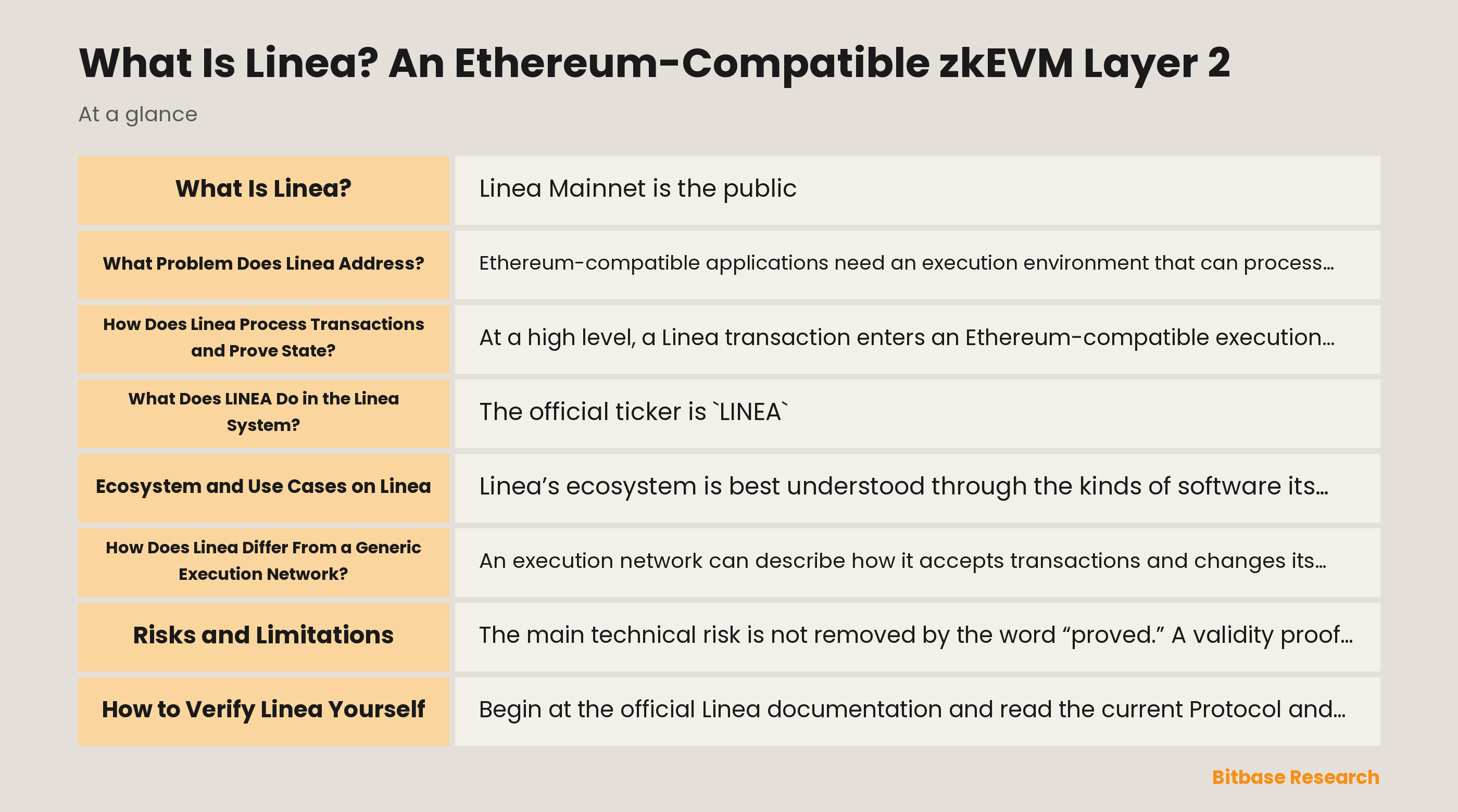
Linea's ecosystem is best understood through the kinds of software its Ethereum-compatible environment can support. A developer can examine whether an application's bytecode, dependencies, RPC assumptions, contracts, and security model fit the target deployment. The Linea documentation presents the network as a zkEVM environment rather than a single application category, so “use case” should mean a concrete application design with a defined state model and verification path, not a claim that every application behaves identically.
The token-related ecosystem description has a different boundary. The official tokenomics publication discusses allocation and funding mechanisms for builders, users, public goods, and Ethereum-oriented development. That is a dated account of the project's stated design. It does not establish the condition of a particular application, the status of a particular program, or the safety of a particular contract. Each of those claims needs a current, independently readable technical and on-chain source.
One listing fact belongs on the record because it is a caution rather than a milestone. Binance's own announcement states that LINEA was listed for spot trading at 2025-09-10 16:00 UTC as the thirty-seventh HODLer Airdrops project, and that a seed tag was applied to it. The seed tag is Binance's label for assets it treats as early-stage and higher-risk; it brings additional trading rules and, in some regions, additional restrictions such as trade-only classification without deposits or withdrawals. Listing on a large venue therefore does not mean the venue has assessed the project favourably, and a reader comparing venues should look at the tag and the regional terms as well as the pair list.
How Does Linea Differ From a Generic Execution Network?
An execution network can describe how it accepts transactions and changes its local state. Linea's protocol documentation adds a specific proving and finalization story: execution traces feed a ZK proving system, and a verifier can check the resulting validity proof without replaying each transaction in a batch. That is not merely an interface preference. It is the mechanism used to connect Layer 2 execution to the evidence submitted for Linea Mainnet's finalization on Ethereum.
Linea also needs to be distinguished from the LINEA token. The network's gas asset is ETH according to the official tokenomics statement, whereas LINEA is documented in a separate economic design. Treating an execution environment, a protocol stack, a network's finalization contracts, and a token as interchangeable would hide the most important verification questions. A reader should identify which object a source actually describes before drawing a conclusion.
Risks and Limitations
The main technical risk is not removed by the word “proved.” A validity proof can attest to a defined execution statement, but it cannot repair a faulty smart contract, an unsafe application rule, an incorrect contract address, a compromised interface, or an unsupported assumption about a component. A reader should distinguish between the protocol's validity claim and the security properties of an individual application built around it. Changes in code, deployments, configurations, or documentation can also affect what a claim means over time.
There are operational and governance limits as well. A Layer 2 relies on a set of software components, data-availability and finalization arrangements, contracts, and processes. The project's token mechanics and ecosystem programs are time-sensitive documentation, not permanent guarantees. No audit conclusion is made here: an audit label is not equivalent to locating the report, checking its scope, and comparing it with the current code and contract deployment. Treat current source pages and on-chain records as things to re-check.
Decentralisation is where the distance between the design and the current deployment is widest, and it is measurable rather than a matter of opinion. As of 2026-08-15 the independent tracker L2BEAT classifies Linea as a Stage 0 rollup and records that only a trusted sequencer may submit transaction batches, with the mechanism for users to submit their own batches currently disabled. It marks as critical the risk that funds can be frozen if the sequencer refuses to include an exit transaction, states that there is no mechanism to force inclusion if the sequencer is down or censoring, and notes that only whitelisted proposers can publish state roots on Ethereum, so withdrawals freeze if those proposers fail. The exit window is listed as none, on the grounds that the contracts are instantly upgradable, and a withdrawal rate limit of 10,000 ETH per twenty-four hours applies. Linea's own documentation agrees on the substance: it marks forced transactions as not yet live and describes the design as typically one sequencer instance per network.
The token generation event on 2025-09-10 did not go smoothly, and the honest way to state it is by source. Independent reporting describes a sequencer degradation on mainnet that day, with block production interrupted for roughly three quarters of an hour shortly before claiming opened, followed by widespread claim-transaction failures. This review could not render the archived status-page incident to confirm those timings from the primary record, so they should be read as press-reported rather than confirmed. What Linea itself published is a security note dated 2025-09-05 that had already warned users the claim website might crash, that gas estimation could malfunction and produce extremely high fees, and that there was no need to rush because tokens would remain claimable for ninety days. That same note warns about fake websites mimicking the official claim site, phishing links, impersonation of Linea representatives, fake contract addresses and fraudulent delegation offers, and it names only three official channels for verification. Anyone following a claim link should arrive at it from the official domain rather than from a search result or a message, and should never send tokens to a token contract address.
How to Verify Linea Yourself
Begin at the official Linea documentation and read the current Protocol and Linea Mainnet pages. Confirm that a page is describing the public network, the Lineth protocol stack, or a specific contract, because those are not interchangeable. For a mechanism claim, compare the stated execution, batching, trace, proving, data-availability, and finalization steps with the source date. For a contract claim, use a project-controlled documentation or explorer link and read the network and contract details rather than relying on a copied address.
For the LINEA identity, follow the Linea site's official block explorer link to the LineaScan token record and inspect it in read-only mode. Compare the displayed name, symbol, exact contract address `0x1789e0043623282d5dcc7f213d703c6d8bafbb04`, network, and proxy or verified-source information with the dated official announcements. A block explorer is a record, not a substitute for source context. This verification path intentionally contains no account connection, signature, claim, acquisition, exchange, staking, or bridging action.
The Bottom Line
Linea is an Ethereum-compatible zkEVM Layer 2 whose current documentation describes a path from execution to batching and traces, then to zero-knowledge validity proofs and Ethereum finalization. That architecture is useful to understand when evaluating a particular deployment, but the relevant proof, contract, version, and application rule must still be checked in context.
LINEA is the officially documented ticker for the separate token design, while ETH is the documented gas asset on Linea. The token's roles should be treated as dated project documentation and verified against the official source trail and the read-only LineaScan record. This profile is educational context, not an instruction to perform any network or token action.
Related market pages
Bitbase pages for the tokens named in this article:
- LINEA: View price · Perpetual market
Related reading
Other Bitbase articles on this topic:
- Rollup Sequencers and Interoperability
- What Is MegaETH? Real-Time Ethereum Execution
- Layer 1 vs Layer 2: How Blockchains Scale
Disclaimer: This article is educational content from Bitbase Academy, provided for information only. It explains what a project does and what role its token plays in that system; it does not constitute investment, trading, tax, or financial advice, and it is neither a recommendation nor an endorsement of any project or token. Bitbase has not carried out due diligence on the project described here, and mentioning it does not mean Bitbase lists or supports the asset. Crypto assets carry significant risk, including price volatility, thin liquidity, smart-contract failure, regulatory uncertainty, and the possible loss of their entire value. Written as of August 2026; a project's status, tokenomics, team, and contracts can change at any time. Verify everything yourself through official channels, the contract address, and a block explorer, and beware of imitation sites and phishing links.
References
[1] Linea Docs — Protocol (official; current protocol stages) docs.linea.build
[2] Linea Docs — Linea Mainnet (official; network and finalization context) docs.linea.build
[3] LINEA: Tokenomics (official announcement, 2025-07-29) linea.build
[4] LINEA: The Token to Power Ethereum's Second Decade (official announcement, 2025-09-03) linea.build
[5] 2025 Launched a New Era for Linea and L2s (official announcement, 2025-12-11) linea.build
[6] Linea (LINEA) token record on LineaScan (official explorer linked by Linea) lineascan.build
[7] linea security and scam awareness linea.build
[8] forced transactions docs.linea.build
[9] sequencer docs.linea.build
[10] faq support.linea.build