
Movement Network is a Move-language blockchain whose native token is MOVE, and it has to be described in two layers: the network is running, while MVMT Labs, the company that originally built it, filed for Chapter 11 bankruptcy on 15 July 2026. This article separates the network, the foundation, the current operator and the bankrupt company, sets out the unresolved review and litigation, and gives you a checklist to confirm all of it yourself.
What Is Movement Network?
Movement Network is a blockchain built around Move, the resource-oriented programming language originally developed at Meta, and MOVE is the token its documentation names as the network asset. Four entities carry that name and they are not interchangeable. Movement Network Foundation, based in Grand Cayman, describes itself as the independent steward of the network. Move Ind. Inc., trading as Move Industries, is the company that runs it day to day. MVMT Labs, Inc., also known as Movement Labs, is the original development company. Movement Network itself is the software.
The reason to insist on that separation is that only one of the four is in bankruptcy. On 15 July 2026 MVMT Labs, Inc. filed for Chapter 11 in Delaware; court documents were first surfaced by CoinDesk and reported from 21 July. Move Industries chief executive Torab Torabi responded publicly that MVMT Labs is a separate legal entity, that Move Industries is not part of the filing, and that Move Industries is operating normally. That is the operator's own statement, consistent with the network still publishing and running services, but it is a statement by an interested party rather than a court finding.
The governance arrangement is documented by the Foundation itself. In a press release dated 11 August 2026 the Foundation said it finalised the appointment of Move Industries as the official primary service provider in December 2025, that Move Industries then assumed primary operating responsibilities on the Foundation's behalf, and that the Foundation's own role now focuses on oversight and treasury management. Move Industries was created earlier, in May 2025, by former Movement Labs staff.
What Problem Does Movement Try to Solve?
The original pitch was a language problem. Most smart-contract platforms inherited an account model in which a token balance is a number in a mapping, so a contract bug can create or destroy that number. Move treats an asset as a resource that the type system will not let a program duplicate or silently discard, which is meant to remove a family of accounting errors before the code runs. Movement's founding claim was that this model deserved a network connected to Ethereum rather than one living entirely on its own.
What the network says it is solving today is a different problem. The current homepage headline is that Movement is the settlement and yield layer for emerging markets, and the framing on that page is cross-border payments: the site states that 685 billion US dollars moves across borders every year and that most of it still clears in three to five days through infrastructure built in the 1970s. Those are the project's own framing numbers, published on its marketing site, not independently audited figures.
Both descriptions come from the project, made at different times, and the second replaced the first. Crypto Briefing reported in July 2026 that Movement had announced a shift toward cross-border payments, remittances and stablecoin settlement in the preceding month, and said it had obtained access to licensed payments infrastructure in North America and Europe. Any article that still describes Movement purely as a Move virtual machine research project is describing 2024.
How Movement Works Today
The execution model is the part that has not changed. Move bytecode runs in the Move virtual machine, assets are represented as resources with ownership and type constraints enforced at the language level, and the official documentation continues to organise the network around API, execution, storage, consensus and networking layers. The public documentation site is docs.movementnetwork.xyz, and the network operates a public block explorer at explorer.movementnetwork.xyz plus a faucet, a bridge and a staking interface.
Where the description genuinely diverges is architecture. The Movement documentation still carries a section headed M1 - Movement L1 and links an architecture page under a mainnet path, which reads as a sovereign Layer 1. Independent reporting describes the same system differently: Crypto Briefing, recounting the company history, wrote that MVMT Labs developed an Ethereum Layer 2 network powered by Move, with the aim of bringing Move contracts to Ethereum. Those two claims imply different security assumptions, and this article does not resolve them for you. If the settlement relationship matters to your decision, read the current architecture page and confirm it there rather than accepting either summary.
The application layer is where the new direction is visible. The site lists yield products denominated in stablecoins and wrapped assets, names Circle, KAST, Juicyway, Canopy, MovePosition, Near, Yuzu Finance and Zoth among ecosystem partners, and on 7 August 2026 announced a WhatsApp-based stablecoin remittance route to Mexico with El Vecino and RISE. The advertised yields appear on a marketing page and are not a guarantee by anyone.
What MOVE Does in the Movement System
MOVE is documented as the network's native asset, associated with transaction fees, validator security and network incentives. Movement runs a staking interface at staking.movementnetwork.xyz and a bridge at bridge.movementnetwork.xyz. Those are protocol roles, and this article states them without suggesting that you acquire, stake, delegate or bridge anything.
The token's history is inseparable from the events described above, and the sequence is documented. A CoinDesk investigation published in April 2025 reported an internal review of a market-making arrangement that allegedly gave an intermediary, Rentech, control over 66 million MOVE. Outlets carrying that reporting characterise it as an allegation examined in an internal review, not as an adjudicated finding. What followed is not in dispute: Binance banned the market maker, Coinbase delisted MOVE in May 2025, and co-founder Rushi Manche was suspended and left the project the same month.
Two consequences of that episode are still open as of August 2026, and both come from the Foundation's own 11 August statement. The independent directors of the Foundation board engaged Paul Hastings and A&O Shearman to continue a third-party review of the 2025 market-maker issues concerning Movement Labs, and the Foundation states that this review remains ongoing. The same firms are engaged on behalf of the Foundation with respect to multiple litigation matters in the Delaware Court of Chancery involving former Movement Labs officers; the Foundation says it is not a party to those matters. Nobody has published a conclusion, and this article does not supply one.
Movement Ecosystem and Adoption Today
Every scale figure Movement publishes is self-reported, and the honest way to read them is as dated marketing claims. The homepage counters state more than 300,000 KYC-verified users, more than 160 countries reached, total value locked on Movement of 3.53 million US dollars, and settlement in under one second. The gap between the user count and the locked value is worth noticing rather than smoothing over: they describe different things, and the second number is small for a general-purpose network.
Partner logos are the same kind of evidence. A logo on a landing page means a relationship the project chose to display, not an audited integration, a revenue share, or an endorsement of the token. If a named partner matters to you, look for that company's own announcement on its own domain and check the date.
The publishing record is at least current. The Movement blog carried an article dated 13 August 2026 on stablecoin rails in the MENA region, the Mexico remittance announcement on 7 August 2026, and a personnel announcement on 29 July 2026. A network that is publishing weekly is not a network that has stopped, which is exactly why the bankruptcy of MVMT Labs must not be reported as the chain shutting down.
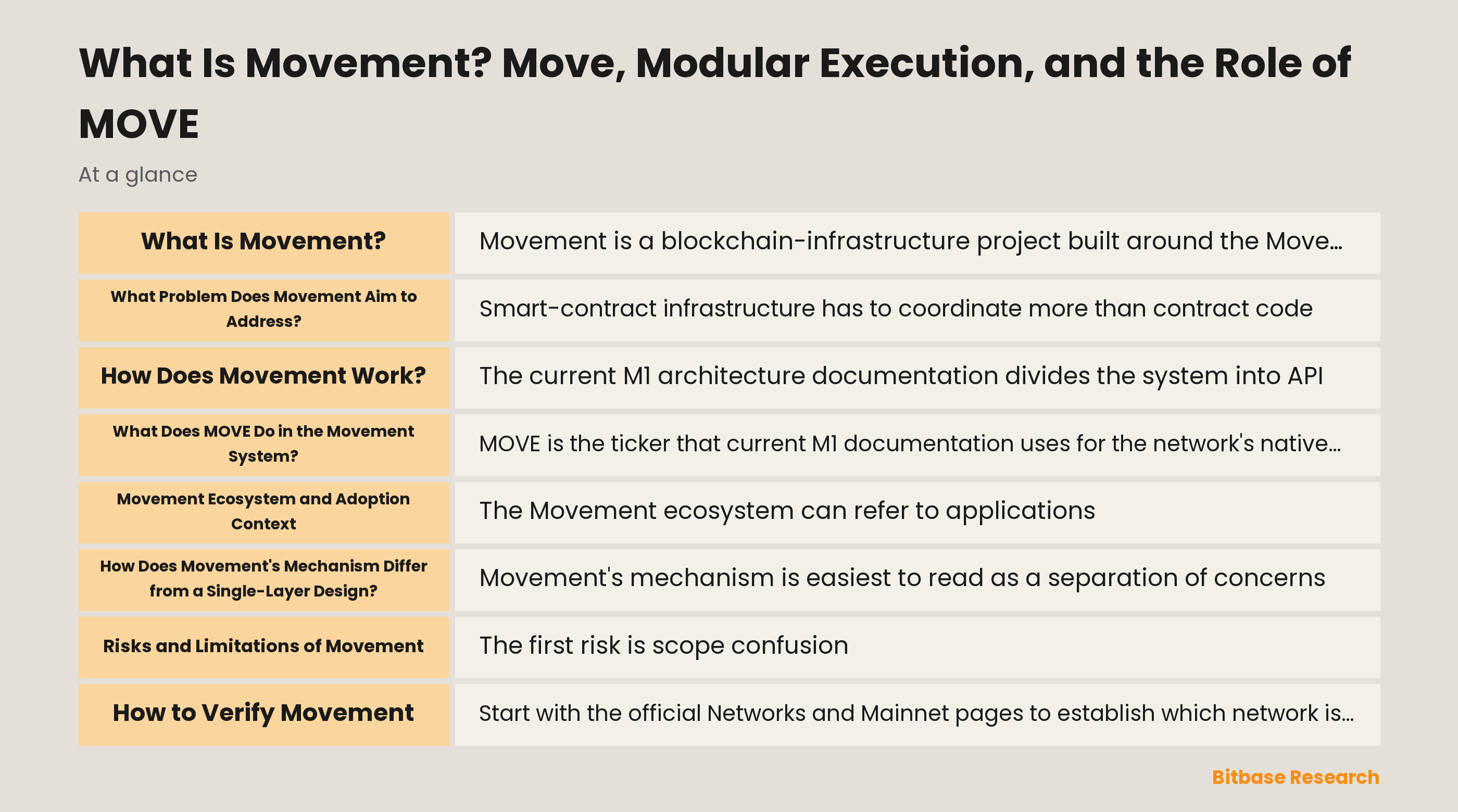
How Movement Differs from Other Move-Based Networks
The first difference is institutional rather than technical. Aptos and Sui were built by teams that carried the Diem codebase forward into networks they still operate. Movement's development company entered Chapter 11 while the network continued under a different operator appointed by a foundation. Whatever you make of the outcome, the structure is unusual: the entity that wrote the software and the entity that runs it are now separate, and only one of them is in a bankruptcy court.
The second is scope. A general Move Layer 1 competes on general-purpose execution. Movement's current positioning is narrower and vertical, aimed at stablecoin settlement and yield for specific payment corridors, with distribution partners rather than a broad developer funnel as the stated route to users. That is a different bet with a different failure mode, and it is not a ranking of one design over another.
Risks and Limitations
The corporate risk is the one to read first, and it has to be stated precisely. MVMT Labs, Inc. filed for Chapter 11 protection in Delaware on 15 July 2026. Chapter 11 is a reorganisation proceeding, and its outcome is decided by a court on a schedule you do not control. The operator says the network is unaffected; that is the operator's position. A bankruptcy of the original developer can still affect intellectual property, contracts, key personnel and funding in ways that become visible only as the case proceeds.
The unresolved-process risk is second. The Foundation confirms that the third-party review of the 2025 market-maker issues remains ongoing and that multiple Delaware Court of Chancery matters involving former Movement Labs officers are outstanding. Ongoing means no conclusion exists, in either direction. Do not read the absence of a finding as exoneration, and do not read the existence of a proceeding as a verdict.
The market and access risk is third and concrete. Coinbase delisted MOVE in May 2025 and Binance banned the market-making account associated with the token launch. Delisting from a major venue durably reduces where an asset can be bought and sold, and thin markets widen spreads and increase the cost of exiting a position. MOVE trades far below the levels of its late-2024 launch period.
The technical and disclosure risks close the list. The documentation and independent reporting describe the network's relationship to Ethereum differently, so the security model is not settled from public sources alone. Every adoption number on the site is self-published, the advertised yields are a marketing surface rather than a commitment, and validator rules, fee settings and token parameters can change through software releases or governance. This article makes no claim about how MOVE is classified in any jurisdiction.
How to Verify Movement and MOVE
Start from the official domain and treat everything else as downstream. Type movementnetwork.xyz and docs.movementnetwork.xyz into the address bar yourself, and reach the social accounts, the bridge, the staking page and the explorer only by following links outward from there. Compare any domain you land on character by character against the one you typed, and stop immediately if a page you arrived at from an advertisement or a message asks you to connect a wallet to claim, migrate or verify anything.
Then separate the entities before you read any claim. The Foundation is the Cayman steward, Move Industries is the operator appointed in December 2025, and MVMT Labs, Inc. is the company in Chapter 11. When you see a statement, ask which of the three made it. Foundation announcements are distributed through newswire services and carry a dated release; the operator's statements come from its own accounts; the bankruptcy record is a court record and is the only one of the three that is not self-published.
Take the network identity to a block explorer. Movement runs explorer.movementnetwork.xyz, and MOVE also exists in bridged and wrapped forms on other chains, so a contract address quoted without the network it belongs to is not an answer. Confirm the chain, the token name and symbol, and the deployment before you accept that an address is the asset you were reading about, because a same-ticker token on the wrong network is the most common way funds go nowhere. For supply and staking parameters, read the chain and the official documentation rather than a price aggregator.
Finally, grade each claim by who is making it and when. Reserve the strongest weight for the court docket and for statements the Foundation makes in a dated release, medium weight for independent reporting that names its sources, and the least for counters on a marketing page. Where a review is described as ongoing, carry the word ongoing into your notes and do not upgrade it to a result. Re-check the case status on the day you act, because the schedule moves.
Conclusion
Movement Network is a Move-language blockchain that is still operating, still publishing, and now positioned as a settlement and yield layer aimed at emerging-market payments. Its original development company, MVMT Labs, Inc., filed for Chapter 11 on 15 July 2026, day-to-day operation passed to Move Industries under an appointment finalised in December 2025, and the Foundation retains oversight and treasury management. MOVE is documented as the network asset used for fees, validator security and incentives.
Two things remain unresolved and neither should be rounded off: the third-party review of the 2025 market-maker issues remains ongoing, and multiple Delaware Court of Chancery matters involving former Movement Labs officers are outstanding. Coinbase delisted MOVE in May 2025. Read the Foundation's dated releases, read the current architecture documentation before accepting any description of how the network settles, and confirm every contract address on a block explorer for the exact chain you intend to use.
Related market pages
Bitbase pages for the tokens named in this article:
- MOVE: View price · Perpetual market
Related reading
Other Bitbase articles on this topic:
- Layer 1 vs Layer 2: How Blockchains Scale
- Ethereum Staking Queues and Issuance: Getting In and Out
- Ethereum Rollups and Data Availability
Disclaimer: This article is educational content from Bitbase Academy, provided for information only. It explains what a project does and what role its token plays in that system; it does not constitute investment, trading, tax, or financial advice, and it is neither a recommendation nor an endorsement of any project or token. Bitbase has not carried out due diligence on the project described here, and mentioning it does not mean Bitbase lists or supports the asset. Crypto assets carry significant risk, including price volatility, thin liquidity, smart-contract failure, regulatory uncertainty, and the possible loss of their entire value. Written as of August 2026; a project's status, tokenomics, team, and contracts can change at any time. Verify everything yourself through official channels, the contract address, and a block explorer, and beware of imitation sites and phishing links.
References
[1] Movement Network official homepage (settlement and yield layer positioning, self-reported counters, partner list) movementnetwork.xyz
[2] Movement Network Foundation, Corporate Governance Updates, official press release dated 11 August 2026 globenewswire.com
[3] Movement official documentation (M1 section, networks, architecture, explorer and faucet links) docs.movementnetwork.xyz
[4] Crypto Briefing, MVMT Labs files for Chapter 11 (15 July 2026 filing, Move Industries statement, company history) cryptobriefing.com
[5] CoinDesk, Movement Labs files for Chapter 11 months after token scandal coindesk.com
[6] CoinDesk, Movement Labs suspends Rushi Manche after Coinbase delists MOVE (May 2025) coindesk.com
[7] Movement blog index (publication dates through 13 August 2026) movementnetwork.xyz
[8] Movement block explorer (chain and contract verification) explorer.movementnetwork.xyz