Nexpace is the named organization and protocol context in the official documentation for MapleStory Universe, while NXPC is the native token label documented for its Layer 1 network. MapleStory Universe, NXPC, NFTs, and NESO are related terms with different scopes.
The questions what is Nexpace NXPC and what is an nxpc token are best treated as identity questions rather than as prompts for a product walkthrough. This profile explains how the official documentation separates the organization, the network ecosystem, a token label, and game-asset records. Current network scope, contract identifiers, asset availability, legal regions, and product status all need a fresh first-party check on the publication date.
What Is Nexpace and MapleStory Universe?
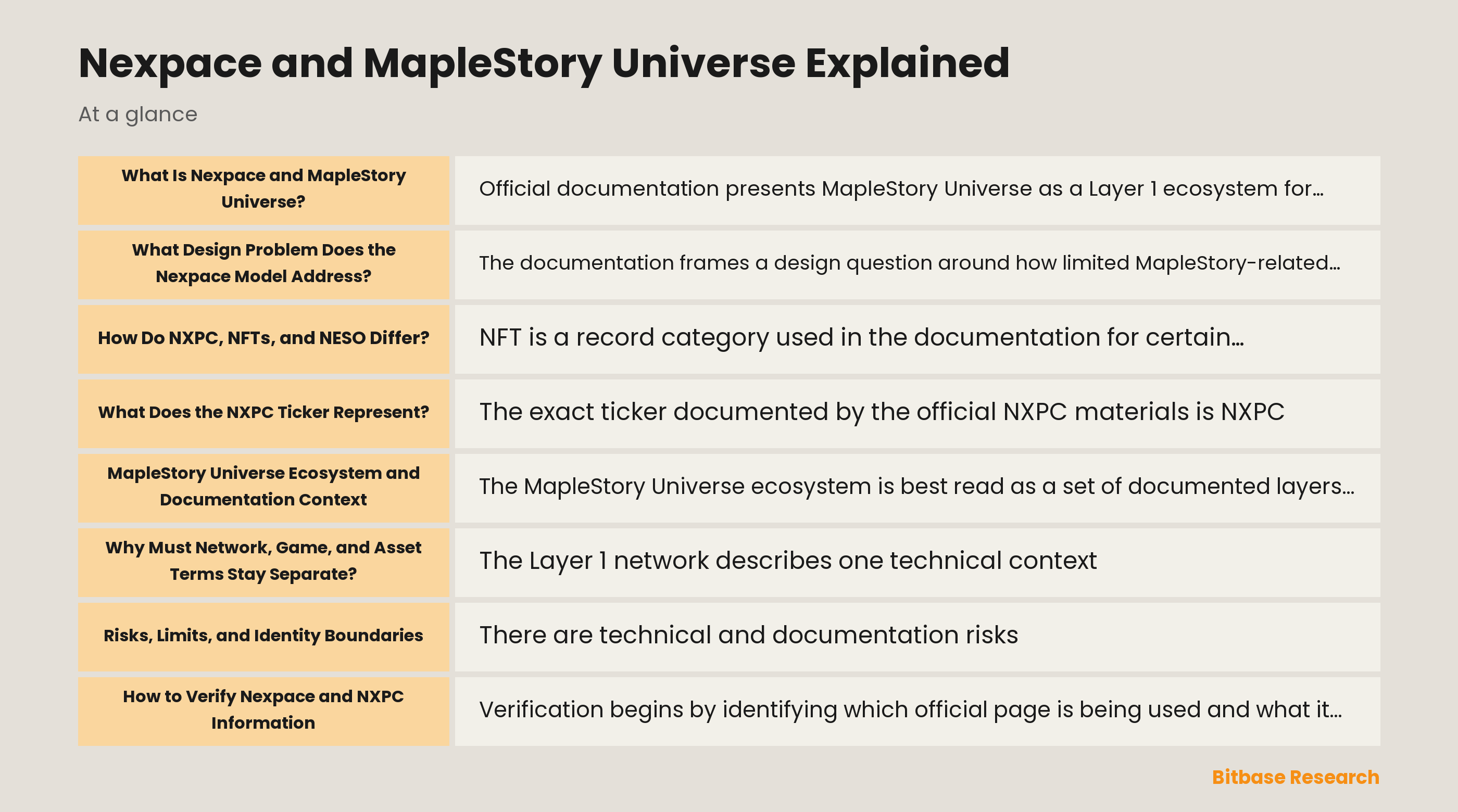
Official documentation presents MapleStory Universe as a Layer 1 ecosystem for applications and experiences built around MapleStory intellectual property.
Nexpace is the name used for the organization and protocol context behind that documentation. The two names therefore should not be collapsed: one can identify the entity or framework described by first-party materials, while the other identifies the documented ecosystem and its components. MapleStory Universe is also not the same thing as one game, one asset collection, or one interface. Its materials describe a network setting, foundational applications, developer-oriented materials, and tokenized asset concepts. A profile should preserve that layered view. A reference to the ecosystem does not by itself establish that every named application, feature, or asset category has the same current scope or availability.
What Design Problem Does the Nexpace Model Address?
The documentation frames a design question around how limited MapleStory-related digital items can retain identifiable metadata and be considered across more than one documented application context. Rather than treating every game item as an isolated record inside a single service, the model describes tokenized records and shared data structures intended to make the item category legible across the wider Universe.
That framing is about organization, not a promise of access or outcome. A limited-supply description does not prove that a particular item is present, usable, or recognized by every component. Likewise, a document describing composability does not establish present technical compatibility. The relevant network, application version, asset class, and documentation revision must remain separate facts for publication-day review.
How Do NXPC, NFTs, and NESO Differ?
NFT is a record category used in the documentation for certain MapleStory-related digital items, including item and character concepts. A collection is a grouping of such records, not another name for NXPC and not a statement that every record grants identical functionality. Metadata, supply rules, and recognized contexts can differ among assets, so a collection label alone should not be treated as a complete identity check.
NXPC is documented as a native token label for the MapleStory Universe Layer 1 network. NESO is documented separately as a game-token label within the same broader materials. The three labels therefore describe distinct categories: tokenized item records, the Layer 1 native token, and a separate game-token concept. Their documented relationships do not erase their different identifiers, versions, conditions, or possible changes over time.
The network those labels sit on has a documented operating shape. Speaking at NDC 2026 and reported by Inven Global on 17 June 2026, Nexpace's head of blockchain described the infrastructure as the Henesys Chain and set out three linked decisions taken over more than a year of live operation: a whitelist under which the company's own assets can be traded only with contracts it has approved, adopted in response to approval-based wallet drains; a move to a permissioned chain on which Nexpace itself runs all thirteen validator nodes, chosen so that the company could take the gas-fee revenue and absorb gas costs for players; and, once the chain was permissioned, a restriction on smart-contract deployment itself, because know-your-customer and anti-money-laundering duties require per-wallet withdrawal limits and traceable asset flows. He described the outcome as a structure he himself found strange, and said the company is now opening pre-verified action modules so that outside builders can combine approved functions instead of deploying their own contracts.
What Does the NXPC Ticker Represent?
The exact ticker documented by the official NXPC materials is NXPC. Those materials describe it as the native token of the MapleStory Universe Layer 1 network and associate it with network-fee use. This is a narrow documentation statement about the token's stated role. It does not establish a price, valuation, ownership result, participation right, or current availability in any particular jurisdiction or product surface.
A ticker is also not a contract address, a network identifier, an NFT collection name, or proof of official status by itself. Similar symbols and copied labels can appear without the surrounding context that makes them meaningful. Supply, allocation, distribution timing, contract identifiers, permissions, and any current implementation details are dynamic matters that must be checked against dated official records before publication.
The issuer's own legal wording is narrower than a ticker suggests. In an official notice dated 25 June 2025 announcing revised terms, the operator states, in capitals, that off-chain or on-chain digital assets exchanged within the MSU Community are regarded as goods or services and are not currencies, payment means or prepaid payment instruments; that they are utility tokens for use solely within the MSU Community; that they do not represent a security, virtual asset or financial instrument under the regulations of the Financial Services Regulatory Authority; and that the company does not facilitate any secondary market for NXPC and NESO. That is the publisher's own characterisation of the token this article is about, and it belongs beside any description of the documented role rather than in a footnote.
MapleStory Universe Ecosystem and Documentation Context
The MapleStory Universe ecosystem is best read as a set of documented layers rather than a single indivisible product. The overview distinguishes foundational applications from developer-facing tools, while the token materials distinguish NFT records, NXPC, and NESO. This structure helps explain why a statement about a game, a network, an item record, or a token needs a source that is specific to that component.
Official materials also describe MapleStory intellectual property as a separate boundary. Using a documented ecosystem term or a tokenized record does not automatically establish intellectual-property rights in created content. The scope of any IP permission, collection status, integration, or asset recognition depends on the applicable official material and date, so it belongs in a publication-day verification list rather than in a general assumption.
Where the token trades and where the game runs are two different maps. The Korea Times reported on 18 May 2025 that NXPC had been trading since 15 May 2025 on Binance, Bybit, Upbit and Bithumb, the same week MapleStory N launched, and that MapleStory N is inaccessible in Korea because domestic rules treat play-to-earn models, in which in-game assets can be converted into virtual assets, as speculative. The listings have persisted: the public market lists published by Upbit and by Bithumb both returned a KRW-NXPC market on 15 August 2026. A reader in Korea can therefore buy and sell the token on a domestic won-denominated venue while being unable to play the game the token is documented to serve, so any statement about availability has to say which of the two it means.
Why Must Network, Game, and Asset Terms Stay Separate?
The Layer 1 network describes one technical context. MapleStory Universe describes the ecosystem presented around that context. A particular game is one possible application context, while an NFT collection is a category of tokenized records and NXPC is a separate native-token label. Treating those terms as interchangeable obscures what the source actually says and can turn a high-level description into an unsupported statement about a specific asset or service.
The same separation applies to Nexpace itself. A document may identify Nexpace as the organization or protocol context, but that does not convert every ecosystem component into a statement about corporate rights, legal terms, or an unchanged product roadmap. Official materials can be updated, components can be versioned, and rights language can be scoped narrowly. Careful writing therefore names the layer being described instead of inferring the rest.
Risks, Limits, and Identity Boundaries
There are technical and documentation risks. Network software, smart-contract logic, data indexing, metadata interpretation, and dependencies can change or contain limitations. A published identifier may be outdated, copied out of context, or attached to a different network. Official documentation is valuable evidence, but it is not a guarantee of security, continuity, asset behavior, or an outcome for a reader.
Identity risk is equally important for a game-linked ecosystem. Nexpace, MapleStory Universe, NXPC, NESO, a named game, and an NFT collection are not interchangeable labels. Similar branding, screenshots, symbols, or unofficial summaries can hide those distinctions. Contract identifiers, supply figures, permissions, audit claims, integrations, legal regions, and the availability of any service must be rechecked from current official sources before a public statement is made.
Two of those documents point in opposite directions, and the gap is itself a risk. The operator states that it does not facilitate any secondary market for NXPC while the token trades on Binance, Upbit and Bithumb, so anyone holding it on an exchange is holding something the issuer describes as a utility token for use solely inside its own community. The same notice of 25 June 2025 sets out sanctions the company may apply, which include recovery, revocation or confiscation of digital assets, whether on-chain or off-chain, to the extent permitted by law and technically possible; suspension or freezing of a wallet or account, which can suspend the digital assets inside it and block transfers within or outside the platform; restriction of transactions; collection of unjust enrichment; and restoration to the original condition. It adds that both on-chain and off-chain digital assets may be confiscated or held where a user is found to be using the community in an inappropriate manner. Set against the permissioned validator set described earlier, these are administrative powers over recorded balances rather than ordinary terms-of-service language.
The parent company's record on disclosed probabilities is relevant because rarity and fusion sit at the centre of this design. In January 2024 the Korea Fair Trade Commission imposed what Yonhap described as a record fine of about 11.6 billion won on Nexon over probability disclosure for MapleStory's paid Cube items. On 22 September 2024 the Korea Consumer Agency and the Fair Trade Commission announced that a collective dispute mediation had been settled: the mediation committee had ruled that Nexon compensate applicants 3.1% of what they spent on Red Cubes and 6.6% of what they spent on Black Cubes; Nexon accepted both that decision and the further recommendation to extend the same compensation to users who had not joined the procedure; and the total was reported as about 21.9 billion won, covering everyone who obtained and used those items between 1 March 2019 and 5 March 2021, the largest such settlement since the procedure was created in 2007. On 28 November 2024 the Supreme Court ruled against Nexon in a related private suit, ordering its Korean unit to return 5% of the 11 million won that one plaintiff had spent, in what Yonhap called the first ruling of its kind.
How to Verify Nexpace and NXPC Information
Verification begins by identifying which official page is being used and what it actually names: Nexpace, MapleStory Universe, NXPC, NESO, a network component, or an NFT record category. Retain the page title, revision context, and publication date. A broad overview can support a broad architectural statement, whereas a token-specific page is needed for a statement about the NXPC ticker or its documented role.
When an official source provides a contract address, preserve the exact network and version context, then compare it with the corresponding block explorer record for that same network. A block explorer can show recorded data, yet it cannot by itself prove that the address is official, current, secure, or applicable to every product component. Conflicts, missing records, or stale pages are reasons to narrow a claim. Before publication, recheck official documentation revisions, the NXPC identifier, any stated network scope, NFT collection terms, NESO terminology, product status, legal-region notices, and rights language. This is a verification discipline, not a substitute for evidence. It keeps dynamic facts from being presented as permanent properties of the ecosystem.
Conclusion
Nexpace and MapleStory Universe describe a documented organization-and-ecosystem context, not one interchangeable object. NXPC is the officially documented native token label for the Layer 1 network, while NFTs and NESO are separate categories with their own terminology and boundaries.
The clearest explanation keeps the network, games, NFT collections, NXPC, NESO, and MapleStory intellectual property distinct. It describes mechanisms at the level supported by first-party materials and avoids turning documentation into a promise about availability, rights, or results.
Publication-ready work should finally recheck all dynamic identifiers and conditions from current official records. That final step protects the distinction between a careful educational profile and a claim that exceeds the source.
Related market pages
Bitbase pages for the tokens named in this article:
- NXPC: View price · Perpetual market
Related reading
Other Bitbase articles on this topic:
- What Is Habbo NFT? A Boundary-Based Guide to Habbo Collectibles
- RARI After the Rarible Sale: What the Foundation and the Token Still Govern
Disclaimer: This article is educational content from Bitbase Academy, provided for information only. It explains what a project does and what role its token plays in that system; it does not constitute investment, trading, tax, or financial advice, and it is neither a recommendation nor an endorsement of any project or token. Bitbase has not carried out due diligence on the project described here, and mentioning it does not mean Bitbase lists or supports the asset. Crypto assets carry significant risk, including price volatility, thin liquidity, smart-contract failure, regulatory uncertainty, and the possible loss of their entire value. Written as of August 2026; a project's status, tokenomics, team, and contracts can change at any time. Verify everything yourself through official channels, the contract address, and a block explorer, and beware of imitation sites and phishing links.
References
[1] Nexpace documentation, MapleStory Universe overview docs.nexpace.io
[2] Nexpace documentation, NXPC docs.nexpace.io
[3] Nexpace documentation, NESO docs.nexpace.io
[4] Nexpace documentation, NFTs docs.nexpace.io
[5] Nexpace documentation, token structure abstract docs.nexpace.io
[6] MapleStory Universe, June 25 legal documents update msu.io
[7] The Korea Times, retro game MapleStory reinvents itself on blockchain koreatimes.co.kr
[8] The Korea Times, Supreme Court rules against Nexon over in-game items koreatimes.co.kr
[9] Inven Global, NDC 2026 retrospective on MapleStory Universe invenglobal.com
[10] ZDNet Korea, MapleStory collective dispute mediation settled, 22 September 2024 zdnet.co.kr
[11] docs.nexpace.io docs.nexpace.io
[12] general disclaimer docs.nexpace.io