Stronghold SHX is best understood by separating Stronghold's payment and financial-service materials, the SHX ecosystem token, the Stellar network, and time-sensitive details about other ledgers.
The phrases what is Stronghold SHX, Stronghold SHX tokenomics and use cases, and shx crypto can point to different questions at once. They may refer to Stronghold as a company, a payments-oriented ecosystem, a token identifier, or ledger records associated with that identifier. This profile keeps those layers separate. It explains the project from official materials without turning a changing service, token record, or document into a permanent claim about availability, authority, or outcomes.
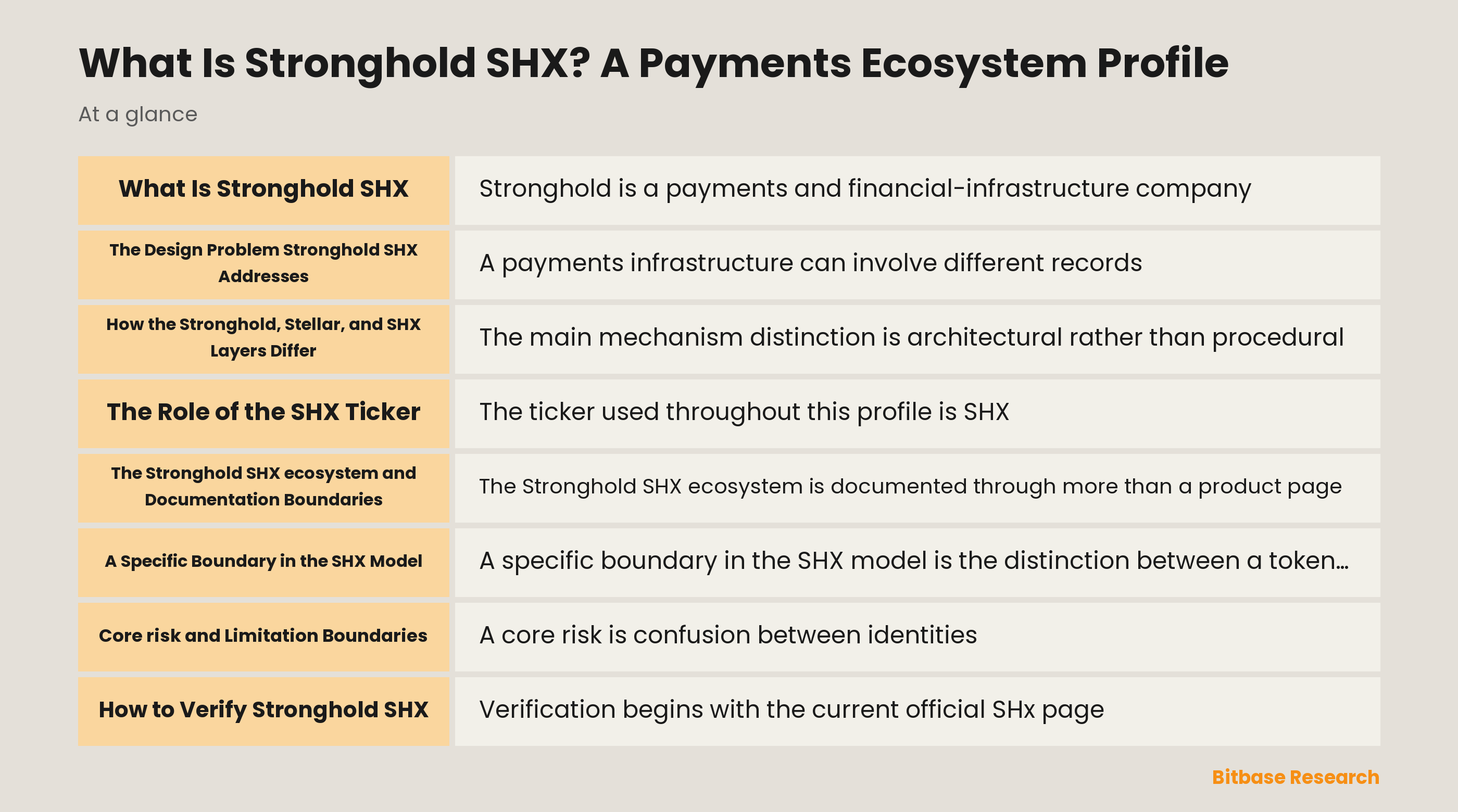
What Is Stronghold SHX
Stronghold is a payments and financial-infrastructure company, while SHX is the ticker-style identifier used here for the ecosystem token described in Stronghold materials. The official SHx page presents the token as a building block connected to an expanding payments ecosystem. That description does not make SHX another name for every Stronghold product or service. Payment services, merchant arrangements, and platform terms have their own operational and legal context, which should be read separately from a token overview.
Official Stronghold material associates SHx with the Stellar network. Stellar is the network layer named in that presentation; it is not Stronghold itself and it is not a synonym for the whole SHX ecosystem. The official page also contains ledger-related information beyond Stellar, but a mention of more than one ledger should be treated as a release-date verification topic. This article therefore does not assume a continuing representation on every ledger or imply that a ledger record makes a financial service available.
Stronghold itself is an operating payments and financial-infrastructure company rather than a token-only project. Its official site lists ACH Payments, Stronghold Direct, Merchant Financing, Checkout, Card Processing, Real Time Payments and Virtual Payment Networks as current product lines, and it publishes developer APIs at docs.strongholdpay.com together with integration tutorials at tutorials.strongholdpay.com. The site footer carries a copyright range running from 2017 to 2025. None of that is evidence about the token; it is the company layer, and a token overview should keep it separate.
The official SHx page publishes ledger addresses on five networks, and a reader should copy them from that page rather than from a search result so as not to pick up the wrong asset. They are Stellar SHX-GDSTRSHXHGJ7ZIVRBXEYE5Q74XUVCUSEKEBR7UCHEUUEK72N7I7KJ6JH, the upgraded Ethereum ERC-20 contract 0x516d31321928700c6b4fb0db0c8c6bc5d6799787, the original Ethereum ERC-20 contract 0xee7527841a932d2912224e20a405e1a1ff747084, Solana EFchnNkBvh4gSY5zqDgqRfuPR7mStBLvKBxPq5JUJcmP and XRP Ledger rfmS3zqrQrka8wVyhXifEeyTwe8AMz2Yhw. Because two Ethereum contracts coexist, an address that resolves in a block explorer is not by itself proof that it is the one the project currently supports.
The Design Problem Stronghold SHX Addresses
A payments infrastructure can involve different records, organizations, settlement arrangements, and service conditions. The design question behind an ecosystem token is how a shared identifier may be connected to the broader infrastructure narrative without collapsing all of those layers into one object. Stronghold's public materials describe SHx in relation to its payments ecosystem, merchant context, liquidity-related concepts, and governance-oriented documentation. Those are documented roles and contexts, not a statement that each connection is active, universal, or identical for every participant.
Keeping the layers distinct helps avoid category errors. A company service can be subject to terms, eligibility, technical maintenance, and regional conditions. A Stellar asset record is a network-level representation. A cross-ledger mention can concern a different technical environment. An ecosystem page can describe a program or community framework. None of those facts, by itself, establishes that another layer is available, secure, legally effective, or guaranteed to perform in a particular situation.
How the Stronghold, Stellar, and SHX Layers Differ
The main mechanism distinction is architectural rather than procedural. Stronghold's payment and financial-service materials describe services and associated conditions, whereas Stellar is the named blockchain network on which SHx is presented as built. The SHX token is an ecosystem component identified within that context. A sound description should not portray the network as a payment processor, the token as a payment service, or a company policy as a property automatically enforced by a public ledger.
Cross-ledger language needs the same discipline. Official material can publish ledger-specific information while the identity, status, and technical treatment of a representation remain facts to recheck on the publication date. A record on one network does not automatically prove a permanent counterpart on another network, a current connection between networks, or a uniform feature set. This is why the article discusses cross-ledger availability only as a boundary for verification, not as an instruction or a promise of interoperability.
One document layer is stated on the official page itself. Stronghold says that, as required under MiCA, it publishes a MiCA-specific white paper, hosted at stronghold.co/shx-mica-whitepaper.pdf, alongside a separate general SHx white paper distributed through a document-sharing link. Publishing a MiCA white paper is a disclosure step taken by the issuer; it is not an approval, an authorisation or a supervisory endorsement, and it says nothing about how any particular national regulator treats SHX in a given market.
The Role of the SHX Ticker
The ticker used throughout this profile is SHX. Stronghold's own materials often style the token name as SHx, but the uppercase ticker makes the identifier visually distinct from the company and from its payment services. A ticker is a label for the documented token reference; it is not evidence that every item carrying a similar label is authentic, current, or connected to Stronghold. The project identity still has to be established from current first-party material and the relevant network context.
Official SHX materials connect the identifier with a payments ecosystem and discuss merchant, liquidity, and governance-related contexts at a high level. These are use-case descriptions rather than automatic entitlements. In particular, Stronghold SHX tokenomics and use cases should not be reduced to a static supply number, allocation table, or assumed feature. Supply, allocation, governance mechanics, audit statements, service functions, and token representations can change or be described differently across documents, so they belong in a publication-date review.
Supply and distribution are stated in the official FAQ and can be read there directly. A fixed limit of 100,000,000,000 SHx was created and, according to that FAQ, will not be increased; approximately 5% of the total supply was released as an airdrop to Stronghold's early user base at the end of 2018; and the FAQ states that no ICO, TGE or IEO has been conducted in respect of SHx. In its listing post of 22 October 2025 the company added that it had locked 60 billion SHx in a five-year smart-contract escrow. That last figure is a company statement about concentration and belongs on the list of things to confirm on-chain rather than to accept from an announcement.
The Stronghold SHX ecosystem and Documentation Boundaries
The Stronghold SHX ecosystem is documented through more than a product page. The official documentation portal includes community guidance and ecosystem-development material, while Stronghold also publishes a white-paper release notice and legal pages. Taken together, those sources show that the project has several documentary layers: company information, token framing, community expectations, ecosystem material, and service terms. They do not turn every community mention or document category into a promise about a live product, a partner, or a particular benefit.
Documentation status matters because ecosystem pages can describe current, historic, proposed, or conditional material. A page about community conduct is not a service specification. A page within an ecosystem-development area is not proof that a particular initiative is open, funded, completed, or suitable for a reader. The current scope of community spaces, governance forums, integrations, and ecosystem programs should be checked in official sources on the publication date. This article deliberately stays at the level of documented structure rather than participation.
On where SHX trades, the checkable facts come from the venues themselves rather than from the project page. Kraken's own asset-listing post dated 22 October 2025 states that SHX funding and trading went live that day, notes that trading through the Kraken app and Instant Buy would follow only once liquidity conditions were met, and warns that geographic restrictions may apply; Stronghold's matching post describes it as the company's first listing on a U.S.-based exchange. Stronghold has separately announced an institutional arrangement with Uphold under which that platform's institutional clients can access SHx, including in over-the-counter markets. The row of exchange logos further down the official SHx page has not been kept in step with these announcements, so that display should not be read as a current list of venues.
A Specific Boundary in the SHX Model
A specific boundary in the SHX model is the distinction between a token reference and the underlying services that Stronghold may describe. The token can be discussed as part of an ecosystem narrative, but it does not itself establish access to a payment product, merchant relationship, liquidity arrangement, governance result, or financial outcome. Similarly, the existence of a Stellar-based representation does not prove that any off-chain process, service term, or organization will act in a certain way.
The legal and operational boundary is equally important. Stronghold's legal pages provide terms and policy material for services, and those materials can be revised or apply differently by context. Geographic availability, identity checks, compliance conditions, financial-service eligibility, and legal effects are not fixed claims for this profile. They require a current, source-specific review before publication. The same caution applies to statements about functionality, integrations, and whether a named ecosystem component remains available.
Core risk and Limitation Boundaries
A core risk is confusion between identities. A company name, token symbol, community account, ledger entry, and service interface can look related without being the same object or being equally authoritative. Incorrect identifiers, outdated copies of pages, impersonation, or a mismatch between a claimed network and the official documentation can create a false impression of what SHX represents. The safest factual boundary is to describe only the relationship that current first-party sources actually support.
There are also technical, operational, documentation, and legal risks. Ledger data can be misread; a representation may be changed or superseded; public materials may age; and services can be altered, limited, suspended, or subject to conditions. No token description guarantees payment completion, service access, network continuity, regulatory treatment, or a financial result. These risks are reasons to preserve distinctions among Stronghold, SHX, Stellar, and any other ledger mention, rather than merging them into one broad claim.
One operational risk is specific to this token and is stated by the project itself. Two Ethereum ERC-20 contracts exist side by side, an original and an upgraded one, and Stronghold operates an upgrade path at gateway.stronghold.co; its own listing post carries the warning that holders who do not complete the upgrade may be at risk of losing funds. The company also describes an SHx bridge between Stellar and Ethereum built on a third-party interoperability protocol, which layers the usual bridge and contract exposure on top of the two-contract situation. Holding a balance labelled SHX therefore does not settle which contract it sits in, nor whether that contract is the one the project currently supports.
How to Verify Stronghold SHX
Verification begins with the current official SHx page, the SHX community and ecosystem documentation, the white-paper release material, and the relevant Stronghold legal pages. The useful questions are whether the source is first party, when it was updated, what layer it describes, and whether it is describing a design, a policy, a community guideline, or a presently available service. This kind of source review distinguishes a durable project explanation from a claim copied from an outdated page.
For ledger identity, a neutral publication-date cross-check compares the official contract address information with public chain records in a block explorer, while keeping the official documentation and the relevant network aligned. It does not require a wallet, a transaction, or interaction with a service. Any address, token representation, network support statement, or cross-ledger claim should be rechecked on the publication date and should not be inferred merely from a ticker or a similarly named record.
Three checks follow directly from the material above. First, take the five ledger addresses from the FAQ block on the official SHx page and paste each one into the explorer for its own network, confirming that the network matches the one named in the source before treating a balance as SHX. Second, open the MiCA white paper and the general white paper from their own links rather than from a summary, and note the revision date on each. Third, when a claim concerns where SHX can be traded, confirm it in the venue's own listing or delisting announcement, because a logo strip on a project page can outlast the arrangement it describes.
Conclusion
Stronghold SHX can therefore be described as an ecosystem token reference connected in official material to Stronghold's payments narrative and to Stellar, with separate documentation for community, ecosystem, and legal topics. That is a narrower and more useful description than treating the token as the whole company, treating the company as a blockchain network, or treating a ledger record as proof of every service-level claim.
The key limitation is that roles are not guarantees. A documented role around payments, merchants, liquidity, or governance does not automatically provide access, control, compensation, completion of a payment, or a particular legal effect. The distinction is especially important when an article uses a short ticker, because short identifiers can conceal the different responsibilities of a company, a network, a token representation, and a service agreement.
Before publication, the review should revisit official domains and document versions, the Stronghold and SHX identity, the applicable Stellar and other ledger information, official contract addresses, supply and allocation material, governance status, audit scope, service and ecosystem availability, legal terms, geographic and compliance conditions, and any partnership claims. This is a factual maintenance checklist, not an instruction to use a product or a token.
Related market pages
Bitbase pages for the tokens named in this article:
- SHX: View price
Related reading
Other Bitbase articles on this topic:
- What Is Rizenet? T-RIZE, RIZE, and Tokenization Boundaries
- What Is Zebec? Streaming Payments On-Chain
- Crypto On-Ramp vs Off-Ramp: What Is the Difference?
Disclaimer: This article is educational content from Bitbase Academy, provided for information only. It explains what a project does and what role its token plays in that system; it does not constitute investment, trading, tax, or financial advice, and it is neither a recommendation nor an endorsement of any project or token. Bitbase has not carried out due diligence on the project described here, and mentioning it does not mean Bitbase lists or supports the asset. Crypto assets carry significant risk, including price volatility, thin liquidity, smart-contract failure, regulatory uncertainty, and the possible loss of their entire value. Written as of August 2026; a project's status, tokenomics, team, and contracts can change at any time. Verify everything yourself through official channels, the contract address, and a block explorer, and beware of imitation sites and phishing links.
References
[1] SHx, Stronghold official page stronghold.co
[2] SHx Community Guidelines, Stronghold SHx documentation docs.shx.stronghold.co
[3] Stronghold Releases White Paper on SHx Token stronghold.co
[4] Stronghold Legal stronghold.co
[5] Bounties, Stronghold SHx documentation docs.shx.stronghold.co
[6] Stronghold, official company site (product lines and developer resources) stronghold.co
[7] SHx MiCA white paper (PDF) stronghold.co
[8] SHx Is Now Live on Kraken, Stronghold news post, 22 October 2025 stronghold.co
[9] SHX is available for trading, Kraken asset-listing announcement, 22 October 2025 blog.kraken.com
[10] Stronghold Partners with Uphold to Expand Institutional Access to SHx stronghold.co