Talus is an AI-agent protocol stack written in Sui Move and deployed on the Sui network, and its token carries the ticker US, which is neither the United States nor the US dollar but a Sui coin type. This article sets out what Talus has shipped, what the official documents say US does, why the protocol is still in a closed mainnet phase, and how to check all of it yourself.
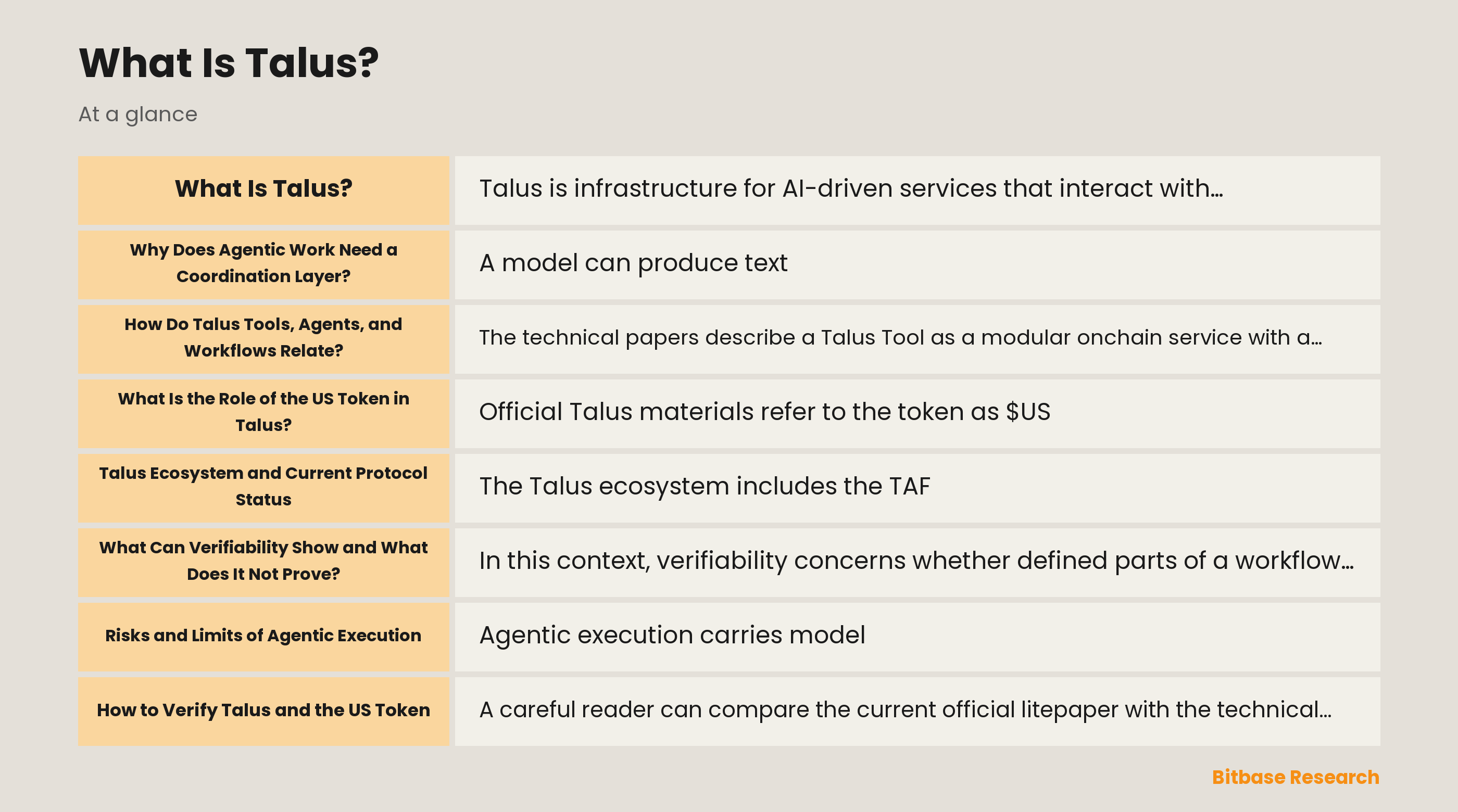
What Is Talus?
Start with the name, because two letters cause most of the confusion. The token is written $US in project materials and appears on data sites as US, so a sentence like "US is listed" tells you nothing until the coin type is attached. It is not a country code, not the dollar, and not a wrapped dollar. On Sui the asset is identified by the type string 0xee962a61432231c2ede6946515beb02290cb516ad087bb06a731e922b2a5f57a::us::US.
Talus itself is infrastructure for autonomous AI agents. The official litepaper, version 2.1 dated 20 March 2026, describes the Talus Agentic Framework, or TAF, as standard interfaces for general-purpose computation exposed as callable services in asynchronous workflows, and states that Talus "is built on the Sui Move stack and deployed on the Sui network, with the Nexus protocol, a Leader network, ecosystem applications, and the $US token". That sets the technical boundary: Talus is a Move protocol stack living on Sui, it runs no consensus or gas token of its own, and Sui validators finalise every Talus transaction.
Marketing language sits above that boundary and should be read as positioning. The April 2026 release calls the work "Phase One of a Global Agentic Layer" and the homepage calls Talus "a decentralized AI automation protocol", so wherever you see it described as an "Agentic Layer 1", treat that as ambition rather than evidence of an independent base chain. Two entities also need separating: the talus.network footer reads "All Rights Reserved @ Talus Labs, Inc.", while the Talus Foundation runs talus.foundation and hosts the token documentation. The v1.0 release quotes Mike Hanono as CEO, so this is not an anonymous team.
Why Does Agentic Work Need a Coordination Layer?
Before a framework like this, a team that wanted software to act on its own had one practical option. A smart contract executes synchronously and deterministically, so it cannot call a language model or a Web2 API and cannot wait for one; anything involving judgment therefore moved to a private server holding a hot key. That server decides and then signs, so nobody outside the operator can check what the agent was permitted to do or whether the action matched the mandate.
Talus's stated answer is to make the permission structure and the settlement onchain objects rather than server configuration. In the project's own framing, TAF defines the inputs and outputs of general offchain computation, including result verifiability, data transmission interfaces and payment flows; tools are composed into workflows expressed as directed acyclic graphs; and a Talus Agent holds authority over resources and delegates it to tools under preconfigured permissions. That is a design claim, not a delivered guarantee: the litepaper says the described use cases "are illustrative of current design goals and supported functionality", and moving trust to a protocol configuration is not removing it.
How Do Talus Tools, Agents, and Workflows Relate?
The three terms do different jobs. A Talus Tool is a modular service with a defined role, wrapping either general computation or a data source. A Talus Workflow is the ordered graph that says which tools run, in what order, and what passes between them. A Talus Agent is the shared onchain entity that holds authority over resources and delegates it to tools for the duration of a workflow, which the litepaper describes as a secure sandbox in which authorised parties can trigger execution.
Nexus is the protocol that runs those workflows on Sui, and it has two halves. Onchain, the Nexus Onchain Package defines the common data structures used by other packages and is maintained by the Talus team; developers build their own Tool and Agent packages on top. Offchain, a Leader network coordinates, linking external services such as language-model APIs to onchain tools and handling data delivery, workflow settlement and liveness. Each execution carries a Leader priority fee proportional to the Sui gas fee, ultimately settled in $US.
What is running today is narrower than the architecture. The litepaper says Nexus "is under active development" and that the current design contemplates an initial Leader configuration for service reliability, with broader distribution of execution responsibilities, TEE-based components and increased permissionless participation described as later steps. The April 2026 release is blunter: although the contracts are on mainnet, "the tooling and infrastructure access are for internal and permissioned use only". Read the coordinator as a configured set today, not an open one.
What Is the Role of the US Token in Talus?
The litepaper gives US three protocol functions and no others. Staking: where protocol rules require it, participants stake or lock $US to operate coordination nodes, register Talus Tools or provide other protocol-defined services, and a leader or tool operator's stake may be slashed for malicious behaviour. Pricing: Nexus uses $US as the reference unit for protocol-defined service charges, prioritisation fees and trusted-execution pricing. Community privilege: long-term holders may become eligible for governance-related community functions. The same document states that holding or locking $US alone does not entitle anyone to passive yield, and that the token is not equity, not debt, not a claim on Talus Labs or the Talus Foundation, and not a claim on protocol revenue or Treasury assets.
Supply and emission sit in the same section. Total supply is 10 billion $US. A fixed percentage is reserved for a Nexus subsidy that rebates part of workflow gas spending, with the rebate rate declining to zero as the budget is distributed. A Loyalty Reward Program lets participants lock $US for non-transferable points and is described as temporary, running until the official staking feature launches or its pool is exhausted. Under the liquidity-control rules, when protocol fee income falls below a defined threshold the protocol may remove a corresponding amount of $US from circulation; above it, fees may go to Nexus Leaders. The litepaper publishes no dated unlock table.
The initial community distribution used an unusual design worth stating precisely. The official post of 24 November 2025 calls it "the crypto industry's first 100% LP-based airdrop": recipients did not receive liquid US but $yUS, described as "a fungible token that wraps an automated LP strategy for a US-USDC pool on Momentum DEX through a NODO AI Vault". Claiming also cost money. In the project's own words, "the transaction will include a $10 fee (paid in SUI) that goes to Clique, the airdrop distribution provider. Talus doesn't receive any portion of this fee." Pre-registration ran from 24 to 28 November 2025, could be done only once and bound the wallet and X account permanently, and the claim window was three days with "no exceptions"; unclaimed allocations were to be recycled.
Talus Ecosystem and Current Protocol Status
The protocol's stage is the single most important ecosystem fact. On 15 April 2026 Talus announced that it "has officially deployed Talus Protocol contracts on the Sui Network mainnet", and the same post says: "This release marks the closed mainnet phase for Talus Protocol." Access is by application through a form, the first named ecosystem application is Doppel Games, whose Agent versus Agent admin app "entered closed Alpha", and the post frames a full public mainnet release as still ahead. As of 14 August 2026 no official announcement of a public or open mainnet has been published.
Around that core sits a list of announced counterparties: Sui and Walrus, Sentient, Allora, Lagrange, Holoworld, NODO, SuiNS, Swarm Network, Noodles Finance, ZO, Super-B, TradePort and Doppel Games. Each is an announcement by the two parties involved, several use exploratory language, and none is an independent measurement of usage. The most recent programme is Talus/acc, announced on 20 May 2026 with Cicada Capital and Sui Network, in which selected teams can unlock milestone-based grants "paid in a mix of $US tokens and stablecoins".
Two publication-day observations cut against that story. The newest post on the official blog is the Talus/acc announcement of 20 May 2026, so there was no new official blog post in the roughly three months to 14 August 2026. And talus.network still carries a newsletter block headed "Talus Is Coming", four months after contracts were reported live on Sui mainnet. Usage figures are thin too: an aggregator page for the coin type listed 234 holders on 14 August 2026, and the project publishes no dashboard of workflows executed.
How Talus Differs from Other Agent Frameworks
The first mechanical difference is where an agent's authority lives. In a conventional agent framework, authority is a private key on the operator's machine and the permission list is server configuration, so the boundary of what the agent may do is only as inspectable as the operator chooses. In the Talus design that authority sits in an onchain Talus Agent object which delegates specific capabilities to registered tools under preconfigured permissions. That relocates the trust boundary; it does not shrink it to zero, and it is a difference in structure rather than a score.
The second is how offchain work is paid for and recorded. TAF specifies delivery-versus-payment settlement between a workflow and the tools it calls, with routing done by an offchain Leader network rather than by the chain. Fully offchain orchestrators leave no third-party-checkable record; fully onchain automation leaves a record but cannot call a language model. Talus splits the difference, and the split has its own cost: an onchain record can show that a defined step was registered and paid for, but not that the model's output was correct.
Risks and Limits of Agentic Execution
Stage risk comes first, and it is explicit rather than inferred. Talus is at an early stage: the protocol has been in a closed mainnet phase since April 2026 with access restricted to internal and permissioned use, and general developer access, TEE-based execution and a permissionless Leader set are later steps rather than delivered features as of 14 August 2026. The litepaper states the limit itself: "No representation is made that any particular feature, milestone, decentralization stage, or application launch will occur on any specific timeline or at all."
Security review is a separate gap. As of 14 August 2026 no public third-party audit report covering the Talus or Nexus contracts could be found on an auditing firm's own site, and a risk score shown by a data platform is not an audit report. Until such a report exists and you can open it on the auditor's domain, treat the contracts as unaudited, including the packages that hold delegated authority over an agent's assets.
The token distribution design carries its own risks. A 100% LP airdrop means recipients were given exposure to a US-USDC liquidity position through a third-party vault rather than the token itself, so what they received depended on that pool, that DEX and that vault operator as well as on Talus. Claiming was conditional on paying a third party — a $10 fee in SUI to the distribution provider Clique — which inverts the usual expectation that a recipient spends nothing before receiving anything, and a missed step forfeited the allocation.
Execution, structural and regulatory risks round out the list. The official blog has not published since 20 May 2026 while the homepage still says "Talus Is Coming", so official channels do not make clear what changed last quarter, and the token documentation sits on a separate foundation domain that renders only in a browser. The Leader network is initially configured by the team, so coordination is centralised at this stage, and staked positions can be slashed. Total supply is 10 billion against a much smaller circulating amount, with no dated unlock table in the litepaper. Finally, the US ticker collides with the two commonest financial uses of those letters, which degrades search results and makes impersonation easier.
How to Verify Talus and the US Token
Start from the official site, not from a search result, and be aware that the project spans more than one domain. Type talus.network into the address bar yourself, and note that the blog is at blog.talus.network and the token documentation at talus.foundation; a link is evidence when it runs from the official site outward, not the other way round. Compare any domain you land on character by character, and treat a merely similar one as unverified until an official page links to it.
Then pin the asset. On Sui a token is identified by a coin type, not by an Ethereum-style address, so the string to check is 0xee962a61432231c2ede6946515beb02290cb516ad087bb06a731e922b2a5f57a::us::US. Paste it into a Sui block explorer and confirm the module and symbol, the decimals, the creation time and the holder count, and above all that the network really is Sui. A token with the same ticker on another chain is a different asset, and with two letters this common that mistake is easy to make.
Take supply and unlocks from the chain and the official documents, not from an aggregator. The litepaper gives total supply as 10 billion and describes the subsidy, loyalty-lock and liquidity-control mechanics, but publishes no dated unlock table; if you find an allocation or unlock page in the foundation documentation, record its version and the date you read it. Circulating supply is a chain question, and the answer belongs to the explorer.
Finally, grade the claims and guard the claim flow. For audits, look for the report on the auditing firm's own site; a badge or score hosted elsewhere is not a substitute. For partnerships, look for the counterparty's own announcement. And treat any wallet connection with suspicion: the project's own airdrop post warns that Talus will "never DM you for support, never ask for your seed phrase, and never provide alternate claim portals", so a page reached from an advertisement or a message that asks you to connect a wallet to claim, migrate or verify is a reason to stop.
Conclusion: Talus as a Coordination Layer
Talus is a Move protocol stack on Sui — the Talus Agentic Framework plus the Nexus execution protocol — built so that an AI agent's permissions, tool calls and payments live in onchain objects rather than on an operator's server. Its token, ticker US, is used inside that system for staking, service pricing and governance-related community functions, with a total supply of 10 billion and no dated unlock table in the litepaper. The protocol has been in a closed, permissioned mainnet phase since April 2026, no public mainnet has been announced, the official blog has been quiet since 20 May 2026, and no public audit report could be found. Read the litepaper yourself, check the Sui coin type on a block explorer, and confirm the current stage from the official blog rather than from a headline.
Related market pages
Bitbase pages for the tokens named in this article:
- US: View price · Perpetual market
Related reading
Other Bitbase articles on this topic:
- What Is OriginTrail? A Decentralized Knowledge Graph
- What Is Recall Network? AI Skill Markets and RECALL
Disclaimer: This article is educational content from Bitbase Academy, provided for information only. It explains what a project does and what role its token plays in that system; it does not constitute investment, trading, tax, or financial advice, and it is neither a recommendation nor an endorsement of any project or token. Bitbase has not carried out due diligence on the project described here, and mentioning it does not mean Bitbase lists or supports the asset. Crypto assets carry significant risk, including price volatility, thin liquidity, smart-contract failure, regulatory uncertainty, and the possible loss of their entire value. This project is at an early stage, and early-stage projects carry a higher risk of failing outright. Its contracts have not been publicly audited, or the published audit covers only part of the code. Written as of August 2026; a project's status, tokenomics, team, and contracts can change at any time. Verify everything yourself through official channels, the contract address, and a block explorer, and beware of imitation sites and phishing links.
References
[1] Talus Network Litepaper v2.1, dated 20 March 2026 (official PDF): TAF definition, Nexus, the three $US functions, 10 billion total supply, subsidy and liquidity-control mechanics, and the no-representation clause talus.network
[2] Nexus: A New Standard for Decentralized Autonomy, whitepaper v1.1 dated 21 August 2025 (official PDF): Talus Agentic Framework on Sui, Agent-as-a-Service and Agent Marketplace talus.network
[3] Talus official homepage: the Talus Is Coming newsletter block, the decentralized AI automation protocol wording, and the All Rights Reserved @ Talus Labs, Inc. footer talus.network
[4] Talus Protocol v1.0 Release: Verifiable AI Agents, Live on Sui Mainnet, official blog post of 15 April 2026: closed mainnet phase, internal and permissioned use only, Doppel Games closed Alpha, Mike Hanono as CEO blog.talus.network
[5] Announcing Talus/acc: Accelerating the Agentic Era, official blog post of 20 May 2026: builder programme with Cicada Capital and Sui Network, milestone grants paid in a mix of $US tokens and stablecoins blog.talus.network
[6] The Talus Airdrop: Everything You Need To Know, official blog post of 24 November 2025: the 100% LP-based airdrop in $yUS, the $10 SUI fee paid to Clique, the pre-registration and claim windows, and the anti-phishing warning blog.talus.network
[7] Talus official blog index, read on 14 August 2026: the most recent post is still the Talus/acc announcement dated 20 May 2026 blog.talus.network
[8] Suiscan block explorer page for the Sui coin type 0xee962a61432231c2ede6946515beb02290cb516ad087bb06a731e922b2a5f57a::us::US, used to confirm module, symbol and network suiscan.xyz
[9] Crypto Economy, 15 April 2026: independent report on the Sui mainnet deployment describing the closed mainnet stage for strategic partners and access restricted to internal and partner use crypto-economy.com
[10] vision.talus.network vision.talus.network
[11] usdus utility.md docs.talus.foundation
[12] allocations and unlock schedule.md docs.talus.foundation