Wayfinder is a project that has described an agent-oriented way to represent routes through blockchain applications and smart contracts. Its published materials use ideas such as wayfinding paths, an ecosystem graph, agents, and interfaces. The important boundary is that navigation information is not itself permission to act, and a generated route is not proof that a proposed on-chain action is safe.
What Is Wayfinder?
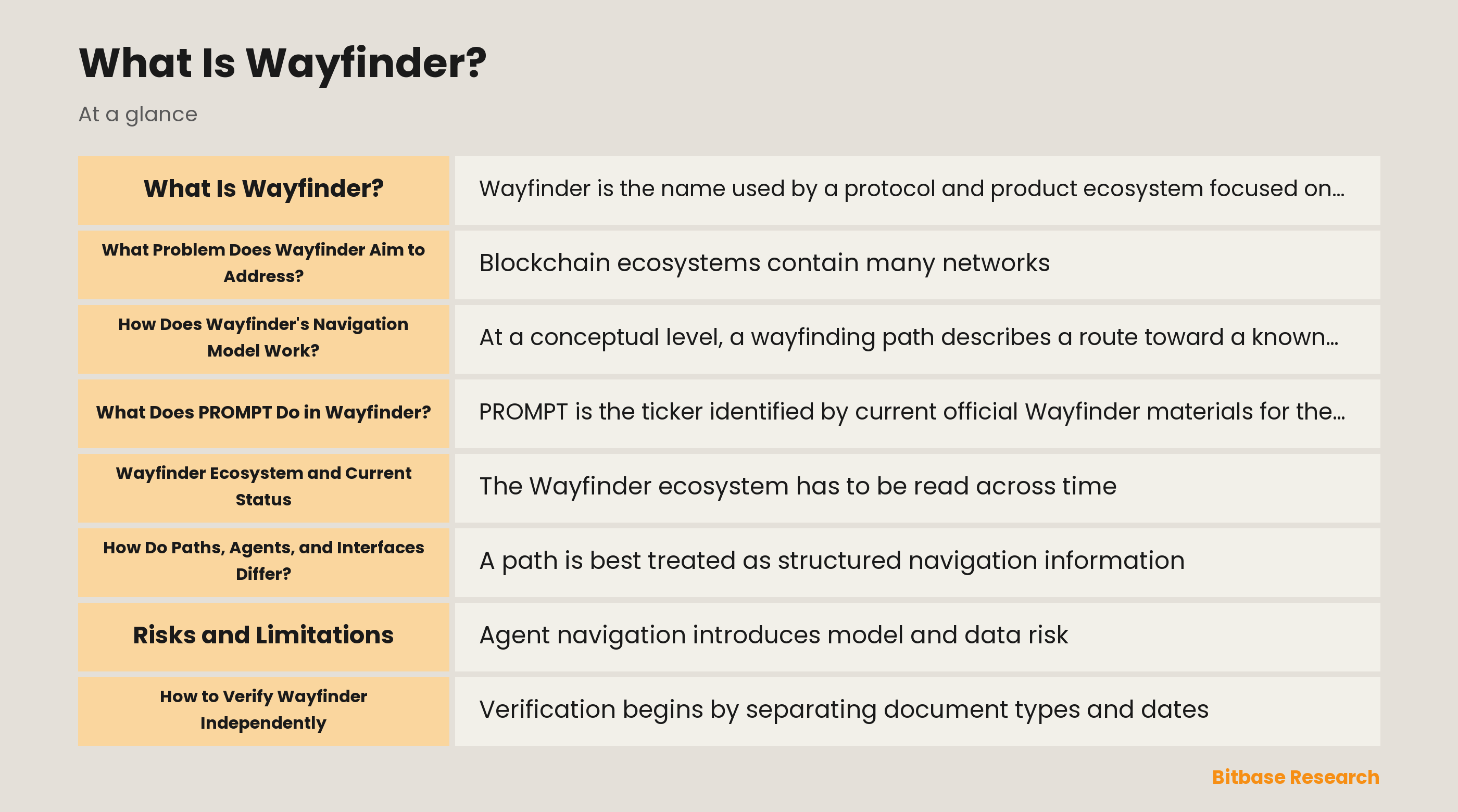
Wayfinder is the name used by a protocol and product ecosystem focused on artificial-intelligence agents in blockchain environments. The March 2024 Wayfinder whitepaper describes a continuously expanding graph of destinations and wayfinding paths. In that document, a path is a structured route associated with blockchain applications or smart contracts, while the graph gives agents a model of possible destinations and relationships. This is best understood as a documented architecture and product direction, not as a guarantee that every described route or destination is currently available.
The project name and token ticker should be kept separate. The current official Wayfinder site identifies PROMPT as its ERC-20 governance and utility token, while Wayfinder refers more broadly to the protocol, interfaces, paths, and agent concepts. Searches for wayfinder crypto, what is wayfinder crypto, or wayfinder tokenomics and use cases need that distinction: a token role is a system-specific claim, whereas the navigation model is an architectural claim about how agents may identify and use defined paths.
Wayfinder should not be described as a universal blockchain map or as a substitute for independent review. A route can be incomplete, stale, maliciously imitated, or inappropriate for a particular context. An agent can also produce a plausible explanation that does not accurately represent the relevant contract, chain state, authorization scope, or intended result. The useful question is therefore not only what a path says, but who defined it, what it points to, what evidence supports it, and what authority would be required before any action could occur.
Two identifiers anchor the rest of this profile. PROMPT is recorded at 0x28d38dF637dB75533bD3F71426F3410a82041544 on Ethereum and at 0x30c7235866872213F68cb1F08c37Cb9eCCB93452 on Base; the same pair appears in the project's own help material and in the listing notice OKX published on 9 April 2025, and each can be opened directly on the corresponding block explorer. The software is developed by the Wayfinder Foundation and is closely tied to Parallel Studios, the studio behind the Parallel trading card game, with the Colony game built on the same agent infrastructure; governance was initially proposed to run through the Echelon Prime Foundation community. That means the project's direction is not independent of one studio's roadmap, which is a statement about structure rather than a judgement about quality.
What Problem Does Wayfinder Aim to Address?
Blockchain ecosystems contain many networks, applications, contract interfaces, and state-dependent rules. Even when a destination is public, identifying a meaningful route through those components can require interpreting contract relationships, supported networks, data dependencies, and the order in which conditions are checked. A navigation layer tries to represent some of that complexity in a reusable form instead of asking every agent or user to infer it from raw addresses and isolated interfaces.
In the whitepaper model, an ecosystem graph links nodes and edges that correspond to destinations and paths. That representation can make a defined route easier for an agent to reason about, compare with its task, and explain in context. It does not turn a path into an authoritative source of truth. The correctness of the graph depends on its inputs, maintenance, scope, versioning, and the interpretation of the agent that uses it.
The problem is therefore partly one of information structure and partly one of trust boundaries. A system may reduce the ambiguity of locating a known contract or application relationship, yet it cannot decide whether a requested outcome is appropriate, whether the surrounding information is current, or whether a user intended to grant the authority implied by a proposed action. Those questions remain outside a navigation label and need explicit review.
How Does Wayfinder's Navigation Model Work?
At a conceptual level, a wayfinding path describes a route toward a known blockchain destination. The original published model frames many paths together as an ecosystem graph, so that an agent can use structured information about connections instead of treating each contract as an isolated endpoint. A route may communicate dependencies, sequence, or conditions that matter to a particular interaction, but the exact format and supported scope are implementation-specific.
An agent is a separate layer from the path itself. It may interpret a request, select or reason over available information, and present a proposed course of action. That reasoning layer can be helpful for navigation, but it can also make mistakes, omit assumptions, or misunderstand a change in a supported environment. The existence of an agent explanation should not be mistaken for verification of the underlying contracts, path publisher, or real-time state.
Authorization is a third and distinct layer. Reading a route, displaying a plan, requesting an approval, and carrying out an on-chain action are not the same event. A sound trust model keeps those boundaries visible: a navigation artifact should identify its source and scope, an agent should communicate uncertainty and limits, and any authority to sign or authorize should remain independently reviewable. Conflating these layers is one of the main ways an apparently simple agent workflow can hide material risk.
What Does PROMPT Do in Wayfinder?
PROMPT is the ticker identified by current official Wayfinder materials for the ecosystem's ERC-20 governance and utility token. The current site associates it with Paths and describes governance and utility roles connected to the Wayfinder ecosystem. That is a statement about the project's own documented design and current presentation. It is not a statement that a particular feature, role, or network condition will remain unchanged.
The March 2024 whitepaper used more provisional language. It described a proposed native asset, then tentatively called PROMPT, and said its eventual implementation details would be subject to community governance. That historical wording matters because it shows why dated design documents cannot be read as permanent specifications. Later site materials and contract records may confirm, revise, narrow, or replace parts of the earlier proposal.
For an educational project profile, the practical conclusion is narrow. PROMPT is the ticker to verify against current official records, and its described governance or utility role belongs to the Wayfinder ecosystem rather than to Wayfinder's navigation concept in the abstract. This article does not infer a valuation, a future distribution, or a reason to take any financial action from those roles.
Wayfinder Ecosystem and Current Status
The Wayfinder ecosystem has to be read across time. The 2024 whitepaper is a useful source for the original graph, path, and Shells-oriented vocabulary, but it explicitly presents itself as a starting point that could evolve through stakeholder and governance input. A whitepaper can establish what its authors proposed at a given time; it cannot by itself establish which components are operating, supported, audited, or available at a later date.
Current official Wayfinder materials present an agent-oriented ecosystem that includes Shells and Paths, and the official organization maintains a public Paths SDK repository. Those materials show active product development, but they also demonstrate why exact product scope must be checked at publication time. The current site, public code, supported environments, review process, and the meaning of individual Path categories can change without making the older architecture false.
The current Terms also characterize the interface and related technology as developmental and warn that artificial-intelligence output may not be verified before it is displayed. This is an important current risk disclosure, not a universal technical conclusion about every implementation. Readers should therefore separate documentation of the ecosystem from proof of a specific deployment's security, availability, legality, or suitability.
Distribution can be described without touching valuation. Total supply is 1,000,000,000 PROMPT, of which roughly 223,900,000 were reported as circulating as of 15 August 2026, and the Ethereum contract showed about 7,414 holders on that date. Trading is spread across a moderate number of venues: aggregator data on 15 August 2026 listed 36 exchanges and 42 markets. The asset has had a centralized listing since 9-10 April 2025, when OKX opened PROMPT/USDT spot trading after a one-hour call auction, and a euro pair is quoted on Kraken. Every one of these figures moves, so each is only usable with the date attached.
How Do Paths, Agents, and Interfaces Differ?
A path is best treated as structured navigation information. It can describe a known destination or relationship and may contain rules or metadata relevant to a route. Its value depends on provenance, version, review status, and whether the route still matches the current environment. A path is not automatically a permission record, an audit result, or an assurance that every consequence of following it is desirable.
An agent is the reasoning and presentation layer that may use paths and other inputs. It can summarize, rank, transform, or propose, but it is probabilistic software with its own failure modes. In particular, an agent can be influenced by incomplete context, malicious content, stale information, or an ambiguous request. A polished answer does not prove that the agent selected the right path or understood every condition attached to it.
An interface is the software surface through which information, prompts, reviews, or authorizations may be presented. The current Terms distinguish the Foundation's interface from a community-driven protocol and say the Foundation does not own, control, manage, or operate the protocol. That legal and operational description should be checked in its current form. More generally, an interface should not obscure whether a statement comes from a path publisher, an agent, a third party, or an on-chain record.
Risks and Limitations
Agent navigation introduces model and data risk. An agent may misunderstand an instruction, select a route built for a different context, or treat stale metadata as current. A path graph can also be incomplete, subject to changes in underlying contracts, or dependent on third-party services. Neither a route label nor an agent response eliminates the need to inspect the exact destination, conditions, and source of the claim.
Signature and authorization risk are especially important. An agent request, a displayed plan, and a cryptographic signature can appear close together while representing very different levels of authority. Phishing pages or lookalike domains can imitate familiar terminology, and a broad authorization can outlive the narrow intent that appeared in a prompt. No agent-generated explanation should be treated as sufficient evidence that a signing or authorization request is authentic, limited, or necessary.
Incorrect routing can create a further risk before a transaction is confirmed. A route may point to the wrong network, a changed contract, an unreviewed component, or a result that does not match the stated objective. Before any signed transaction, the relevant contract, network, authorization scope, and intended outcome require independent verification. Developmental software, unverified generated content, smart-contract vulnerabilities, and changing third-party dependencies are additional limitations rather than edge cases.
Liquidity is the sharpest limitation here. As of 15 August 2026, a single pair on one venue - PROMPT/USDT on LBank - accounted for about 66 percent of reported spot volume, while the second-largest market, PROMPT/USDT on OKX, accounted for roughly 4 percent and no other market reached that share. When two thirds of turnover sits at one exchange, a holder's ability to exit depends heavily on that one venue continuing to operate, to support the asset and to process withdrawals; an outage, a delisting or a regional restriction there is not a marginal event. The ten largest spot markets by volume on that date did not include Coinbase, Binance's main spot market or Upbit, so access through those venues should not be assumed.
The distribution itself has already failed once in public. When PROMPT was claimed in April 2025, The Block reported that a bot named Yoink front-ran claims made through the Kaito campaign and extracted about 119 ETH, then worth roughly 200,000 US dollars, from claimants; reporting attributed the opening to a claim contract that did not bind the recipient into the Merkle proof, so any claim sitting in the mempool could be taken by whoever paid more for inclusion. The distribution was paused by the party running it and the project said affected users would be compensated. The point is not the amount but the category: a claim flow is a separate piece of software from the protocol, and it can break while the protocol itself is intact.
How to Verify Wayfinder Independently
Verification begins by separating document types and dates. The official website can identify the current project entry point, the whitepaper records an earlier architecture proposal, and the Terms state current interface disclosures. A reader should not use an old document to fill gaps in a current product claim, nor use a current landing page to rewrite the historical meaning of a whitepaper. The status of a Path, Shell, integration, or supported environment should be checked at the time it matters.
PROMPT should be verified through the current official contract record for the relevant network, then compared with the same contract address on the appropriate block explorer. The token name or ticker alone is not enough because names can be imitated and network-specific records can change. The official help material currently publishes records for Ethereum L1 and Base, but their accuracy, network scope, and continued relevance are facts to recheck before publication or reliance.
For a path or agent claim, require a clear source, version, review state, and description of authorization boundaries. Public source code can help establish what a repository contains at a particular commit, but it does not prove that a hosted interface runs that code or that a particular path has been independently audited. Unexpected prompts, signature requests, or requests for broad authorization are warning signals, not verification evidence. A named auditor's own report and its stated scope are more meaningful than a logo or an unsupported assurance.
The contract check can be done in under a minute and is worth doing before anything else. Open the Ethereum address 0x28d38dF637dB75533bD3F71426F3410a82041544 on an Ethereum block explorer and the Base address 0x30c7235866872213F68cb1F08c37Cb9eCCB93452 on a Base explorer, and confirm that the symbol, the decimals and the deployment record match what the project's own help material states. Then check the same two strings against an exchange's own listing notice, because a venue that lists the asset publishes the addresses it credits. If a third address appears anywhere for the same ticker, treat it as unverified until an official page carries it, and remember that a matching ticker on two networks is not evidence that a third deployment is genuine.
Conclusion
Wayfinder is most usefully understood as an evolving project around structured blockchain navigation, agent reasoning, and interfaces. Its published path and graph ideas can clarify why agent systems need more context than an isolated contract address, yet those ideas do not collapse navigation, intent, verification, and authority into one trusted step.
The verified ticker for the current Wayfinder ecosystem is PROMPT. The main factual boundary is temporal: the 2024 whitepaper describes a proposed architecture, while current site, contract, interface, and review facts can change. Any publication should recheck those current facts and preserve the distinction between a route, an agent suggestion, and an independently reviewed authorization.
Related market pages
Bitbase pages for the tokens named in this article:
- PROMPT: View price · Perpetual market
Related reading
Other Bitbase articles on this topic:
- What Is Perle? Human-Verified AI Data and PRL
- What Is POND? Marlin, Oyster, and Asset Boundaries
Disclaimer: This article is educational content from Bitbase Academy, provided for information only. It explains what a project does and what role its token plays in that system; it does not constitute investment, trading, tax, or financial advice, and it is neither a recommendation nor an endorsement of any project or token. Bitbase has not carried out due diligence on the project described here, and mentioning it does not mean Bitbase lists or supports the asset. Crypto assets carry significant risk, including price volatility, thin liquidity, smart-contract failure, regulatory uncertainty, and the possible loss of their entire value. Written as of August 2026; a project's status, tokenomics, team, and contracts can change at any time. Verify everything yourself through official channels, the contract address, and a block explorer, and beware of imitation sites and phishing links.
References
[1] Wayfinder official website wayfinder.ai
[2] Wayfinder Whitepaper V1.0, March 2024 paper.wayfinder.ai
[3] Wayfinder Terms of Service app.wayfinder.ai
[4] PROMPT token contract addresses, Wayfinder Help Center helpcenter.wayfinder.ai
[5] Wayfinder Paths SDK, official GitHub organization github.com
[6] OKX announcement, listing of PROMPT (Wayfinder) for spot trading, 9 April 2025 www.okx.com
[7] Etherscan, PROMPT token contract on Ethereum etherscan.io
[8] Basescan, PROMPT token contract on Base basescan.org
[9] CoinGecko, Wayfinder (PROMPT) markets and supply data www.coingecko.com
[10] The Block, MEV bot front-ran Wayfinder PROMPT airdrop claims on Kaito www.theblock.co