Before the order goes in, decide which HOOD you mean. Robinhood Markets trades as HOOD on Nasdaq, and on Bitbase those four letters point at three separate instruments: a tokenized stock price page, a spot market for that token, and a perpetual futures contract. They differ on what you hold, when it trades, and what can force you out of it. This profile covers where Robinhood's revenue comes from, what moves the stock, and how the three routes compare.
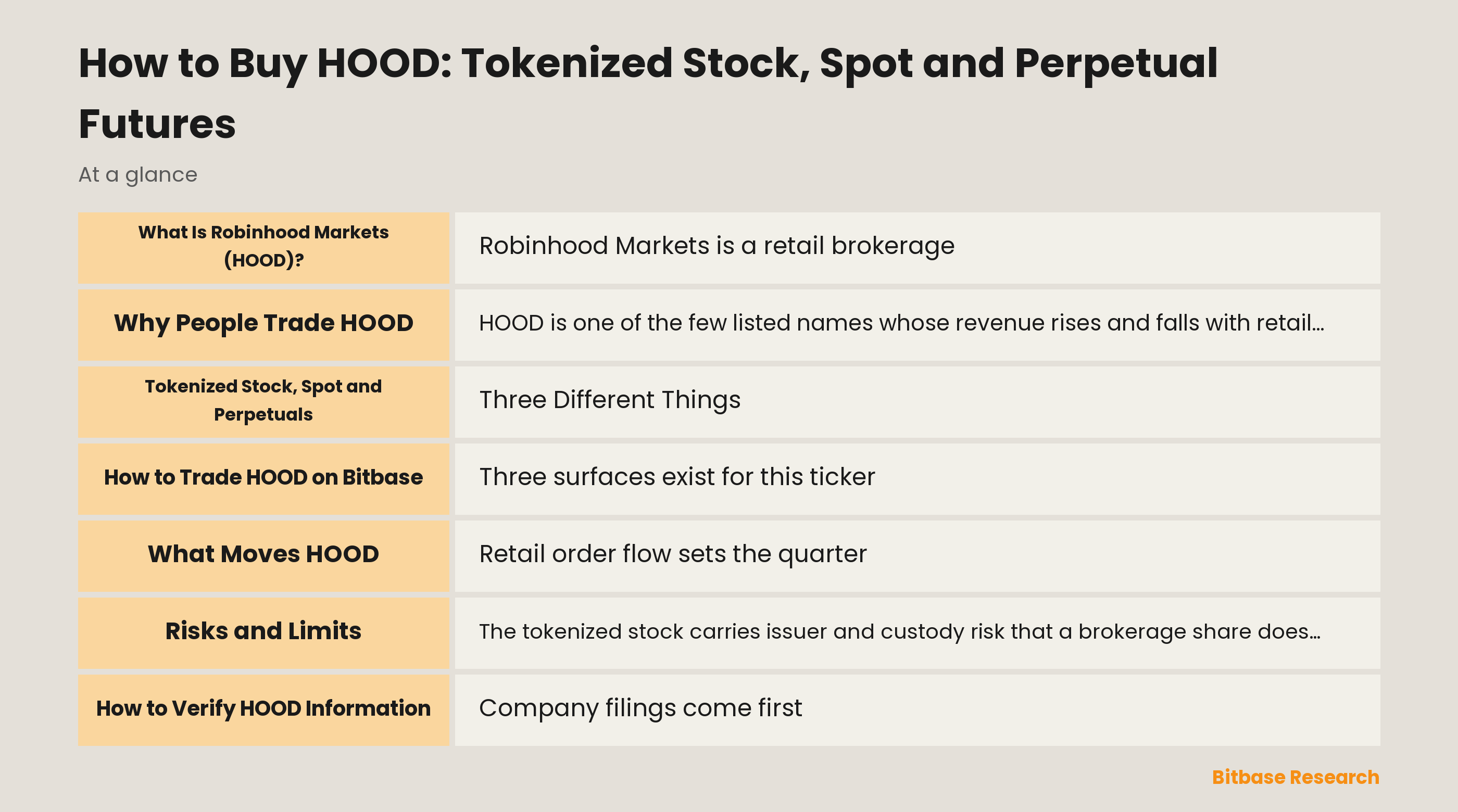
What Is Robinhood Markets (HOOD)?
Robinhood Markets is a retail brokerage. It is incorporated in Delaware, listed on Nasdaq under HOOD, and a component of the S&P 500, which it joined in the September 2025 index rebalance. It describes itself as offering retail brokerage, crypto, advisory, digital banking and private markets access; what it sells in every case is access to markets rather than a product of its own.
Its annual report groups revenue into three lines, and that split explains how the share behaves. Transaction-based revenue comes from routing customer orders in options, cryptocurrencies and equities out to market makers, priced differently by asset class: options per contract, equities primarily off the bid-ask spread of the underlying activity, crypto as a fixed percentage of notional order value. Net interest revenue comes from margin loans, cash sweep, segregated cash and securities lending. Other revenue is largely Gold subscription fees.
That routing model is the practical difference between a broker and an exchange: orders leave the app and execute elsewhere rather than matching on a book the company runs. In 2025 that stopped being the whole picture. Robinhood acquired Bitstamp, which its own annual report describes as "a globally-scaled cryptocurrency exchange with retail and institutional customers", so the group now holds both models, and its European business runs through a separate regulated entity.
Why People Trade HOOD
HOOD is one of the few listed names whose revenue rises and falls with retail trading activity itself. Because the fee is charged per order rather than on assets held, a quarter in which private investors trade more options, more crypto and more shares is mechanically a better quarter. The stock is a position on participation rather than on any single asset.
Its relationship with crypto is unusually direct. For a listed company the connection to token prices is normally a matter of sentiment; here, cryptocurrency trading is one of the three transaction revenue categories in the accounts, and the Bitstamp acquisition added an exchange business on top of it. Crypto strength shows up in the revenue line, not only in the multiple.
Tokenized Stock, Spot and Perpetuals: Three Different Things
The Bitbase price page for this ticker lists Robinhood Markets (Ondo Tokenized Stock), trading under the symbol HOODON. The issuer name inside that title is the important part, because it decides what the instrument is.
Ondo's documentation is explicit on three points. The token is not one-for-one with a share: "One token does not necessarily represent the value of one share, and the price of one token will not always match the price of the underlying asset." It is structured as a total return tracker, designed to give the economic result of holding the share with distributions reinvested net of withholding tax rather than paid out. And holders receive no shareholder rights: the documentation states you "do not receive shareholder voting rights, statutory information rights or other shareholder rights". The product is generally available to non-US investors, subject to jurisdictional limits.
Trading hours are the detail that catches people out. Ondo describes trading as running 24/5, with pauses possible around corporate actions and risk limits. That is far longer than a Nasdaq session, and still not the continuous schedule crypto traders are used to.
This ticker carries a wrinkle the others do not. Robinhood is itself an issuer of stock tokens in Europe, and its own product is built differently: it describes Classic Stock Tokens as "derivative contracts between you and Robinhood", priced at the prices of the underlying securities "without granting rights to them", with the underlying assets owned by Robinhood. The HOOD token on Bitbase is not one of those. It comes from Ondo, a different issuer with a different structure; the shared name is not shared structure.
A perpetual futures contract is different again. It holds nothing: no share, no token, no claim on Robinhood. It tracks a price, settles against a stablecoin, exchanges funding payments between longs and shorts, and can be liquidated. It is leveraged directional exposure, not ownership of anything the company issued.
How to Trade HOOD on Bitbase
Three surfaces exist for this ticker, and they answer different questions.
The price page is the reference point: quote, chart and market data for the tokenized stock. It requires no position, and it is where the token's full name and symbol can be read.
The tokenized stock spot market is where the token is bought and held outright. There is no funding payment and no liquidation price; the position sits in the account until it is sold. It suits economic exposure without leverage, for someone who accepts an issuer-structured instrument in place of a registered share.
The perpetual futures market is where leveraged directional positions are opened. It carries a funding payment, a maintenance margin requirement and a liquidation price, which suits shorter holding periods and hedging rather than an intention to own part of the company.
Which tickers have which of these surfaces differs by name; the tokenized stock lineup is where to check.
The decision that matters is between the second and the third, and it turns on whether the trade is a holding or a position with a deadline.
What Moves HOOD
Retail order flow sets the quarter, and it has to be read across three asset classes at once. Options volume, crypto trading and equity sessions each feed a separate transaction line, and each line is priced on a different basis, so they do not move together: a soft equity tape can be masked by an active options book.
Crypto acts on this name through the accounts rather than through the narrative. Token prices move both trading volumes and the exchange business acquired with Bitstamp, which is why HOOD carries a beta to crypto that a payments company or an index fund does not have.
Rates work on a different line of the income statement altogether. Net interest revenue is earned on margin loans, swept cash and segregated balances, so a policy decision reprices that line at once, on a schedule set by central banks rather than by trading appetite.
The least predictable input is regulation of the revenue model itself. The company's own risk factors name "our reliance on transaction-based revenue, including PFOF, the risk of new regulation or bans on PFOF and similar practices". Payment for order flow is how routed orders are monetised, and a rule change there does not dent one quarter; it changes how a revenue line works.
Product expansion sets the longer rhythm. Futures, prediction markets, credit cards, retirement accounts, banking services and the European build-out each add a revenue line and a supervisory surface at the same time, and appear in the operating metrics well before the profit line.
Index membership changed the holder base. Joining the S&P 500 obliges funds tracking that index to hold the name, which alters who owns the stock and how it trades around rebalances, independent of anything the company does.
Risks and Limits
The tokenized stock carries issuer and custody risk that a brokerage share does not. Its value depends on the issuer's structure holding up, with no shareholder claim to fall back on. Redemption paths, eligibility and jurisdictional limits are set by the issuer rather than the venue, and can change.
The 24/5 schedule creates gap risk. The underlying trades in a Nasdaq session; the token trades outside it. For a brokerage whose news flow includes regulatory announcements as well as earnings, a position held across that boundary can move with no way to hedge in the primary market.
The perpetual adds funding cost and liquidation. Funding accrues against whichever side is crowded, so a directionally correct trade held long enough can still lose money to it, and leverage shortens the distance to the liquidation price.
The business itself is procyclical. Brokerage revenue falls when markets go quiet, and the operating result and the appetite for the shares answer to the same conditions, so they move together rather than offsetting. Sizing a cyclical single-name position like a diversified holding is the error to avoid.
How to Verify HOOD Information
Company filings come first. Robinhood's investor relations pages carry the quarterly results and the operating updates published alongside them, and the SEC's EDGAR database carries the filings themselves, including the risk factors that name the dependence on transaction-based revenue and on payment for order flow.
For the tokenized instrument, the issuer's documentation is the authority on what the token is and is not. Backing structure, rights, hours and eligibility come from Ondo's own pages, not from the venue's listing. Read Robinhood's European product pages separately if the two structures need telling apart.
For the instruments on Bitbase, the price page carries the current quote and the market pages carry the contract specifications, including funding and margin terms for the perpetual. Those terms change: read them at the time of the trade, not from memory.
Conclusion
Robinhood Markets earns its money from activity: orders routed, balances lent, subscriptions billed. HOOD is therefore a position on how much people trade, on where rates sit, and on whether the rules governing routed order flow stay as they are. On Bitbase the ticker resolves into three instruments: a tokenized stock issued by Ondo that is not a share and grants no shareholder rights, a spot market in that token, and a perpetual that holds nothing. Which one fits is a question about holding period and about how much issuer structure you are prepared to take on.
Related market pages
Bitbase pages for the tokenized stocks named in this article:
- HOOD: View price · Tokenized stock spot · Perpetual market
Related reading
Other Bitbase articles on this topic:
- How to Buy AMZN: Retail, Ads and AWS Under One Ticker
- How to Trade ARM: Arm Holdings, a Chip Design Licensor
- How to Trade ASML: Lithography Exposure Without a Share
- What Is Venice AI (VVV)? Privacy Modes, the Token and DIEM
Disclaimer: This article is educational content from Bitbase Academy, provided for information only. It explains what a company or fund does and how the instruments referenced here differ from one another; it does not constitute investment, trading, tax, or financial advice, and it is neither a recommendation nor an endorsement of any security, token, or trading strategy. A tokenized stock is issued by a third party and is designed to give economic exposure to an underlying asset: it is not a share, it carries no shareholder rights, and it depends on the issuer's structure, eligibility rules, and redemption terms, which the issuer can change. Perpetual futures are leveraged derivatives that hold no underlying asset and can be liquidated, and trading hours, product availability, and eligibility differ by instrument and by jurisdiction and can change at any time. Written as of September 2026; verify everything yourself through company filings, the issuer's own documentation, and the product pages of the venue you trade on.
References
[1] Ondo Stocks overview: backing, rights and trading hours (Ondo official documentation) docs.ondo.finance
[2] SEC EDGAR: Robinhood Markets annual report on Form 10-K, including revenue categories, the Bitstamp acquisition and the risk factors on transaction-based revenue and PFOF www.sec.gov
[3] Robinhood Europe: Classic Stock Tokens described as derivative contracts between the customer and Robinhood, granting no rights to the underlying shares robinhood.com
[4] S&P Dow Jones Indices press release: Robinhood Markets joins the S&P 500, effective prior to the open on 22 September 2025 press.spglobal.com