A stock index is a published rule that produces a number, and a number is not something anyone can hold. Every route into index exposure is therefore a wrapper built around that number, and the wrapper rather than the index decides what sits in the account, what it costs to keep, and whether the position has an end date. What follows is what an index actually measures, what each wrapper holds, what moves the number itself, and where to check every part of it.
What a Stock Index Actually Measures
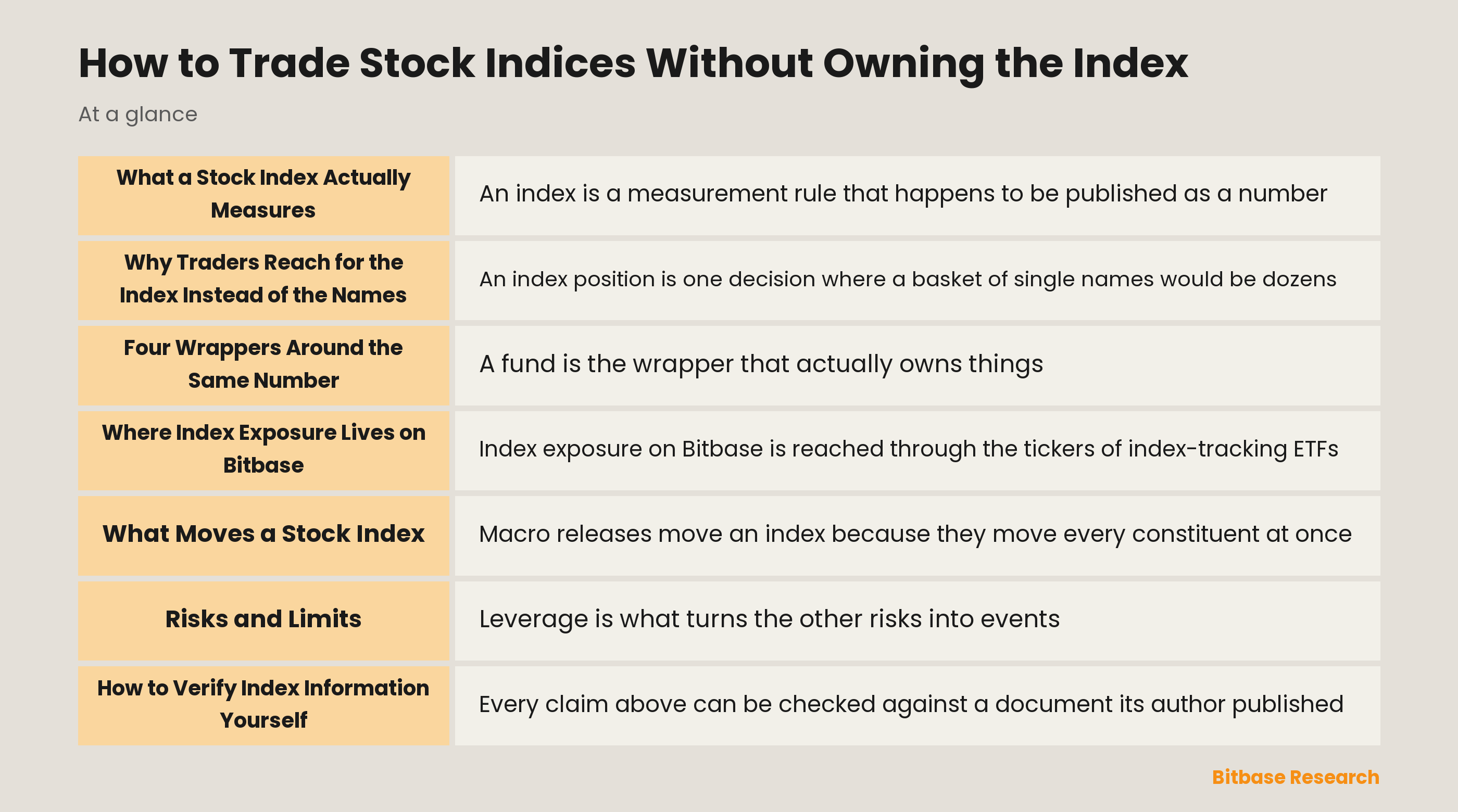
An index is a measurement rule that happens to be published as a number. The rule fixes which securities are eligible, how much each one counts, and on what calendar the answer is allowed to change, and all of it is written down in public. Nasdaq's methodology for the Nasdaq-100 states that the index is designed to measure the performance of a hundred of the largest Nasdaq-listed non-financial companies, and that it weights them by a modified market capitalization scheme.
Weighting decides what the number reacts to. Under a capitalization-weighted scheme a company's share of the index rises with its market value, so the largest members move it far more than the smallest ones do. Other index families weight by price instead: S&P Dow Jones Indices describes a price weighted index as one where constituent weights are determined solely by the prices of the constituent stocks, with shares outstanding set to a uniform number across the index. Neither is more correct; they are different measurements of the same market, and knowing which one a product tracks is the difference between reading a move and being surprised by it.
The calendar matters as much as the formula. The Nasdaq-100 methodology sets reconstitution annually and rebalancing quarterly, with reference, announcement and effective dates published in advance, and it notes that between those scheduled events constituents may be subject to corporate actions and events that require maintenance and adjustments to the index. Membership is not permanent, and the changes arrive on a schedule anyone can read months ahead.
What the rule never produces is an asset. There are no index shares, no custodian holding an index, and nothing to hand over at settlement. That single absence generates every structure in the rest of this article.
Why Traders Reach for the Index Instead of the Names
An index position is one decision where a basket of single names would be dozens, and it changes the exposure rather than reducing it: company-specific news arrives diluted, while anything moving the whole market arrives at full strength. That is also why macro views live here. A view about interest rates, or about where the economy is heading, has no natural single-stock expression, because it applies to every constituent at once.
Hedging is the mirror image of the same logic. Someone holding a portfolio of individual shares can offset the broad market component with a short index position and keep the stock-specific bets intact: the hedge works on the shared part of the risk and does nothing about the rest, which is precisely what it is for.
Four Wrappers Around the Same Number
A fund is the wrapper that actually owns things. The SEC's investor bulletin on exchange-traded funds describes them as a way for investors to pool money in a fund that invests in stocks, bonds or other assets and to receive an interest in that pool in return, with shares traded on an exchange at prices that, in the bulletin's words, “may or may not be the same as the net asset value.” For an index-based ETF, the adviser seeks to track an underlying securities index. You hold a claim on a portfolio, and the portfolio holds the shares.
A dated futures contract owns nothing. The CFTC glossary defines one as an agreement to buy or sell for delivery in the future, at a price fixed when the contract is entered, that can be satisfied by delivery or by offset. Because an index cannot be delivered, index futures are cash settled: the same glossary describes cash settlement as paying a cash amount based on the level of an index, by a procedure the contract specifies. The expiry calendar lives in the exchange's contract specification, and the position is carried on margin rather than paid for outright. For a concrete example of a dated equity-index contract, see our guide to E-mini S&P 500 futures (ES).
A perpetual futures contract removes the expiry and replaces it with a running cost. No calendar forces a decision; instead a funding payment passes between the long and short sides at intervals, which is how the contract stays tethered to the market it references. It is a leveraged derivative that holds no underlying asset and can be liquidated.
A tokenized wrapper is the newest of the four, and the one where the label tells you least, because the issuers do not share a structure. Backed says each xStock “is backed 1:1 by the underlying asset held in regulated custody.” Robinhood Europe UAB says its Classic Stock Tokens “are derivative contracts between you and Robinhood,” priced at the prices of the underlying securities “without granting rights to them.” Ondo says of its own tokenized stocks that “one token does not necessarily represent the value of one share.” Three products, three different things to hold, one adjective; the issuer's documentation is the only place the terms are settled.
Where Index Exposure Lives on Bitbase
Index exposure on Bitbase is reached through the tickers of index-tracking ETFs, and each surface asks something different of you.
A price page is the surface that asks nothing: quote, chart and market data for one tokenized ETF listing, plus the name of the wrapper and of the issuer standing behind it. The tokenized S&P 500 ETF page and the tokenized Nasdaq-100 ETF page are two of these, and the issuer named on one is not the issuer named on the next. Reading either settles the thing worth settling before an order exists: whose paper this is.
The SPY perpetual market is the surface where a directional position gets opened with leverage instead of bought outright. Funding flows toward whichever side is crowded, maintenance margin has to stay covered for the position to survive, and the liquidation price sits wherever the chosen leverage puts it. Those three mechanics fit a view with a deadline attached to it.
What is listed under a given name is not uniform across tickers, and the TradFi coverage page is the page that answers it.
What Moves a Stock Index
Macro releases move an index because they move every constituent at once. Inflation prints, employment data and central bank decisions change the rate at which future cash flows are discounted, and the index registers that without any company having reported anything.
Concentration is the force most often underestimated. Weighting means the largest members dominate the arithmetic, so the earnings date of one very large company becomes an index event in everything but name. A rule that selects a hundred companies does not make a hundred companies matter equally on any given day.
Composition changes move it on a published schedule. Reconstitutions and rebalances add and remove members and reset weights, and because funds tracking the index have to follow, flows cluster around dates announced in advance.
Some of the movement belongs to the wrapper rather than to the index. The gap between a dated future and the cash index is what the CFTC glossary calls the basis: the difference between the cash price and the price of the nearest futures contract. It responds to the cost of carrying a position, which the same glossary describes as including interest on the deposited funds. Financing conditions can move a futures price while the index has not moved at all. On a perpetual that pressure shows up as funding; on a fund, as a market price above or below net asset value.
Risks and Limits
Leverage is what turns the other risks into events. A margined position is larger than the cash behind it, so an adverse move consumes the deposit faster than it moves the index, and a liquidation can close the position at the worst moment of a move that later reverses.
Expiry is an operational risk as much as a cost. A dated contract ends whether or not anyone acts on it, and staying exposed past that point means opening a new one at a new price. A perpetual inverts that: it never expires, so the cost is continuous rather than concentrated, and funding accrues in whichever direction the crowd leans regardless of whether the view proves right.
Wrapper divergence is the quiet one. Tracking an index is an objective rather than a guarantee, and the SEC's bulletin is explicit that ETF shares trade at prices that “may or may not be the same as the net asset value.” A tokenized wrapper adds its issuer to that list, since the structure, the eligibility rules and the redemption terms are set by the issuer and can be changed by it.
Diversification, meanwhile, is a property of the index and not of the trade. A leveraged position on a broad index is a leveraged position, and the breadth of the underlying does nothing to soften a margin call.
How to Verify Index Information Yourself
Every claim above can be checked against a document its author published, and the sources sort by wrapper.
The index provider publishes the methodology: eligibility criteria, the weighting scheme, the reconstitution and rebalance calendar and the treatment of corporate actions, all dated. Nasdaq publishes the Nasdaq-100 methodology and S&P Dow Jones Indices publishes its index mathematics and its own families' methodologies, and a question about what an index measures is answered there rather than in commentary about it.
The exchange publishes the contract specification for a dated future: settlement method, contract months, trading hours and required margin. A worked example of one index future is a faster way in than a general description, but the specification is what binds.
For terminology, the CFTC glossary gives a regulator's own definition of basis and cash settlement, and the SEC's investor bulletins cover how funds are structured. For a tokenized wrapper the issuer's documentation is the only source that governs, and issuers state materially different things. For a perpetual it is the venue's own contract specification, since funding intervals, margin tiers and liquidation mechanics are set per venue and per contract.
Conclusion
An index is a rule that outputs a number, and every way to trade it is a wrapper answering the question the number leaves open: what is actually being held. A fund holds shares, a dated future holds nothing and ends, a perpetual holds nothing and charges continuously, and a tokenized wrapper holds whatever its issuer has written down. Choosing between them is less a view about the market than a decision about which terms to accept, and those terms are published in every case for anyone willing to read them before the position rather than after.
Related reading
Other Bitbase articles on this topic:
- How to Buy INTC: A Chip Designer That Owns Its Factories
- How to Trade IREN: From Bitcoin Mining to AI Data Centres
- How to Buy and Trade IWM, the Russell 2000 ETF
Disclaimer: This article is educational content from Bitbase Academy, provided for information only. It explains what a company or fund does and how the instruments referenced here differ from one another; it does not constitute investment, trading, tax, or financial advice, and it is neither a recommendation nor an endorsement of any security, token, or trading strategy. A tokenized stock is issued by a third party and is designed to give economic exposure to an underlying asset: it is not a share, it carries no shareholder rights, and it depends on the issuer's structure, eligibility rules, and redemption terms, which the issuer can change. Perpetual futures are leveraged derivatives that hold no underlying asset and can be liquidated, and trading hours, product availability, and eligibility differ by instrument and by jurisdiction and can change at any time. Written as of September 2026; verify everything yourself through company filings, the issuer's own documentation, and the product pages of the venue you trade on.
References
[1] CFTC glossary: futures contract, cash settlement, basis and carrying charges www.cftc.gov
[2] SEC Office of Investor Education and Advocacy, Investor Bulletin: Exchange-Traded Funds (ETFs) www.sec.gov
[3] Nasdaq-100 Index methodology: index description, eligibility criteria and index calendar indexes.nasdaq.com
[4] S&P Dow Jones Indices, Index Mathematics Methodology: price weighted and capitalization weighted indices www.spglobal.com