S&P 500 futures are cash-settled contracts on the level of the S&P 500 index, listed on CME. ES is the E-mini S&P 500 futures contract and MES is the Micro E-mini version, one-tenth its size. Neither gives you ownership of the companies in the index: you trade a margined contract with an expiry date, daily mark-to-market and a contract specification set by the exchange.
What ES Actually Is
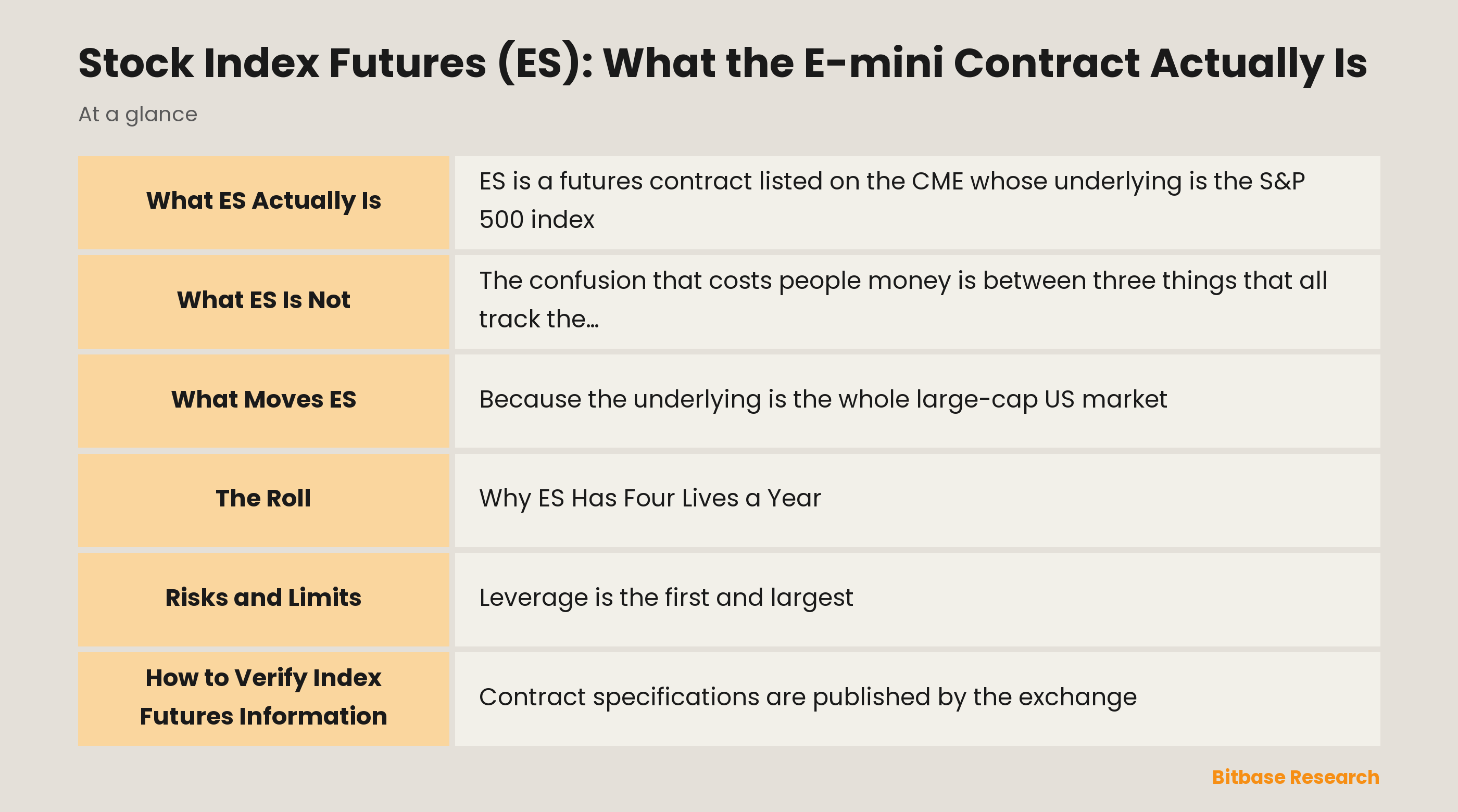
ES is a futures contract listed on the CME whose underlying is the S&P 500 index. Two things about that sentence do most of the work.
First, the underlying is an index, which is a number, not a thing you can deliver. So the contract is cash-settled: at expiry no shares change hands, and the difference between the entry price and the final settlement value is paid in cash. There is no version of holding ES to expiry that leaves you owning 500 companies.
Second, it is a futures contract, which means it is an agreement about a future price, entered on margin. You post a fraction of the notional value as initial margin, and the position is marked to market every day — gains are credited and losses debited daily rather than at the end. A move against you can require more margin the same day.
The "E-mini" in the name is historical. The original S&P 500 pit contract was larger; the E-mini was the electronically traded, smaller-notional version, and it long ago became the main one.
ES vs MES at a Glance
MES, the Micro E-mini, tracks the same index on the same calendar as ES; what differs is how much exposure a single contract carries.
| Feature | ES | MES |
|---|---|---|
| Underlying | S&P 500 index | S&P 500 index |
| Contract | E-mini S&P 500 futures | Micro E-mini S&P 500 futures |
| Relative size | Standard E-mini size | One-tenth the size of ES |
| Settlement | Cash settled | Cash settled |
| Expiry | Quarterly: March, June, September, December | Same quarterly cycle |
| Main difference | Larger notional exposure per contract | Smaller notional exposure per contract |
Contract multipliers, tick values, margin requirements and trading hours should always be checked against the current CME contract specifications before trading. For a closer side-by-side of contract size, margin, trading hours and rollover, see the ES vs MES futures guide.
What ES Is Not
The confusion that costs people money is between three things that all track the S&P 500.
An index fund or ETF holds the underlying shares. You own a share of a portfolio, you receive dividends, and there is no expiry and no margin call. It trades during exchange hours.
A futures contract holds nothing. It is a leveraged, expiring, cash-settled agreement. There are no dividends, because there is no share — though dividend expectations are already priced into the futures curve, which is one reason the future does not track the index exactly.
A perpetual on an index, where such a thing exists on a crypto venue, is a third structure again: no expiry, and a funding payment instead of a curve. It is not what ES is, and the two behave differently around dividend dates and rate changes.
Reading a quote for one and trading the other is the single most common error with index products.
What Moves ES
Because the underlying is the whole large-cap US market, ES responds to things that move the market as a whole rather than to any single company. Scheduled macro releases — inflation prints, employment data, central bank decisions — produce the sharpest intraday moves, and they land at fixed times that anyone can look up in advance.
Index concentration matters more than it used to. When a handful of very large companies make up a substantial share of the index weight, their earnings dates become de facto index events. An index future is a diversified instrument in name; in practice its short-term behaviour can hinge on a small number of names.
The futures curve adds its own driver. The gap between the future and the spot index reflects financing cost and expected dividends, so the basis moves with interest rates independently of anything happening to the companies. Traders holding across a roll pay attention to this because it is a cost, not a forecast.
Overnight is the part most equity traders underestimate. ES trades nearly around the clock on weekdays, so the gap that a cash-market trader sees at the open has usually already happened in the futures session — priced in, hours earlier, in a thinner book.
The Roll: Why ES Has Four Lives a Year
ES contracts expire quarterly, in March, June, September and December. A position is not automatically carried forward: to stay exposed past expiry you close the expiring contract and open the next one, which is called rolling.
Rolling is not free and it is not neutral. The two contracts trade at different prices, the spread between them reflects financing and dividends, and liquidity migrates from the front contract to the next one over a window of days rather than at a single moment. Rolling late means trading in a thinning book; rolling early means giving up the more liquid contract. Neither is wrong, but neither is automatic, and a trader who forgets the calendar discovers it at expiry.
This is the structural difference from a perpetual that matters most. A perpetual has no expiry and therefore no roll; it charges you continuously through a funding rate instead. A quarterly future concentrates that cost into four decisions a year.
S&P 500 Futures vs an S&P 500 ETF
Both can give exposure to the same index. The differences are in what you hold and what you have to manage while you hold it.
| Feature | Futures | ETF |
|---|---|---|
| Ownership | Derivative contract; holds no shares | Shares of a fund that holds the index stocks |
| Expiry | Yes, on a quarterly cycle | No scheduled expiry |
| Margin | Futures margin, marked to market daily | Depends on the brokerage account |
| Settlement | Cash settled at expiry | Fund shares stay in the account until sold |
| Dividends | Reflected in the futures price, not paid out | The fund may distribute dividends |
| Roll | Required to keep dated futures exposure | Not required simply to keep holding the ETF |
How to Trade S&P 500 Futures Step by Step
None of these steps predicts the index; they decide whether the position you open is the one you meant to open.
1. Choose whether the position size fits ES or the smaller MES. MES allows finer sizing, but a smaller contract is not a less leveraged one.
2. Check the active contract month and its expiry date. As expiry approaches, liquidity moves to the next contract, so the front month is not always the one to trade.
3. Review the current multiplier, tick value, margin requirement and trading hours on the exchange's specification page, and the margin your broker actually charges.
4. Decide the maximum loss and the position size before entering: work out what a move of a given number of index points costs at that contract's multiplier.
5. Check whether major macro releases, or earnings from the index's largest companies, fall within the holding period: those are the fixed times when the sharpest moves tend to arrive.
6. If you will still hold near expiry, decide in advance whether to close the position or roll it to the next contract.
Risks and Limits
Leverage is the first and largest. Initial margin on an index future is a small fraction of notional, which means the position size most people think they are taking is far smaller than the one they actually have. Daily mark-to-market turns an adverse move into a same-day cash requirement.
Gap risk compounds it. The contract trades nearly continuously on weekdays but not on weekends, and news over a weekend is expressed as a gap at the Sunday open with no opportunity to have exited in between.
Expiry and roll are operational risks, not just costs. A position left in an expiring contract will be settled in cash whether or not that was the plan, and the settlement calculation for the quarterly expiry has its own procedure that differs from an ordinary daily close.
Finally, "diversified" describes the underlying, not the trade. A leveraged position on a diversified index is still a leveraged position, and the diversification does nothing about the leverage.
How to Verify Index Futures Information
Contract specifications are published by the exchange: contract size, tick value, trading hours, margin requirements and the expiry calendar all come from CME's own product pages, and they are the only authoritative source for them. Margin requirements in particular change, and brokers may require more than the exchange minimum.
Index methodology is published separately by the index provider, and it is where to look for how constituents are selected and weighted, and how and when the index is rebalanced. Concentration questions are answered there, not in market commentary.
For the equity-linked products that do exist on a crypto venue, the tokenized stock lineup is where to see what is listed. For any specific instrument you are about to trade, the contract specification from the venue you are trading on is the one that binds — not a general description of "index futures," and not this article.
Conclusion
ES, and MES at one-tenth its size, is a cash-settled, quarterly-expiring, margined contract on an index. Almost everything that surprises people about it follows from one of those four words: nothing is delivered, the calendar forces a decision four times a year, the position is larger than the cash posted, and the thing being tracked is a number rather than a portfolio. Understanding those before deciding on a position is more useful than any view on where the index is going.
Frequently asked questions
What is the difference between ES and MES?
Both are CME futures on the S&P 500 index, with the same quarterly calendar and cash settlement. MES is one-tenth the size of ES, so one contract carries a tenth of the notional exposure, and because both are quoted in the same index-point increments, each tick is worth a tenth as much too.
Do S&P 500 futures own the stocks in the index?
No. The contract is a derivative on the index level and holds nothing. At expiry it is settled in cash against a special opening quotation of the index, calculated from the opening prices of the component stocks, so no shares are delivered at any point.
Do S&P 500 futures expire?
Yes. ES and MES are dated contracts on a March, June, September and December cycle, and the final settlement value is set on the third Friday of the contract month. Keeping exposure past an expiry means closing the expiring contract and opening a later one.
Related reading
Other Bitbase articles on this topic:
- How to Trade GS: Goldman Sachs, Deal Fees and a Perpetual
- How to Buy INTC: A Chip Designer That Owns Its Factories
- How to Trade IREN: From Bitcoin Mining to AI Data Centres
Disclaimer: This article is educational content from Bitbase Academy, provided for information only. It explains what a company or fund does and how the instruments referenced here differ from one another; it does not constitute investment, trading, tax, or financial advice, and it is neither a recommendation nor an endorsement of any security, token, or trading strategy. A tokenized stock is issued by a third party and is designed to give economic exposure to an underlying asset: it is not a share, it carries no shareholder rights, and it depends on the issuer's structure, eligibility rules, and redemption terms, which the issuer can change. Perpetual futures are leveraged derivatives that hold no underlying asset and can be liquidated, and trading hours, product availability, and eligibility differ by instrument and by jurisdiction and can change at any time. Written as of September 2026; verify everything yourself through company filings, the issuer's own documentation, and the product pages of the venue you trade on.
References
[1] CME Group: E-mini S&P 500 futures contract specifications www.cmegroup.com
[2] S&P Dow Jones Indices: S&P 500 index methodology and constituents www.spglobal.com
[3] CME Group: Micro E-mini S&P 500 futures contract specifications www.cmegroup.com
[4] CME Rulebook, Chapter 358: E-mini S&P 500 futures (cash settlement and final settlement price) www.cmegroup.com