Issue 18 closed by saying that a regulator publicly pre-committing to act if the legislature fails lowers the cost of legislative failure at exactly the moment the sponsors need that cost to feel high. This week the legislature priced that failure itself, and the number is 67 seconds. The Senate met twice, both times pro forma: the Congressional Record stamps Monday, August 24 as convening at 12:30:01 p.m. and adjourning at 12:30:33, and Thursday at 34 seconds [1]. Counting the stamped seconds inclusively, as the Record presents them, that is 33 and 34. The House did the same, introducing bill numbers H.R. 10138 through H.R. 10183 by title across the two days; a full-text scan of the Congressional Record's Public Bills and Resolutions granules for six crypto search terms returned nothing [2].
A full enumeration of the Federal Register for the window found no crypto-specific rulemaking, order, or notice from any US financial regulator. Thirty-five SEC documents, seventeen Treasury, four Federal Reserve, one CFTC, one OCC, zero FinCEN — and no crypto-specific rulemaking among them [3]. The two proposals this series has been tracking, the SEC's Regulation Crypto Assets and Treasury's GENIUS Act rulemaking, were both published before the window opened, on August 21 and August 18 [4][5]. One in-window Federal Register document does name digital assets, and it is not a crypto rule: an OFAC determination applying Executive Order 13902 to five sectors of the Iranian economy, of which digital assets is one [36].
The Federal Reserve Bank of Kansas City convened roughly 120 officials from more than 70 countries under the theme "Financial Innovation: Implications for Payments and Policy." The Chair's keynote contains zero occurrences of the words stablecoin, payment, payments, or digital. Four other participants put four mutually incompatible positions on stablecoins and tokenised deposits on the record the same day. Section 6 takes that apart.
And the only thing that moved price was the front end. The two-year Treasury sat between 4.17% and 4.24% for four sessions and then closed Friday at 4.34%, up 14 basis points on the day against 6 at the ten-year and 3 at the thirty [6]. Bitcoin fell 3.03% that session and finished the week within a tenth of a percent of where it started [7].
Week of August 24 to August 30, 2026
Bitbase Research · August 31, 2026
The one chart that matters
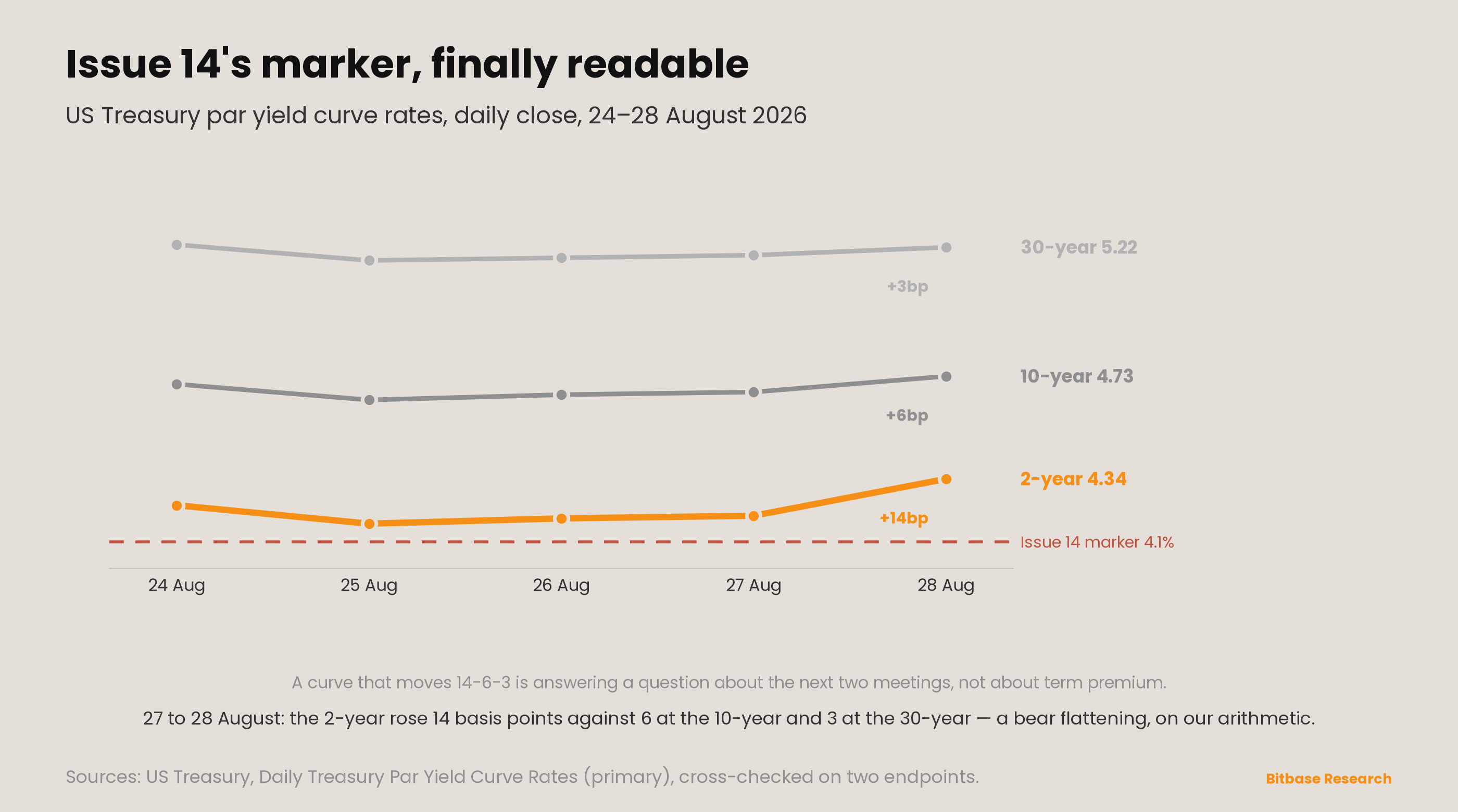
Issue 14 set two macro markers for this series to carry: the two-year Treasury near 4.1% and the dollar index near 100.8. Issue 17 read the two-year at 4.17% on August 14, seven basis points above the threshold, and downgraded the dollar leg on tier grounds. Issue 18 could reach neither at Tier-1 and issued no pass or fail. One correction to our own record while we are here. Issue 18 said it was withdrawing "the pass" on the dollar leg. No pass was ever issued: Issue 16 read the index at 101.46 and recorded a failure against the 100.8 threshold, and Issue 17 declined to record a verdict on tier grounds. There was nothing to withdraw. This week the two-year is readable at Tier-1, from the Treasury's own daily par yield curve, and the answer is unambiguous.
The full window, in percent, for the two-year, ten-year and thirty-year: August 24, 4.24 / 4.70 / 5.23; August 25, 4.17 / 4.64 / 5.17; August 26, 4.19 / 4.66 / 5.18; August 27, 4.20 / 4.67 / 5.19; August 28, 4.34 / 4.73 / 5.22 [6]. The figures reproduce exactly on a second Treasury endpoint, the annual CSV download — the cross-check this series wanted last week and could not get [6].
The shape of Friday's move is the finding, not its size. Fourteen basis points at the two-year against six at the ten and three at the thirty is a bear flattening: the market repriced how soon policy moves, not how much term premium the long end deserves. A curve that moves 14-6-3 is answering a question about the next two meetings. Issue 18 built its section 2 around a long end that a Treasury announcement had briefly flattened and supply had promptly unflattened; this week the long end barely participated at all, ending the window at 5.22 against 5.23 on Monday, a net one basis point in a six-basis-point range [6].
So the Issue 14 marker fails, and the failure is now Tier-1 rather than inferred. The two-year is 24 basis points above the 4.1% level Issue 14 named, and it got there in a single session. The dollar leg remains where Issue 18 left it—withdrawn, not failed—because no exchange settlement price for the dollar index was reachable this week either. Secondary readings put it near 99.65 to 99.70 at the week's close, about a point below the 100.8 Issue 14 named [25]. A marker is not restored on a secondary print, so this series reports the level and leaves the verdict withdrawn.
This week's structural signal
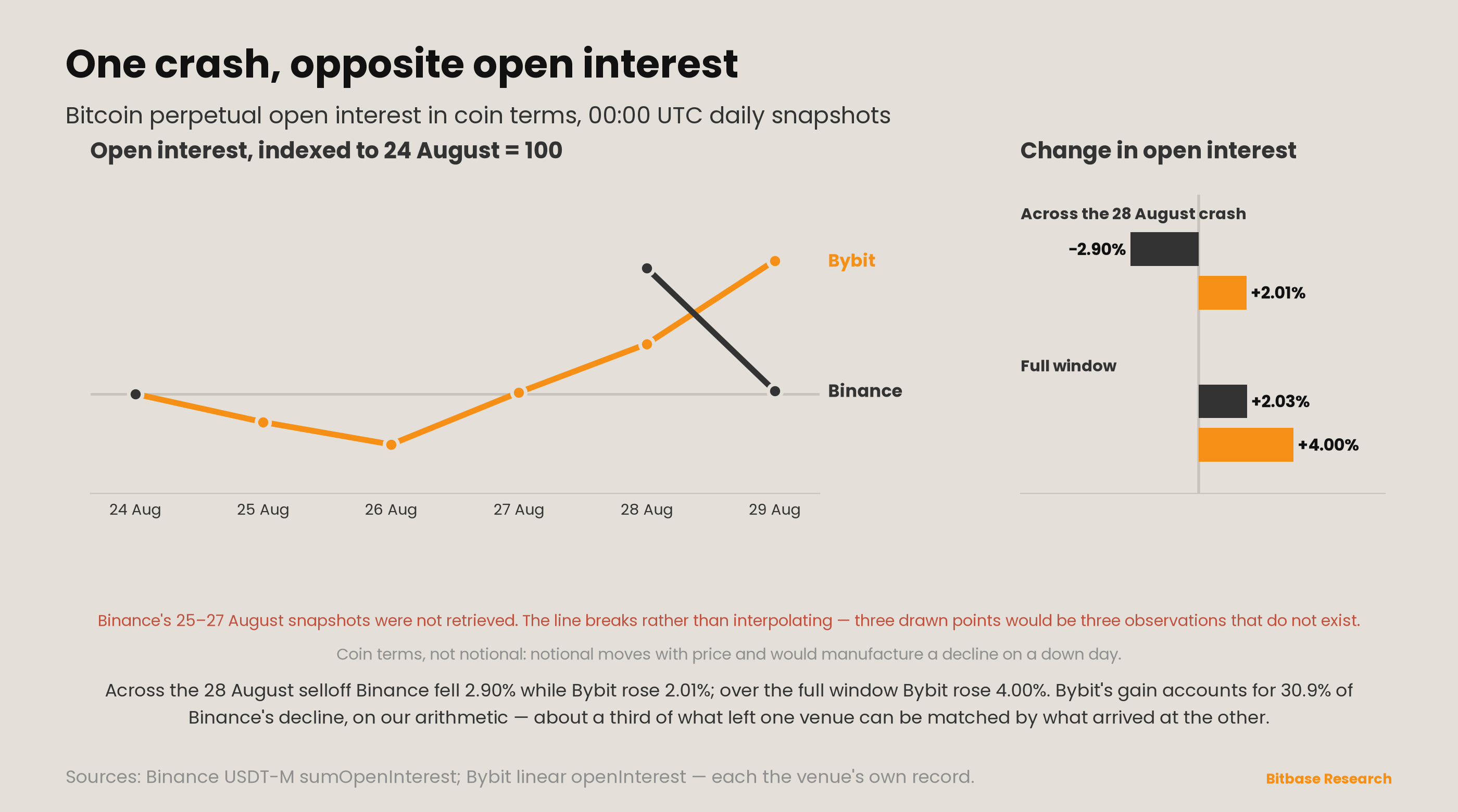
Across the August 28 selloff, bitcoin perpetual open interest on Binance fell 2.90% and on Bybit rose 2.01%. Binance's USDT-margined BTCUSDT open interest, measured in coin terms at 00:00 UTC snapshots, went from 108,761.98 BTC on August 28—the window's peak—to 105,609.14 BTC on August 29 [8]. Bybit's linear BTCUSDT open interest went from 48,566.75 BTC to 49,541.54 over the same two snapshots — +2.01% on our arithmetic — and across the full window ran 47,983.49 on August 24 to 49,904.45 on August 30, +4.00% [9]. Same instrument, same measure, same event, opposite direction.
But the migration reading needs its own subtraction, and it does not fully net. Binance shed 3,152.84 BTC across the crash; Bybit added 974.79. On our arithmetic Bybit's gain accounts for 30.9% of Binance's decline, so the defensible statement is narrower than "positions moved": roughly a third of what left one venue can be matched by what arrived at the other, and the remaining two-thirds is unaccounted for on this evidence and may simply have closed.
Funding tells the same divided story. Binance's BTC perpetual funding was positive at every one of the window's twenty-one eight-hour settlements, with no regime flip, opening the week at the +0.0100% cap on all three settlements [8]. Bybit's compressed harder and earlier, bottoming on August 26 at +0.0069% for the day, about 2.5% annualised on our arithmetic [9]. Binance's August 26 daily total was not retrieved, so the two are not compared at that date: the +0.0100% quoted above for Binance is a per-settlement cap on August 24, not a daily total, and the two measures must not be set side by side. What the retrieved days do support is that Binance's funding stayed positive at all twenty-one settlements while Bybit's fell to roughly a tenth of its opening level by midweek.
Open interest and funding in this section are primary, read from each venue's own history endpoint. The liquidation total is not: it is one outlet relaying CoinGlass, and it is carried at secondary [8][9][10].
What this rules out is weaker than it looks, and one rival explanation survives. A 5.63% intraday drop with $478m to $488m of reported liquidations looks like a single market deleveraging, and on Binance that is what the coin-terms series shows [8][10]. A rise in Bybit open interest is equally consistent with new positions opening there during the drop — short-side entries relocate nothing. Separating relocation from fresh shorts needs Bybit's long/short account ratio or its taker flow, neither of which this issue retrieved. But a market that deleverages does not simultaneously add 2% to open interest somewhere else. Positions did not only close; they moved. An aggregate that nets these two reports a small decline — a true number describing nothing that happened.
Four cautions. Open interest here is in coin terms, not notional: notional moves with price and would manufacture a decline on a down day. The snapshots are 00:00 UTC daily, so the path between them is unobserved — which is also why this issue makes no claim about what happened within any single hour. The two venues do not serve the same taker base, so a divergence says where positions sit, not who is right. And two venues are a sample, not the market: OKX, Bitget, Hyperliquid and CME all carry material bitcoin open interest and none was retrieved this week, so the point about aggregation is demonstrated on two venues rather than established across the complex.
Dual-track scoreboard
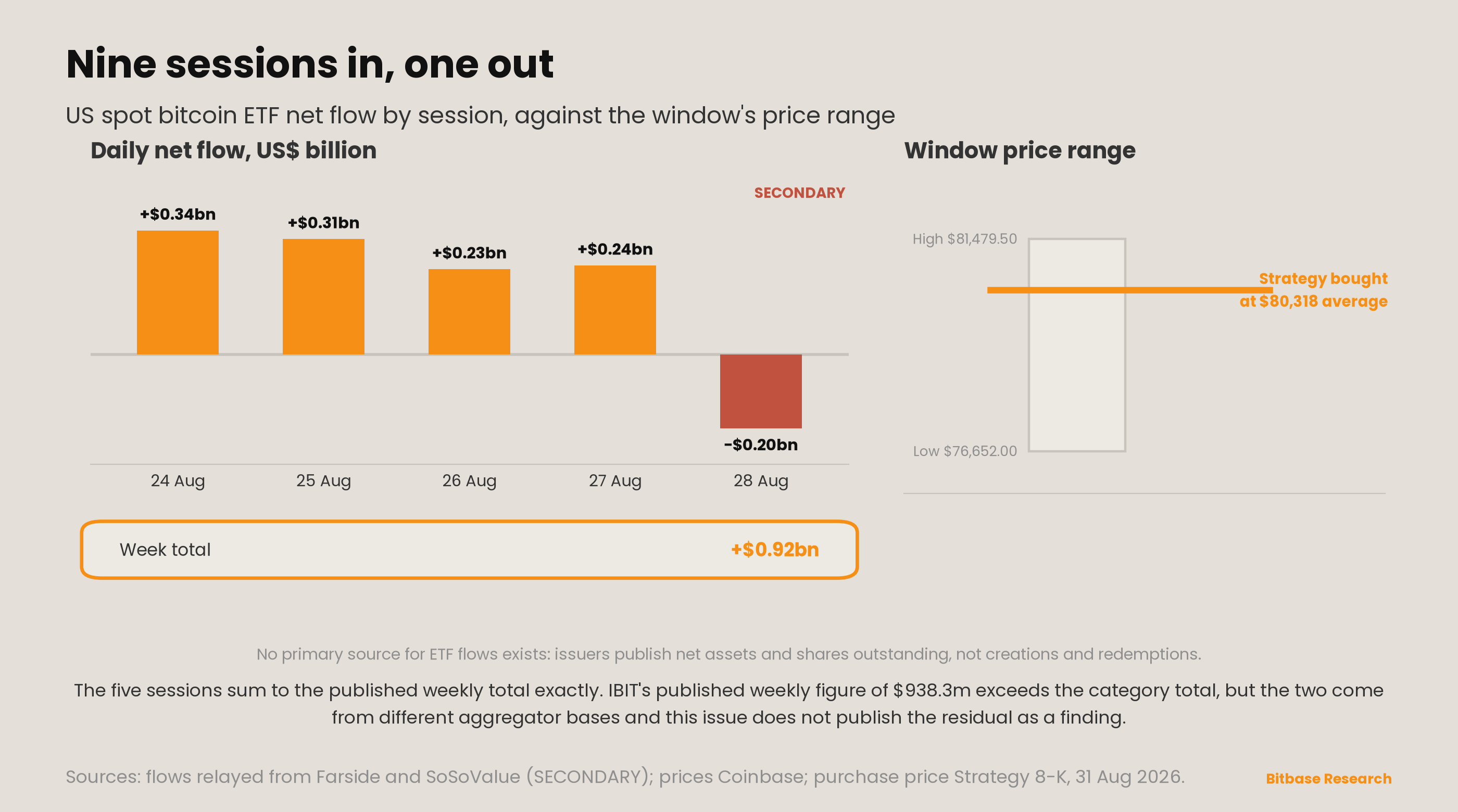
Track 1 — US spot ETF flows. Every number in this track is secondary, and this series will keep saying so until that changes. Issuers publish net assets and shares outstanding, not creations and redemptions; Farside Investors and SoSoValue both refused automated retrieval this week; so each figure below is a news outlet relaying an aggregator [11][12].
US spot bitcoin ETFs took net inflows of $337.56m on Monday, $314.3m on Tuesday, $232.2m on Wednesday and $242.3m on Thursday, then a net outflow of $201.9m on Friday, for a published weekly total of $924.5m that reconciles exactly to the sum of the five sessions [11][12][13][14][15]. That Friday outflow ended a nine-session inflow run stretching back to August 17 and worth $3.04bn [15].
IBIT's published weekly figure exceeds the published category total, and this issue declines to turn that into a finding. BlackRock's fund is reported at $938.3m against the category's $924.5m [12][13]. The subtraction would give a $13.8m net drag, and we are not publishing it as one: the two figures come from different aggregator bases, and Section 7 documents those same bases differing by roughly $9m on a single ether session. A residual smaller than the known cross-basis gap is not distinguishable from it. On the stock side, where a primary source does exist, iShares publishes IBIT net assets of $60,341,516,047 on 1,373,240,000 shares at a NAV of $43.94, as of August 28 [16].
Ether did not follow bitcoin's reversal. Its streak reached ten consecutive sessions and was unbroken at the window's close, one longer than bitcoin's, with ETHA taking roughly 72% of a $1.42bn nine-session run and posting no net-selling day [17][18]. iShares publishes ETHA net assets of $8,378,411,061 on 455,960,000 shares at a NAV of $18.38, same as-of date [19].
Track 2 — Strategy. Here the sourcing is primary and the record is complete. The 8-K filed Monday, August 24 covers August 17 to 23 and reports no bitcoin purchased and no bitcoin sold; the activity columns are dashes, and holdings stood at 840,447 BTC at an average purchase price of $75,385 [20]. The 8-K filed Monday, August 31 covers this window and reports 4,603 bitcoin purchased for $369.7m at an average price of $80,318 — the company's first purchase in any weekly period since the week ended June 21 [21]. Holdings are 845,050 BTC.
And "first purchase since June" understates it, because in between the company was a net seller. Across five disclosed periods from May 26 to August 9, Strategy sold 6,948 bitcoin—32, then 1,363, 2,225, 1,638 and 1,690—at average sale prices between $59,256 and $77,135, funding preferred distributions and STRC repurchases [20][21]. That total is our arithmetic over five primary filings; no single filing states it. The weekly table's header tracked the shift: "BTC Sold" through early August, "BTC Purchased / (Sold)" from August 17, and on August 31 the sale column disappears again.
Three things about that purchase are worth more than the purchase. It was made at an average price above the window's midpoint, into a week that closed lower. Weekly ATM common issuance fell from $2,006.5m to $602.8m, a cut of 70%, and a Free Writing Prospectus filed August 24 puts the company's own mNAV at 1.01x—equity issued at parity with net asset value, which is where the mechanism stops being accretive [20][21][22]. And the filing itemises the week's uses in a way the prior week's did not: $50.7m of STRC dividends, $369.7m of bitcoin, and $151.8m of STRC repurchases, which come to $572.2m of the $602.8m raised, leaving $30.6m on our arithmetic that the filing lists as a fourth use without quantifying [21]. The week before, the same footnote had disclosed a residual rather than naming every line.
On the radar—week of August 31 to September 6
The Senate returns at 11:30 a.m. on Monday, August 31 — the first minute of legislative time the market-structure bill has had since Issue 17 gave it a date [1]. Issue 18 noted a procedural vote on September 15 and a three-week window before the election recess. First question: does the bill get floor time, or does the three-week window start being spent?
Second, September 9 is an effective date, not an operation, and this series should not repeat the conflation. Treasury's first liquidity-support buyback on or after that date is September 10 in the 10-to-20-year sector; the first 20-to-30-year operation is September 24; the operation actually scheduled for September 9 is a cash-management buyback in the 1-month-to-2-year bucket [23]. And the tentative schedule posted at Treasury's own URL is still the August 5 version, still listing $2bn maxima for every long-end operation through November 4 [23]. Does the promised updated schedule appear before the operation it governs?
Third, ICI publishes the week ended September 2 on Thursday, September 3. After a week in which the retail and institutional legs swapped signs at comparable size, does the composition hold or revert?
Fourth, does the two-year hold above 4.30%? A single session created the level; the question is whether it survives a week without a keynote.
Fifth, Strategy bought at $80,318 with its mNAV at parity. If it buys again next week, the average price and the ATM size together say whether the June-to-August pause is over or whether this was one opportunistic week.
Signal tracking update
Issue 18's radar asked five questions. Three have clean answers, one has a secondary answer this issue will not upgrade, and one was malformed.
First, what did the Chair say about the long end? Nothing, and the check is word-level. Across the roughly 36,900 characters of the August 28 keynote, the terms term premium, long end and yield curve do not appear, and neither do stablecoin, payments, tokenization or digital [24]. Second, did he address meeting frequency in public? He did not. The proposal to cut the FOMC from eight meetings to six, which the July minutes record him opening, went unmentioned. Both absences were checked by name against the primary text, not inferred from coverage.
Third, did September pricing hold? The direction moved against holding, and this issue reports that at secondary tier only. Issue 18 recorded CME FedWatch at 68.4% for no change on August 20. One publisher reports hike odds moving from roughly 35% to roughly 57% after the speech, without stating snapshot times [25]. These are two different quantities and they sum above unity, so they are not one series: 68.4% no-change and 35% hike cannot describe the same moment. Issue 18 gave the same warning about its own figure. What this issue reports is the direction, not a magnitude and not an inversion of any single reading. CME's own tool was not reached, so no pass or fail is issued on the magnitude. What is Tier-1 is the 14 basis points at the two-year, and those point the same way.
Fourth, the Strategy filing landed and answered the question Issue 18 actually asked. That issue judged a sale the more informative outcome in a record-inflow week with bitcoin near $77,000. Neither happened: the week of August 17 to 23 was a no-purchase, no-sale week [20]. The informative event arrived one week later and in the opposite direction.
Fifth, the buyback question was malformed and this issue corrects the record rather than answering it. Issue 18 wrote that a doubled buyback operation produced a rally largely given back within two sessions. No doubled operation has occurred. The August 19 move followed Treasury's announcement; the long-end operation that preceded it, on August 18, was a standard $2bn one that filled its cap on $19.868bn of offers [23][26]. The only buyback conducted inside this window was August 25 in the 5-to-7-year bucket, and it took $1.191bn against a $4bn maximum on $8.402bn offered—29.8% of cap [26]. The long end is heavily oversubscribed and the belly is not. That is the evidence for Treasury targeting the increase where it did, and it is a stronger fact than the half-life question it replaces.
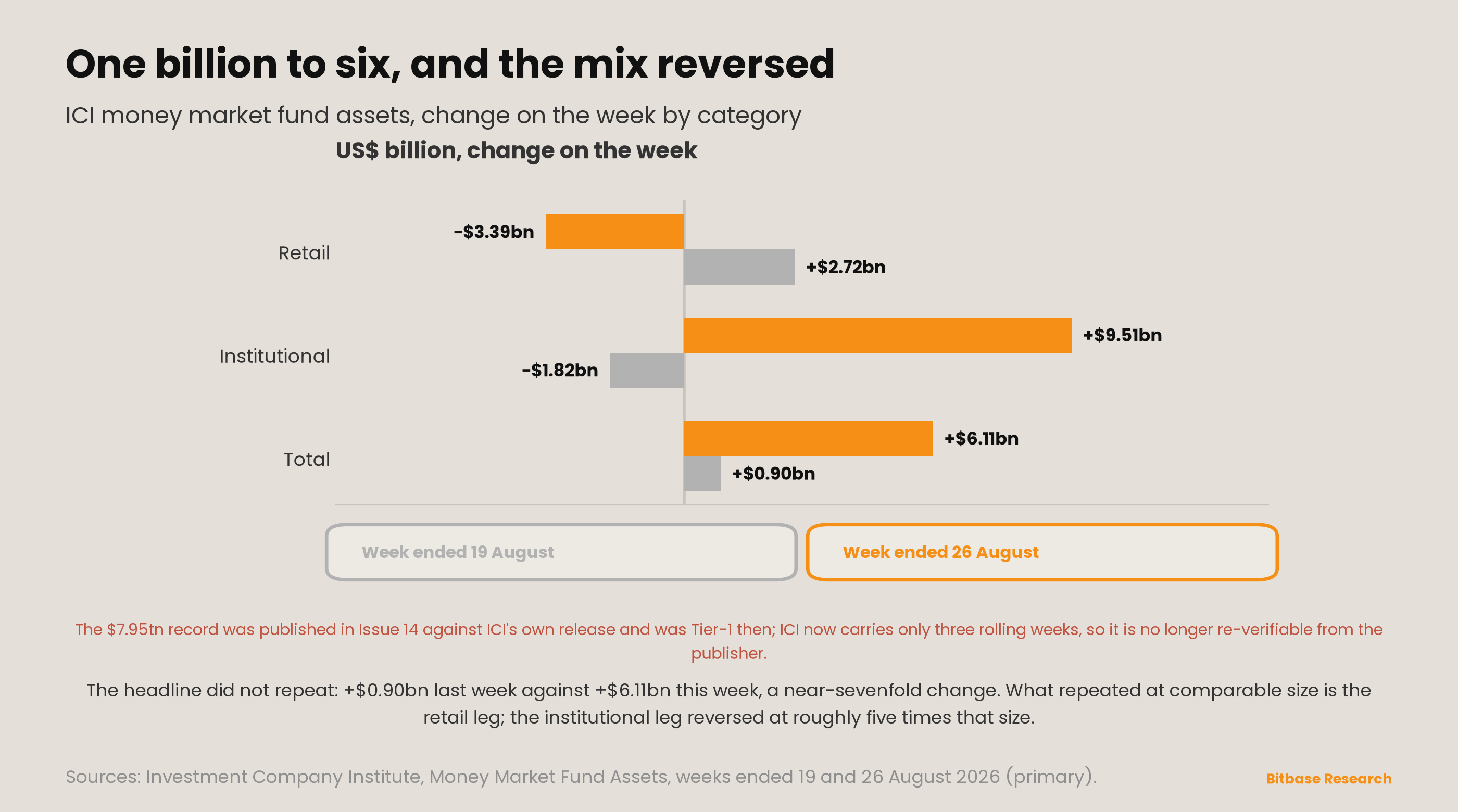
SIGNAL — Deep Dive 1 Part 1: "MMF asset scale inflection point." STATUS: Still stalled, but the composition moved violently underneath a quiet headline. Per the Investment Company Institute, total money-market-fund assets rose $6.11bn to $7,934.59bn for the week ended Wednesday, August 26; government funds added $6.31bn, prime lost $834m, tax-exempt added $633m [27]. Retail assets fell $3.39bn to $3,102.81bn while institutional rose $9.51bn to $4,831.79bn—both legs reversing the signs they carried last week at comparable size [27]. Issue 18 reported retail up $2.72bn and institutional down $1.82bn, summing to the +$0.90bn headline it printed. The headline itself did not repeat: +$0.90bn last week against +$6.11bn this week, a near-sevenfold change. What repeated at comparable size is the retail leg, which reversed from +$2.72bn to −$3.39bn; the institutional leg reversed at roughly five times that size, from −$1.82bn to +$9.51bn. One correction to our own reading: last week's figures reconcile exactly against ICI's current table, with no revision. One correction to the provenance of a number this series carries. The $7.95tn record was first published in Issue 14, not Issue 16, and it was Tier-1 when published — against ICI's own release for the week ended July 8. What is true now is narrower: ICI's page carries only a rolling three-week table and its spreadsheet refused retrieval, so the record is no longer independently re-verifiable from the publisher, and the distance-to-record inherits that.
SIGNAL — Deep Dive 1 Part 6: "CME crypto-derivatives open interest." STATUS: RETIRED, and staying retired. This issue neither revives it nor reopens the gap count.
SIGNAL — Deep Dive 1 Part 6: "Whether the CFTC licenses more venues for perpetual-swap-style products." STATUS: A fifth answer, and it required no Commission action at all. On August 27 KalshiEX LLC self-certified five crypto perpetual futures contracts—AAVEPERP, ADAPERP, BNBPERP, VVVPERP and WLDPERP—all recorded as Certified on the CFTC's own designated-contract-market product register [28]. Across roughly 314 in-window product filings by all DCMs, those five were the only perpetual filings [28]. There is still no second onshore licensee. What changed is breadth on the incumbent, obtained through the self-certification path, which the Commission does not have to approve. Issue 18 recorded a Chairman publicly pre-committing to build a regime if Congress stalls; that statement was August 20, outside this window. The CFTC's own press-release index carries one release inside the window, an enforcement order unrelated to perpetuals [28]. The Federal Register enumeration at [3] cannot support that negative and is not cited for it: the Federal Register does not publish agency press statements.
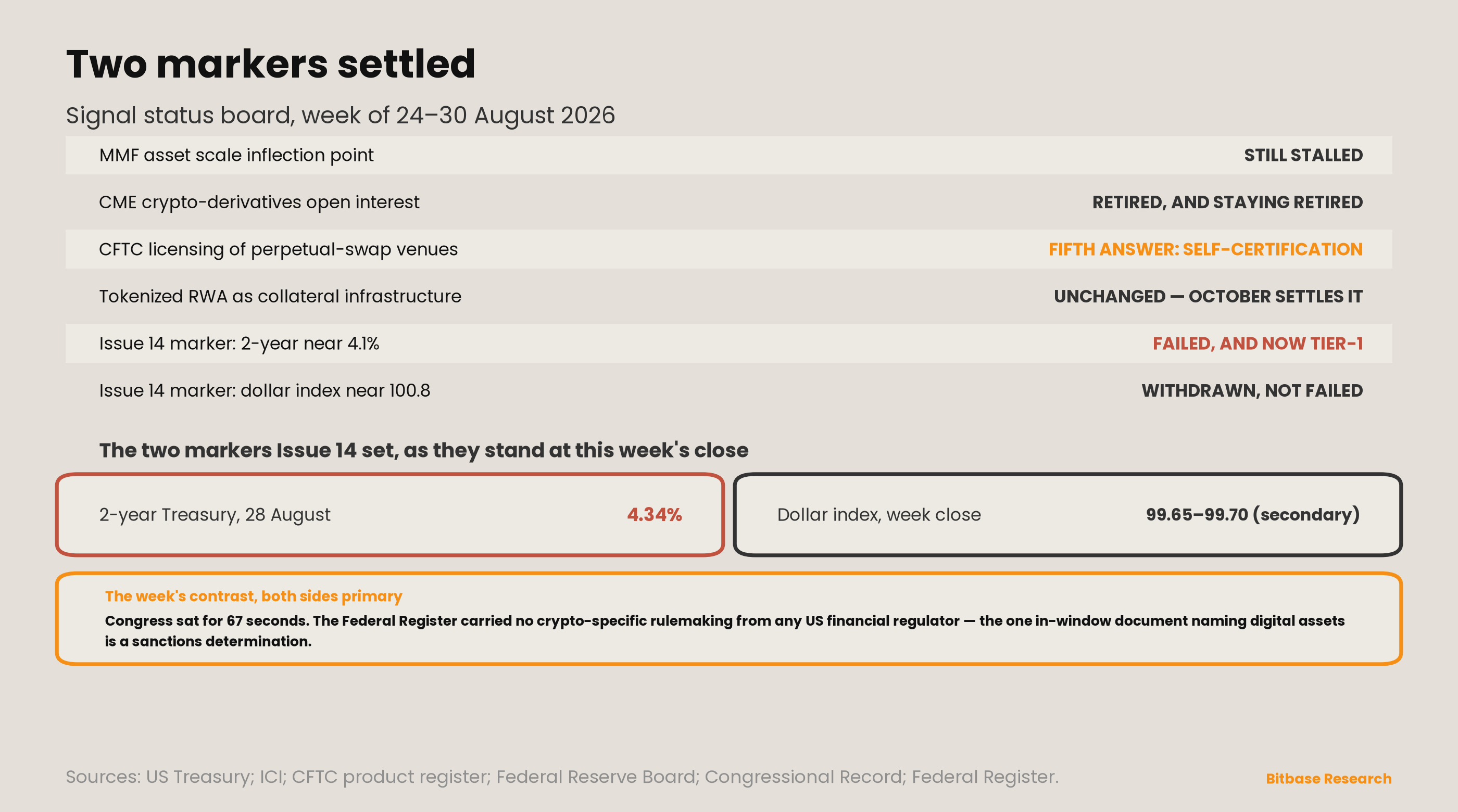
SIGNAL — Deep Dive 1 Parts 3 and 6: "Tokenized RWA as common collateral infrastructure." STATUS: Unchanged; October settles it. No new DTCC disclosure inside the window. One measurement note for the record: the tokenised-RWA market size is published at $44.7bn by Token Terminal, $38.74bn by rwa.xyz and $31.5bn by Dune for the same week, because the three scope commodities, equities and stablecoins differently [29]. They are not three estimates of one quantity and must not be netted or averaged.
New dimension—the symposium on payments whose keynote never said the word
The Kansas City Fed chose financial innovation and payments as the organising theme of the 2026 Jackson Hole symposium. The Chair's keynote does not contain the word. Not stablecoin, not payment, not payments, not digital. The one appearance of "token" is in the artificial-intelligence sense—model access tokens, cited at more than $100bn of annualised sales for the two leading labs, up 500-plus percent [24].
The absence is the Chair's, not the symposium's, and the distinction matters: the symposium produced more on this subject than any recent central-bank gathering. Four substantive positions went on the record on August 28 alone, each sourced to the speaker's own publication, and they do not agree.
Darrell Duffie's paper rejects both instruments for the job. "Stablecoins and tokenized commercial bank deposits are unsuitable for multi-trillion-dollar core-market infrastructure applications such as clearinghouse margin payments and financing government securities," it argues, offering four alternatives for safe cash settlement and dismissing retail central bank digital currency as unlikely to "support wallets that are sufficiently large for financial-market applications" [30].
Isabel Schnabel's ECB remarks take the opposite side on tokenised deposits and put the central bank inside the system rather than beside it. "Central banks need to go on-chain too," she said. "That means bringing central bank money into the tokenised environment." On stablecoins: "best understood as complements to central bank money, not substitutes for it." She named live Eurosystem infrastructure—Project Pontes, linking DLT to TARGET settlement, and Project Appia [31].
Pablo Hernández de Cos, for the BIS, attacked stablecoins on singleness. "Ben owns USDT (Tether), but Marie only accepts USDC (Circle)... this transaction may not go through at par. There is no mechanism that enforces singleness" [32]. His division of labour gives tokenised deposits the bulk of day-to-day payments and wholesale settlement, leaving stablecoins specialised roles such as decentralised lending pools [32].
And the paper on the international monetary system was co-authored by an employee of a stablecoin issuer. "Financial Innovation and the International Monetary System," presented by Eswar Prasad, is co-written with Gordon Liao of Circle Internet Financial and Tony Zhang; it reports combined USDC and USDT circulation rising from $4.7bn in January 2020 to $263bn in December 2025, and argues tokenisation could "increase the private sector demand for U.S. Treasuries" [33]. That is not a conflict to be scored, but it is a fact a reader should hold while reading the paper's conclusions about dollar demand.
The new dimension is what this implies for how this series reads Federal Reserve communication. The Board gave exactly one speech in the whole of August 2026, and it is this one [34]. Its only press release in the window concerned an enforcement action against a former bank employee [34]. When an institution speaks once a month, the topics it declines to raise carry as much information as the ones it does—and this month the institution convened the world's monetary officials on payments and used its single speech to talk about inflation instead.
Caveats
The ETF track is the weakest-sourced material here, and the weakness is structural, not circumstantial. No primary source for ETF flows exists: issuers publish net assets and shares outstanding, not creations and redemptions. Farside Investors and SoSoValue both returned HTTP 403 to automated retrieval; CoinGlass loaded but rendered every data field as "Last update: —"; Fidelity's FBTC page served no fund data [11][12]. Every flow figure in Section 3 is a news outlet relaying an aggregator. This issue publishes them at secondary tier rather than omitting them. Where a primary source does exist—net assets and shares outstanding at BlackRock's own iShares pages—this issue uses it and labels it separately [16][19].
A correction to a claim that circulated widely this week and that this issue declines to repeat. August 27 was reported as the day US spot bitcoin ETF net assets "crossed $100 billion." It is a re-crossing from below during a recovery, not a first. Read as a milestone, it would mislead.
Two reconciliation problems inside the flow data. Four of the five bitcoin sessions show a $0.1m disagreement between the published daily total and the sum of that same table's own per-fund columns; only August 24 reconciles exactly [13]. And the August 27 ether session is published at $225.8m by Farside and $235m by SoSoValue, roughly $9m apart. That single session accounts for essentially the whole of the weekly disagreement, which runs $815.7m on a Farside basis against $824m to $824.4m depending on which relay of SoSoValue you read [14][17]. Both bases are reported; neither is chosen, and the residual few hundred thousand dollars is rounding rather than a second dispute.
Two primary domains would not serve this issue directly. kansascityfed.org returned HTTP 403 and home.treasury.gov timed out; the symposium agenda and Treasury press material were read through a text-extraction proxy applied to the exact primary URL, and Duffie's paper was confirmed at its own kansascityfed.org address [30]. The content is primary; the retrieval path was not, and this issue records that rather than presenting a clean fetch.
Three figures this issue could not verify to Tier-1 and does not upgrade. CME's own FedWatch tool was not reached, so the September hike repricing is carried at secondary with unstated snapshot times [25]. ICI's $7.95tn record for the week ended July 8 is not confirmable from ICI's own table, which carries only three rolling weeks. And no exchange settlement price for the dollar index was reachable, so the Issue 14 dollar leg stays withdrawn rather than failed.
Two attributions this issue deliberately does not make. Treasury publishes the par yield curve at daily close only, so nothing here claims the August 25 buyback operation caused that day's low at the thirty-year. And the OFAC determination of August 24, which named digital assets among five sectors under Executive Order 13902 as part of a campaign against Iran, has been described elsewhere as a first for the sector; three independent legal readers of the same document simply list it as one of five new sectors, so this issue reports the determination and not the superlative [35][36].
Related reading
Other Bitbase articles on this topic:
Disclaimer: This article is market commentary from Bitbase Research, provided for information only. The views are those of Bitbase Research as of the date of writing and do not constitute investment, trading, tax, or financial advice, nor an offer or solicitation to trade. Data in this issue is current as of August 30, 2026; markets and disclosures may change, so refer to the latest information from authoritative sources. Trading crypto assets and leveraged products carries significant risk, including the possible loss of your capital.
References
[1] Congressional Record, Senate proceedings, August 24 and August 27, 2026. congress.gov
[2] Congressional Record, Public Bills and Resolutions, August 24 and August 27, 2026. congress.gov
[3] Federal Register, documents published August 24–30, 2026, by agency. federalregister.gov
[4] SEC, Regulation Crypto Assets, Release Nos. 33-11434 and 34-106150, File No. S7-2026-27, published August 21, 2026. federalregister.gov
[5] US Treasury, GENIUS Act Regulations on Payment Stablecoin Issuance, Offer, and Sale, published August 18, 2026. federalregister.gov
[6] US Treasury, Daily Treasury Par Yield Curve Rates, August 2026. home.treasury.gov
[7] Coinbase Exchange, BTC-USD daily candles, August 24–30, 2026. exchange.coinbase.com
[8] Binance, USDT-M perpetual open interest and funding history, BTCUSDT and ETHUSDT, August 24–30, 2026. binance.com
[9] Bybit, linear perpetual open interest and funding history, BTCUSDT, August 24–30, 2026. bybit.com
[10] Coinpedia, liquidation totals for August 28, 2026, citing CoinGlass. coinpedia.org
[11] Farside Investors, Bitcoin ETF flow tables. farside.co.uk
[12] SoSoValue, US spot bitcoin and ether ETF flow dashboards. sosovalue.com
[13] TFTC, daily US spot bitcoin ETF flow tables, August 24–28, 2026. tftc.io
[14] FinanceFeeds, US spot ether ETF net inflows, August 27, 2026. financefeeds.com
[15] CryptoTimes, bitcoin ETF nine-session streak and August 28 reversal. cryptotimes.io
[16] iShares, iShares Bitcoin Trust ETF fund page, as of August 28, 2026. ishares.com
[17] Farside Investors, Ethereum ETF flow tables. farside.co.uk
[18] COINOTAG, ether ETF ten-session streak, citing SoSoValue. coinotag.com
[19] iShares, iShares Ethereum Trust ETF fund page, as of August 28, 2026. ishares.com
[20] Strategy Inc, Form 8-K filed August 24, 2026, covering August 17–23, 2026. sec.gov
[21] Strategy Inc, Form 8-K filed August 31, 2026, covering August 24–30, 2026. sec.gov
[22] Strategy Inc, Free Writing Prospectus filed August 24, 2026 under Rule 433. sec.gov
[23] US Treasury, Tentative Schedule of Treasury Buyback Operations, August 2026 Quarterly Refunding. home.treasury.gov
[24] Kevin Warsh, In Our Time, remarks at the Jackson Hole Economic Policy Symposium, August 28, 2026. federalreserve.gov
[25] Rio Times, September rate-hike odds after the Jackson Hole keynote. riotimesonline.com
[26] US Treasury Fiscal Data, Treasury Securities Buybacks operations dataset. fiscaldata.treasury.gov
[27] Investment Company Institute, Money Market Fund Assets, week ended August 26, 2026. ici.org
[28] CFTC, Industry Filings: Designated Contract Market Products register. cftc.gov
[29] Crypto Times, tokenized RWA market size citing Token Terminal, August 27, 2026. cryptotimes.io
[30] Darrell Duffie, Tokenized Finance and The Perimeter of Central Banking, August 22, 2026. kansascityfed.org
[31] Isabel Schnabel, Central banks on-chain, Jackson Hole, August 28, 2026. ecb.europa.eu
[32] Pablo Hernández de Cos, Pushing the monetary frontier: stablecoins and tokenised deposits, August 28, 2026. bis.org
[33] Gordon Liao, Eswar Prasad and Tony Zhang, Financial Innovation and the International Monetary System, August 2026. kansascityfed.org
[34] Federal Reserve Board, speeches and press releases index, August 2026. federalreserve.gov
[35] US Treasury, Operation Economic Outcast press release, August 24, 2026. home.treasury.gov
[36] OFAC, determination under Executive Order 13902 pursuant to 31 CFR 560.802, published August 27, 2026. federalregister.gov