Issue 24 closed on share sales back in the buyer's funding and a thirty-year that had held above 5.50% through a full calendar, and asked whether the level would hold through a week without one. It held for that week and broke in the next, and the share sales shrank while the buybacks of the company's own preferred grew [1][2][9]. This issue covers two weeks, October 5 to 18, because there was no issue on October 12.
The single most useful fact in this issue is what the buyer bought. The two filings that cover September 28 to October 11 record 584 bitcoin for $50.2m and $368.7m of repurchases of the company's Stretch preferred [1][9]. On our arithmetic, that is $7.34 of preferred for every dollar of bitcoin. Share sales raised $15.7m and $21.0m, against $246.2m in the filing Issue 24 read [16]. USD Cash fell from $1.00bn to $640.5m. The second filing does not say how its $192.4m of repurchases was paid for; the balance fell by that amount plus the $0.5m it says went to bitcoin.
The long end set a new high and then turned. The thirty-year closed above 5.50% on every session of the first week, setting a 2026 high of 5.67% on October 7, and then fell to 5.43% by October 15, 24 basis points in five sessions [2]. The window's only top-tier release, the September CPI on October 14, showed prices up 0.6% on the month and 3.7% on the year [8]. The thirty-year fell 4 basis points that day and 9 the next, and the 2s30s spread went from 90 basis points to 66.
Bitcoin fell in both weeks and rose at both weekends. The contract lost 3.19% in the first week and 1.96% in the second, ending the window −5.09% at 82,078.00 after an intraday low of 79,732.30 on October 15, the lowest since September 18 [3]. Leverage split by venue for a third window: Binance open interest ended 3.74% lower and Bybit's 8.73% higher, and Binance printed four negative daily funding totals, the first of them its first since June 25 [4][5][6][7].
One more item completes the issue. Section 6 reads two crypto rulemakings from agencies outside the stablecoin law, the SEC and the CFTC, which take their boundaries from that law's definitions [11][12].
Two weeks of October 5 to October 18, 2026
Bitbase Research · October 19, 2026
The one chart that matters
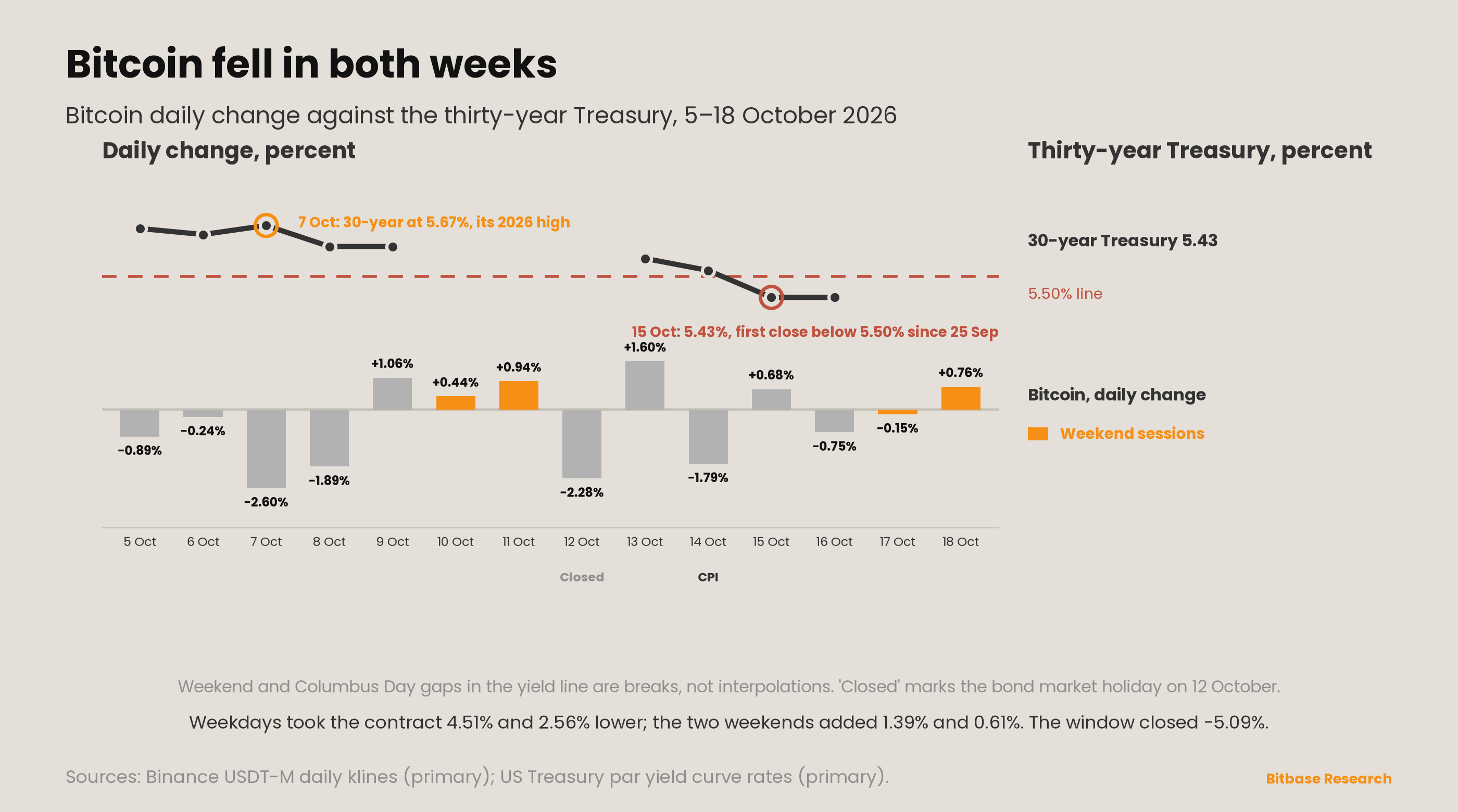
Daily closes for BTCUSDT perpetuals, USDT-margined futures, UTC, with the thirty-year Treasury par yield on the right axis and the 5.50% line marked [2][3]:
| Date (UTC) | Close | Session | Calendar | 30Y par yield |
|---|---|---|---|---|
| October 4 (prior close) | 86,482.80 | +2.09% | — | — |
| October 5 | 85,717.20 | −0.89% | — | 5.66 |
| October 6 | 85,507.50 | −0.24% | — | 5.64 |
| October 7 | 83,281.90 | −2.60% | — | 5.67 |
| October 8 | 81,711.00 | −1.89% | — | 5.60 |
| October 9 | 82,578.50 | +1.06% | — | 5.60 |
| October 10 | 82,941.00 | +0.44% | — | — |
| October 11 | 83,723.00 | +0.94% | — | — |
| October 12 | 81,813.40 | −2.28% | Bond market closed | — |
| October 13 | 83,125.70 | +1.60% | — | 5.56 |
| October 14 | 81,641.50 | −1.79% | CPI | 5.52 |
| October 15 | 82,195.40 | +0.68% | — | 5.43 |
| October 16 | 81,578.30 | −0.75% | — | 5.43 |
| October 17 | 81,455.90 | −0.15% | — | — |
| October 18 | 82,078.00 | +0.76% | — | — |
Bitcoin lost ground on the weekdays of both weeks and gained at both weekends [3]. On our arithmetic, the first week's five weekdays took the contract 4.51% lower and its weekend added 1.39%; the second week's weekdays took off 2.56% and its weekend added 0.61%. The four weekend sessions were also the four thinnest in the window, 37,033 to 96,831 bitcoin traded, against a weekday range of 109,022 to 220,199.
Issue 24 called its weekend gain one window, not a pattern, and the year's record still argues against one [3]. Five of the six weekend sessions since October 3 closed higher. Across 2026 to October 18, on our arithmetic, the 84 weekend sessions averaged −0.02% and the 207 weekday sessions +0.02%. Three weekends in a row is a run, not a finding, and section 7 says why this issue does not treat it as one.
The CPI day traded heavily around the release and closed lower [3][8]. The 12:00 UTC hour of October 14, which contained the 12:30 release, traded 29,006 bitcoin, the most of any hour that day; the session closed at 81,641.50, 2.14% below that hour's open. This describes the timing of one day, not a response to the data.
The right-hand axis held the line for a week and then left it [2]. The thirty-year closed at 5.66, 5.64, 5.67, 5.60 and 5.60 in the first week, and at 5.56, 5.52, 5.43 and 5.43 in the second; the bond market was closed on October 12 for Columbus Day. The 5.43% of October 15 is its first close below 5.50% since September 25. Bitcoin did not follow the long end in either direction: it fell in the week the thirty-year set its high and in the week the thirty-year fell 17 basis points. That is an observation about two weeks, not a claim that the two are unrelated.
This week's structural signal
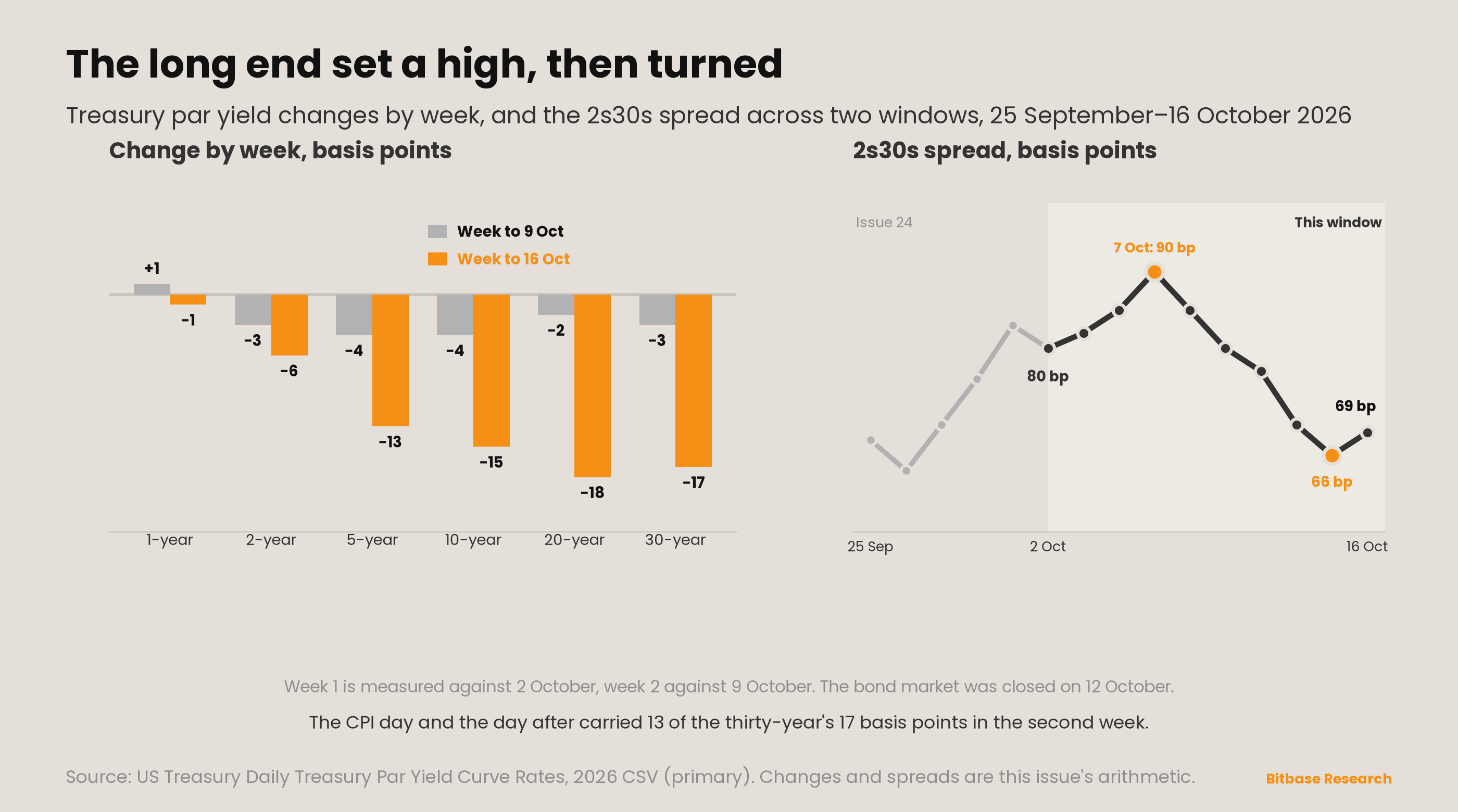
Change in basis points: the first week against the prior close of October 2, the second against October 9 [2]:
| 1Y | 2Y | 5Y | 10Y | 20Y | 30Y | |
|---|---|---|---|---|---|---|
| Week to October 9 | +1 | −3 | −4 | −4 | −2 | −3 |
| Week to October 16 | −1 | −6 | −13 | −15 | −18 | −17 |
| Window | 0 | −9 | −17 | −19 | −20 | −20 |
| Date | 2Y | 10Y | 30Y | 2s10s | 2s30s |
|---|---|---|---|---|---|
| October 2 (prior close) | 4.83 | 5.28 | 5.63 | 45bp | 80bp |
| October 5 | 4.84 | 5.31 | 5.66 | 47bp | 82bp |
| October 6 | 4.79 | 5.27 | 5.64 | 48bp | 85bp |
| October 7 | 4.77 | 5.28 | 5.67 | 51bp | 90bp |
| October 8 | 4.75 | 5.22 | 5.60 | 47bp | 85bp |
| October 9 | 4.80 | 5.24 | 5.60 | 44bp | 80bp |
| October 13 | 4.79 | 5.21 | 5.56 | 42bp | 77bp |
| October 14 | 4.82 | 5.19 | 5.52 | 37bp | 70bp |
| October 15 | 4.77 | 5.10 | 5.43 | 33bp | 66bp |
| October 16 | 4.74 | 5.09 | 5.43 | 35bp | 69bp |
For two windows the long end did the rising; in the second week of this one it did the falling [2]. Issues 23 and 24 recorded a curve steepening from the back. The first week extended that: the ten-year set a 2026 high of 5.31% on October 5, and the twenty-year at 5.71% and the thirty-year at 5.67% set theirs on October 7, when the 2s30s spread reached 90 basis points, its widest since September 3. Yet the week ended close to where it began, with the two-year and the thirty-year each 3 basis points lower. The second week did the moving: the thirty-year fell 17 basis points, the twenty-year 18 and the two-year 6. A curve whose long end falls faster than its front end is flattening from the back, and the 2s30s spread closed the window at 69.
The CPI day and the day after carried most of the second week's move [2][8]. The September CPI rose 0.6% on the month after 0.4% in August, and 3.7% on the year against 3.4%; excluding food and energy it rose 0.3% and 2.6%, against 2.4% a month earlier. Gasoline rose 9.1%, which the Bureau of Labor Statistics says accounted for over half of the monthly increase. On the release day the two-year rose 3 basis points and the thirty-year fell 4; the next day the two-year fell 5 and the thirty-year 9. On our arithmetic, the two sessions together carried 13 of the thirty-year's 17 basis points in the week. A faster annual rate than August's, and a long end that fell 13 basis points across it and the following session, is a pairing this issue records without explaining.
Inside the one-year, yields moved the other way [2]. The one-month bill ended the window 8 basis points higher, after a 2026 high of 4.17% on October 15, and the three-month and six-month 7 higher each; the one-year was unchanged. On our arithmetic, six of the fourteen maturities in the Treasury's table set 2026 highs in the window, three bills in the second week and three long maturities in the first. The window's curve turned around the one-year: bills up, coupons down, the most at the longest maturities.
The structural reading changes [2][17][18]. The bear steepening of Issues 23 and 24 held for one more week and then reversed. One week of flattening from the back is not a new regime, and the data here cannot say whether it reflects the inflation report, a smaller premium for holding duration, positioning or supply. The window had no FOMC meeting, and its only top-tier release was the CPI.
Dual-track scoreboard
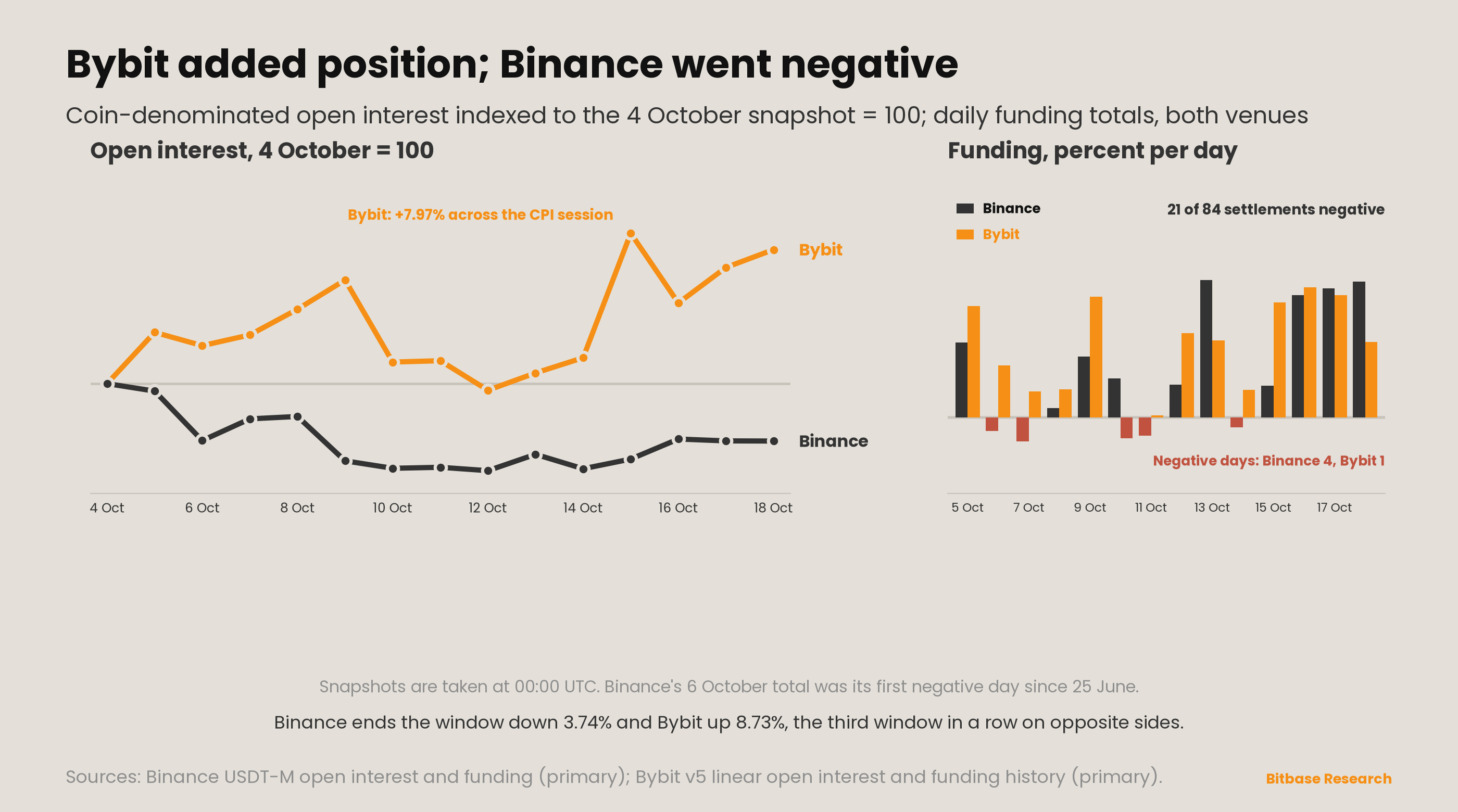
Coin-denominated open interest in BTCUSDT perpetuals, daily snapshots at 00:00 UTC [4][6]:
| Snapshot (00:00 UTC) | Binance (BTC) | Bybit (BTC) |
|---|---|---|
| October 4 (prior close) | 97,928 | 55,247 |
| October 5 | 97,452 | 57,092 |
| October 6 | 94,297 | 56,613 |
| October 7 | 95,681 | 57,000 |
| October 8 | 95,834 | 57,923 |
| October 9 | 93,004 | 58,976 |
| October 10 | 92,529 | 56,023 |
| October 11 | 92,593 | 56,071 |
| October 12 | 92,378 | 55,009 |
| October 13 | 93,419 | 55,631 |
| October 14 | 92,500 | 56,178 |
| October 15 | 93,117 | 60,656 |
| October 16 | 94,395 | 58,148 |
| October 17 | 94,276 | 59,427 |
| October 18 | 94,267 | 60,068 |
Binance ends the window 3.74% lower; Bybit 8.73% higher [4][6]. It is the third window in a row in which the two venues ended on opposite sides: in Issue 23 Binance fell and Bybit rose slightly, and in Issue 24 the reverse. Binance's decline came in the first week, 5.45% to the October 11 snapshot, with its largest step, −3.24%, across October 5; Bybit's rise came in the second, 7.13%, with its largest step, +7.97%, across October 14, the CPI session. The two venues moved in the same direction on eight of the fourteen daily steps, and because the count is in coins, each step is contracts opened or closed, not a revaluation.
Funding, summed across the three eight-hour settlements in each UTC day; window totals are summed from the unrounded settlements [5][7]:
| Date | Binance | Bybit |
|---|---|---|
| October 5 | +0.0101% | +0.0150% |
| October 6 | −0.0018% | +0.0070% |
| October 7 | −0.0032% | +0.0035% |
| October 8 | +0.0013% | +0.0038% |
| October 9 | +0.0082% | +0.0163% |
| October 10 | +0.0053% | −0.0028% |
| October 11 | −0.0024% | +0.0003% |
| October 12 | +0.0044% | +0.0114% |
| October 13 | +0.0185% | +0.0104% |
| October 14 | −0.0013% | +0.0037% |
| October 15 | +0.0043% | +0.0155% |
| October 16 | +0.0165% | +0.0175% |
| October 17 | +0.0174% | +0.0165% |
| October 18 | +0.0183% | +0.0102% |
| Window total | +0.0956% | +0.1285% |
Binance printed a negative daily total on October 6, its first since June 25, and three more after it [5]. The others came on October 7, 11 and 14; Bybit printed one, on October 10 [7]. Twenty-one of the eighty-four settlements were negative, sixteen of them in the first week, against nine of forty-two in Issue 24.
The second week paid more than the first on both venues [5][7]. Binance's total rose from +0.0174% in the first week to +0.0782% in the second, and Bybit's from +0.0432% to +0.0852%; Binance's last three days were three of its four highest in the window. On our arithmetic, per week, the window paid 59% of Issue 24's total on Binance and 109% on Bybit. Funding rose through a week in which the price fell: longs paid more to hold their positions, and the data does not say who they were.
What is absent from this scoreboard, and named rather than omitted: spot ETF daily flows, for the reason recorded in Issues 21 to 24 — this series has no primary retrieval path for them and does not source them second-hand.
On the radar—week of October 19 to October 25
First, what does the filing covering October 12 to 18 fund, and does it say how its preferred repurchases were paid for? As of this issue's data cut, 03:52 UTC on October 19, the filing does not exist; the most recent Form 8-K on the company's EDGAR index is the October 16 filing on Stretch dividends [10]. The filing covering October 5 to 11 stated the source of its bitcoin purchases and not of its $192.4m of repurchases [9]; the next one either states it or does not.
Second, does USD Cash print below $500m? It printed $640.5m as of October 11, after $833.4m a week earlier [1][9]. The balance is now disclosed to a tenth of a million dollars, so this question can be decided, unlike the one Issue 23 asked at $1.00bn.
Third, does the thirty-year close back above 5.50% on any session? It closed the window at 5.43% [2]. The next window has no FOMC meeting, which is scheduled for October 27 and 28, no top-tier release on the Bureau of Labor Statistics schedule, and no GDP or PCE release, which the Bureau of Economic Analysis has on October 29 [17][18][19]. The level broke in a week with data; the next window shows whether it returns in a week without.
Fourth, do Binance and Bybit open interest end the week on the same side of where they began? They have ended on opposite sides for three windows [4][6]. It is decidable from the same two endpoints, and a fourth split would make the divergence a standing feature rather than a repeated one.
Fifth, does a document implementing the GENIUS Act reach the Federal Register, or does any of the five comment periods move? None did in this window [21]. The same Federal Register query will answer both, and this series will report the documents and their dates, not their contents, until there is a final rule.
Signal tracking update
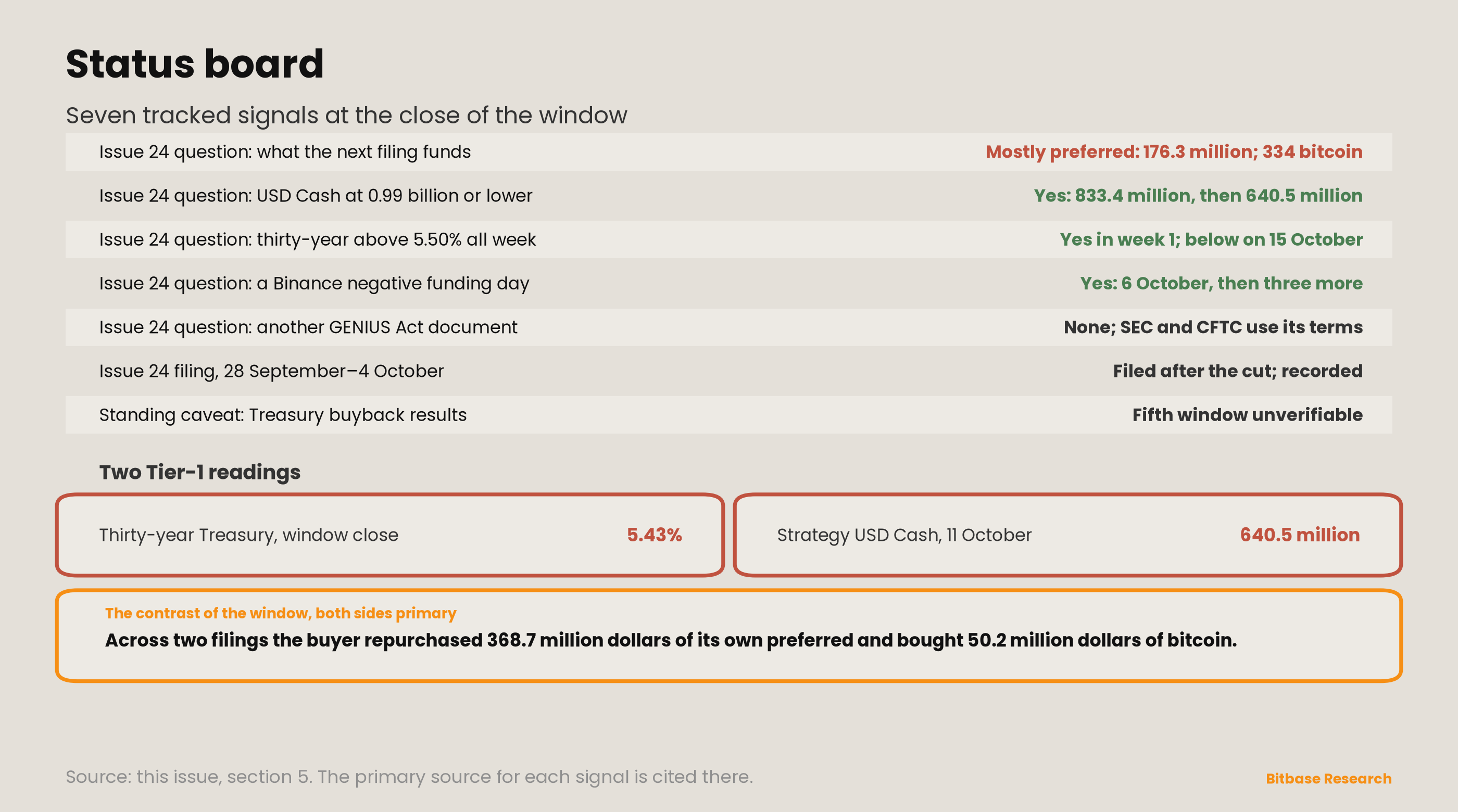
Issue 24's radar asked five questions about the week of October 5 to 11. All five settle on that week. The second week was not asked about; where it matters it is reported beside the answer, not scored. After them, one item Issue 24 could not report is recorded.
First, what did the filing covering Issue 24's window fund, and with what? Mostly the company's own preferred, from USD Cash; and some bitcoin, from share sales and USD Cash together [1]. Strategy's filing for September 28 to October 4 reports two sub-periods. From September 28 to 30 there were no share sales and no bitcoin purchases, and 1,033,168 Stretch shares were repurchased for $102.6m, $80.4m of it from USD Cash and $22.2m from interest earned on the company's cash, cash equivalents and short-term investments. From October 1 to 4, 92,894 shares of common stock raised $15.7m, and 334 bitcoin were bought for $28.7m, with $15.7m from those sales and $13.0m from USD Cash; a further 740,634 Stretch shares were repurchased for $73.7m from USD Cash. Holdings as of October 4 were 848,000 bitcoin. On our arithmetic, the three batches of repurchases in the two filings averaged $99.31, $99.51 and $99.58 a share [1][9]; the October 16 filing says management will recommend holding Stretch's dividend rate at 12.00% "until STRC has demonstrated sustained, healthy trading near $100 per share", and declares daily dividends for November that are payable only if a special meeting on October 28 approves the change [10]. Issue 24 set out three outcomes — stay with share sales, return to USD Cash, or buy nothing — and the filing did the first two at once. The question is settled on its own measure; the framing was narrower than the outcome.
Second, did USD Cash print $0.99bn or lower? Yes: $833.4m as of October 4, and $640.5m as of October 11 [1][9]. Both filings print the balance in millions, to one decimal place, where the filing Issue 24 read printed $1.00bn [16]. On our arithmetic, $833.4m plus the $167.1m the October 5 filing says USD Cash paid, $154.1m to repurchases and $13.0m to bitcoin, is $1,000.5m: if nothing else moved the account, the September 27 balance sat half a million dollars above the line Issue 24 could not decide. STATUS: CONFIRMED. The filing for October 5 to 11 lists $0.5m of USD Cash spent, on bitcoin, while the balance fell $192.9m; on our arithmetic the difference equals that filing's $192.4m of Stretch repurchases to the tenth of a million.
Third, did the thirty-year stay above 5.50% on every session of a week without a top-tier release? Yes [2]. Readings 5.66, 5.64, 5.67, 5.60, 5.60; the 5.67% of October 7 is its high of 2026. STATUS: CONFIRMED. The second week, which no radar asked about, took it below the line: 5.43% on October 15, the day after the CPI. A level that held through a week without data and gave way in the week with data is recorded here as a sequence, not as a cause, and section 4 asks whether it returns.
Fourth, did Binance print a negative daily funding total? Yes — on October 6, at −0.0018%, its first since June 25 [5]. It printed three more, on October 7, 11 and 14, and Bybit printed one, on October 10 [7]. Issue 24 said a Binance negative day would make the reading one on two venues rather than one. It now is, and on Binance it came four times in nine days. STATUS: CONFIRMED.
Fifth, did another GENIUS Act rulemaking document reach the Federal Register? No document implementing the Act did [21]. The same query, run across the window, returned four documents that mention stablecoins, from FinCEN on October 5, the SEC on October 6, the NCUA on October 9 and the CFTC on October 13; none is issued under the Act [11][12][22]. STATUS: UNCHANGED. The SEC and CFTC documents borrow the Act's definitions, and section 6 reads where.
One item Issue 24 could not report is recorded here, as a completion rather than a correction. Issue 24 said that as of its data cut, 09:25 UTC on October 5, the filing covering its window did not exist [1]. That was true at the cut: EDGAR accepted the filing at 16:00 UTC the same day, six and a half hours later. Nothing Issue 24 stated changes, and its readings of the earlier filings stand; what the late filing contains is in the first two answers above. The cut stays where it is: a filing that arrives after it belongs to the next issue, which is why this issue's first question in section 4 is about a filing that does not yet exist.
New dimension—the stablecoin law's definitions reach other rulebooks
Issue 24 recorded three GENIUS Act documents and the dates on which the stablecoin law now runs. In this window two agencies that do not administer that law published crypto rulemakings that take their boundaries from it, and this section reads those boundaries and the dates, which the documents state on their face, not what the rules would require.
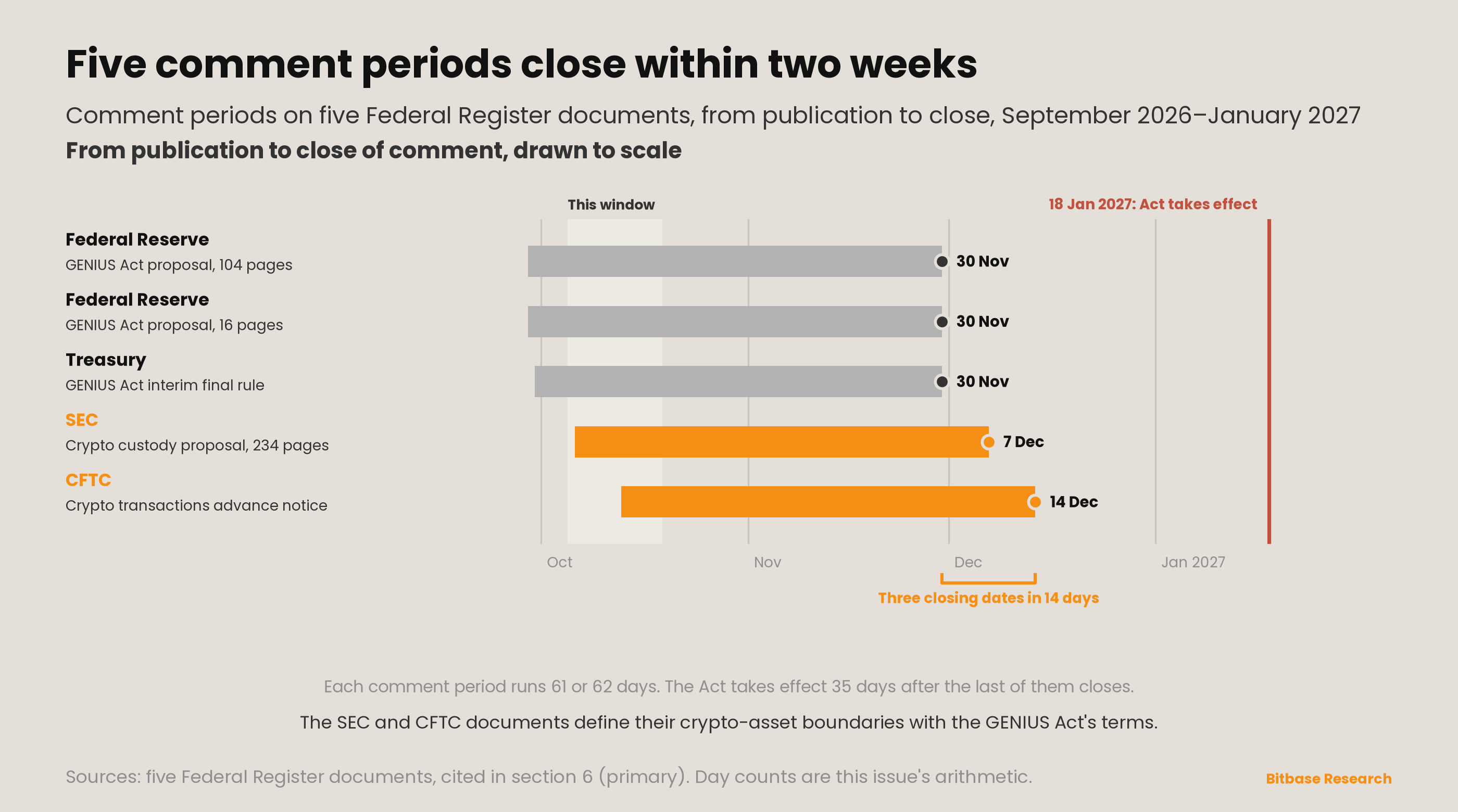
The SEC's proposal, published October 6, runs to 234 pages [11]. It would set new custody rules for regulated funds under the Investment Company Act and amend the custody rule for registered investment advisers, to cover crypto assets. Its definition of a crypto asset, in its own words, is "generally consistent with the definition of 'Digital Asset' in section 2(6) of the GENIUS Act". For the advisers' rule it lists payment stablecoins from permitted issuers beside cash, bank accounts and tokenized deposits as digital representations of funds. Comments are due by December 7, 2026.
The CFTC's advance notice, published October 13, runs to 30 pages [12]. It concerns section 2(c)(2)(D) of the Commodity Exchange Act, which requires leveraged, margined or financed retail commodity transactions to take place on a designated contract market unless they result in actual delivery within 28 days, and it states the Commission's intent to develop "fit-for-purpose rules" for such transactions in crypto assets. It says that "Any crypto asset, other than a 'payment stablecoin' issued by a 'permitted payment stablecoin issuer'", as the GENIUS Act defines those terms, could meet the definition of a commodity. Comments are due by December 14, 2026. An advance notice is the step before a proposal, not a proposal.
On our arithmetic, five comment periods now close within fourteen days of one another [11][12][13][14][15]. November 30 for the Federal Reserve's two proposals and Treasury's interim final rule, December 7 for the SEC and December 14 for the CFTC; each period runs 61 or 62 days from publication. The stablecoin law takes effect on January 18, 2027, 35 days after the last of them, as Treasury's rule states.
In both new documents a payment stablecoin from a permitted issuer falls on the cash side of the line [11][12]. For the CFTC it is outside the definition of a commodity; for the SEC's advisers' rule it is grouped with cash, bank accounts and tokenized deposits as a digital representation of funds. The status the stablecoin law grants an issuer is now also part of what decides which side of two other agencies' lines a token falls on, in the documents' own terms.
What this does not establish. It does not establish what either rule would require; this series has not read their substance and will not assess it before there is a final rule. It does not establish that the CFTC will propose rules at all, since an advance notice can end where it starts. It says nothing about stablecoin supply, which this series does not track. What it establishes is two more dated documents, two more deadlines, and a definition that has travelled from one statute into two other rulebooks.
Caveats
This issue reports two weeks as one window. Issue 24's questions are settled on the week they asked about, and the second week is reported but not scored. Where this issue compares itself with Issue 24's single week, it uses per-week figures, which are its own arithmetic.
Section 1's weekend run is three weekends, not a pattern. The year's record, in which weekend sessions averaged slightly less than weekday sessions, argues against reading one into it, and the weekend sessions were the thinnest of the window. This issue records the run as a fact about two windows' timing and volume, not as a judgement about how bitcoin trades.
Section 2's CPI accounting is arithmetic, not attribution. Summing changes by calendar day assigns a move to the day it happened on, not to the release published that day; other data, auctions, moves in other sovereign markets and positioning fall on the same days. The thirty-year's 2026 high came on a day with no top-tier release, which is a statement about the calendar's coverage as much as about the market.
The auction calendar remains the blind spot. Treasury publishes auction results on the host whose certificate chain does not verify on this machine, so this issue does not know which coupon auctions fell inside the window or how they cleared. Supply is one of the explanations for the long end's move that section 2 cannot exclude, in either direction.
Section 3's open interest counts contracts, not intentions. A fall on Binance and a rise on Bybit are compatible with positions moving between venues, with different participants on each, and with both; coin-denominated open interest cannot separate them. The negative days are small, the deepest −0.0032%, and are reported because they settle a question asked in advance, not because of their size.
Section 5's Strategy readings rest partly on this issue's arithmetic. The filing for October 5 to 11 does not state how its $192.4m of repurchases was funded; that the USD Cash balance fell by the same amount is a match, not a disclosure. The $1,000.5m balance assumes nothing else moved the account, and the per-share repurchase prices are averages of aggregate prices, not trades. The daily Stretch dividends declared on October 15 are payable only if a special meeting on October 28 approves the change [10].
Section 6 reads definitions and dates, not rules. The boundaries quoted are as the SEC and the CFTC state them in the Federal Register; this issue has not read the statutes themselves and does not assess what either document would require of any firm.
One quantity remains a standing limitation. Treasury long-end buyback results: five windows, and in this one the same stated mode — certificate chains that this machine's TLS library rejects on the TreasuryDirect and fiscal-data hosts, while the SEC's host verifies on the same path at the same time [20]. This is not evidence that no operation ran, and it will be restated each issue until the series has a verified retrieval path.
Related reading
Other Bitbase articles on this topic:
Disclaimer: This article is market commentary from Bitbase Research, provided for information only. The views are those of Bitbase Research as of the date of writing and do not constitute investment, trading, tax, or financial advice, nor an offer or solicitation to trade. Data in this issue is current as of October 18, 2026; markets and disclosures may change, so refer to the latest information from authoritative sources. Trading crypto assets and leveraged products carries significant risk, including the possible loss of your capital.
References
[1] Strategy Inc, Form 8-K filed October 5, 2026, accession 0001193125-26-413164, Item 8.01, period September 28–October 4, 2026. sec.gov
[2] US Treasury, Daily Treasury Par Yield Curve Rates, 2026 CSV download. home.treasury.gov
[3] Binance USDT-M futures, BTCUSDT klines, daily and hourly, UTC. fapi.binance.com
[4] Binance USDT-M futures, open interest history, BTCUSDT, daily. fapi.binance.com
[5] Binance USDT-M futures, funding rate history, BTCUSDT. fapi.binance.com
[6] Bybit, open interest, linear BTCUSDT, daily. api.bybit.com
[7] Bybit, funding rate history, linear BTCUSDT. api.bybit.com
[8] US Bureau of Labor Statistics, Consumer Price Index, September 2026, released October 14, 2026. bls.gov
[9] Strategy Inc, Form 8-K filed October 13, 2026, accession 0001193125-26-419726, Exhibit 99.1, period October 5–11, 2026. sec.gov
[10] Strategy Inc, Form 8-K filed October 16, 2026, accession 0001193125-26-423400, Item 8.01. sec.gov
[11] US Securities and Exchange Commission, proposed rule, Adviser and Regulated Fund Custody Rules; Crypto Custody Rules, Federal Register document 2026-20466, October 6, 2026. govinfo.gov
[12] US Commodity Futures Trading Commission, advance notice of proposed rulemaking, Regulation Crypto Asset Transactions and Regulation Crypto Asset Markets, Federal Register document 2026-20888, October 13, 2026. govinfo.gov
[13] Board of Governors of the Federal Reserve System, proposed rule, Implementing the Federal Reserve Board's Responsibilities Under the GENIUS Act, Federal Register document 2026-19860, September 29, 2026. govinfo.gov
[14] Board of Governors of the Federal Reserve System, proposed rule on application procedures for a subsidiary to issue payment stablecoins, Federal Register document 2026-19899, September 29, 2026. govinfo.gov
[15] US Treasury, interim final rule, Forms and Procedures for Review of State Certifications by the Stablecoin Certification Review Committee, Federal Register document 2026-19966, September 30, 2026. govinfo.gov
[16] Strategy Inc, Form 8-K filed September 28, 2026, accession 0001193125-26-403417, Item 8.01, period September 21–27, 2026. sec.gov
[17] Board of Governors of the Federal Reserve System, FOMC meeting calendars, 2026. federalreserve.gov
[18] US Bureau of Labor Statistics, schedule of selected releases, October 2026. bls.gov
[19] US Bureau of Economic Analysis, release schedule. bea.gov
[20] TreasuryDirect, buyback announcements and results by operation date; not retrievable over a verified connection from this machine, see section 7. treasurydirect.gov
[21] Federal Register, document search for "stablecoin", publication dates from September 1, 2026. federalregister.gov
[22] National Credit Union Administration, notice, Proposed Agency Information Collection Activities; Comment Request, Federal Register document 2026-20729, October 9, 2026. govinfo.gov