Buying ARKK does not buy you an index. It buys you a manager's current opinion, expressed as a portfolio that can change without notice and without a rulebook you can read in advance. That is the whole difference between this fund and the passive ETFs it sits next to on a screen, and almost everything else about how it behaves follows from it.
What Is the ARK Innovation ETF (ARKK)?
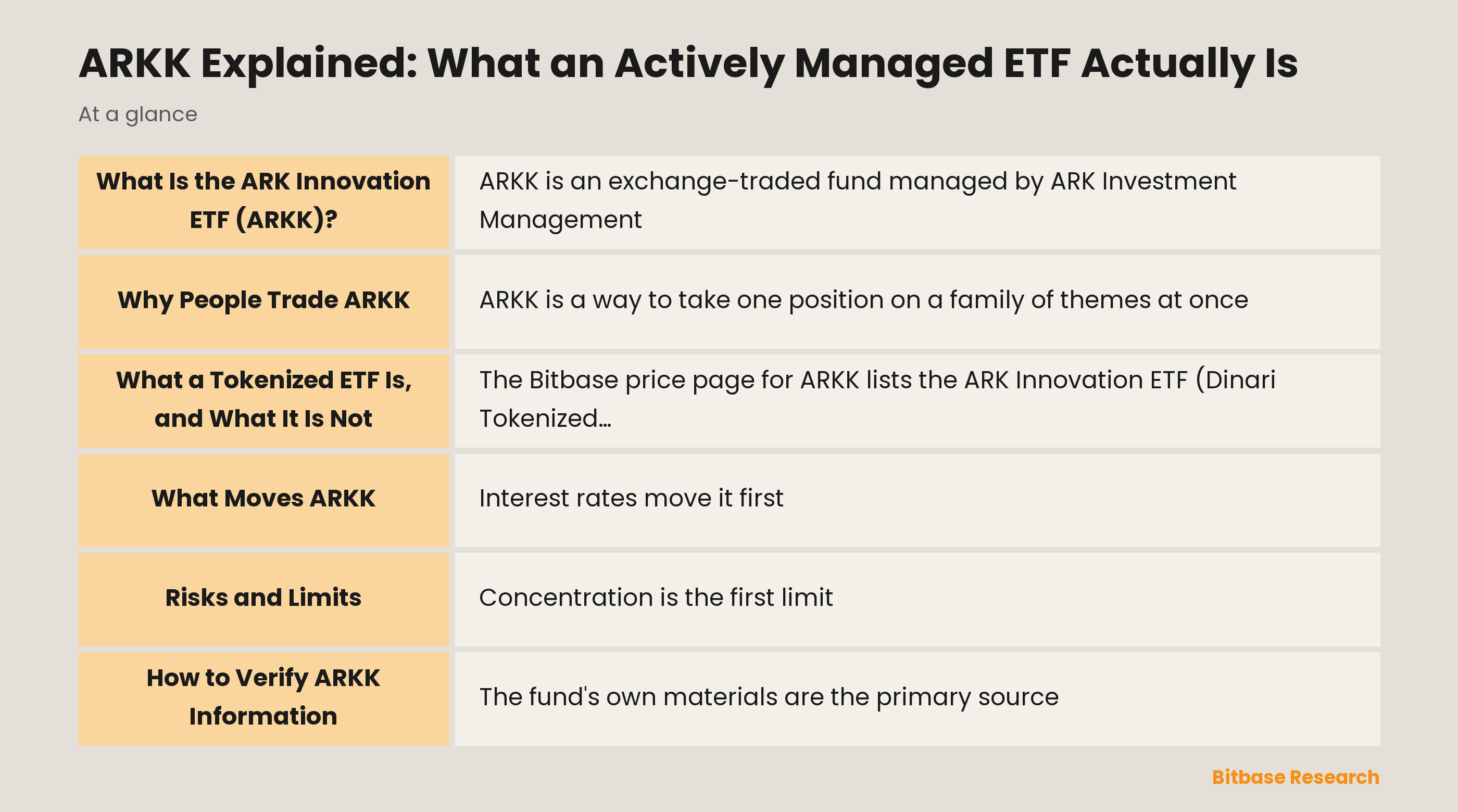
ARKK is an exchange-traded fund managed by ARK Investment Management. It is actively managed: there is no index behind it, no published rulebook determining what goes in and what comes out, and no rebalancing schedule you can anticipate. The manager decides, and the fund's composition is the record of those decisions.
Its stated focus is companies the manager judges to be exposed to disruptive innovation. That phrase is doing a lot of work, and it is worth reading as what it is: a thesis, not a screen. A passive fund's definition of its universe is mechanical — market capitalisation, sector code, index membership. An active fund's definition is a judgment, and the judgment can move.
The wrapper is still an ETF, so the mechanical parts behave the way ETF mechanics normally do. Shares are created and redeemed in blocks by authorised participants, that process is what keeps the market price near net asset value, and the fund trades on an exchange throughout the session rather than pricing once a day like a mutual fund.
Why People Trade ARKK
ARKK is a way to take one position on a family of themes at once. Someone who wants exposure to a cluster of high-growth, mostly unprofitable-early, long-duration companies can buy the fund instead of picking among them, and can do it in a single ticker.
It also behaves as a barometer. Because the portfolio concentrates in long-duration growth, the fund tends to amplify moves in risk appetite: it rises harder than the broad market in a risk-on stretch and falls harder when discount rates rise. Traders use it as a read on the environment as much as a position in it.
The third reason is concentration itself. Active management here has historically meant a relatively small number of holdings with meaningful position sizes, which is exactly what an investor is buying — and exactly what makes the fund unsuitable as a substitute for a diversified core holding. What the fund holds today is a question with a current answer, published by the manager; it is not a fact you should carry over from something you read last year.
What a Tokenized ETF Is, and What It Is Not
The Bitbase price page for ARKK lists the ARK Innovation ETF (Dinari Tokenized ETF). That naming matters, because three different objects are in play and only one of them is the fund.
The fund is a registered investment company whose shares are bought through a broker. Owning them makes you a shareholder of the fund, with whatever rights that carries.
A tokenized ETF is a token issued by a third party. Dinari describes its tokens as backed one-for-one by the underlying security, with issuance and redemption happening only after the corresponding brokerage order settles. Dividends reaching the issuer are calculated and distributed to holders, with a minimum threshold below which nothing is paid out. Dinari's own documentation states that the tokens have not been registered under the US Securities Act and may not be offered or sold to US persons, and it operates several trading sessions rather than one continuous market: regular US hours, extended pre- and post-market sessions, an overnight session, and a 24/7 session that covers only a limited set of tickers with thinner liquidity.
A perpetual futures contract is a third structure, and for this ticker it is worth naming precisely because it is absent: there is no ARKK perpetual on Bitbase. Where a perpetual does exist for a ticker, it holds nothing at all and tracks a price with leverage. For ARKK, the tokenized ETF page is the surface that exists.
The practical reading: a tokenized ETF gives economic exposure to a fund that itself gives exposure to a manager's decisions. Two layers of someone else's judgment sit between the token and the companies.
What Moves ARKK
Interest rates move it first, and they move it more than they move the broad market. The fund's holdings tend to be companies whose value sits far out in the future, and the present value of distant cash flows is the part of a valuation most sensitive to the discount rate. A repricing of rate expectations hits this portfolio before it hits an earnings number.
Manager decisions move it second, and this is the driver that has no equivalent in a passive fund. A change in conviction can shift the portfolio's exposure without any news about the fund itself. The published holdings are the only way to see it, and reading them is not optional for anyone holding the fund.
Single-name news moves it third, disproportionately. Concentration means one holding's earnings or regulatory event can move the whole fund in a way that would be invisible inside a broad index.
Flows move it fourth and least visibly. Persistent inflows or outflows in a concentrated fund interact with the liquidity of the underlying positions, and that interaction is a real cost that never appears as a line item.
Risks and Limits
Concentration is the first limit. This is not a diversified holding, and treating it as one is the most common error made with thematic funds generally.
Style risk is the second. A fund built around one thesis will underperform for as long as that thesis is out of favour, and "out of favour" can last longer than most holding periods.
The tokenized wrapper adds its own layer. A token depends on the issuer's structure, its eligibility rules and its redemption terms, and those are set by the issuer rather than by the fund or the exchange. Session structure matters too: a token that trades outside the fund's own market hours can move on news with the primary market shut, and the 24/7 session covers only some tickers and carries thinner liquidity.
Fees compound quietly. An actively managed fund charges more than an index tracker, and over a long holding period the difference is not a rounding error.
How to Verify ARKK Information
The fund's own materials are the primary source: the prospectus states the objective, the strategy and the fee, and the manager publishes the fund's holdings on its own schedule. Read the holdings before assuming what the fund is exposed to; in an actively managed fund that is the only reliable answer.
For the tokenized instrument, the issuer's documentation is the authority on backing, dividends, sessions and who may hold it. It is a separate document from anything the fund or the exchange publishes, and it answers different questions.
For what exists on Bitbase for this ticker, the price page is the reference, and the tokenized stock lineup shows which tickers carry a spot market or a perpetual as well. Not every ticker has a spot market or a perpetual, and the absence of one is not a promise that it is coming.
Conclusion
ARKK is an actively managed, concentrated, long-duration equity fund in an ETF wrapper, and on Bitbase it appears as a tokenized ETF rather than as a share of the fund. Each of those words costs something: active means you are buying judgment, concentrated means single names matter, long-duration means rates matter more than earnings, and tokenized means an issuer's structure sits between you and the fund. None of that makes it a bad instrument. It makes it a specific one, and worth understanding before it is sized.
Related market pages
Bitbase pages for the tokenized stocks named in this article:
- ARKK: View price
Related reading
Other Bitbase articles on this topic:
- BAC Stock Explained: Lending, Trading and the Token
- Bullish Stock (BLSH): An Exchange, an Index, and a Media Business
- Bitdeer (BTDR): The Bitcoin Miner That Builds Its Own Chips
- How to Trade MSTR: Strategy and Its Bitcoin Balance Sheet
Disclaimer: This article is educational content from Bitbase Academy, provided for information only. It explains what a company or fund does and how the instruments referenced here differ from one another; it does not constitute investment, trading, tax, or financial advice, and it is neither a recommendation nor an endorsement of any security, token, or trading strategy. A tokenized stock is issued by a third party and is designed to give economic exposure to an underlying asset: it is not a share, it carries no shareholder rights, and it depends on the issuer's structure, eligibility rules, and redemption terms, which the issuer can change. Perpetual futures are leveraged derivatives that hold no underlying asset and can be liquidated, and trading hours, product availability, and eligibility differ by instrument and by jurisdiction and can change at any time. Written as of September 2026; verify everything yourself through company filings, the issuer's own documentation, and the product pages of the venue you trade on.
References
[1] ARK Innovation ETF fund page: prospectus, objective, fee and the manager's own holdings disclosure www.ark-funds.com
[2] Dinari documentation: what a tokenized share is, backing, sessions and who may hold it docs.dinari.com
[3] SEC investor bulletin on ETFs: creation and redemption, NAV and how ETFs differ from mutual funds www.sec.gov