Average True Range (ATR) is a technical indicator that measures market volatility. It shows how much an asset typically moves over a selected period, but it does not predict whether price will move up or down.
What the ATR measures
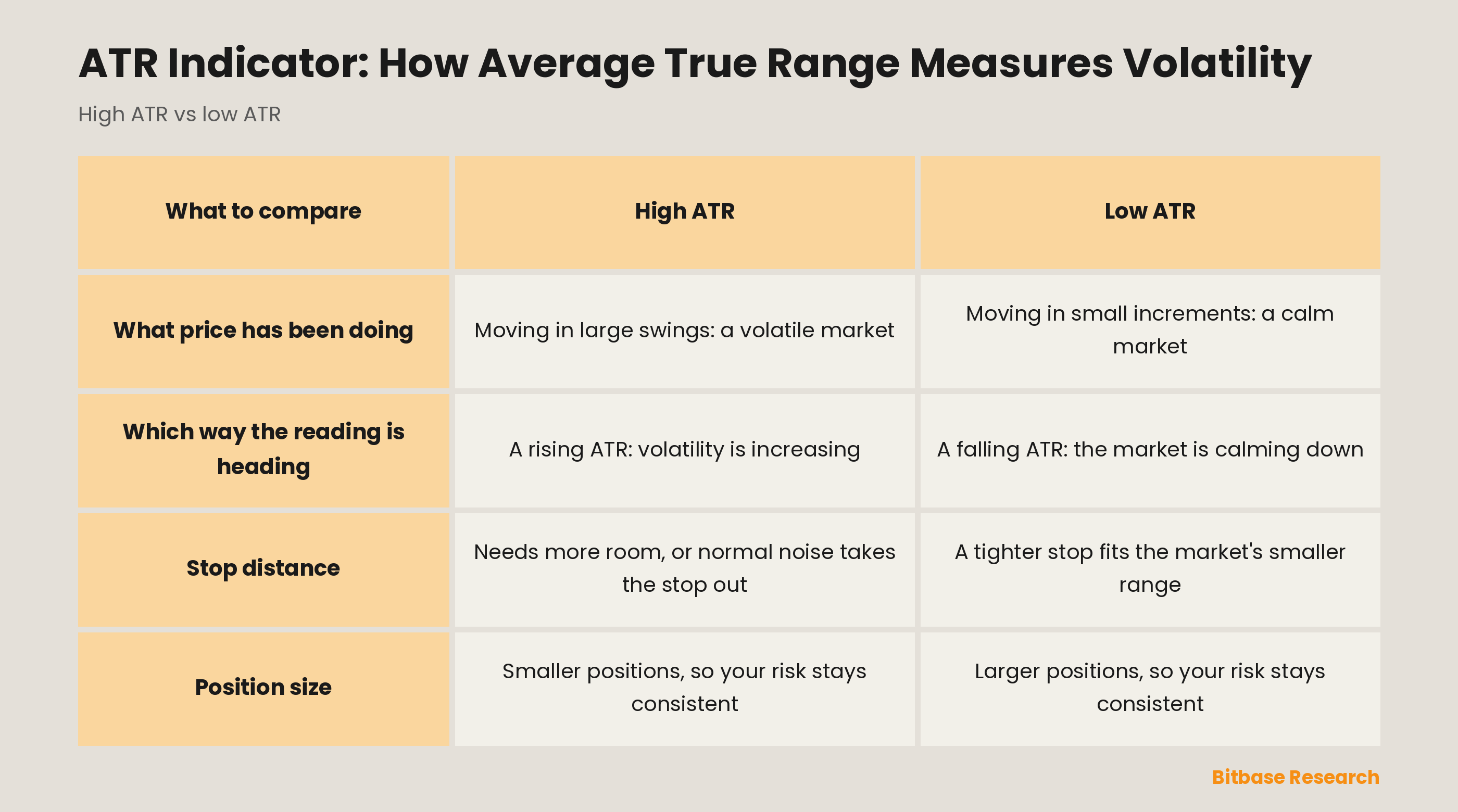
The ATR, or average true range, measures volatility, the size of price movements, without regard to direction. A high ATR means price has been moving in large swings, a volatile market; a low ATR means it has been moving in small increments, a calm one. It does not tell you whether price is going up or down, only how far it tends to travel in a given period. That makes it a pure gauge of how active a market is.
What true range is
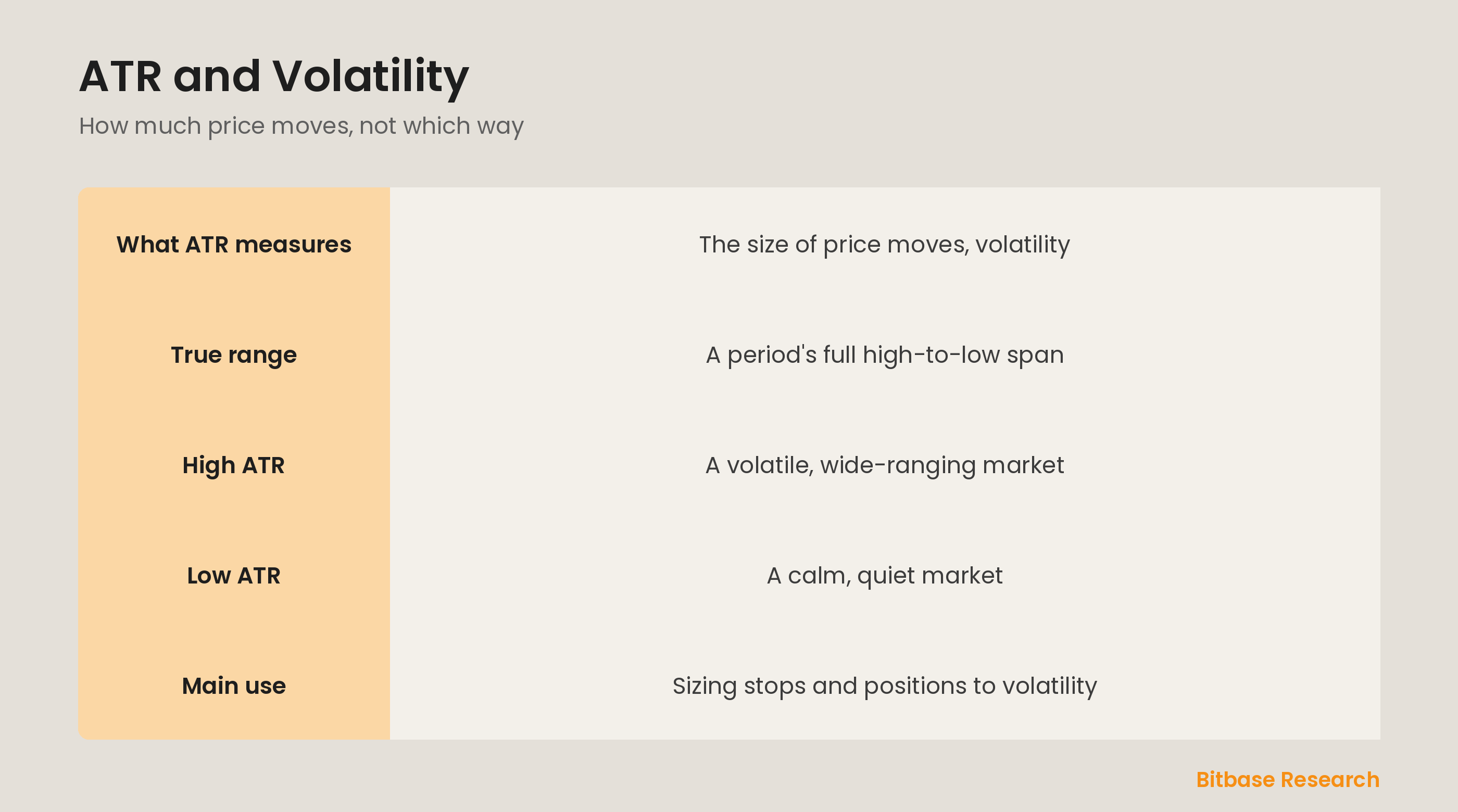
The ATR is built from the true range of each period. True range is the full extent of a period's movement, measured as the largest of three spans: the current high to low, or the distance from the prior close to the current high or low. This captures the whole move including any gap from the previous close, which a simple high-minus-low can miss. The ATR is then just an average of true range over recent periods, smoothing it into one figure.
Reading ATR levels
The ATR is read in the price units of the asset, not on a fixed 0 to 100 scale, so what counts as high or low is relative to the market and its price. What matters is the trend and comparison: a rising ATR means volatility is increasing and the market is getting more active, while a falling ATR means it is calming down. Comparing the current ATR to its recent range tells you whether conditions are unusually turbulent or quiet right now.
Using ATR for stops and sizing
The ATR's most practical use is risk management. Because it measures how much price typically moves, it helps you set stops at a sensible distance: a stop placed too tight for a volatile market gets hit by normal noise, while one scaled to the ATR gives the trade room to breathe. The ATR also guides position sizing, letting you take smaller positions when volatility is high and larger ones when it is low, so your risk stays consistent.
High ATR vs low ATR
The bottom line
The ATR, or average true range, measures volatility, how much price moves, not its direction, by averaging the true range of recent periods, which captures each period's full span including gaps. A high ATR means a volatile market and a low ATR a calm one, read relative to the asset rather than a fixed scale. Its most practical use is risk management, sizing stops and positions to the market's volatility so your risk stays steady. To keep learning the fundamentals, follow more from Bitbase Academy.
Frequently asked questions
What does ATR mean?
ATR stands for average true range. It measures volatility, meaning how far an asset typically travels over a chosen period, by averaging the true range of recent periods. It says nothing at all about whether price will go up or down.
Does high ATR mean price will fall?
No. A high ATR only says the market has been moving in large swings; the move can be up or down. The ATR is a pure gauge of how active a market is, which is why it is used for sizing risk rather than for picking a direction.
What ATR period is commonly used?
There is no single correct period. A shorter window puts fewer periods into the average and reacts faster to a change in volatility, while a longer window is smoother and slower, so match the window to the horizon you actually trade.
How is ATR different from ADX?
The ATR measures volatility, how far price moves, and is read in the price units of the asset rather than on a fixed scale. The ADX is read on a fixed 0 to 100 scale and measures trend strength. A market can be very volatile with no trend at all, so the two answer different questions.
Related reading
Other Bitbase articles on this topic:
- Parabolic SAR Indicator Explained
- SMA vs EMA: Which Moving Average to Use
Disclaimer: This article is educational content from Bitbase Academy, provided for information only. It does not constitute investment, trading, tax, or financial advice. Crypto assets are volatile; assess your own risk. Written as of June 2026; refer to the latest official information.
References
[1] Investopedia, "Average True Range (ATR): Definition and Formula" investopedia.com
[2] Investopedia, "Volatility: Meaning in Finance and How It Works" investopedia.com
[3] Investopedia, "Technical Analysis: What It Is and How to Use It" investopedia.com