No coin is listed on a stock exchange, and the reason is not that anyone is running late. A listing admits a security that an issuer applied for, and a coin has no issuer to apply. What does exist are three connections between the two markets, and a rulebook that governs one side of the line and not the other. This page maps both.
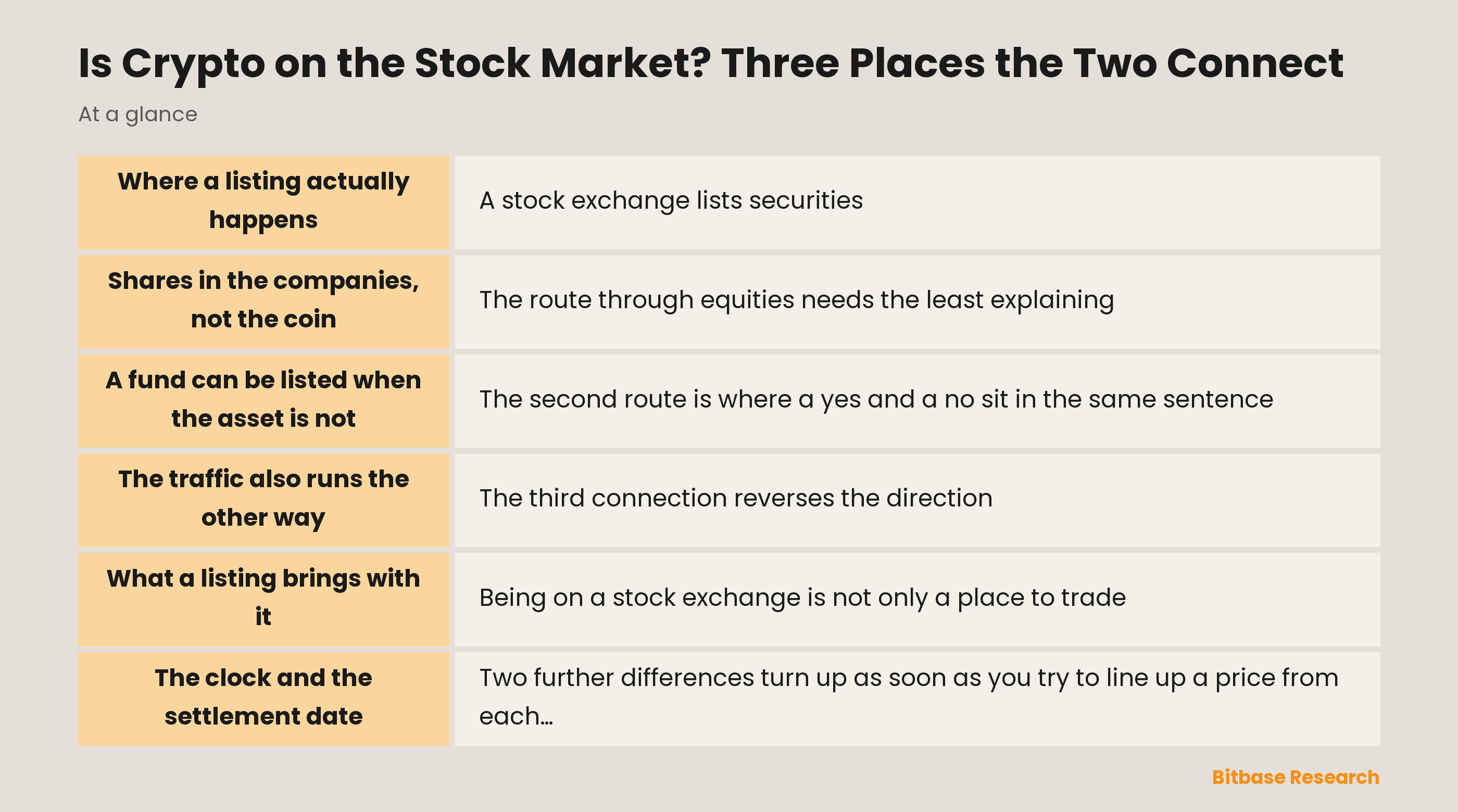
Where a listing actually happens
A stock exchange lists securities. A company applies, meets the standards the exchange publishes, and its shares are admitted to trading under a symbol. Every step has a named party on the other side of it: an issuer that files, an exchange that reviews, and a regulator that had to approve the standards being applied.
A coin has none of those parties behind it. There is no company to submit an application for bitcoin, no board to sign the filing, and no set of accounts for an exchange to review. The question of when a coin will list on a national securities exchange has no procedure behind it to be waiting on.
Coins trade on crypto venues and on the chains themselves, and neither of those is a securities exchange. That is the short answer. The longer one is that money crosses between the two markets at three points, and at two of them something genuinely is listed.
Three places the two markets touch
| Route | What the exchange admitted | What the holder ends up with |
|---|---|---|
| Shares in crypto companies | The company's own equity | A claim on a business |
| Crypto exchange-traded funds | Fund shares | A share in a fund that holds the asset |
| Tokenized stocks and index funds | Nothing; the instrument lives on a chain | Whatever the issuer's terms grant |
Read the middle column before the other two. In the first two rows a security really was admitted to an exchange and the crypto part sits behind it. In the third row nothing was admitted anywhere, and the traffic runs in the opposite direction.
Shares in the companies, not the coin
The route through equities needs the least explaining. Exchanges, miners, treasury companies and payment firms are ordinary listed companies whose results depend on crypto, and their shares trade in the ordinary way, in a session, under a symbol the exchange assigned.
Buying one of them puts a business between you and the asset. The share carries a power bill or a payroll, a share count that management can increase, and a queue of creditors ahead of shareholders, none of which the coin has. What the label covers and what each group of companies is actually exposed to is a question about crypto stocks rather than about the coin itself.
A fund can be listed when the asset is not
The second route is where a yes and a no sit in the same sentence. In January 2024 the SEC approved the listing and trading of a number of spot bitcoin exchange-traded product shares, and the statement announcing it drew the line in the same breath: the Commission approved the listing and trading of those shares, and it did not approve or endorse bitcoin.
What became tradable on an exchange was fund shares. The bitcoin behind them is held in custody for the fund and is still listed nowhere. So a fund can turn up in a brokerage account, in a stock screener and on a ticker tape while the asset it holds stays outside all three.
How the share price stays tied to the bitcoin the fund holds is a mechanism in its own right, built out of creation and redemption baskets rather than out of the exchange listing. It is worth reading before treating the fund and the coin as one holding, because the two can diverge and the reasons they diverge are specific.
The traffic also runs the other way
The third connection reverses the direction. Instead of bringing crypto onto an exchange, it brings exchange-listed exposure onto a chain, as a token that references a listed name.
Index funds show the shape of it, because a single one of them stands in for a whole market rather than for one company. A fund you would normally buy through a brokerage account can also appear as a SPY price page and as a SPY perpetual contract on a crypto venue, and the same is true of the QQQ price page beside it. The symbol is familiar; the instrument underneath it is not the fund share.
What a tokenized symbol entitles its holder to is set by whoever issues it, and the issuers behind these pages have not built the same product as each other. Not all of them are backed one for one by the underlying, the trading week differs from one issuer to the next, and dividends are handled in different ways. The tokenized stock and ETF pages show which names have which surfaces, and identifying the issuer behind a name is what settles which set of terms applies to it.
What a listing brings with it
Being on a stock exchange is not only a place to trade. It is admission to a rulebook, and four of its provisions have no counterpart on the crypto side.
Admission is itself one of them. A company gets onto an exchange by meeting the standards that exchange publishes, and regulated exchanges are in turn required to have rules designed to prevent fraud and manipulation. A token can be created and traded with no step of that kind in front of it.
Then there are market-wide circuit breakers. Declines of 7%, 13% and 20% in the S&P 500 trigger three levels of halt: the shallower two pause trading for fifteen minutes when they hit before 3:25 in the afternoon, and the deepest closes the market for the remainder of the trading day.
Individual stocks get price bands as well. Under limit up-limit down, a stock has a band set as a percentage above and below its average price over the preceding five minutes, the band doubles during the opening and closing periods, and a trade outside it does not happen.
Liquidity is assigned rather than hoped for. One designated market maker is attached to each security listed on the New York Stock Exchange, with obligations to maintain a fair and orderly market in it. All four provisions are administered by the exchange that admitted the security, which is exactly what a coin lacks: with no admitting venue, a halt on one platform leaves every other platform trading.
The clock and the settlement date
Two further differences turn up as soon as you try to line up a price from each market.
The stock market has a closing price because it has a close. The New York Stock Exchange runs a closing imbalance period from ten minutes before four in the afternoon, then holds a closing auction at four. That auction is a scheduled event producing one price at one moment. Crypto runs 24/7, so a closing price for a coin is a cut-off somebody chose, and two data providers can choose different ones.
Settlement is the other. The SEC shortened the standard settlement cycle for most broker-dealer transactions in securities from two business days after the trade date to one, with a compliance date in May 2024. A transfer on a chain settles when the network confirms it. A share bought on a Friday and a coin bought on the same Friday are therefore in different states over the weekend.
What changes about a number you read
Once you know which side of the line a number came from, several familiar figures stop being comparable.
Market value is assembled differently on each side. Crypto market cap is a coin price multiplied by circulating supply, while a company's market capitalisation is a share price multiplied by shares outstanding, and the share count is set by a company that can issue more of them. Two figures with almost the same name are built from different inputs.
Yesterday's price is not the same kind of fact either. On the stock side it is the auction print. On the crypto side it depends on the cut-off, which is why the same coin can show two different daily closes on two different screens.
Exposure through a listed proxy carries an extra layer. A company that holds or mines a coin comes with that coin plus a business, so its share can fall on a day the coin rises, and the gap is the business rather than an error in either price.
The bottom line
Crypto is not on the stock market in the literal sense, because listing is something an issuer applies for and a coin has no issuer. The two markets meet in three other ways: shares in companies whose results depend on crypto, funds whose shares are listed while the asset they hold is not, and tokenized instruments that carry listed names onto a chain.
The difference that matters after that is the rulebook. Listing standards, circuit breakers, price bands, assigned market makers, a scheduled close and a settlement date all belong to the security and the exchange that admitted it, not to the asset underneath. Knowing which side a price came from tells you which of those applied to it. To keep working through the fundamentals, follow more from Bitbase Academy.
Related reading
Other Bitbase articles on this topic:
- How to Trade MA: Mastercard, the Network Behind the Card
- How to Trade MARA: A Bitcoin Miner That Also Holds Bitcoin
- How to Buy META: The Tokenized Stock and the Perpetual
- Liquidity Mining Dilution: Why the Same APR Pays You Less
- Why Selfie Verification Keeps Failing on a Crypto Exchange
Disclaimer: This article is educational content from Bitbase Academy, provided for information only. It does not constitute investment, trading, tax, or financial advice. Crypto assets are volatile; assess your own risk. Written as of September 2026; refer to the latest official information.
References
[1] SEC investor bulletin on market volatility safeguards: market-wide circuit breakers at declines of 7%, 13% and 20% in the S&P 500, and limit up-limit down price bands set as a percentage above and below the average price over the immediately preceding five-minute trading period www.sec.gov
[2] SEC press release 2023-29: the standard settlement cycle for most broker-dealer transactions in securities shortened from two business days after the trade date to one, with a compliance date of May 28, 2024 www.sec.gov
[3] Statement of the SEC Chair, Jan. 10, 2024: the Commission approved the listing and trading of a number of spot bitcoin exchange-traded product shares, did not approve or endorse bitcoin, and noted that such regulated exchanges are required to have rules designed to prevent fraud and manipulation www.sec.gov
[4] New York Stock Exchange, market model page: there is one designated market maker assigned to each NYSE listed security, and DMMs have obligations to maintain fair and orderly markets for their assigned securities www.nyse.com
[5] New York Stock Exchange, trading information page: the closing imbalance period runs from 3:50 p.m. to 4:00 p.m. ET and the closing auction is held at 4:00 p.m. ET www.nyse.com