A tokenized stock arrives wearing a company name, and the name is the part you already recognise. The part that decides what you hold is the issuer, and on Bitbase the issuer is named on every price page and stamped into some of the symbols. Four of them sit behind the tokenized stocks and ETFs listed there, and they answer the basic questions differently: whether a share is held against your token, how a dividend reaches you, and when the thing trades. Reading the symbol is the fastest way to find out which set of answers you have bought into.
The suffix is a signature
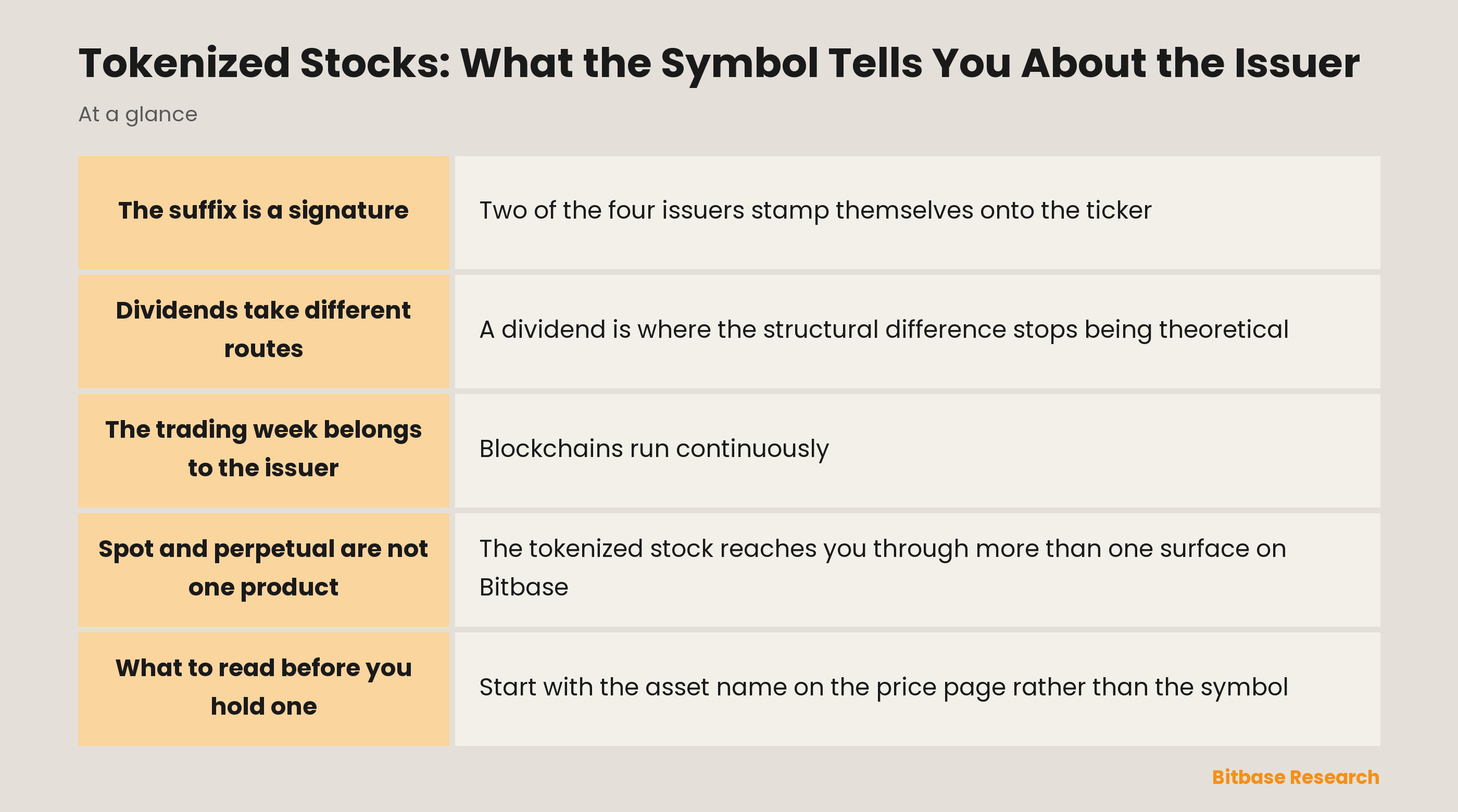
Two of the four issuers stamp themselves onto the ticker. An xStocks token carries an X on the end, so Tesla reaches you as TSLAX. An Ondo token carries ON, so NVIDIA reaches you as NVDAON. Nothing about the company has changed. The extra letters record who wrote the token, and whose terms travel with it.
The other two leave the ticker alone. Broadcom issued by Robinhood is written AVGO, and the SPDR fund issued by Dinari is written SPY — letter for letter the symbol the primary listing uses. When the symbol is silent the asset name is not: each price page names the issuer next to the company, which is why the name deserves a look before the price does.
That gives you two ways to identify an issuer, and you need both. A suffix tells you on sight. No suffix means you read the name.
Four issuers, four instruments
The reason this matters is that the four are not variations on one design. They differ on what stands behind the token and on what the token legally is.
| Issuer | What the token is | Backing | Trading week |
|---|---|---|---|
| Ondo | A tokenized stock built as a total return tracker | Not one token to one share | 24/5, with off-hours trading on a smaller set of tickers |
| xStocks (Backed) | A tokenized security issued by a Jersey company | 1:1, underlying held in regulated custody | 24/7 on-chain, per the issuer |
| Robinhood | A derivative contract between you and Robinhood | Underlying owned by Robinhood, held with a US-licensed institution | Monday 02:00 to Saturday 02:00 CET |
| Dinari | A dShare minted when a brokerage order fills | 1:1 with the security | US market sessions, plus an around-the-clock window on some tickers |
Ondo is where the plainest reading of the phrase breaks down. Its documentation states that one token does not necessarily represent the value of one share, and that the price of one token will not always match the price of the underlying asset. The product is a total return tracker: dividends are reinvested net of withholding tax rather than paid out, and Ondo states that holders do not receive shareholder voting rights, statutory information rights or other shareholder rights. Minting and burning are instant, and Ondo describes a buy or a sell as arriving in a single atomic transaction.
xStocks goes the other way on backing. Each xStock is backed 1:1 by the underlying asset held in regulated custody, and the tokens are issued by Backed Assets (JE) Limited, a Jersey company. Backed describes the token as exposure to, and a claim on, the value of the collateral rather than a claim on the rights attached to it, and redemption runs toward the issuer.
Robinhood differs in kind rather than in degree. It states that Classic Stock Tokens are derivative contracts between you and Robinhood, priced at the prices of the underlying securities without granting rights to them, and that the underlying assets are owned by Robinhood and held with a US-licensed institution. Your counterparty is the broker, and the share behind the quote is the broker's.
Dinari ties issuance to an order. A dShare is a token backed 1:1 by a security, commonly a US equity, and tokens appear or disappear only once the matching brokerage order has filled through Alpaca, so supply moves in step with a real trade rather than ahead of one.
Dividends take different routes
A dividend is where the structural difference stops being theoretical. Ondo reinvests it into the token rather than paying it out. Robinhood says it passes a corresponding amount on to eligible holders in cash. Dinari calculates and distributes once the underlying cash lands, with direct holders receiving USD+ and wrapped holders receiving the underlying dShare deposited into their wrapped position.
Three issuers, three different things landing in three different places. Where an issuer does not set its handling out in writing, that is a question to put to the issuer rather than a blank to fill in from someone else's answer.
Shareholder rights diverge the same way. Ondo states plainly that they are absent, and Robinhood states that its tokens grant no rights to the underlying shares or ETPs. For the other two the public documentation does not settle it, so the safe reading is that a token is not a registered shareholding until an issuer says otherwise in writing.
The trading week belongs to the issuer
Blockchains run continuously; tokenized stocks do not inherit that automatically. Each issuer sets its own week.
Ondo trades 24/5 and pauses for corporate actions and risk controls, with a smaller set of tickers also available in off-hours sessions. Robinhood defines its week precisely, from Monday 02:00 CET to Saturday 02:00 CET. xStocks is described by its issuer as tradeable 24/7 across chains, which is a statement about the token on-chain rather than about the hours of any particular venue.
Dinari splits the day: the regular US session, pre-market and after-hours windows that accept limit orders only, an overnight window on the same terms, and a separate around-the-clock window that runs on-chain, covers a subset of tickers and carries thinner liquidity. Outside regular hours a market order is converted into a marketable limit order, so it may fill completely, partly, or not at all.
The practical consequence is the seam. Anything that happens while the primary listing is closed has only one venue left to register in, and it registers there against whatever depth that venue happens to have at the time. How wide that window is depends on which issuer wrote your token.
Spot and perpetual are not one product
The tokenized stock reaches you through more than one surface on Bitbase, and those surfaces are separate instruments rather than views of one.
A spot market trades the token itself. For Tesla that is the tokenized stock spot market, whose pair name carries a B on the base symbol as an internal convention. Buying there leaves you holding the issuer's token, with everything above still true of it: the same backing, the same rights, the same week.
A perpetual futures contract has no issuer at all, so nothing in the table above applies to it: there is no backing to check and no issuer week to compare, because nobody has issued you anything. It tracks a price and settles in stablecoin, and what you carry instead is margin, a funding payment and a liquidation level. Both instruments can print the same number and still resolve differently. Which surfaces a given name carries is set out on the tokenized stock lineup.
What to read before you hold one
Start with the asset name on the price page rather than the symbol, because the issuer is spelled out there and the symbol may not carry it. Then match that issuer to its structure, which comes down to one question: is a share held against your token, or does your counterparty hold the asset and owe you a payoff?
Check the trading week against the session of the primary listing, and treat the gap as a feature of the product rather than an accident. Check how a corporate event reaches you: reinvestment, a cash payment and a token deposit are three different bookkeeping situations.
Then read the issuer's own documentation. A venue describes its market; only the issuer describes the claim, and the claim is what you hold. These tokens sit inside the wider family of tokenized securities, and the mechanics of real-world asset tokenization are worth having in view before the equity case starts to look familiar.
The bottom line
Tokenized stocks are not one instrument with four brands on it. The suffix, or its absence and the name beside it, points at an issuer, and the issuer decides whether a share is held against your token, whether a dividend arrives and in what form, whether any shareholder right survives, and when the market is open. Ondo does not promise one token per share; Robinhood writes a contract rather than holding one for you; xStocks and Dinari both back one for one and still differ in how and when they trade. Read the symbol, then the issuer, and only then the price.
Related reading
Other Bitbase articles on this topic:
- How to Buy MSFT: Three Segments Behind One Ticker
- How to Trade MSTR: Strategy and Its Bitcoin Balance Sheet
- How to Trade MU: Micron Memory, Spot and Perpetual Futures
- NFT Bid Scams and Fake Token Offers Explained
- Hammer and Shooting Star Candlesticks
Disclaimer: This article is educational content from Bitbase Academy, provided for information only. It does not constitute investment, trading, tax, or financial advice. Crypto assets are volatile; assess your own risk. Written as of September 2026; refer to the latest official information.
References
[1] Ondo Finance, Ondo Tokenized Stocks documentation, Overview docs.ondo.finance
[2] xStocks, official site xstocks.com
[3] Robinhood Europe, UAB, Invest product pages for the European Union robinhood.com
[4] Dinari, documentation, What is a dShare docs.dinari.com
[5] Dinari, documentation, Trading Hours docs.dinari.com
[6] Dinari, documentation, Dividend Payments docs.dinari.com