A trading competition publishes two lists that look alike and are not. One says which trades the counter does not add up. The other says which behaviour gets a participant disqualified. Reading the first as an accusation, or the second as a technicality, is the mistake that gets people into trouble, and the distinction generalises far beyond any single event.
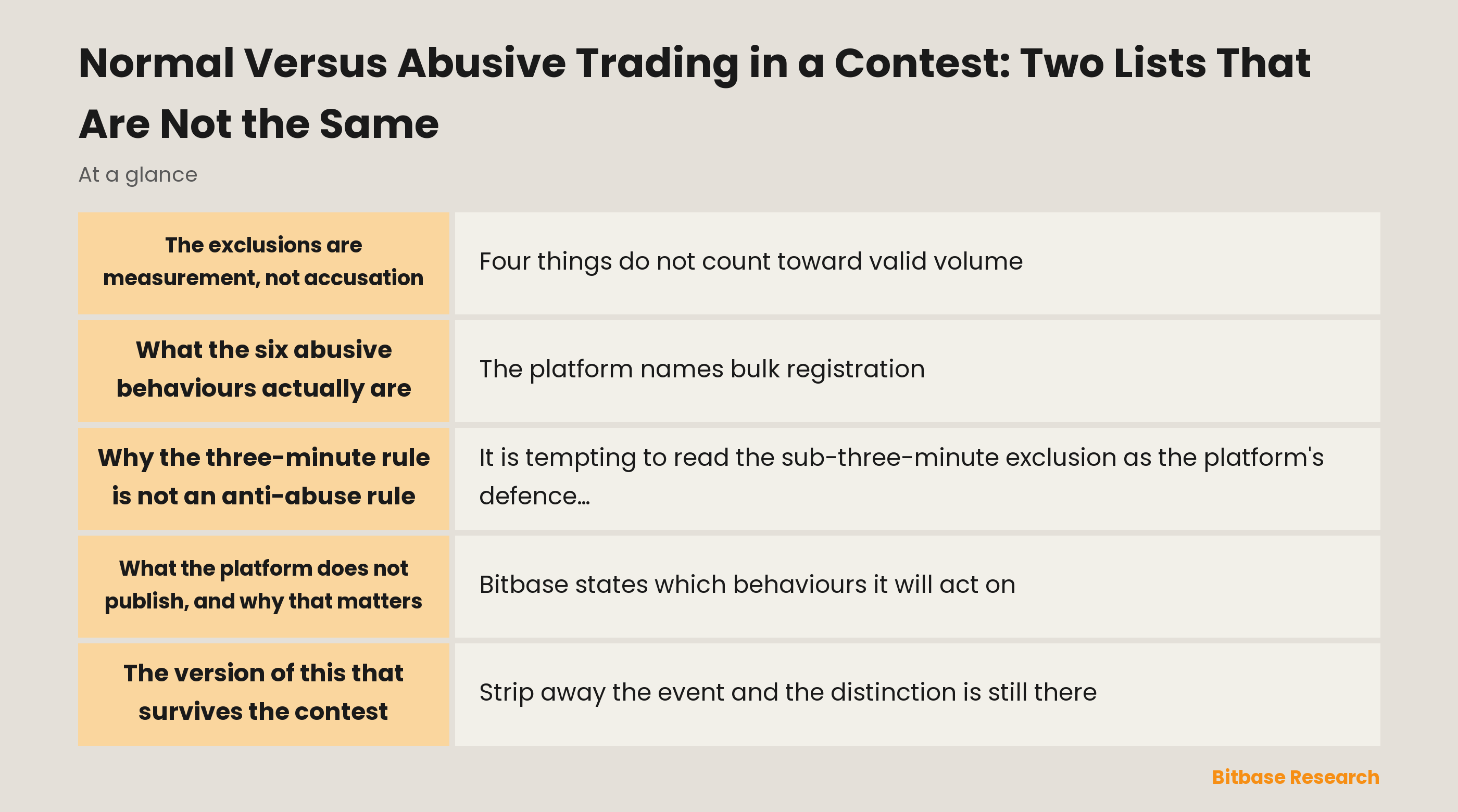
Two lists, two different jobs
Bitbase's dual leaderboard competition states both of them. Rule nine lists four categories of trade that are not counted as valid volume. Rule fourteen lists six kinds of conduct the platform describes as abusive and reserves the right to disqualify.
The first list is a definition of the measurement. The second is a definition of misconduct. Nothing on the first list is being called cheating, and nothing on the second becomes acceptable by being small. Keeping them apart is the whole of this article.
| Exclusions (rule nine) | Abuse (rule fourteen) | |
|---|---|---|
| What it describes | What the volume counter ignores | What gets a participant removed |
| Doing it is | Ordinary trading that simply does not score | Grounds for disqualification and clawback |
| Consequence | Your total is lower than you expected | Eligibility and rewards revoked |
The exclusions are measurement, not accusation
Four things do not count toward valid volume: API trades, orders with zero fees, volume generated using futures bonuses or futures trial funds, and orders held for less than three minutes.
Every one of those is a legitimate way to trade. API access is how most systematic traders work. Zero-fee orders exist because the fee schedule creates them. Bonus-funded positions are positions the platform itself handed out. Closing inside three minutes is what a scalper does for a living, and what anyone does when a trade goes wrong immediately.
None of that is prohibited during the event. It simply does not accumulate toward the 50,000 USDT threshold or the ranking above it. A participant who trades through an API all day has not broken a rule; they have entered a contest whose scoreboard does not watch that channel. The practical effect is that a competition total and a trading volume figure on your own statement can differ substantially, and neither number is wrong.
The three-minute condition is the one that quietly matters most, because it is the boundary the sixth item on the abuse list runs into.
What the six abusive behaviours actually are
The platform names bulk registration, volume manipulation, multi-account arbitrage, reverse trading, high-frequency wash trading, and manipulation via emulators. Four of them share a single shape: manufacturing the appearance of activity without taking the risk that activity normally carries.
Wash trading is buying and selling the same instrument against yourself so that volume prints without a position ever really being held. Reverse trading does it across two accounts, one long and one short in the same size, so the pair nets to nothing while both sides print volume. Multi-account arbitrage spreads one person's activity across identities to collect a reward designed for many people. Bulk registration is the supply chain that makes the previous two possible.
The remaining two are different in kind. Volume manipulation is the general category the others are instances of. Emulator-based manipulation is automating a mobile client to imitate a human user, which is a way of doing any of the above at scale.
What unites them is not that they are clever. It is that they move a reward away from participants who took real risk toward someone who took none, which is the same reason wash trading and fake volume distort exchange rankings generally.
Why the three-minute rule is not an anti-abuse rule
It is tempting to read the sub-three-minute exclusion as the platform's defence against wash trading. It is not, and treating it that way leads to a bad conclusion.
The exclusion is a filter on what scores. It removes the cheapest way to inflate a total, which happens to be the same technique an abuser would reach for first, but it applies identically to an honest scalper who never intended to inflate anything. Someone whose strategy is genuinely short-holding is not accused of anything; their volume simply does not count here.
Conversely, holding a wash trade for four minutes does not launder it. The position would then clear the counting threshold and still be wash trading, still on rule fourteen's list, still grounds for disqualification. The counter and the conduct rule are independent tests, and passing one says nothing about the other.
That independence is the reason the two lists cannot be merged into a single mental rule of thumb. There is no threshold that makes manufactured volume legitimate, and no legitimate technique that becomes misconduct by being fast.
What the platform does not publish, and why that matters
Bitbase states which behaviours it will act on. It does not publish how it detects them, what thresholds it applies, or what the review process looks like. It reserves the right to revoke eligibility and rewards for suspected violations and to recover illicit gains, and it holds final interpretation of the event.
Two things follow. First, anyone claiming to know where the detection line sits is guessing, and a guess about an unpublished threshold is the worst possible basis for a decision. Second, the absence of a published threshold is not the absence of a rule: the conduct list is the rule, and it is written in behavioural terms precisely so that it does not depend on a number that could be gamed.
The honest summary is that a participant can know exactly what is prohibited and cannot know exactly what will be flagged. That asymmetry is uncomfortable and it is also the normal state of affairs for market-conduct rules generally, including the signals exchanges watch outside any competition.
The version of this that survives the contest
Strip away the event and the distinction is still there, because both halves of it exist in ordinary trading.
The measurement half becomes the general habit of asking what a number counts before comparing it to another number. Reported exchange volume, your own realised return, a strategy's backtested performance: each is defined by inclusions and exclusions, and two figures with the same name are frequently not the same quantity.
The conduct half becomes simpler still. Activity that only makes sense because someone is watching a scoreboard is activity with no independent reason to exist, and the risk that it will be judged against you does not go away when the scoreboard does. A trade worth making because of the position it creates is worth making either way; a trade worth making only because it prints is the one to look at twice.
The bottom line
Rule nine tells you what the counter ignores. Rule fourteen tells you what gets you removed. Trading through an API, taking zero-fee orders, using bonus funds or closing inside three minutes are all ordinary and all uncounted. Wash trading, reverse trading across accounts, multi-account arbitrage, bulk registration, volume manipulation and emulator use are none of them ordinary, and holding them longer does not fix them.
The full terms sit on the event page, and the rules explainer walks the thresholds and payouts in order. To keep learning the fundamentals, follow more from Bitbase Academy.
Related reading
Other Bitbase articles on this topic:
- Dual Leaderboard Competition: What the Standings Say Four Days In
- Inside Futures Team Pro: the Three Awards and How They're Shared
- Halftime Whistle: The Score So Far
- How Funding Payments Affect Your Profit and Loss on a Perpetual
- Floor Price Manipulation on Non-Fungible Token Marketplaces
Disclaimer: This article is educational content from Bitbase Academy, provided for information only. It does not constitute investment, trading, tax, or financial advice. Crypto assets are volatile; assess your own risk. Written as of September 2026; refer to the latest official information.
References
[1] Bitbase, dual leaderboard futures trading competition, official rules and event page www.bitbase.com