Search for the best crypto stocks to buy and what comes back is a ranking: a snapshot of how some companies looked the day it was written. Any of them can sell new shares, change what it does with its coins, or switch machines off the week after. What outlives the snapshot is the set of questions used to build it.
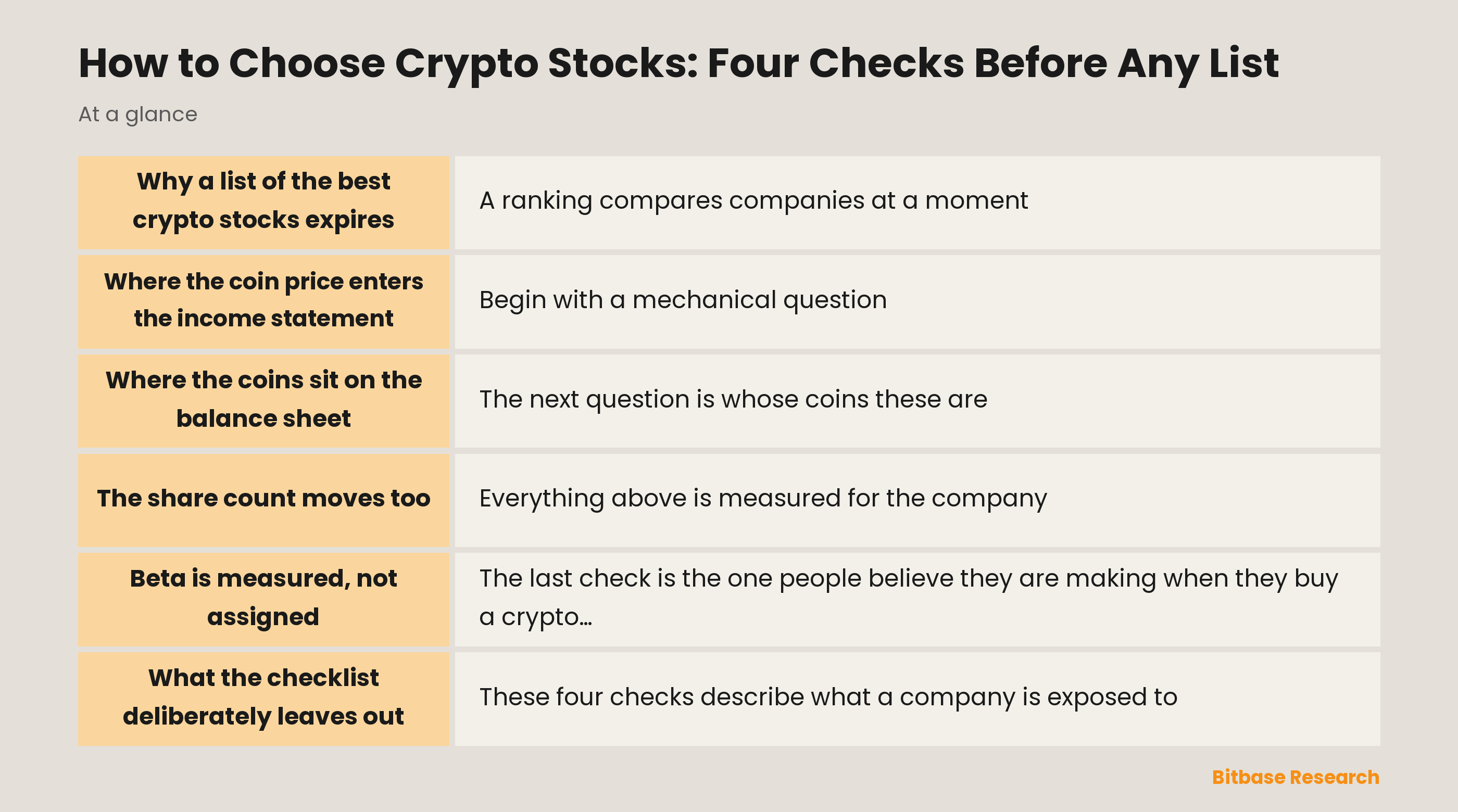
Why a list of the best crypto stocks expires
A ranking compares companies at a moment, and its inputs move at different speeds: some change when the accounts are published, some on the day of an announcement, and some with the price of a coin nobody at the company controls. It decays because it is a function of moving parts, not because whoever built it was careless.
The second problem is particular to this corner of the market. A crypto stocks list collects businesses that share a theme rather than a mechanism. A company that produces coins, one that owns coins, one that runs a venue where others trade them, and one that sells hardware to all three can sit in the same table, and the coin price reaches each by a different route. What is worth keeping from the exercise is not a name but an answer sheet that can be run again when something moves.
Where the coin price enters the income statement
Begin with a mechanical question. If the coin doubled tomorrow, which line of this company's accounts would move, and how soon? There are at least three answers, and mixing them up is what makes a watch list meaningless.
The coin price can be the price at which output is sold, as it is for a business whose product is newly produced coins. The coin chart reaches revenue directly, but so does the quantity produced, and that depends on how much capacity the whole network is running. It can instead drive the amount of activity a fee is charged on: for a business paid per transaction the variable that matters is turnover, which can rise in a falling market. Or it can miss the operating business entirely and show up only in the value of what the company already owns, arriving through the balance sheet rather than the income statement.
Which route applies tells you which series to watch, and the answer sits in the revenue and segment disclosures, not in how the company describes itself. A page calling the business a blockchain company gives you the theme; the accounts give you the mechanism.
Where the coins sit on the balance sheet
The next question is whose coins these are. Coins bought with the company's own money are an asset the shareholder is exposed to. Coins held for customers are the customers' property, and the company's exposure to their price is not the size of the wallet. A headline figure for coins on a platform settles neither version.
The second half of the same check is how the coins were paid for, because coins funded out of operating cash are a different proposition from coins funded by issuing new shares or new debt: the second version has a claim attached to it. The financing section of the cash flow statement is where the two are told apart, and the notes state the accounting policy that decides whether a move in the coin price reaches reported earnings at all.
The share count moves too
Everything above is measured for the company. You would own a fraction of it, and that fraction is not fixed. A company can register shares to be sold gradually into the open market instead of in one priced deal; the rule permitting this defines an at-the-market offering as an offering of equity securities into an existing trading market for outstanding shares of the same class at other than a fixed price.
That is a normal way to raise money, and for a company whose plan is to buy more coins it is an obvious one. It also means the thing being tracked has two moving parts: coins per share can fall while total coins rise. Any per-share figure is only as good as the pair of dates behind it.
The history matters as much as the level: a record of repeated issuance is part of what the company is, and a one-line ranking has no room for it.
Beta is measured, not assigned
The last check is the one people believe they are making when they buy a crypto stock: how much of the coin's move does this share actually deliver? That is a measurement, and every measurement has settings — which coin the share is compared against, over which window, at which frequency, and whether levels or returns are compared.
Two settings deserve naming. Trading hours differ, because the market for a listed share has an open and a close while a coin market runs on without one, so a move that lands overnight reaches the share as a gap at the open rather than as a sequence of steps. And the relationship is conditional: a figure measured over one stretch describes that stretch. The same caution applies to any measured relationship between crypto and equities, gold, or risk appetite.
A share is also a claim on a company, with its own costs, debt, tax, and contracts. Whatever the measured relationship turns out to be, it carries those risks on top of the coin's.
Each check has a document behind it
None of this needs a data vendor. In the United States, company filings sit in a public system holding millions of informational documents filed by publicly traded companies and others, and access is free.
| The check | Where the answer is filed | What it still does not tell you |
|---|---|---|
| Which line the coin price reaches | Revenue and segment disclosures in the annual report | Whether that line will grow |
| Whose coins these are, and how they were paid for | Balance sheet, accounting policy notes, and the financing section of the cash flow statement | What the coins will be worth |
| How many shares exist, and how the count got there | Share data in the periodic reports, and the filings that registered the offering | Whether more will be issued |
| How much of the coin move the share delivered | Nowhere: computed from price series rather than filed | Whether the figure holds next window |
The annual report is long, but the parts that matter are labelled: a description of the business, a section on the risks the company says it faces, management's discussion of the year's results, and the financial statements. A company registered outside the United States files a different annual form, still with the same regulator if its shares are listed there, so the form name changes while the four questions do not.
What the checklist deliberately leaves out
These four checks describe what a company is exposed to. They do not say whether to own it, how much of it to own, or when. Those are separate decisions with their own methods, and collapsing them into the research is how a note turns into a recommendation.
How much is a question about what a loss would do to the rest of the account rather than about how good the idea feels, which is the job position sizing does.
When is a question about entry method: committing everything at once and committing on a schedule have different exposure profiles, and the choice between a lump sum and instalments is made on its own terms.
Whether crypto exposure belongs in the portfolio at all sits above all of it. That is the order used when an institutional allocation is written down, where the mandate is settled before the asset.
Where to look up a name you have in hand
A quote page is the opposite of a ranking in one respect: it puts nothing in order, and it does not go out of date. If a ticker is already in hand, that page is where the current reading lives, and the four checks are what gets brought to it. MSTR, HOOD, MARA and RIOT each have one, listed here as names to test the checks on rather than as a shortlist.
Separately from the shares themselves, some names also exist here in tokenized and perpetual form. Which names that covers changes on its own schedule, so the tokenized stock lineup is kept as a page rather than repeated inside an article.
The bottom line
A ranking answers a question next to the one that was asked. The four checks answer the one that was asked: which line the coin price reaches, whose coins are on the balance sheet, what has happened to the share count, and what the measured relationship with the coin actually describes. None of them says what to buy, and that is not a hole in the method: it is the part that stays with the person deciding.
Related reading
Other Bitbase articles on this topic:
- Crypto in the Name Does Not Make It a Crypto Stock
- Crypto or Stocks: The Six Measures That Decide It
- Crypto Tickers Collide and Stock Symbols Do Not
- How to Buy TSLA: Two Segments, Three Instruments
- How to Calculate a Token Treasury Runway
Disclaimer: This article is educational content from Bitbase Academy, provided for information only. It does not constitute investment, trading, tax, or financial advice. Crypto assets are volatile; assess your own risk. Written as of September 2026; refer to the latest official information.
References
[1] Legal Information Institute, 17 CFR 230.415: definition of an at-the-market offering www.law.cornell.edu
[2] US Securities and Exchange Commission, EDGAR: free public search of company filings www.sec.gov
[3] US Securities and Exchange Commission, Investor Bulletin: How to Read a 10-K/10-Q www.investor.gov