A crypto stock price looks like a single fact, and it is not. The same company can carry one quote in the regular session, a different one in extended hours, and a third on a tokenized version of the share that keeps trading after the exchange has shut. This article is about where each number comes from, what makes it jump, and how the coin reaches the share price at all. The live figures belong on a price page, not in an article that ages the moment it is written.
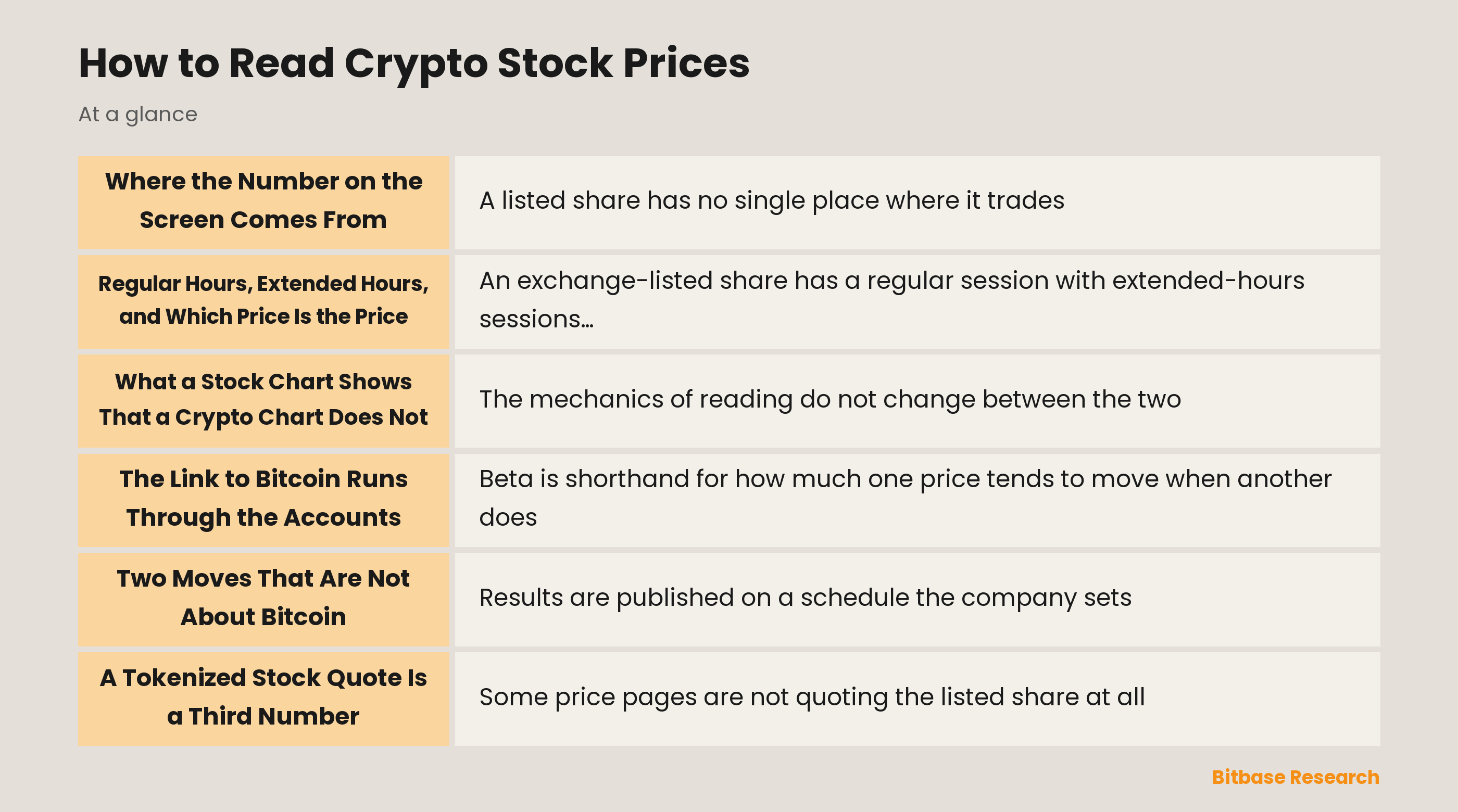
Where the Number on the Screen Comes From
A listed share has no single place where it trades. Routing decides where an order goes, and the SEC's guide to trade execution puts it plainly: for a stock listed on an exchange, "your broker may direct the order to that exchange, to another exchange (such as a regional exchange), or to a firm called a 'third market maker.'" The quote you read summarizes activity across those venues rather than reporting from one machine.
The same guide warns that "because price quotes are only for a specific number of shares, investors may not always receive the price they saw on their screen." A quote is a trade that happened, or a bid and an offer good for a stated size. It is not a promise about yours.
Crypto quotes are assembled the other way round. When you sit down to read a crypto price chart, you are looking at one venue's own book, or at an index a data provider built from several venues. The number is local to whoever produced it, which is why two venues can print different prices at the same moment and neither is wrong.
Regular Hours, Extended Hours, and Which Price Is the Price
An exchange-listed share has a regular session with extended-hours sessions around it, and quotes from the two should be read differently. The SEC's bulletin on after-hours trading gives the reason twice. On liquidity: "During after-hours, there may be less trading volume for some stocks, making it more difficult to execute some of your trades." On spreads: "Less trading activity could also mean wider spreads between the bid and ask prices."
The consequence is the part that gets skipped: "the prices of some stocks traded during the after-hours session may not reflect the prices of those stocks during regular hours, either at the end of the regular trading session or upon the opening of regular trading the next business day." An extended-hours print is a real trade at a real price and still not a preview of tomorrow's open.
The same risk list carries "Uncertain Prices" and "Price Volatility", and the bulletin adds that "news stories announced after-hours may have greater impacts on stock prices." For a crypto-linked company the hours in which its own announcements land are the hours in which its quote is thinnest. Crypto has no session to be inside or outside of, so the coin trades through the weekend while the share does not.
What a Stock Chart Shows That a Crypto Chart Does Not
The mechanics of reading do not change between the two. Candlestick charts behave identically whichever asset is plotted. What changes is what the chart is permitted to contain.
Gaps are one of them. A session that closes and reopens leaves an interval with no trading in it, so the chart jumps from one bar to the next with nothing drawn between. That empty space is a closed door, not a move; on a continuously traded market the same distance would be filled with trades.
Restated history is the other. A split changes the share count and the price per share together: as the SEC describes it, when "a company declares a stock split, its share price will decrease, but a shareholder's total market value will remain the same." A charting tool that redraws old prices on the post-split basis stops the split from looking like a crash, which also means a long-run stock chart can show a price nobody was ever quoted.
The Link to Bitcoin Runs Through the Accounts
Beta is shorthand for how much one price tends to move when another does. Applied to a crypto-linked share it records that two prices moved together, not the route by which they did. That route sits in the accounts, and it differs by corner of the sector.
Where a company earns fees on trading, the coin arrives as volume. Fees charged per order, or as a percentage of notional value, convert a busy market into revenue directly, which makes an active quarter a better quarter whichever way the coin went.
A mining company meets it as revenue per unit of work. Hashprice is what a unit of hashrate earns over a day: the coin price multiplied by the share of block rewards and fees that unit can expect to win. When the coin falls and mining difficulty does not, hashprice falls with it across the whole fleet at once, and where the cost of running that fleet does not fall alongside, profit moves by more than revenue does.
On a balance sheet that holds coins, it arrives as the value of the holding. The ratio quoted for this is mNAV: market capitalization divided by the value of the coins held. Above one, the market pays more for the wrapper than for its contents; below one, less. A share bought at a premium can lose money on a day the coin rises, because the premium moved and the coin did not move enough to cover it.
Two Moves That Are Not About Bitcoin
Results are published on a schedule the company sets, and when they land outside the regular session the bulletin's warning about after-hours news applies directly. The quote that reopens next morning is not a continuation of yesterday's trend but the first price at which the market will trade a company it now knows more about, and the gap says nothing about where things go next.
Issuance works differently. When a company sells new shares to fund itself, the number of claims on the same business rises, so each existing share stands for a smaller slice than it did the day before. For companies that raise money in order to buy coins this cuts both ways, because the share count and the coin holding both change and mNAV moves on the ratio between them. A step down on an issuance day is not a verdict on bitcoin.
A Tokenized Stock Quote Is a Third Number
Some price pages are not quoting the listed share at all. They quote a tokenized instrument that references it, and the issuer named in the page title decides what that instrument is. The pages for Strategy, Robinhood Markets and MARA Holdings do not all come from the same issuer, and the differences are structural rather than cosmetic.
What that instrument is, and therefore how far its number can sit from the share's, is decided by the issuer rather than by the exchange. Ondo, whose tokens sit behind the second and third of those pages, states that one token does not necessarily represent the value of one share and that the price of one token will not always match the price of the underlying asset. A different issuer stands behind the first, on its own terms. Elsewhere the gap is wider than a pricing convention: Robinhood's European product is not a tokenized share, and the company describes Classic Stock Tokens as derivative contracts between you and Robinhood, priced at the prices of the underlying securities without granting rights to them. Backing, dividends, holder rights and the hours each token keeps are settled one issuer at a time, and what a tokenized stock is sets them out side by side; the tokenized stock and ETF directory is where the pages themselves are gathered.
Looking Up the Live Number
A price page names the instrument in full alongside its symbol, and the name is what to read first: it tells you whether you are looking at a listed share or a token, and if a token, whose. If a number matters enough to act on, take it from the page at the moment you act rather than from anything written down, this article included. Quotes move, and the share and the token keep different hours.
The Bottom Line
A crypto stock price is three questions wearing one number: which venue and which session produced it, what the instrument behind it actually is, and which part of the company's accounts the coin reaches. Extended-hours prints are real trades that owe nothing to tomorrow's open. Gaps and restated history are conventions of the equity chart rather than signals inside it. Read the name on the page, then read the number.
Related reading
Other Bitbase articles on this topic:
- Crypto Tickers Collide and Stock Symbols Do Not
- How to Buy Crypto Stocks: Three Routes and What You Actually Own
- How to Buy Stocks with Crypto: Two Routes from Stablecoins
- How to Buy TSM: From Taipei Shares to Tokens and Perpetuals
- Validator Jailed: What It Means and How Unjailing Works
Disclaimer: This article is educational content from Bitbase Academy, provided for information only. It does not constitute investment, trading, tax, or financial advice. Crypto assets are volatile; assess your own risk. Written as of September 2026; refer to the latest official information.
References
[1] US Securities and Exchange Commission, Trade Execution: What Every Investor Should Know sec.gov
[2] US Securities and Exchange Commission, After-Hours Trading: Understanding the Risks sec.gov
[3] US Securities and Exchange Commission, Stock Splits sec.gov
[4] Ondo Stocks overview: backing, rights and trading hours (Ondo official documentation) docs.ondo.finance
[5] Robinhood Europe: Classic Stock Tokens described as derivative contracts between the customer and Robinhood, granting no rights to the underlying shares robinhood.com