
A miner earns the coin it produces and a treasury company holds coins on its balance sheet, so both carry the crypto price straight into their accounts. Stablecoin issuers and infrastructure companies do not. One earns from a short-term interest rate set on a central bank's calendar, the other earns a fee on activity, and buying either as a proxy for coin prices imports a position you may not have meant to take.
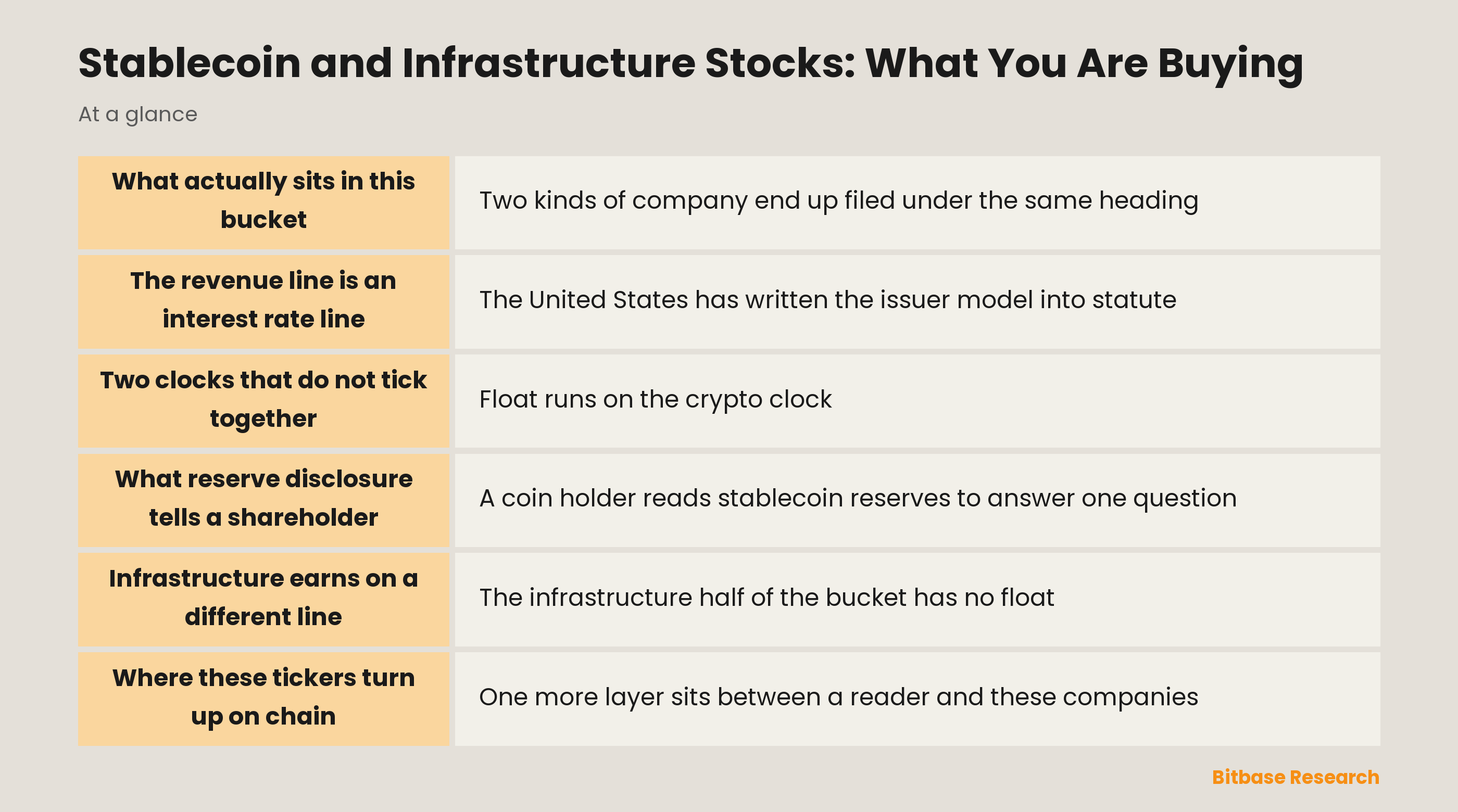
What actually sits in this bucket
Two kinds of company end up filed under the same heading, and they do not make money the same way.
The first is the issuer. Circle Internet Group, Inc. trades on the New York Stock Exchange under the ticker CRCL, and Circle states that USDC is issued by its regulated affiliates. Its product is a dollar-pegged stablecoin, engineered not to appreciate, so there is no coin gain to book. What the company has instead is the money handed over to mint the token.
The second is infrastructure: companies running lending, settlement or tokenization on public blockchains rather than issuing a dollar token. Figure Technology Solutions, Inc. trades on Nasdaq under the ticker FIGR and is classified in Securities and Exchange Commission records under loan brokers. It describes itself as using blockchain and AI to deliver a new standard in financial efficiency: faster approvals, lower costs, and transparent access.
Neither is a miner and neither is a treasury company. Coins pass through these businesses rather than sitting inside them, and what stays behind is a rate or a fee.
The revenue line is an interest rate line
The United States has written the issuer model into statute. The GENIUS Act, Public Law 119-27, approved July 18, 2025, requires a permitted payment stablecoin issuer to maintain identifiable reserves backing the outstanding payment stablecoins on an at least 1 to 1 basis, and it enumerates what those reserves may hold: insured deposits, Treasury bills with a remaining maturity of 93 days or less, and registered government money market funds.
The same act closes the other end. It provides that no permitted payment stablecoin issuer shall pay the holder of any payment stablecoin any form of interest or yield, whether in cash, tokens, or other consideration, solely in connection with the holding, use, or retention of such payment stablecoin.
Put the two provisions together and the top of the income statement is written for you in outline: circulating float, multiplied by a short-term rate. The general version is how stablecoin issuers make money; the equity version is that identity with a share count underneath it. What the reserve earns and what the company keeps are two different figures, and everything between them is where a shareholder looks next.
Halve the short rate and leave the float exactly where it is, and the top line halves with it. Nothing has to happen in the crypto market for that.
Two clocks that do not tick together
Float runs on the crypto clock. It grows when trading venues need dollar collateral, when payment corridors settle in tokens, when on-chain markets are busy, and it shrinks when leverage comes out. Token supply sits on a public blockchain, so this input can reprice a stock on a day with no company news in it.
The rate runs on a policy calendar whose meeting dates are published in advance. It is set for reasons that have nothing to do with crypto, and it reaches the revenue line close to mechanically.
Because different processes set them, the two need not move together and can move against each other. When policy rates fall, the same float earns less, whatever the float is doing; whether that environment also grows the float is a separate question each cycle. A shareholder here holds an adoption position and a rates position at once, and the two can offset inside one ticker.
What reserve disclosure tells a shareholder
A coin holder reads stablecoin reserves to answer one question: will the peg hold. A shareholder opens the same document for a different one: how durable is this revenue, and what is it actually being earned on.
Composition answers both at once. Circle states that USDC is 100% backed by highly liquid cash and cash-equivalent assets, that the majority of the USDC reserve is invested in the Circle Reserve Fund, an SEC-registered 2a-7 government money market fund, and that the portfolio is custodied at The Bank of New York Mellon and managed by BlackRock. To a holder that is a safety statement; to a shareholder it is also a yield statement, because a government money market portfolio pays what government money market portfolios pay.
Cadence and signature are the other half. Circle publishes monthly reserve attestations by a Big Four accounting firm, names Deloitte and Touche LLP as its independent auditor, and states that daily, independent, third-party reporting on the portfolio is publicly available via BlackRock. An attestation is a snapshot of the reserve, not an audit of the company, and that distinction carries further here because the reserve is the revenue-producing asset. The exchange-side version of the discipline is proof of reserves and liabilities, and its habit, never reading an asset figure without the claim standing against it, transfers directly.
Infrastructure earns on a different line
The infrastructure half of the bucket has no float. A company running credit, settlement or tokenization on a blockchain is paid for activity: originating, servicing, matching, settling. Its income moves with volume and with what it can charge, not with the yield on somebody else's dollars.
So the first question about any name here is a classification question rather than a sentiment one. Establish which line the revenue sits on before deciding what the stock is exposed to, and settle it from the company's own filings rather than from the sector it gets grouped into. Figure's classification under loan brokers is a filing answering that question directly.
Where these tickers turn up on chain
One more layer sits between a reader and these companies: a ticker on a crypto venue does not have to resolve to a share.
A tokenized stock is a token issued by a third party and designed to give economic exposure to an underlying asset. What backs it, when it trades and what it entitles the holder to are decided by whoever issues it, and issuers differ on every one of those points. The price page for CRCL carries the ticker as a tokenized stock issued by Ondo, which is explicit that one token does not necessarily represent the value of one share and that a token's price will not always match the price of the underlying asset. Ondo also states that holders receive no shareholder voting rights and no other shareholder rights.
Which tickers carry a tokenized market at all differs from name to name, and the tokenized stock listings are where to check. This is not a technicality: economic exposure without shareholder rights is a different instrument from a share held through a broker.
The risks that belong to this bucket
Rate risk enters this bucket from outside the market being watched. A decision taken at a policy meeting reaches an issuer's revenue line directly, and keeps reaching it in quarters when nothing is happening in crypto.
Regulatory risk here is unusual in that the framework defines the product rather than only policing it. The statute says what the reserve may hold and forbids paying holders yield, so rulemaking under it does not adjust this business at the edges. It also defines who may issue at all, directing regulators to receive, review, and consider for approval applications from any insured depository institution that seeks to issue payment stablecoins through a subsidiary. Rules that make an incumbent legitimate also describe how someone else becomes legitimate.
Concentration is the third. An issuer whose income is a claim on a short-term interest rate, in a product category regulators have only recently defined, does not diversify one exposure against the other. On the infrastructure side, volume can fall for reasons that say nothing about whether the technology works.
The bottom line
Stablecoin and infrastructure stocks are the part of the listed crypto sector where the coin price is not the main variable. An issuer's revenue is a float multiplied by a short-term rate the crypto market does not set; an infrastructure company's revenue is a fee on activity. Both give exposure to adoption, and neither carries the coin price into the accounts the way a miner or a treasury company does. Read the reserve disclosure for durability rather than for the peg, establish which line a company's income sits on, and check what a ticker resolves to before assuming it is a share. To keep learning the fundamentals, follow more from Bitbase Academy.
Related reading
Other Bitbase articles on this topic:
- How to Trade MARA: A Bitcoin Miner That Also Holds Bitcoin
- How to Buy META: The Tokenized Stock and the Perpetual
- How to Buy MSFT: Three Segments Behind One Ticker
- Maximum Transaction Fee Exceeded: What That Wallet Warning Means
Disclaimer: This article is educational content from Bitbase Academy, provided for information only. It does not constitute investment, trading, tax, or financial advice. Crypto assets are volatile; assess your own risk. Written as of September 2026; refer to the latest official information.
References
[1] United States Government Publishing Office, Public Law 119-27 (GENIUS Act), full statutory text: reserve requirements, eligible reserve assets, the prohibition on paying yield to holders, and who is permitted to issue. www.govinfo.gov
[2] Circle, USDC page: reserve composition, the Circle Reserve Fund, custody and management, monthly attestations, daily third-party portfolio reporting and the independent auditor. www.circle.com
[3] US Securities and Exchange Commission, EDGAR filer data for Circle Internet Group, Inc.: ticker CRCL, exchange NYSE. data.sec.gov
[4] US Securities and Exchange Commission, EDGAR filer data for Figure Technology Solutions, Inc.: ticker FIGR, exchange Nasdaq, SIC 6163 Loan Brokers. data.sec.gov
[5] Figure, company website: the company's own description of what its business does. www.figure.com