Crypto stocks are shares in listed companies whose results are tied to crypto, and that one label covers businesses that behave in completely different ways. A miner, a treasury company and a chip maker end up on the same lists, yet what you own in each case is equity in a company rather than the coin. This page sorts the label into five groups and says what each is exposed to.
What a crypto stock is
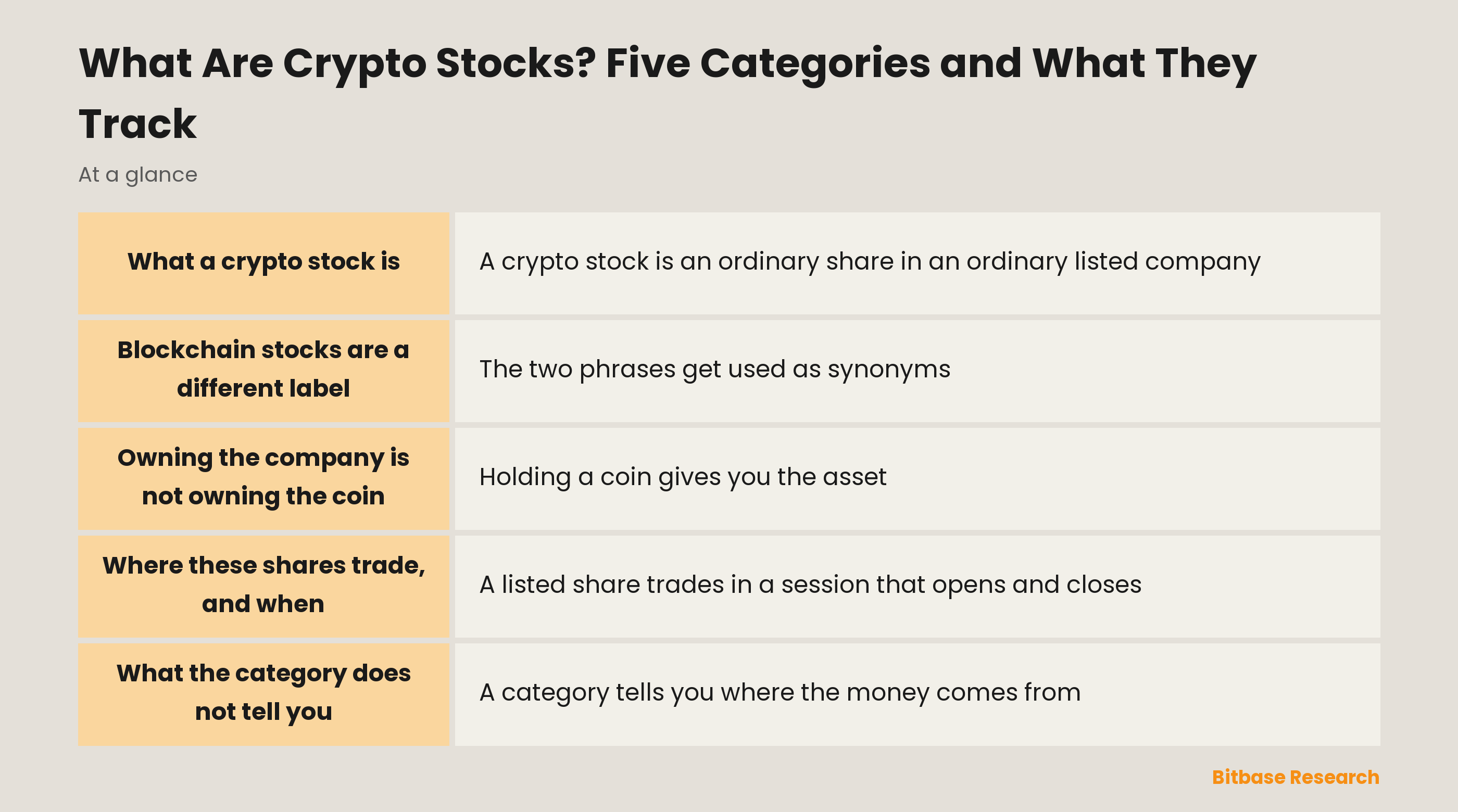
A crypto stock is an ordinary share in an ordinary listed company. What earns it the label is what the company does with crypto: run the machines that mine a coin, operate a venue where coins change hands, hold coins on its balance sheet, issue a stablecoin, or sell hardware and payment services to the businesses that do those things.
Two consequences follow from the word share. You are buying a claim on a company: its revenue, its costs, its debts, and whatever is left for shareholders once everyone ahead of them has been paid. And the company sits between you and the crypto price, so even coin held straight on the balance sheet arrives with a share count, an interest bill and a management team attached.
A crypto stock therefore gives you exposure to a business that is exposed to crypto. Both layers are live at once, and the second is why these shares can move against the asset they are named after.
The five categories
The label is too broad to be useful until it is sorted, and the question that sorts it is where the money comes from.
| Group | What the business does | What the results follow |
|---|---|---|
| Exchanges and brokers | Run venues and brokerage accounts for crypto and other assets | Trading activity and the fees on it |
| Miners | Run hardware to earn newly issued coin and block fees | Coin price, network share, power bill |
| Digital asset treasury companies | Hold coin on the balance sheet as a reserve asset | Coin price and the terms of the financing |
| Stablecoin and infrastructure issuers | Issue stablecoins and run the rails that move them | Balances outstanding and what reserves earn |
| Chips and payments | Sell hardware or payment services with a crypto-facing line | Their own end markets, crypto as one input |
Exchanges and brokers get paid when people trade. Coinbase Global lists on Nasdaq under COIN, and Robinhood Markets lists there under HOOD and files with the SEC under the classification used for securities brokers and dealers. Revenue rises with how much customers trade, which is related to the coin price without being the same thing: a flat market with heavy volume can still be a strong quarter. Bitbase carries a HOOD price page.
Miners convert electricity into coin. MARA Holdings trades on Nasdaq under MARA, and bitcoin mining is what puts a company in this group: hardware competes for newly issued coin and the fees in each block. Revenue arrives denominated in the asset itself while power, machines and staff are priced in dollars, so margins swing further than the coin does, in both directions. That name is quoted on the MARA price page.
Digital asset treasury companies buy the coin instead of producing it. Strategy, listed on Nasdaq under MSTR and named MicroStrategy until 2025, states in its annual report that bitcoin serves as the primary treasury reserve asset on an ongoing basis, and that before that year it relied primarily on sales of class A common stock and senior convertible notes to purchase bitcoin. That second clause is the category in miniature: the coin lands on the balance sheet, and the instruments used to pay for it land with it. Quotes sit on the MSTR price page.
Stablecoin and infrastructure issuers earn from balances rather than from price moves. Circle Internet Group lists on the New York Stock Exchange under CRCL, and regulated affiliates of Circle issue USDC, a digital dollar redeemable one for one and backed by cash and cash-equivalent assets. Reserves of that kind produce a return, which puts this group on a different clock: what is outstanding, and what those reserves earn.
Chips and payments is where the label reaches outside the crypto business itself. A semiconductor company is called a crypto stock because miners buy its hardware, and a payment company because it added a crypto or stablecoin product. Neither fact says how much of the company depends on crypto; the segment and revenue disclosures in its filings do. The group is defined by having the crypto line inside a larger business rather than as the business.
Blockchain stocks are a different label
The two phrases get used as synonyms, and they are not. A crypto stock is defined by exposure to crypto asset prices or to crypto trading activity. A blockchain stock is defined by use of the technology: a logistics firm tracking shipments on a distributed ledger, a bank testing settlement, a vendor selling ledger tooling. The technology can be in production while nothing on the income statement responds to the coin price.
The test is not the announcement, it is the accounts. If the connection would survive a halving of the coin price untouched, it is a technology story; if a revenue line rises and falls with the coin, it is a crypto stock. A list assembled from announcements will hold both.
Names are not a test either. MARA Holdings filed with the SEC under four earlier names before this one, and the whole sequence sits in one registrant record. What a company does is described in its filings, not in its ticker.
Owning the company is not owning the coin
Holding a coin gives you the asset. Holding the share gives you a slice of a company that produces, holds or serves the asset, and the gap shows up in three places.
Share count. A company can create more shares, and treasury companies fund purchases that way by design, so coin held per share and coin bought per dollar invested can move apart. Whether a coin's own supply can grow is a question about its protocol and its governance.
Costs and priority. A business carries a power bill, salaries and often notes to repay, all of them fixed claims settled before shareholders see anything, which is the mechanism behind the larger swings in both directions. If the company fails, shareholders stand last in the queue; a coin in your own wallet has no capital structure above it, in exchange for a different set of risks.
Everything else the company does. An exchange has a regulatory posture and a product roadmap, a miner has sites and power contracts, and both move the share on days when the coin is still.
Where these shares trade, and when
A listed share trades in a session that opens and closes, while the coin market does not close. A weekend move in the coin has nowhere to go in the share until the session reopens, and then arrives at once, in the opening print.
Settlement differs as well. The SEC shortened the standard settlement cycle for most broker-dealer transactions from two business days after the trade date to one, with a compliance date in May 2024. An on-chain transfer settles when the network confirms it. The same word covers two different processes.
Shares also carry corporate actions with no coin equivalent, such as splits, dividends and index additions, each able to move a price on its own.
Shares are not the only route to these tickers. Tokenized stock markets and perpetual futures track the same names without being shares, and what each entitles the holder to is set by whoever issues the instrument. Which tickers have which surfaces is listed on the tokenized stock and futures lineup.
What the category does not tell you
A category tells you where the money comes from, not that a share will follow the coin. Two miners with the same hardware and different power contracts can report different results from an identical coin price, and a treasury company's shares can move on the terms of its last financing rather than on the asset it bought.
The boundary is also moving. Trading venues have been building traditional-finance products from the other side of the same line, so which businesses count as crypto companies keeps changing.
A category is not a selection either: sorting a ticker into the right group tells you which forces act on it, not whether the price already reflects them.
The bottom line
A crypto stock is equity in a company whose results depend on crypto, and the five groups differ in how that dependence is built: fees at exchanges and brokers, produced coin at miners, purchased coin at treasury companies, reserve balances at stablecoin issuers, and one product line inside a larger business at chip and payment firms.
Read the group first and the ticker second. It tells you what a company would have to get right for its share to track the coin, and where the two part ways: share issuance, fixed costs, bankruptcy priority, and a trading session that closes. To keep working through the fundamentals, follow more from Bitbase Academy.
Related reading
Other Bitbase articles on this topic:
- How to Buy MSFT: Three Segments Behind One Ticker
- How to Trade MSTR: Strategy and Its Bitcoin Balance Sheet
- How to Trade MU: Micron Memory, Spot and Perpetual Futures
- Network Congestion Indicators and What Each One Measures
- What Is a Blockchain Bridge?
Disclaimer: This article is educational content from Bitbase Academy, provided for information only. It does not constitute investment, trading, tax, or financial advice. Crypto assets are volatile; assess your own risk. Written as of September 2026; refer to the latest official information.
References
[1] SEC EDGAR: Strategy Inc, annual report on Form 10-K for the fiscal year ended December 31, 2025, covering bitcoin as the primary treasury reserve asset and the class A common stock and senior convertible notes used to buy it www.sec.gov
[2] SEC press release 2023-29: the standard settlement cycle for most broker-dealer transactions shortened from two business days after the trade date to one, with a compliance date of May 28, 2024 www.sec.gov
[3] SEC EDGAR: company filing index for MARA Holdings, Inc., CIK 0001507605, showing the Nasdaq listing under MARA and the four earlier registrant names www.sec.gov
[4] SEC EDGAR: company filing index for Robinhood Markets, Inc., CIK 0001783879, showing the Nasdaq listing under HOOD and the securities broker-dealer classification www.sec.gov
[5] SEC EDGAR: company filing index for Coinbase Global, Inc., CIK 0001679788, showing the Nasdaq listing under COIN www.sec.gov
[6] SEC EDGAR: company filing index for Circle Internet Group, Inc., CIK 0001876042, showing the New York Stock Exchange listing under CRCL www.sec.gov
[7] Circle, USDC page: USDC is issued by regulated affiliates of Circle and is described as a fully reserved digital dollar redeemable 1:1 for US dollars, backed by highly liquid cash and cash-equivalent assets www.circle.com