Two positions can quote the same headline rate and finish the year in different places. The rate is not what separates them. What separates them is whether each reward goes back to work by itself or waits in a separate pile until you move it. Auto compounding and manual claiming answer that one question differently, and the answer is worth a specific amount you can work out before you choose.
What compounding changes about a staking reward
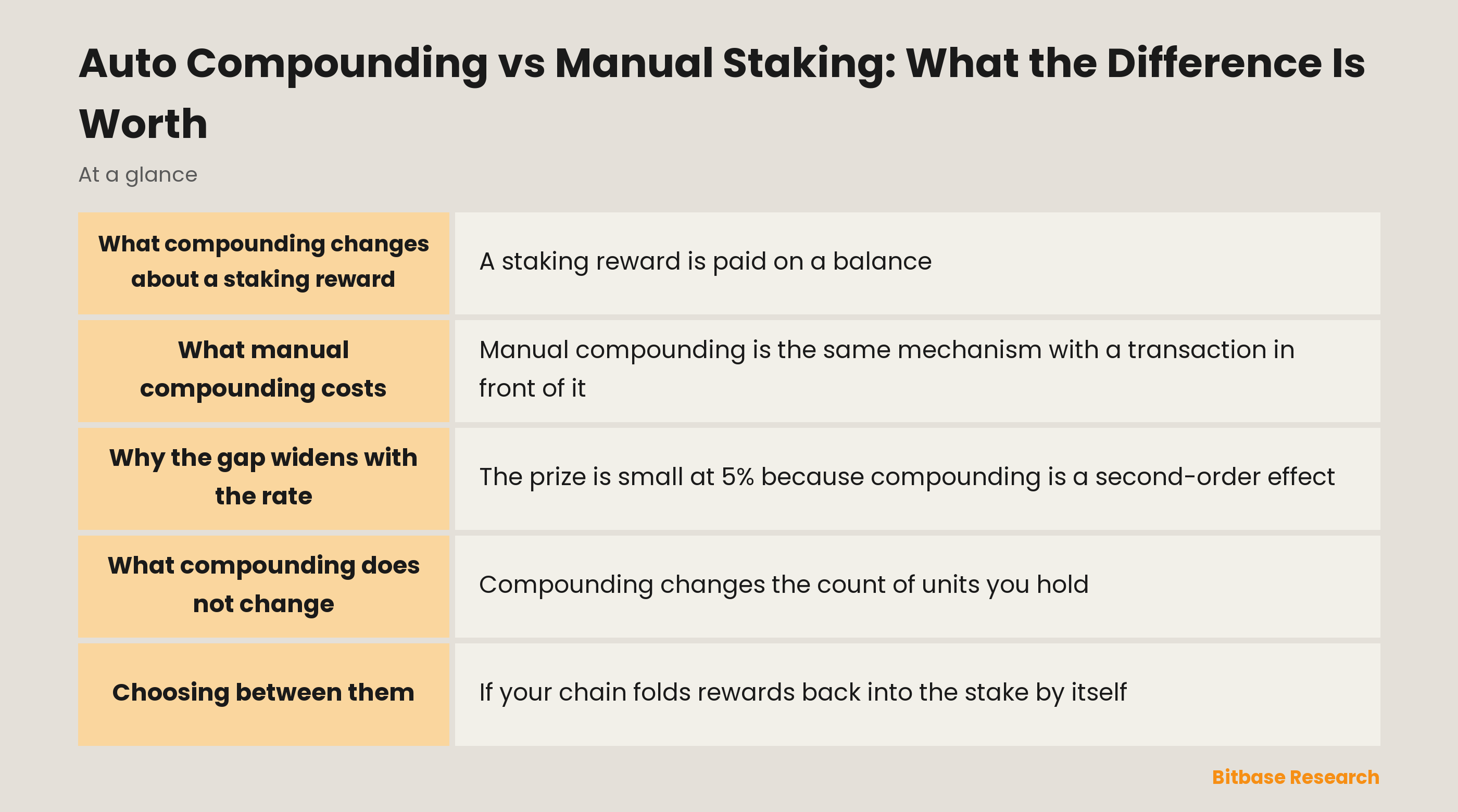
A staking reward is paid on a balance. Compounding is what happens when the reward joins that balance and starts earning alongside it. The protocol's rate does not move; the base the rate is applied to does, and it moves again every time another reward lands.
That is why the same position gets quoted two ways. Written out in full on first use, the annual percentage rate and the annual percentage yield are shortened from here on to APR and APY. APR states the pay with no reinvestment at all. APY states the same pay with reinvestment folded in at a stated frequency. Where the two figures differ, the difference is compounding and nothing else.
Reading a rate therefore means reading a frequency with it. A rate quoted without one is incomplete, because the same protocol pay can be presented as either figure depending on an assumption that sits behind the number rather than in it.
Where the reward goes back to work
Three arrangements are worth separating, and they differ in who has to act.
Some chains put the reward straight back into the stake. Solana's documentation states that rewards accumulate every epoch and are automatically compounded, which means the account that earned them is larger the next time the protocol pays. Nothing is claimed, nothing is signed, and the APY is what you receive.
Other chains hold the reward outside the delegation until you ask for it. The Cosmos SDK distribution module describes collected rewards as pooled globally and divided out passively to validators and delegators. A delegator gets them out with a withdrawal message, which sends the rewards from the module account to the withdraw address. Until that message is sent and the proceeds are delegated again, the reward earns nothing.
A liquid staking token adds a third arrangement, where the compounding is a property of the token's accounting rather than of your actions. Lido's integration guide describes two forms side by side: the stETH balance on the holder's address changes daily as the oracle report comes in, while wstETH does not rebase and its price denominated in stETH changes instead. One design grows your unit count, the other grows what a unit redeems for, and neither asks you to send a transaction.
| Arrangement | Who has to act | What your balance does |
|---|---|---|
| Reward added to the stake | Nobody | The staked amount itself grows |
| Rebasing staking token | Nobody | The unit count rises on a schedule |
| Exchange rate staking token | Nobody | Units stay fixed, redemption value rises |
| Claim and delegate again | You, once per cycle | Nothing moves until you sign |
What manual compounding costs
Manual compounding is the same mechanism with a transaction in front of it. Every cycle you claim, you pay a network fee, and often a second one to delegate the proceeds. Those fees are charged per transaction, not per token, so they fall on a small position exactly as hard as on a large one.
That fixed cost is what decides the question, and it decides it differently for every position size. The gain from compounding scales with the amount staked. The cost of collecting it does not. Somewhere between them is a position size below which claiming more often leaves you with less, and it is worth finding that point before setting a schedule rather than after.
There is a second cost that no fee schedule prints. Each claim is a decision, a signature, and an approval, and every one of those is an opportunity to sign the wrong thing. Frequency multiplies exposure to that class of mistake as reliably as it multiplies fees.
How much the frequency is worth
The arithmetic is small enough to do in full. Take a nominal 5% a year and reinvest at different intervals. Each row below is the same protocol pay, differing only in how often the reward rejoins the balance.
| Reinvestment interval | Effective annual rate | Extra over the nominal rate |
|---|---|---|
| Once a year | 5% | None |
| Every quarter | 5.09% | 0.09% |
| Every month | 5.12% | 0.12% |
| Every day | 5.13% | 0.13% |
| Continuously, the ceiling | 5.13% | 0.13% |
Two things fall out of that table. The first is that the whole prize is 0.13% of the position a year, not a percentage point and not a multiple. The second is that daily reinvestment already sits at the mathematical ceiling to the nearest hundredth of a point, so no schedule tighter than daily has anything left to collect.
The same table sets a budget for each claim. Reinvesting monthly captures 0.12% spread over twelve claims, so a claim costing more than roughly 0.01% of the position eats the gain it was sent to collect. Reinvesting daily spreads a barely larger prize over 365 claims, which makes the budget per claim about 28 times tighter. Higher frequency buys very little extra yield, and it multiplies the bill.
Why the gap widens with the rate
The prize is small at 5% because compounding is a second-order effect: it earns a return on returns, and at a low rate the returns are small to begin with. Raise the nominal rate and the same daily schedule pays visibly more. At 20% a year, reinvesting daily produces 22.13%, an extra 2.13% rather than 0.13%.
That is the working test for a manual schedule. On a low, steady rate the case for claiming often is weak, and a fixed transaction fee can exceed the entire annual gain. On a high advertised rate the compounding term is large enough to matter, but a high advertised rate is also the one that deserves a look at where the staking rewards come from before any schedule is set.
What compounding does not change
Compounding changes the count of units you hold. Whether more units means a larger share of the network is a separate question, and it is answered by issuance rather than by your reinvestment schedule. If supply is growing at the same time, the real yield after that dilution can be a good deal smaller than the effective rate. Compounding raises the nominal figure; it does not touch the denominator.
It does not change liquidity either. A reward folded back into the stake is staked, which means it is subject to the same unbonding period as the rest. Automating the reinvestment quietly automates the lock-up, which is a fair trade only if you did not need that reward as spendable capital.
It does not change the risk that produced the reward either. Auto compounding on top of a validator that gets penalised compounds the exposure along with the pay. A liquid staking token that accrues by exchange rate accrues a claim on staked assets, not the assets themselves. The mechanism enlarges the position; it does not alter what the position is exposed to.
Choosing between them
If your chain folds rewards back into the stake by itself, there is nothing to choose. The effective rate is already what you are paid, and a manual schedule adds fees without adding yield.
If the rewards sit in a separate pile, treat the schedule as a cost question rather than a discipline question. Work out the annual extra your frequency buys, divide it by the number of claims, and compare that budget with what one claim costs on your chain at the size you hold. Claim when the answer is positive, and let the pile grow when it is not.
If you hold a liquid staking token, the compounding is already in the accounting, and the thing to check is the accounting itself: whether your balance is meant to grow or your redemption ratio is. Reading one design as though it were the other will make a correct position look broken.
The bottom line
Auto compounding and manual claiming are two answers to a single question: does the reward rejoin the balance by itself. The answer sets the distance between a position's APR and its APY, and that distance is something you can compute rather than something you have to trust: 0.13% a year at a nominal 5%, and 2.13% at 20%.
Manual claiming can close the same gap, but it pays fees per claim while the gain accrues per token, so a schedule that makes sense for a large delegation can be a net loss on a small one. Work the budget out before you set a calendar, check whether your chain has already done the work for you, and remember that compounding enlarges a position without changing what that position is exposed to. To keep learning the fundamentals, follow more from Bitbase Academy.
Related reading
Other Bitbase articles on this topic:
- Validator Jailed: What It Means and How Unjailing Works
- What Is Lido? stETH, Node Operators and Dual Governance
- Automatic Margin Addition Explained: What It Does to Your Liquidation Price
Disclaimer: This article is educational content from Bitbase Academy, provided for information only. It does not constitute investment, trading, tax, or financial advice. Crypto assets are volatile; assess your own risk. Written as of September 2026; refer to the latest official information.
References
[1] Solana, What Is Staking?, learn guide solana.com
[2] Cosmos SDK, x/distribution module documentation, tag v0.50.10 github.com
[3] Lido Documentation, Lido Tokens Integration Guide docs.lido.fi