You open a position with 1,000 USDT set aside behind it, and the reason you set that amount aside is that it is the most you are willing to lose. Then a setting called automatic margin addition moves more collateral in from your wallet, without asking, at the moment the position is about to be closed out. The trade survives longer and the number you treated as your maximum loss is no longer the maximum. Here is what the setting changes, what it leaves alone, and what it quietly undoes.
What automatic margin addition actually does
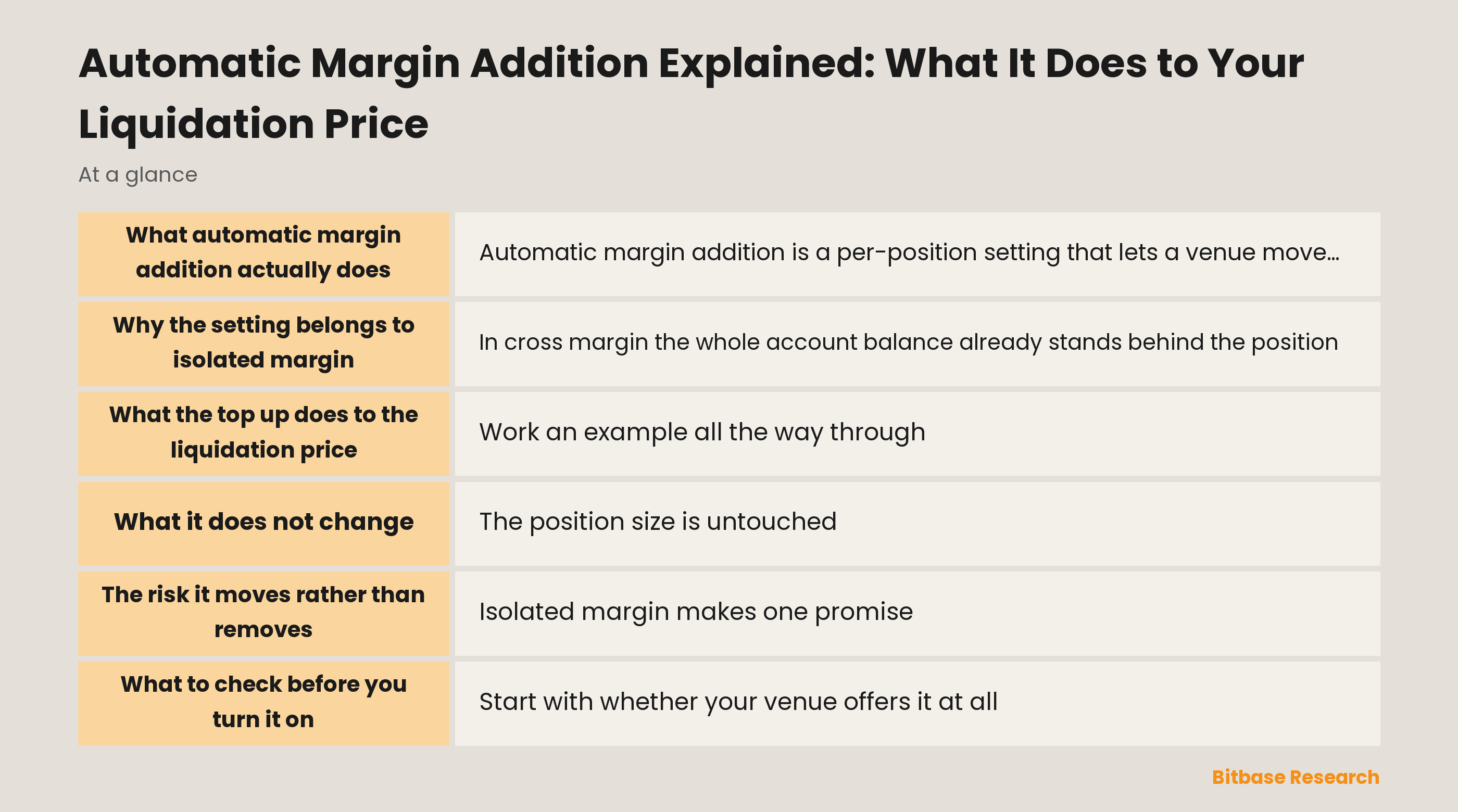
Automatic margin addition is a per-position setting that lets a venue move collateral out of your available balance and into the margin backing one specific position, at the moment that position is close to being closed out. Nothing about the position itself changes. What changes is the size of the buffer standing behind it.
The trigger is the threshold that would otherwise end the trade. Deribit states the requirement plainly: maintenance margin is the minimum amount of margin required to keep the position open. Kraken words the isolated case as an isolated position's equity, meaning its isolated initial margin plus unrealised profit and loss, falling below the required maintenance margin for that position. Automatic margin addition intercepts that moment and lifts the equity rather than letting the threshold be crossed.
The name describes the mechanism accurately. It adds margin. It does not add anything else, and everything that follows is a consequence of that one narrow action.
Why the setting belongs to isolated margin
In cross margin the whole account balance already stands behind the position, so there is nothing left to add; the funds are committed by the mode itself. Isolated margin does the opposite. It fences off a fixed amount of collateral for one position and leaves the rest of the balance out of reach.
Automatic margin addition is a door in that fence. The isolated structure stays, one position with its own dedicated collateral, but more of that collateral can arrive later when the position needs it. This is why the setting has no meaning in cross mode, and why switching it on is a decision about the fence rather than a decision about the trade.
What the top up does to the liquidation price
Work an example all the way through. A long position with a notional of 10,000 USDT opened at 10x carries an initial margin of 1,000 USDT. At an entry price of 20,000 USDT, that notional is a quantity of 0.5 BTC. With a maintenance margin rate of 0.5%, the maintenance requirement for the position is 50 USDT.
The liquidation price of a long is entry multiplied by one, minus one over the leverage, plus the maintenance margin rate. At 10x with a 0.5% maintenance rate the multiplier is 0.905, so the line sits at 18,100 USDT.
Check the allowance rather than trusting the formula. The position can absorb 950 USDT of loss before its equity reaches the 50 USDT maintenance requirement, and a loss of 950 USDT on a quantity of 0.5 BTC is exactly the distance from 20,000 USDT down to 18,100 USDT. If the two routes disagree, one of the starting numbers is wrong.
Now let the setting fire and move a further 1,000 USDT in. The margin behind the position becomes 2,000 USDT against the same 10,000 USDT of notional, so the effective leverage is 5x and the multiplier becomes 0.805. The liquidation price is now 16,100 USDT.
The line moved 2,000 USDT further from the entry, and it moved because the collateral under the position changed rather than because anything happened in the market. That is the whole benefit of the setting, stated in one number.
What it does not change
The position size is untouched. The quantity is still 0.5 BTC and the notional is still 10,000 USDT, so the maintenance requirement is still 50 USDT. Margin tiers are indexed to position size, so a top up does not push the position into a band with a higher rate. Adding to the position would do that; adding margin to it does not.
It also does not reduce the loss. It enlarges the loss the position is allowed to reach. The trade that would have ended at 18,100 USDT having lost 950 USDT can now run to 16,100 USDT, where it has lost 1,950 USDT. Survival was bought with money, and the price of the extra distance is exactly the money that was moved.
The direction of the trade is not improved either. A position that was wrong at 18,100 USDT is still wrong at 16,100 USDT, and it now has more of your balance behind it. The setting is a financing decision made automatically, at the worst moment to be making one.
The three routes collateral can take
| Route | What backs the position | When collateral moves | What caps the loss |
|---|---|---|---|
| Isolated margin on its own | The margin you assigned | Only when you assign it | The margin you assigned |
| Isolated margin with automatic addition | The assigned margin plus whatever arrives later | Automatically, near the threshold | Your available balance, or a cap you set |
| Cross margin | The whole account balance | Continuously, by design | The account |
The middle row is the one worth reading twice. It has the shape of the first row and the exposure of the third.
The risk it moves rather than removes
Isolated margin makes one promise: the loss on this position is bounded by the collateral you assigned to it, and the rest of the balance is safe. Automatic margin addition removes that bound. The loss is now capped by whatever the setting is allowed to reach, which is either a limit you configured or the whole available balance if you configured nothing.
A liquidation that arrives after several automatic top ups is a larger event than the one that would have arrived without them, because more of your collateral was standing behind the position when it finally broke. The setting does not lower the probability of being wrong. It raises the amount at stake when being wrong is confirmed.
There is a second effect that is easy to miss. Collateral pulled into one position is collateral that is no longer available to the others, so a losing position can drain the buffer protecting positions that are still fine. When one setting quietly links positions that were supposed to be separate, the account stops behaving the way its mode label suggests.
What to check before you turn it on
Start with whether your venue offers it at all, because margin controls are not uniform. Kraken states for its multi-collateral derivatives that margin preferences apply per contract and can only be changed before opening a position, and that once a position is open its margin preferences cannot be changed. A venue with that rule is telling you the decision belongs at order entry, not later.
Then find the cap. A setting that can draw an unlimited amount from the available balance and a setting that can add a fixed amount once are different instruments wearing the same name, and only one of them keeps a bound on the loss.
Check the source of the funds next. If the top up is drawn from the same balance that supports your other margin, the maintenance margin on those other positions is affected by a top up you never approved. Finally, decide the question the setting answers on your behalf: if this position needs more money, do you want to give it more money? That question deserves an answer before the position exists, and the setting answers it the same way every time.
The bottom line
Automatic margin addition moves collateral from your available balance into one position when that position approaches its threshold, which pushes the liquidation price further away by lowering the effective leverage. In the worked example, one top up of 1,000 USDT moved the line from 18,100 USDT to 16,100 USDT.
What it buys is distance, and what it costs is the bound that made isolated margin worth choosing. Before enabling it, confirm the cap, confirm where the funds come from, and confirm that you would have made the same transfer by hand at that moment. If the answer is no, the setting is making a decision you would not make. To keep learning the fundamentals, follow more from Bitbase Academy.
Related reading
Other Bitbase articles on this topic:
- Coin-Margined vs USDT-Margined Futures: Which Contract to Trade
- How Funding Payments Affect Your Profit and Loss on a Perpetual
- What Is Margin Trading in Crypto? Borrowing to Trade Bigger
- Auto Compounding vs Manual Staking: What the Difference Is Worth
- Maker vs Taker Fees in Crypto: What Is the Difference?
Disclaimer: This article is educational content from Bitbase Academy, provided for information only. It does not constitute investment, trading, tax, or financial advice. Crypto assets are volatile; assess your own risk. Written as of September 2026; refer to the latest official information.
References
[1] Kraken Support, Managing margin and liquidations in multi-collateral trading support.kraken.com
[2] Deribit Insights, Introduction to Leverage and Margin insights.deribit.com