Its funding is the business. Bank of America Corporation takes in deposits, lends and invests them, and reports the difference as net interest income, so the price of money reaches this ticker as a revenue line. BAC is the symbol the common stock carries on the New York Stock Exchange; on Bitbase the same three letters carry a price page for a Dinari tokenized stock. This profile covers how the company is assembled, what it says moves its revenue, and what that token is.
What Is Bank of America (BAC)?
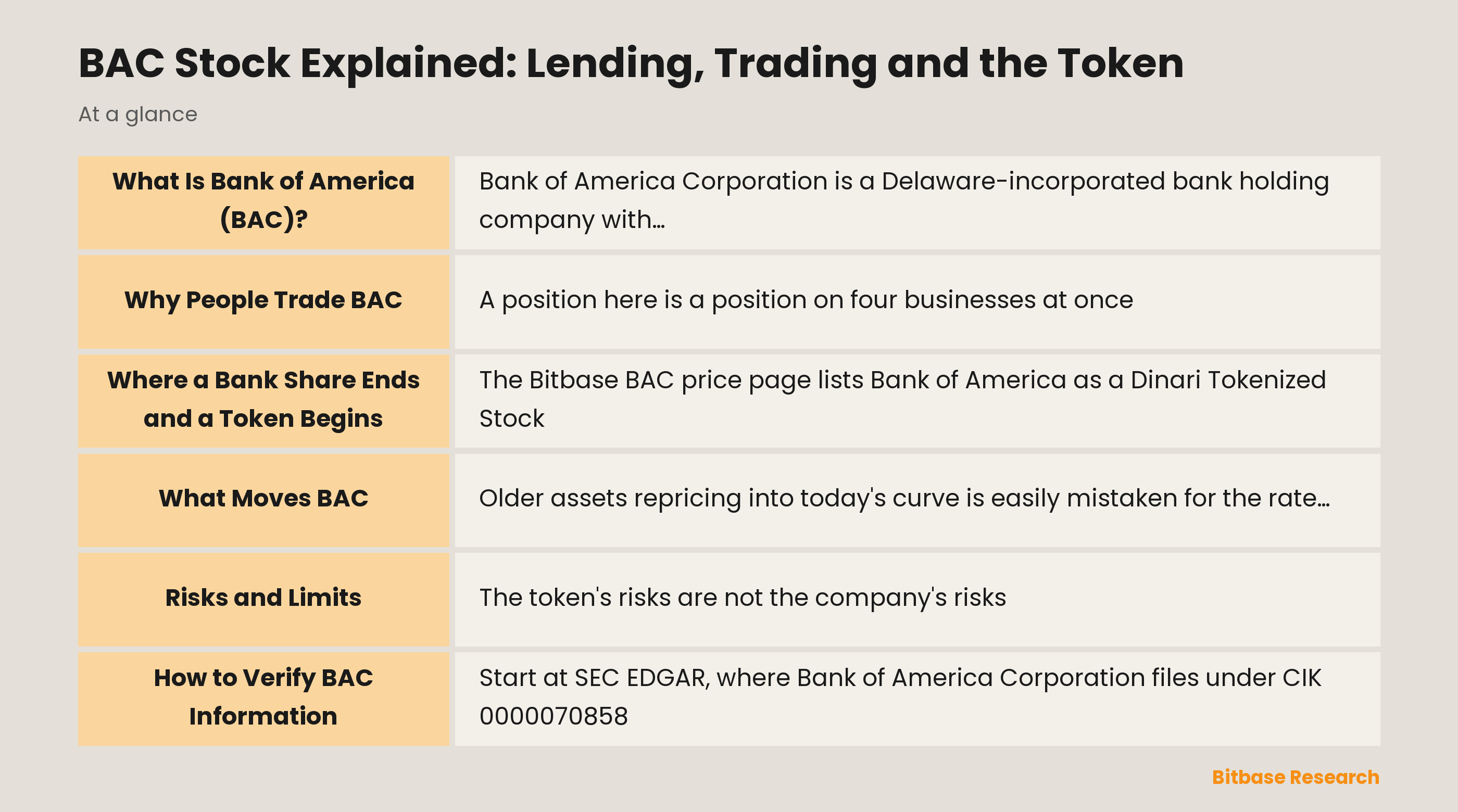
Bank of America Corporation is a Delaware-incorporated bank holding company with its principal executive offices at 100 North Tryon Street, Charlotte, North Carolina. Its common stock is registered on the New York Stock Exchange under the trading symbol BAC; lending and trading in certain financial instruments are performed by banking affiliates including Bank of America, N.A., a member of the FDIC.
The company reports through four segments. Consumer Banking offers credit, banking and investment products to consumers and small businesses. Global Wealth and Investment Management delivers investment management, brokerage, banking and retirement products through a network of financial advisors. Global Banking provides lending-related products, working capital and treasury solutions, and underwriting and advisory services. Global Markets offers sales and trading, including research, across fixed income, credit, currencies, commodities and equities. Whatever belongs to none of the four is reported in All Other.
Two of those names double as brand names: the company states that "Bank of America" and "BofA Securities" are the marketing names used by its Global Banking and Global Markets divisions. For a sense of scale that will not expire, read the supervisory regime rather than a market value: Bank of America Corporation is one of the eight firms the Federal Reserve supervises through its Large Institution Supervision Coordinating Committee, the program it applies to large, systemically important firms.
Why People Trade BAC
A position here is a position on four businesses at once, and they do not run on one clock. Consumer credit conditions reach the result through one segment, a deal calendar through another, market volumes through a third and client balances through the fourth, while interest rates reach all four through the balance sheet underneath. That is why the ticker gets used as a one-line view on the US household and the US rate cycle.
The bundling cuts both ways: a quarter can be strong for trading and weak for credit, and the reported number nets the two before anyone outside sees them.
The relationship with crypto is indirect. None of the four reported segments is a digital asset business, so no line in these accounts tracks a token price the way a miner's or an exchange's does. What links this share to that market is the funding channel rather than the balance sheet: episodes of banking stress reprice risk across assets that have nothing else in common.
Where a Bank Share Ends and a Token Begins
The Bitbase BAC price page lists Bank of America as a Dinari Tokenized Stock. That label is the load-bearing part of the line, because three structures can carry these letters and only one of them is a share.
A share is the registered instrument. Bought through a broker on the New York Stock Exchange, it makes you a shareholder of Bank of America Corporation, with whatever rights that carries.
A dShare is Dinari's token, defined by how it comes into existence: Dinari describes it as a token backed one-for-one by a security, commonly a US equity, with tokens created or destroyed only after the corresponding brokerage order has filled through Alpaca. Supply follows a completed trade rather than running ahead of one. Trading runs in several sessions rather than one continuous market: regular US hours; pre-market and post-market sessions that accept limit orders only; an overnight session on the same basis; and an around-the-clock window covering a limited set of tickers with thinner liquidity. Outside regular hours a market order becomes a marketable limit order, so it may fill in full, in part, or not at all. Dividends are calculated and distributed once the underlying cash arrives: direct holders receive USD+, wrapped holders receive the underlying dShare into their wrapped position, and nothing is distributed below a minimum threshold.
Where the issuer's documentation does not settle a question, the honest move is to leave it unsettled. Issuers of tokenized stocks differ in exactly the places that decide what you hold.
A perpetual futures contract is a third structure again, and it holds nothing: no share, no token, no claim on the company. It tracks a price with leverage, settles in stablecoin, pays or receives funding between longs and shorts, and can be liquidated. Which of these surfaces exists differs by ticker, and the TradFi listings page is where to check.
What Moves BAC
Older assets repricing into today's curve is easily mistaken for the rate decision everybody watches. The company's quarterly reporting names fixed-rate asset repricing among the sources of higher net interest income: loans and securities written at older fixed rates mature on their own schedule and are reinvested at whatever the curve then offers, so part of the revenue line moves whether or not a central bank acts this quarter.
Balances move it alongside spreads. The same reporting names higher loan and deposit balances among the drivers of that line, so a quarter can show a narrower spread and a larger revenue number at once. Rate and volume are separate levers.
Some of the interest income arrives from the trading desk rather than from lending. The company names higher net interest income related to Global Markets activity as a driver in its own right, so the financing that supports client positions lands in the same revenue line as a mortgage book. Anyone modelling this share as a pure lender is modelling a narrower company than the one that files.
The fee lines run on two clocks. An asset management fee is charged against balances, so a market drawdown shrinks the fee base itself rather than only the appetite to transact. An investment banking fee is earned when a transaction completes, and a deal calendar can empty out for reasons unrelated to the bank arranging the deals.
Supervision arrives on a schedule and lands on the capital rather than the revenue. The Federal Reserve's supervisory stress test is a forward-looking quantitative evaluation of bank capital that demonstrates how a hypothetical macroeconomic recession scenario would affect firm capital ratios, and the stress capital buffer requirement integrates the Board's non-stress regulatory capital requirements with its stress-test-based ones. For a firm inside that program, a scheduled publication becomes a constraint on how much capital it is free to return.
Risks and Limits
The token's risks are not the company's risks. Holding a dShare is a claim defined by the issuer's structure and by terms the issuer sets and can change, and the token exists because a brokerage order filled somewhere else. No shareholder claim on Bank of America Corporation sits behind it.
Session structure creates two problems at once. Outside regular US hours the order type changes underneath you: a market order becomes a marketable limit order, and a limit order the market does not reach simply does not fill. The around-the-clock window carries thinner liquidity, so a price seen there is made by fewer participants than a price during a regular session.
Perpetual futures add a running cost and a forced exit. Funding accrues in whichever direction the crowd sits, leverage shortens the distance to liquidation, and equity-referenced contracts can gap around scheduled corporate events.
The company's own risks are cyclical rather than idiosyncratic, which makes them easy to underweight in a calm quarter. Credit costs rise when households and companies struggle, and can turn a good revenue quarter into a poor earnings quarter. Funding costs rise when depositors have better alternatives. And because part of the capital requirement comes out of the stress test, the capacity to return capital is not entirely the company's own decision.
How to Verify BAC Information
Start at SEC EDGAR, where Bank of America Corporation files under CIK 0000070858. The annual report on Form 10-K carries the segment definitions and the risk factors. Quarterly results arrive as an 8-K with the earnings release attached as an exhibit, and that exhibit is where the segment results and management's own list of what moved revenue appear. The cover page of any 8-K states the registered security, the trading symbol and the exchange.
The investor relations site carries the same filings plus the presentation materials. For supervisory status, the Federal Reserve publishes the list of firms in its large-institution supervisory program, and a separate quarterly release ranks US commercial banks by consolidated assets.
For the token, go to the issuer. Dinari's documentation is the authority on what a dShare is, when it trades, what happens to an order placed outside regular hours, and how a dividend reaches a holder. For the quote itself, the price page is the reference.
Conclusion
Bank of America is one balance sheet with four businesses on top of it, answering to different clocks. That is what makes the share easy to misread: a strong quarter in one segment can be invisible in the reported total, and a scheduled supervisory publication can matter more to the capital return than anything the business did. On Bitbase the letters lead to a price page carrying a token issued by Dinari, and what that token is comes from the issuer's documentation, not from the company's filings.
Related market pages
Bitbase pages for the tokenized stocks named in this article:
- BAC: View price
Related reading
Other Bitbase articles on this topic:
- ARKK Explained: What an Actively Managed ETF Actually Is
- Bullish Stock (BLSH): An Exchange, an Index, and a Media Business
- Bitdeer (BTDR): The Bitcoin Miner That Builds Its Own Chips
- How to Trade MU: Micron Memory, Spot and Perpetual Futures
Disclaimer: This article is educational content from Bitbase Academy, provided for information only. It explains what a company or fund does and how the instruments referenced here differ from one another; it does not constitute investment, trading, tax, or financial advice, and it is neither a recommendation nor an endorsement of any security, token, or trading strategy. A tokenized stock is issued by a third party and is designed to give economic exposure to an underlying asset: it is not a share, it carries no shareholder rights, and it depends on the issuer's structure, eligibility rules, and redemption terms, which the issuer can change. Perpetual futures are leveraged derivatives that hold no underlying asset and can be liquidated, and trading hours, product availability, and eligibility differ by instrument and by jurisdiction and can change at any time. Written as of September 2026; verify everything yourself through company filings, the issuer's own documentation, and the product pages of the venue you trade on.
References
[1] SEC EDGAR: Bank of America Corporation filings under CIK 0000070858, including the 10-K segment definitions and risk factors and the 8-K quarterly earnings exhibits www.sec.gov
[2] Bank of America investor relations: the same filings plus the quarterly presentation materials investor.bankofamerica.com
[3] Federal Reserve: the firms supervised through the Large Institution Supervision Coordinating Committee www.federalreserve.gov
[4] Dinari documentation: what a dShare is, when it trades, how an order behaves outside regular hours and how a dividend is handled docs.dinari.com